
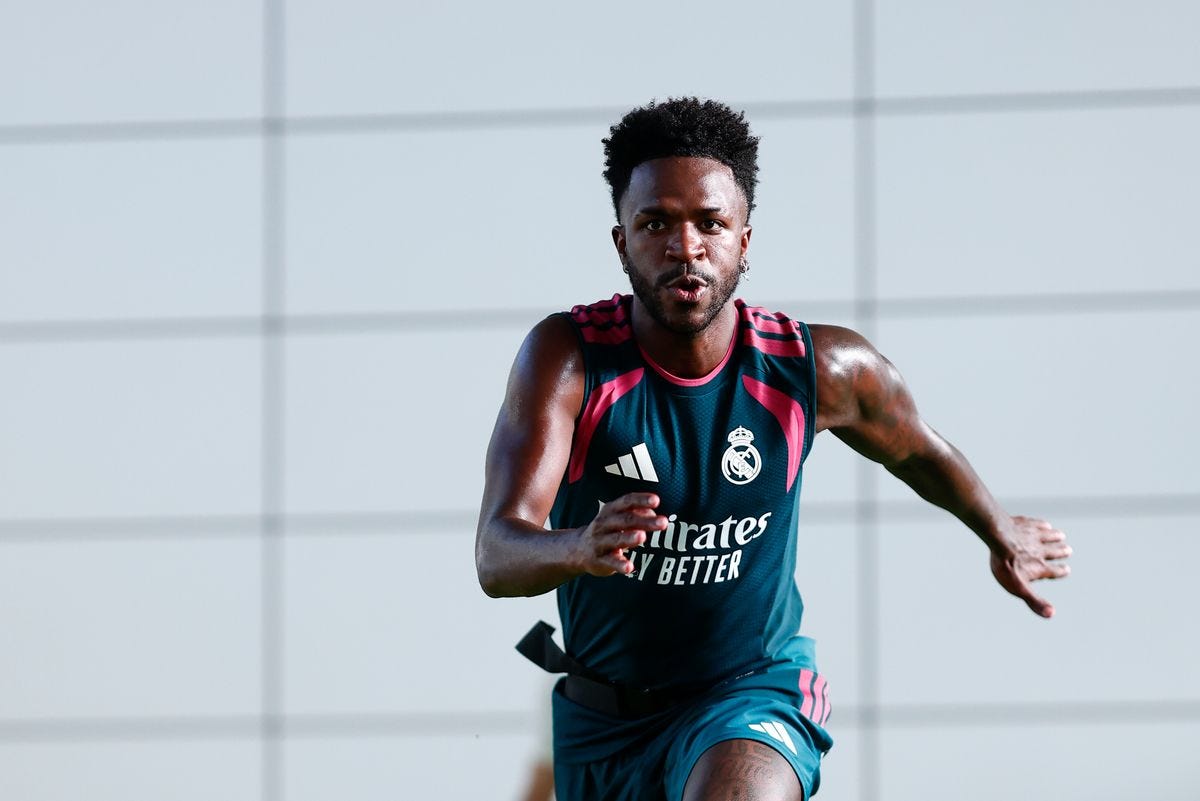
When reports first linked Arsenal with Vinícius Júnior earlier this summer, it felt almost too ambitious to believe. One of the world’s elite footballers, a Champions League winner entering his prime, being seriously associated with a move to the Emirates was the sort of transfer that would redefine expectations.
But with Real Madrid now tying the Brazilian down to a new 6-year contract, Arsenal miss out on what would have been one of the biggest signings in the club’s history.
The disappointment is understandable. Yet perhaps the bigger issue isn’t losing Vinícius himself. It’s the question his likely absence leaves behind.
How do Arsenal take their attack to another level this summer?
Bruno Guimarães looks set to add even more quality, leadership and control to an already outstanding midfield.
On paper, Arsenal are stronger than they were 12 months ago.
But the left side of the attack remains the one area that still feels unresolved.
Replacing Leandro Trossard with Christos Tzolis may prove to be excellent business over the long term. The Greek international has the profile, age and upside to become an important player. However, in the short term, it feels more like succession planning than genuine transformation.
Gabriel Martinelli remains a dangerous weapon on his day, while Tzolis offers fresh competition, but if Arsenal’s ambition is to dominate both domestically and in Europe, is that enough?
That’s the decision Arteta and sporting director Andrea Berta must answer before the window closes.
The problem is that the market offers very few obvious solutions.
Bradley Barcola would arguably be the closest stylistic fit to the type of explosive left winger Arsenal crave, but he now appears close to Liverpool (and with an inflated price-tag). Antonio Nusa possesses enormous potential and the kind of pace that can stretch any defence. Iliman Ndiaye would bring energy, versatility and Premier League experience. There’s also Kenan Yildiz, but he’s recently signed a contract at Juventus and the price would likely be astronomical.
All are talented players.
The question is whether any of them truly elevate Arsenal’s attack in the same way Vinícius would have.
That is the dilemma.
There is, of course, another argument. Rather than spending heavily on another attacker, Arsenal could redirect those funds elsewhere. William Saliba’s injury concerns have highlighted the need for elite defensive depth, while further strengthening other positions would leave Arteta with arguably the deepest squad in Europe. Jurrien Timber is yet to be seen in pre-season and Ben White doesn’t look himself - a right back could also be needed.
But there is an obvious counterpoint.
Arsenal’s defence has already proven itself capable of winning the Premier League. Between Saliba, Gabriel, Timber, White, Mosquera, Hincapie, Calafiori and Myles Lewis-Skelly, the foundations are exceptionally strong. The biggest opportunity for marginal gains now lies at the other end of the pitch.
Perhaps the answer isn’t simply signing another left winger.
Perhaps it’s rethinking the attack altogether.
Eberechi Eze has the technical quality and creativity to operate from the left in a much narrower role, drifting inside rather than hugging the touchline. Noni Madueke has already shown he is capable of attacking from either flank, giving Arsenal another layer of tactical flexibility.
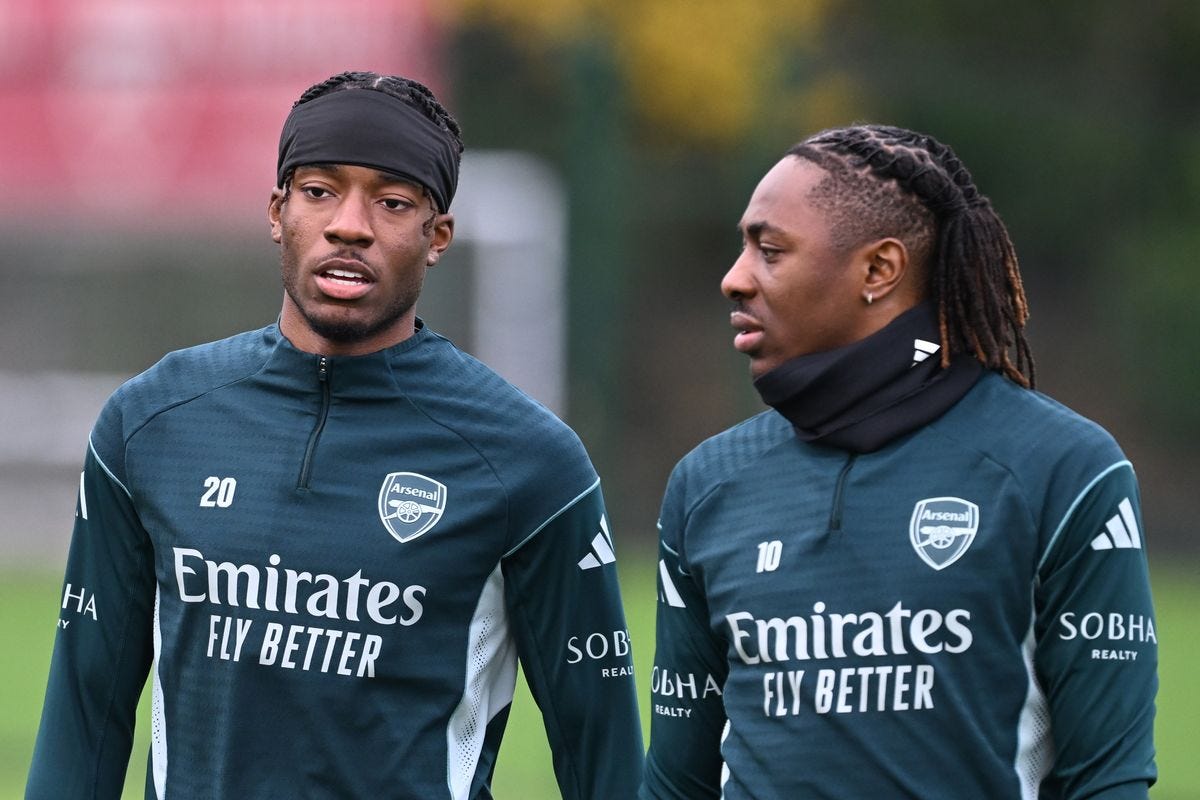
Viewed through that lens, the profile of Arsenal’s next signing could change.
Instead of searching for a traditional winger, the Gunners could target another elite forward capable of rotating across the front line. A player in the mould of Julián Álvarez suddenly becomes a fascinating option.
While Álvarez isn’t a natural touchline winger, he has repeatedly shown he can operate from the left before drifting centrally as an auxiliary striker. Imagine a fluid front line where Kai Havertz starts as the central forward before dropping into midfield, allowing Álvarez to attack the spaces beyond. Alternatively, Gyökeres could occupy centre-backs while Álvarez and Eze rotate around him.
Rather than relying on fixed positions, Arsenal would become significantly harder to defend against, with constant movement, overloads and unpredictability replacing rigid structures.
It’s a different way of thinking, but perhaps that’s exactly what Arsenal need.
Missing out on Vinícius Júnior would undoubtedly be a setback. Players of his calibre rarely become available, and even fewer seriously consider Premier League moves while in their prime.
But one transfer should never define an entire summer.
Arsenal still have multiple routes to improving their attack, whether through another marquee signing, a more creative redistribution of roles within the existing squad, or by investing in a forward capable of playing across several positions rather than being confined to one.
What matters is that, when September arrives, Arsenal’s attack looks more dangerous than it did last season.
Because championship-winning teams don’t stand still after success.
They evolve.
Arsenal have already built one of Europe’s strongest defensive units. The next step is ensuring they possess the firepower to match it.
Thanks for reading Fresh Arsenal Digest! This post is public so feel free to share it.
No posts
Comments
Nothing yet. Say the first thing.
Sign in to join the conversation.