
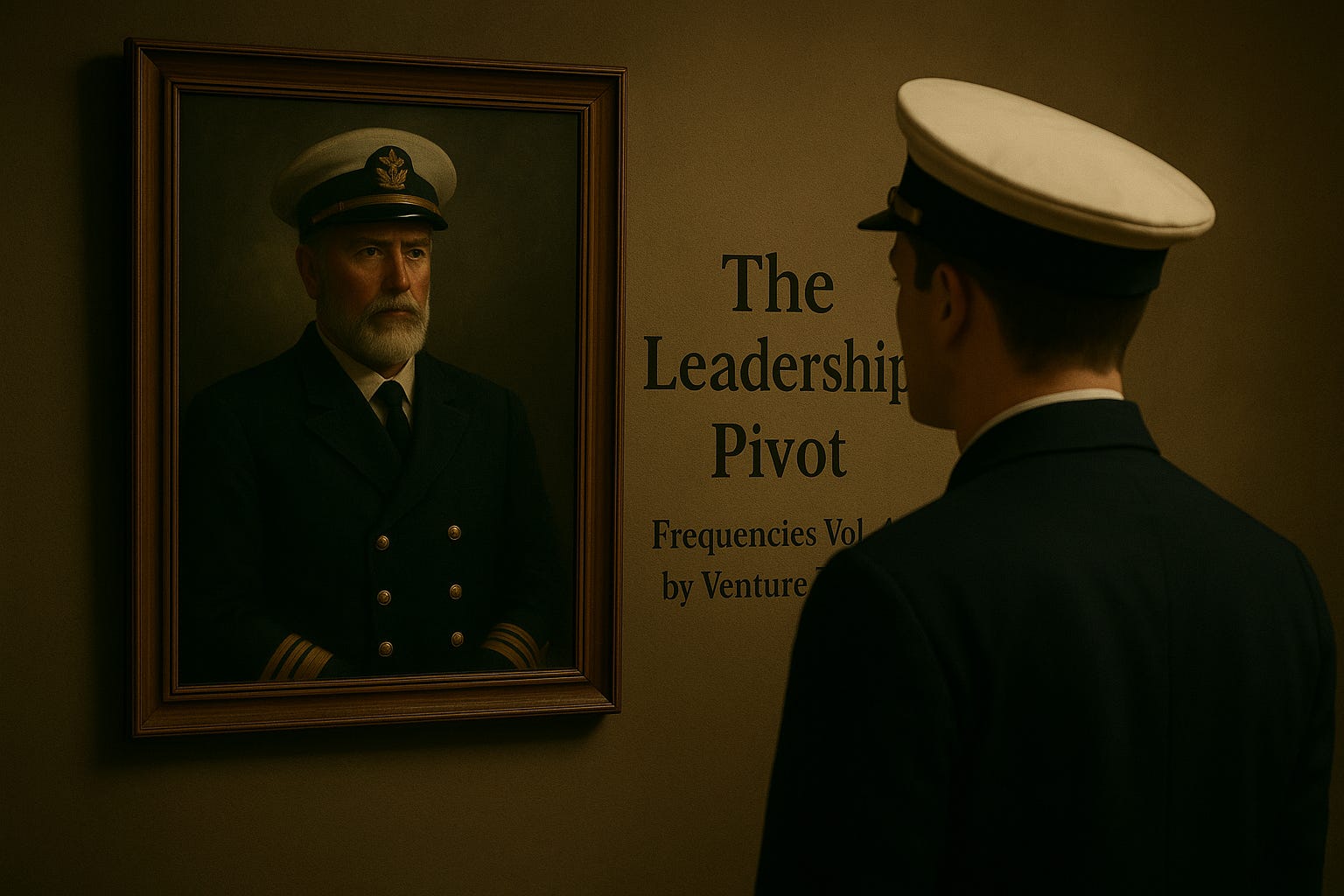
In startup mythology, becoming “CEO” after the Series A feels like a natural next step. The founder gets the title they’ve been acting out since day zero, investors congratulate them, and the press paints them as a rising leader.
But inside the industry sits the thought everyone takes for granted:
most founders don’t become CEO after raising their Series A.
It isn’t a fall from grace, it’s the predictable byproduct of a gap founders rarely see coming: the difference between building a company and leading one. These aren’t stages of the same identity. They’re different jobs, with different rules. Whether founders can make that shift determines whether they remain in charge of the company they created or become the first person it outgrows.
The leadership gap doesn’t usually start with ego. It begins when founders forget the distance between their speed of learning and everyone else’s. As one operator put it:
“When you learn things quickly, it’s difficult to remember what it was like before you knew it.”
Early on, this speed is the reason the company exists. But as teams grow, the founder’s instinctive leaps become disorienting. Directions feel abrupt. Shifts feel sudden. The founder begins speaking in conclusions while the team is still catching up to the premise.
Startups don’t break because the founder loses clarity, they break because clarity stops being shared. A brilliant founding brain is not automatically a leadership brain. One thrives on acceleration; the other on translation.
Boards notice this far earlier than founders do.
Founders often assume that the traits that helped them recruit early hires and raise early capital will continue to carry them. In the earliest days, that’s true… energy replaces structure, and vision substitutes for organization.
But then the team hits size, and the job changes.
“A founder leads because of their passion and their ability to articulate a vision.” But managing? “That’s the part they fail.”
The company stops needing personal heroics and starts needing systems. Delegation becomes real delegation, not task assignment. Decisions must be made through others, not around them. The founder who thrived in chaos is suddenly responsible for replacing it with structure.
Some adapt. Most resist.
Among the skills founders must learn, the hardest and most underestimated is listening, the kind that changes decisions.
“Listening requires remembering what the other person said so precisely that if you had to, you could repeat it back.”
Most founders don’t listen that way. They listen like strategists… scanning for angles, moving ahead mentally, shaping the answer before the other person finishes. Their speed becomes a barrier.
When teams stop feeling heard, they stop surfacing real problems. Executives soften bad news. The founder’s instincts become isolated, unchallenged, and increasingly inaccurate. What looks like decisiveness becomes a lack of visibility.
It’s one of the earliest cultural fractures, and boards read it as a sign the founder is leading alone, never a good omen for scaling.
There comes a moment when the company matures faster than the founder does.
“You cannot tie a person built for ambiguity into the structure required for scale.”
The founder who thrived on improvisation now faces a company that must operate predictably. Systems take the place of instincts. Planning replaces gut. Leadership shifts from personal execution to organizational choreography.
Some founders describe this moment as suffocating. Others fight it outright. But the outcome is consistent: either the founder evolves into someone capable of leading at scale, or the company quietly begins preparing for someone who can.
This transition, or refusal to make it, is the defining reason founders don’t make it past post-Series A.
Another idea from the leadership workshop cuts straight to the issue:
“Give each team member leadership-level responsibilities.”
Many founders can’t. They hire smart people, then continue making decisions for them. They want leverage but resist surrendering control. They delegate tasks, not outcomes. They say the company needs them less, but behave as if the opposite is true.
This isn’t a capability problem, it’s an identity one. Letting go requires rewriting what it means to be “the founder.”
Those who survive the transition begin seeing themselves not as the company’s central operator, but as its multiplier. The person who enables the work rather than doing the work. It’s a quieter, more mature kind of leadership, and it’s rarely glamorous. But it’s what boards look for when deciding whether a founder can grow with the company or must be replaced by someone who will.
The founder to CEO statistic isn’t a failure rate, rather a description of a pivot most founders never make. Founding and leading are not two stages of the same journey. They are separate identities that only occasionally coexist inside the same person.
The founders who remain CEOs aren’t simply the ones who were always meant to be.
They’re the ones who evolved faster than their companies did. They learned to listen deeply, translate clearly, delegate fully, and let go when needed. They accepted that leadership is less about being at the center and more about creating the conditions for others to thrive.
Most founders don’t make that shift.
But those who do?
They don’t just keep the title, they grow into it.
Thanks for reading Frequencies! This post is public so feel free to share it.
No posts
Comments
Nothing yet. Say the first thing.
Sign in to join the conversation.