
Have you ever said tu but accidentally sounded like tout? Or heard a French speaker say a word with u and thought :
“Wait... how is that sound even made?”
If so, you are in very good company. For English speakers, the French U is one of the most frustrating sounds in the language because it simply does not exist in English.
But here is the good news: you do not need a special talent for languages. You just need a little bit of mouth gymnastics.
Watch the short videos below as you go through the exercises. For pronunciation, your eyes are almost as important as your ears.
Let’s build this sound step by step.

Linguists use something called a vowel map to show where sounds are produced in the mouth. You do not need to memorize it, but it reveals an incredibly useful shortcut.
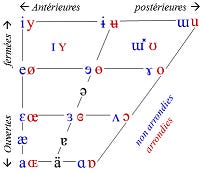
The French U (written /y/ in phonetics) is produced in almost the exact same place as the English “ee” sound (like in see) (written /i/ in phonetics).
The tongue position stays the same. Only the lips change.
For “ee”: Lips stretched slightly into a smile 😊
For the French U: Lips rounded forward 😗
That’s it. The tongue stays where it is.
Try this in front of a mirror if you can. It might feel slightly ridiculous (but at least you're not filming yourself and putting it on the internet 😅).
Say “eeeee” (like in cheese). Notice:
Your tongue is pushed forward
Your lips are relaxed or slightly smiling
Keep saying “eeeee”, do not move your tongue
Slowly push your lips forward as if you are about to whistle or blow a kiss. You should hear the sound transform. Congratulations, you are now producing the French U.
⚠️ Many learners focus only on the lips and forget about the tongue. Rounded lips alone usually create OU, not U.
The French U is:
Tongue forward (”ee”) ✅
Lips rounded (”oo”) ✅
Both happen together.
Start with the “ee” sound, keep the tongue where it is, and round the lips.
Bi → Bu
Di → Du
Li → Lu
Ni → Nu
Vi → Vu
Notice what changes, and more importantly, what doesn’t.
Now let’s level up with words. Remember: Tongue forward → round lips:
Lune (moon)
Tu (you)
Une (a / one)
Bus (bus)
Bulle (bubble)
Musique (music)
Peluche (soft toy / plushie)
Now that you have conquered the “U”, we need to talk about its sneaky cousin: the “OU” sound.
It is completely normal if you have a hard time hearing the difference between these two vowels! But the secret to hearing the difference is actually feeling it in your mouth. Once you can physically produce the two sounds, your ears will naturally begin to distinguish them.
Here is how it works: for both sounds, your lips are tightly rounded. The only difference is the placement of your tongue!
The French “U” (Tongue Forward) / The French “OU” (Tongue Back):
Tu (You) Tout (All)
Vu (Seen) Vous (You, formal/plural)
Jus (Juice) Joue (Cheek / Play)
Puce (Flea) Pousse (Push)
Dessus (Above) Dessous (Under)
Can you physically feel your tongue moving from the front to the back of your mouth? That feeling matters.
A reader left a comment last week mentioning their struggle with the word ahuri (stunned or dumbfounded). And honestly... I understand why.
For an English speaker, ahuri is basically a mini obstacle course for your mouth because you move through several very different positions in a short amount of time: You go from a wide, open mouth (A), to tightly rounded lips (U), and back to a stretched smile (I).
Try pronouncing this sentence : Tu as vu la lune au-dessus du bus?
Take your time with these exercises. Muscle memory takes repetition, so be patient with yourself. One day you will say tu, vu, or lune and suddenly realize:
“Wait... I didn’t even think about it.”
I hope this helped, and I hope the French U feels a little less intimidating now.
À la semaine prochaine,
Marie
Comments
Nothing yet. Say the first thing.
Sign in to join the conversation.