
John McLoughlin was not immediately enthused about the idea of allowing retired voyageur settlers to establish farms in the Willamette valley. He turned down numerous requests before finally relenting in 1829, and even then only under certain conditions. Others without the necessary resources to establish themselves on a firm footing continued to be denied. So it is with a certain bemusement that we read his letter to the Secretary of War in the spring of 1848, in which he proposes a rear-view mirror version of the history of the French settlement in the Willamette valley and makes recommendations as to the eligibility of the “half-breed” population of the valley for American land claims. I’ll put the text of the letter at the end of this post for the truly curious.1
McLoughlin’s June 1848 letter to the Secretary of War concerning the status of the “half-breed” farmers in the Willamette valley details his (supposed) intentions in 1829 in ways that are not always explicit in the documents of the era.
The Willamette settlers have long seemed to be an exception to the rule that Frenchtown settlers always chose whenever possible to settle near their tribal relations. However, in this document we see that according to McLoughlin, in the early days of the transition from trapper to settler, HBC men wanted to do exactly that— settle in other parts of the country, near the families and tribes of their wives. McLoughlin refused because to allow them to return to their extended families would mean their children would be raised as Indians, not educated in white culture and affinities. By gathering the métis Willamette families together on French Prairie, he claimed that not only would their children be educated as though white, but that also these families would in effect serve as hostages for the good behavior of their Indian relations. McLoughlin further insists that the reverse could also come true–should the American government decide to dispossess the métis Willamette settlers of French prairie of their holdings, those families would return back among the tribes to spread resentment against the United States for treating them so unjustly.
The double-edged status of the half-breed settler here is curious. McLoughlin’s arguments demonstrate that the half-breed settler’s status was transitional and directional, either a stage on the path to the (desireable) assimulation with white culture, or potentially an aborted step towards “civilization” followed by reintegration with Native culture. McLoughlin’s arguments show that the half-breed settler has to be proven to be “white”, by his industrious and virtuous behaviour, but remains at risk of becoming wholly Indian. McLoughlin refers only to those families who settled, but we can infer from family histories that not all mixed families sought to till the land– some chose rather to assimulate with their various tribal connections, and thus often disappear from documentation.
McLoughlin’s explanation of the intentional concentration of the HBC settlers on French Prairie regardless of immediate kin connections also explains the flurry of displacement that took place several generations later at the time of allotment, when mixed descendants “returned” to claim land on the reservations where they had the strongest kin connections.
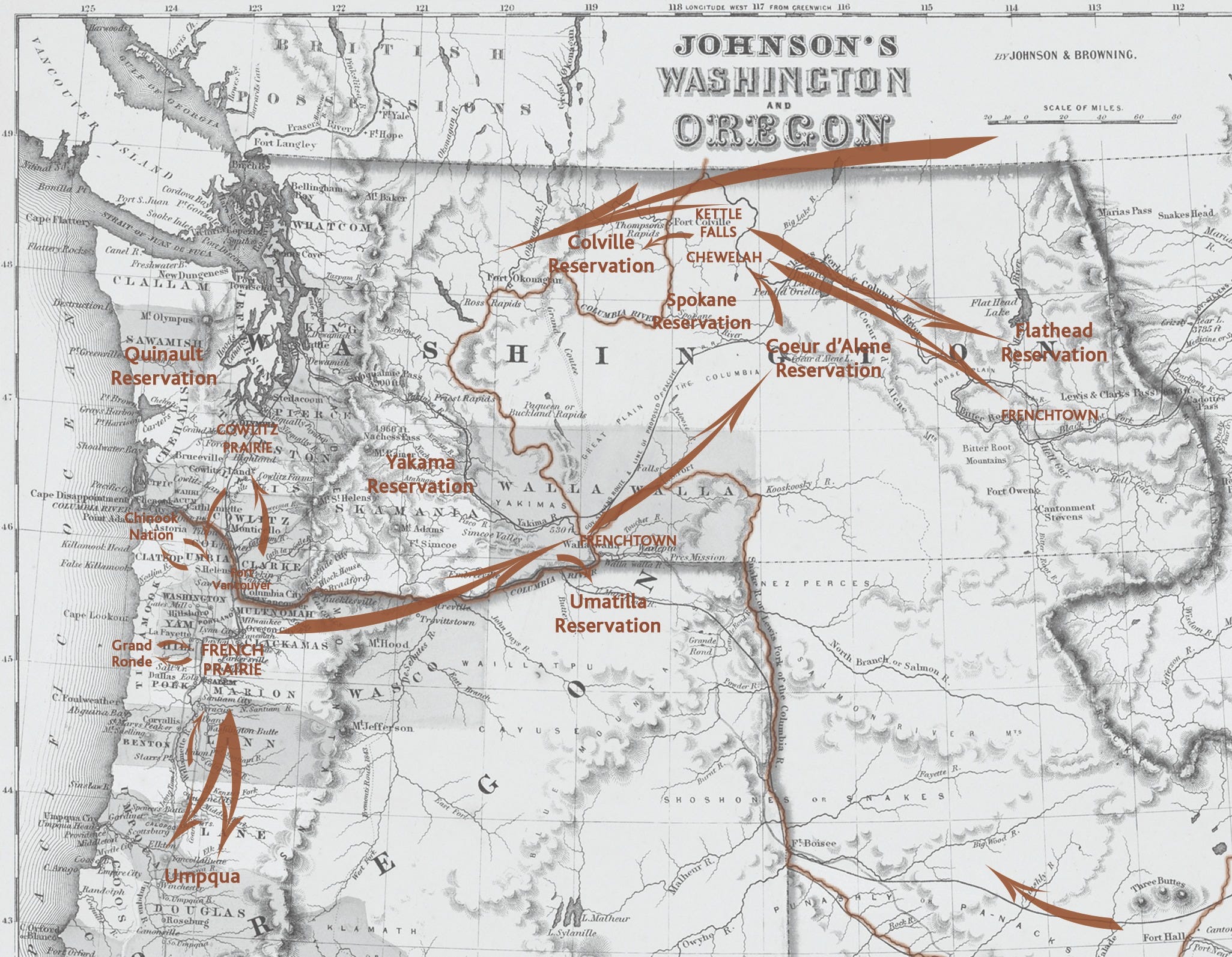
© Sarah Hurlburt on behalf of the Frenchtown Historical Foundation 2026.
Oregon City, Oct 21, 1847; recd May 1848.
Mr McLaughlin to the Secretary of War
[…] I would also like be to call the attention of government to the situation of the half breed population settled as farmers in this country when I came here in 1824 …and after examining the country, I came to the conclusion from the goodness of the soil in the Willamette Valley, the mildness of the winter and celebrity of the climate that it was the place best adapted for farming in North America, and immediately began to take every measure in my power, which could tend to promote the settling of the country by whites for the purpose. I encouraged the old trappers to open farms in the Willamette Valley, and as it is the best place to have a beneficial effect on the whole country. But as it was well known, the Willamette Valley would become United States territory. The Canadians observed that they and their children would not be allowed the same advantages as American citizens when the United States established their jurisdiction over the country and wish to be allowed to settle on other parts of the country among the relations of their wives. But as this would scatter them over the country and their children would become Indians, I considered it my duty to prevent this and persuade them to trust to the justice of the United States government, and settle in the Willamette, where they could all be collected [and] their children instructed on the premises of the Christian religion, taught to farm, and brought up with the feelings and sympathies of whites, throw their influence on the side of the whites, and in fact, render them hostages for the good behavior of their Indian relations, as Indians, judging of themselves would be afraid that if whites suffered injuries on their lands that we would retaliate on their relations settled among us.
But there is a report here that the half breeds will not be allowed to have claims of land by the United States government. If such unfortunately be the case, it would destroy the prospects of these persons and forced them with their parents to return among the Indians, where they will disaffect the Indians to an American interests, when by allowing them to hold their claims as American citizens, they would facilitate immensely the settling of the country by their influence over their Indian relations. And of which indulgence they are worthy, as all who know them must admit. They are as peaceable, orderly, and industrious as any settler in the country. Indeed the grandmother of the most extensive cultivator in the country was an Indian. The man sold 2000 bushels wheat. He has been a trapper, began to farm some years ago with a capital of only $250. Last summer he built a grist meal with one room of stone and in a few days will have a sawmill in operation. And I am certain it is sufficient for their conduct to be known and the facility they have afforded to settle this country to secure them the justice to which they are entitled, as it may be said by subduing the Indians they have been the means of this country being peaceably settled by the white and at not 100th part of the expense it would have cost the government if these men had not prepared the way.
Yours, John McLoughlin
No posts
Comments
Nothing yet. Say the first thing.
Sign in to join the conversation.