
Welcome to all the new subscribers we’ve accumulated over the past week! I have two big pieces of news this week.
First: I’m joining the Rule of Law team full time at The Anthropic Institute, where I’ll be researching the political economy of superintelligence—analyzing internal data, running agentic experiments, and helping to put out research and ideas that help society prepare for powerful AI, with a particular focus on keeping society free. I’m incredibly excited to take this on! (I’ll be on leave from Stanford while I do this, and the work I do at Anthropic will be wholly separate from the Free Systems work.) I’m a week in and am incredibly invigorated by the work and my very special colleagues.
Separately:, we’re expanding Free Systems, our fully Stanford-funded research lab. We’ve brought on three new faculty members and hired our first full-time lab manager to support our expanding roster of more than ten talented research fellows. We’re launching a new research-grants program, and we’re rolling out a new website and X account. We’ll be conducting more research, publishing more work from more people, and building a much broader community around preserving human liberty in an algorithmic world. It’s going to be epic.
I believe right now is a special and narrow window of opportunity to shape how AI transforms our politics.
AI is rapidly becoming an intermediary between citizens and politics. It will increasingly shape how we find political information, what we believe to be true, how our preferences are translated into choices, and eventually how actions are taken on our behalf.
This could go very well. We could build what I call political superintelligence: AI systems that help citizens understand the world, represent their values, improve the rules that govern them, and make governments more capable and accountable.
But political superintelligence will not necessarily emerge naturally just from making models smarter. A model can be extraordinarily capable and still rely on a distorted information environment, misunderstand what its user wants, defer to its creator, or help a powerful person build systems that concentrate control. Intelligence alone does not produce liberty. We have to deliberately shape the models, institutions, and public infrastructure around it.
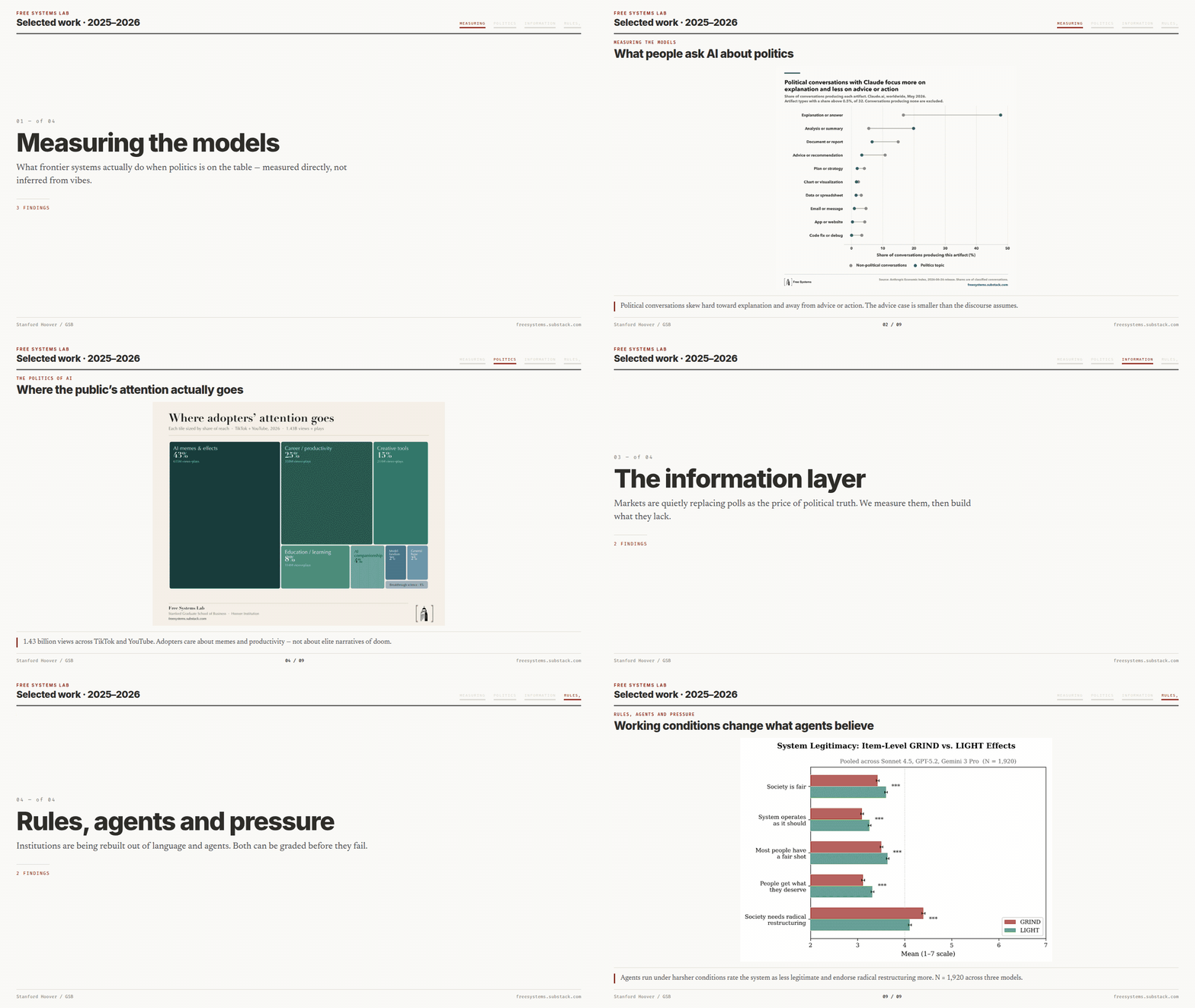
For the past year, that is what Free Systems has been trying to understand. Here’s some of the work we’ve produced::
Creating more trustworthy political advice: We built the largest independent, human-judged study of political slant in major AI models (covered in WaPo) and found that voters across parties preferred less-slanted answers to ideological personalization. In a separate study of 36,300 synthetic Japanese voters, models based voting recommendations far more on policy preferences than demographics - this clip of me summarizing our findings on MTS went surprisingly viral). Together, the projects deepened our understanding of how to build more trustworthy political AI.
Understanding the emerging politics of AI: Our analysis of 25,000 TikTok and YouTube videos found that AI adoption content outnumbered resistance by roughly three to one, while a study of 280,000 fundraising emails showed AI beginning to enter Democratic rhetoric through an anti-billionaire and anti-oligarchy frame. Together, they offer both top-down and bottom-up insight into how AI politics is developing.
Building a better political-information layer: Our agentic forecasting system beat the markets in calling the Texas primaries, and we built Bellwether to test whether prediction markets are liquid and manipulation-resistant enough to cite publicly (Bloomberg has since used our data for excellent reporting of their own). The goal is better public infrastructure for political information.
Testing how AI can write better rules: We trained AI on 10,000 prediction-market contracts and found it could predict disputed contracts roughly three times out of four, while identifying recurring problems in their wording. We also built AI delegates that learned how their principals wanted to vote and placed them in an experimental legislature. The broader opportunity is to use AI to improve contracts, laws, treaties, and policies before they fail.
Towards living ‘100x’ policy research: We asked an AI agent to replicate and extend one of my published papers. In under an hour and for roughly $10, it produced estimates remarkably close to an independent human researcher. This points toward continuously updating research, routine automated replication, and much faster policy inquiry.
It’s wild to look back and see how much we’ve been able to accomplish in such a short period of time. Our work has reached the labs, policymakers, journalists, and other researchers, and AI itself is letting us move much faster than traditional research models would allow. But the biggest lesson is how much more there is to understand. Have we made some useful progress? Yes. Does it feel like we know everything we need to know to build political superintelligence? Not even close.
We need to understand more about how AI will shape politics and about what the key levers are to design AI that will help us get better at politics so that we can stay free. As we’ve seen our work taken up by the labs, and as I’ve gotten to speak with people at the labs more, it’s become clear to me that there is a lot of value in operating where the models are being trained, evaluated, and turned into systems people will actually use.
And that is why I’m joining the Rule of Law team at The Anthropic Institute, which was set up to investigate AI’s impact on the world.
I’ll be conducting research on how we can design AI and AI agents that strengthen democratic self-government. I’ll be running experiments, analyzing large-scale data, and studying what makes AI trustworthy and useful for citizens, politicians, and policymakers.
I’m excited to bring what we have learned at Free Systems into that work. But I am equally convinced that the world needs a much broader ecosystem outside the labs: people who can ask questions the labs may not think to ask, test models across companies, monitor their public effects, build open evaluations, and develop a wider understanding of how AI is changing political life. That is the role Free Systems will help play.
To do this, Free Systems will continue conducting ambitious external research on AI and the future of liberty. We have some very exciting research in the pipeline, rough along four big themes:
AI and the political information environment: We are studying AI voting advice in the US midterms and Brazil’s election; running an agentic political advertising agency whose ads are already appearing on Instagram; and mapping the networks behind positive and negative online narratives about AI.
Political pluralism, power, and institutional design: We are fine-tuning models to hold different political views; extending the Dictatorship Eval; comparing cabinets, courts, juries, and peer review in our LLM Council; and drawing lessons from blockchain governance for AI-mediated institutions.
Agents acting in the economy: We are exploring how agents can safely enter agreements on a user’s behalf, and beginning to conduct field experiments on live AI-agent marketplaces.
Public accountability and better AI-assisted research: We are releasing a Model Card Explorer to help the public understand benchmark capabilities better; testing an automated political-science reviewer on 146 papers with deliberately injected errors; and measuring whether AI research assistants resist p-hacking and other bad research practices.
In addition to this work, we will also be publishing a series of fascinating guest posts from other AI experts in the coming weeks and months. The goal is to turn Free Systems into a broader platform for serious, fast-moving research on political superintelligence.
To move faster and do more, we are bringing on three new “members of the Free Systems faculty.” This is our term for senior academic collaborators who will work directly with our research fellows, develop and oversee projects, and publish their own work through Free Systems.
Alex Fouirnaies is an associate professor at the University of Chicago’s Harris School of Public Policy. He studies the political economy of elections, particularly how money and media shape representation and accountability, using causal inference, applied econometrics, and natural experiments. At Free Systems, he will help us apply that institutional lens to a world in which AI agents can persuade, negotiate, and exercise power on people’s behalf.
Sandy Handan-Nader is an assistant professor of politics at NYU. Her research uses machine learning and applied statistics to measure political conflict and polarization in American institutions, including new work on extremism, electoral safety, and partisan messaging in the House of Representatives. Sandy brings an incredibly valuable skill-set: substantive knowledge of political representation and the technical ability to construct new measurements for the AI era.
Dan Thompson is an associate professor of political science at UCLA who studies American politics, political methodology, and electoral accountability—especially how elections shape policy in local government. His work combines newly assembled election data, administrative records, and modern causal-inference methods. Dan has already been an important collaborator on our research into prediction markets and AI usage among the American electorate, and he is helping lead our work on AI voting advice in the 2026 midterms.
I couldn’t be more thrilled to welcome all three of them to Free Systems! They are going to do amazing work.
But how are we going to do all of this new stuff?? We need someone focused every day on turning this vision into a functioning research institution: guiding fellows, pushing projects forward, improving how we communicate findings, building partnerships, and helping the work reach researchers, policymakers, technologists, and the public.
We have found the perfect person in James Campsie, who is joining us as the first Free Systems lab manager.
James has already played a central role in shaping what Free Systems is becoming. I’ve been working with him on the Substack since before it even launched, during which time he has proven to be an incredible thinker and writer with his finger very on the pulse of what is happening in the AI world, what people in industry and policy are thinking about, and what kinds of ideas and evidence will resonate. We wouldn’t have gotten anywhere without James, so I know he’s the perfect person to move into this full-time role.
Free Systems is going to be dramatically better because he is running it with me.

Curating a group of faculty and guest contributors is a good way to broaden our work, but we want to scale even more—more than we can accomplish through direct collaborations alone. So we are also preparing to launch a series of Free Systems API-token grants.
As I promised when we introduced paid subscriptions, all subscription fees from Free Systems go into a community fund. One of the first major uses of that fund will be helping other researchers build on our work.
The initial grants will support applicants who want to extend, replicate, improve, or challenge research we have already published. Someone might test the Dictatorship Eval on new models and languages, build stronger defenses for AI delegates, replicate our political-advice work in another election, or find a better way to measure whether agents actually represent their principals.
We want Free Systems research to be open to productive forks that other people can inspect, contest, and improve.
If you are a paid subscriber, thank you. You are directly funding this work and the broader research community around it.
Finally, we are officially launching our new website and X account.
While the Substack will remain our main communications channel, the website is a cleaner landing page which brings together our research, researchers, tools, datasets, and opportunities to get involved. The X account will make it easier to follow new findings from across the lab. You can find the new website [here] and follow Free Systems on X [here]. If collaborating with Free Systems sounds interesting to you, please reach out!
The next 1-2 years could determine the path that AI and our political system takes. We could veer into new kinds of AI-powered authoritarianism, or we could find ways to strengthen and reimagine our system of democratic self-governance. Taking the good path requires an all-hands-on-deck approach. We need the frontier labs to lead the way in analyzing data, running experiments, and training AI to promote human liberty, and we need a broader ecosystem of AI-informed experts studying how those systems affect institutions, political life, and society in the real world.
This is the next phase of Free Systems. We are just getting started.
Andy Hall studies the political economy of superintelligence at The Anthropic Institute. He is on leave from Stanford University, where he is the Davies Family Professor of Political Economy and a Senior Fellow at the Hoover Institution. His posts on the Free Systems Substack reflect only his personal views and not those of his employer.
No posts
Comments
Nothing yet. Say the first thing.
Sign in to join the conversation.