
Unsolved math problems are falling to AI at a rapid pace—here’s just the latest big news, this time from OpenAI:

Noam Brown@polynoamial
An internal version of Astra, @OpenAI’s next major model family, solved 10 major open problems in mathematics, quantum complexity, and theoretical computer science. We believe it will be a major step for scientific reasoning. openai.com/index/ten-adva…


Lijie Chen @wjmzbmr1
10 proofs from our next major model Astra on long-standing open problems in mathematics and theoretical computer science (also including new circuit lower bounds for computing the permanent!) GPT-5.6 has already enabled so much exciting work in math and science. Can’t wait to
8:17 AM · Aug 1, 2026 · 116K Views
49 Replies · 220 Reposts · 1.56K Likes
These are open problems in math of a particular form, and crucially, solving them is verifiable. AI seems poised to autonomously solve a very wide array of problems like these, where it can work on them and verify for itself if it has gotten the answer right or not.
Sadly, most of the big questions of political economy don’t work this way. AI can still help us with them, for sure, but we probably won’t see the same kind of rapid progress in the study of politics as we’re seeing right now in math and coding. But I’ll still be trying.

Andy Hall@ahall_research
Claude not super bullish on going after verifiable questions in political economy: “The honest caveat: the field’s biggest questions — why nations fail, when democracies backslide — resist this entirely because the verifier is history and n is small.” Sad!

Andy Hall @ahall_research
What is the space of all verifiable tasks and how do we prioritize the most useful? That seems like the question now
4:09 PM · Aug 1, 2026 · 873 Views
1 Reply · 1 Repost · 10 Likes
The policy debate around AI is a good example of this challenge—solving AI policy is not the kind of verifiable problem AI can solve for us, so we have to avail ourselves of other, less reliable political methods.
In the past several weeks, we’ve seen a positive Cambrian explosion of “open letters” about AI—starting with the economists’ letter on why we should study AI more urgently, followed by NVIDIA’s open letter on the value of open-weights models, and then the lab researchers’ letter on building the infrastructure to facilitate a global pause on AI development.
I have a great deal of respect for the organizers and participants of all three letters, and it is great to see so much engagement on such important issues. I do, though, have some doubts about whether the open letter is the right way to drive forward this policy conversation…
Andy Hall@ahall_research
I think perhaps now would be a good time for us to consider a global pause on the development of open letters about AI policy. The past several weeks have seen a remarkable spike in the frequency of "open letters"---from the economists' letter on the urgency of studying AI, to https://t.co/jeyXxv5XRj
11:15 PM · Jul 28, 2026 · 4.84K Views
4 Replies · 7 Reposts · 50 Likes
The basic problem with open letters is that they risk devolving into signaling exercises that encourage what Timur Kuran calls “preference falsification.” When every policy debate becomes a quantitative exercise in toting up who signed and didn’t sign, I’m not sure it helps us get closer to the truth using reason and evidence. This was not the intent of any of the open letter authors—and I’m not saying that open letters are always a bad idea—but I worry that this is where this kind of raft of letter-writing could head.
We have long historical experience with open letters, and I’m not sure the history tells us they’re good. I just listened to Joanne Paul’s phenomenal biography of Thomas More, and I’d forgotten what a crucial role “open letters” played throughout the Reformation. I’m not drawing too close of an analogy between the Reformation and our current AI policy debates (ha), but in general I think it’s bad to create political discussions that focus on who’s in which camp, and in pressuring people to join one camp or the other—and open letters, I fear, tend to have this effect. One way to see this is to watch X each time a new open letter is released. It is always followed by a somewhat tedious raft of people posting their explanations for why they did or didn’t sign.

We may not be able to unleash frontier models on verifiable “open problems” in political economy, but we can still do a lot of exciting stuff with AI. In the vision I sketched for the “100x Research Institute,” I envisioned the new kinds of research that AI enables.
One of those new kinds of research I called “living research”---research projects that update as new data comes in, instead of being entombed in amber inside a static PDF that becomes rapidly obsolete.
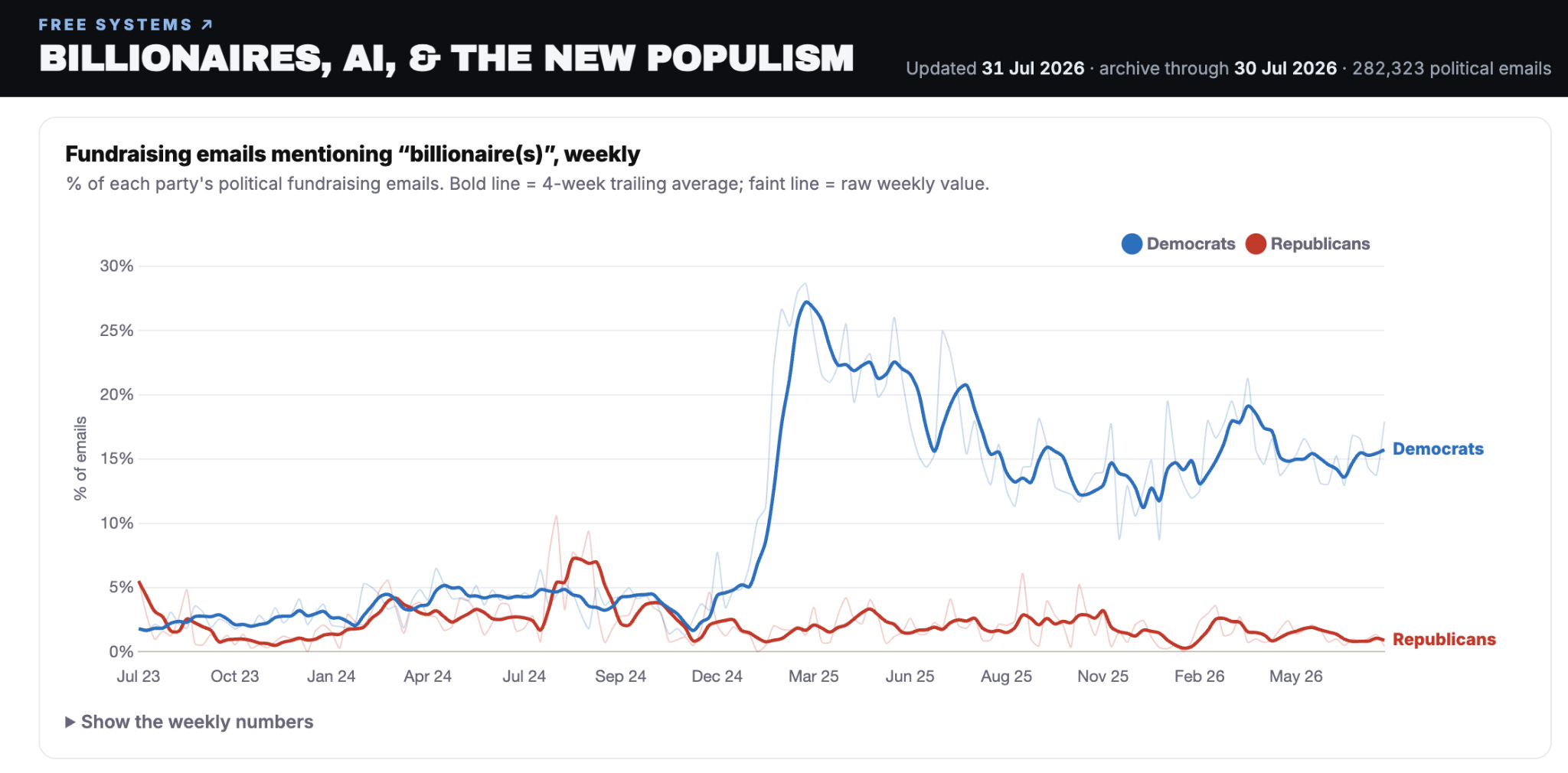
I’m not just talking about this new kind of research, I’m doing it! A few weeks back, I wrote a piece tracking the rise of anti-billionaire populism among Democratic politicians, and how it is slowly transferring into their views on AI.
Now, I’ve released a live dashboard that updates automagically each week as Derek Willis adds new emails to his open database. You can check it out here:
https://inbox.freesystems.net/
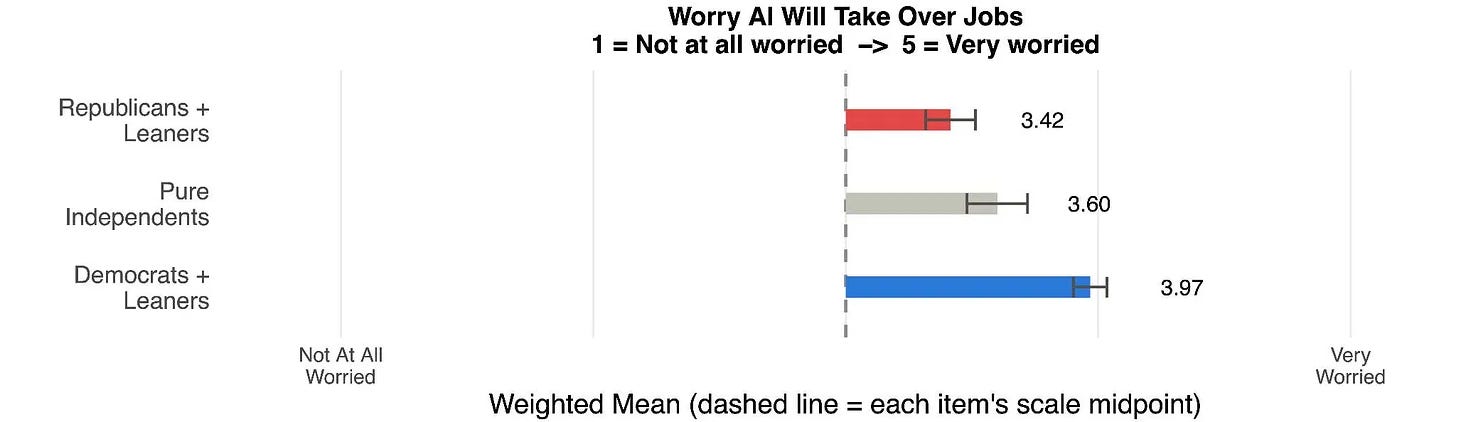
Dan Hopkins, distinguished political scientist at Penn, has some new research out on his Substack about how Americans are viewing AI and the economy. It’s really interesting!
One key finding jumped out at me: Democrats are substantially more concerned about AI taking over jobs than Republicans are. This could have to do with general attitudes/vibes around AI, or it might well reflect the different kinds of jobs that Democrats vs. Republicans tend to hold. Either way, the growth of this kind of polarization is well worth watching, and fits with the polarization I’ve seen in the fundraising emails, and which people are finding in lots of other places as well.
2026 is not only going to be the first big “AI election,” it’s also going to be yet another watershed in the astonishing rise of prediction markets and politics, as I’ve been tracking for a while.
Liam Vaughan has a fascinating deep dive out this week at Bloomberg looking into the different ways people try to manipulate prediction markets around elections—usually unsuccessfully, but still something we should be thinking about. The piece references several Free Systems research pieces, including https://freesystems.substack.com/p/prediction-markets-are-eating-american and https://freesystems.substack.com/p/bellwether-building-trust-in-prediction.
The inexorable march towards some sort of industry-led self governance around model safety and security continues…

METR@METR_Evals
We have reached an agreement with OpenAI to conduct an independent review, with Redwood Research, of the model behavior observed during the Hugging Face incident. We will publish a blog post that describes the terms of our engagement, the scope covered, and tentative conclusions.
1:48 AM · Jul 30, 2026 · 214K Views
44 Replies · 255 Reposts · 2.31K Likes
No posts
Comments
Nothing yet. Say the first thing.
Sign in to join the conversation.