
The crypto industry spent a year building toward one piece of legislation, got it to the one-yard line, and then watched it stall out because of how much money the president has personally made from crypto. That’s not a talking point from the opposition. That’s the actual state of play in the Senate right now, and it’s what moved Bitcoin’s price in both directions this week.
Here’s the sequence.
On July 20, reports came out that Trump had agreed to the ethics provisions Democrats wanted attached to the CLARITY Act.
The market read that as the deal breaking open.
Bitcoin pushed above $66,000 over July 20 and 21, and spot Bitcoin ETFs ran seven straight days of inflows through July 22, close to $1 billion, the longest positive stretch in eleven weeks.
BlackRock’s IBIT did $319 million of the $499 million that came in that week alone.
Then Senate Republicans actually published the updated text on July 22, and the ethics language turned out to be much lighter than advertised. Democrats rejected it inside a few hours.
On July 23, Majority Leader John Thune told reporters he didn’t think they’d be able to get it done before the recess.
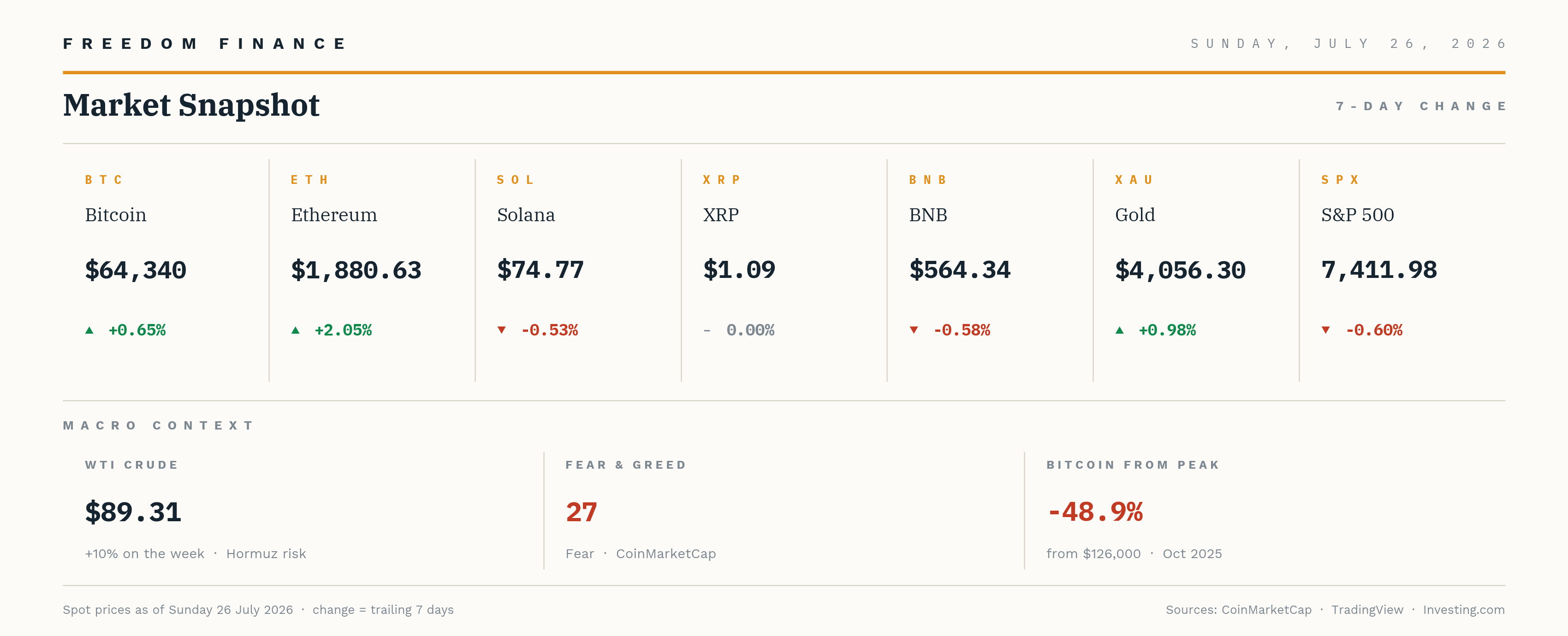
The ETF streak snapped the same day with $225 million out, followed by another $240 million out on July 24, two of the heaviest single-day redemptions of the month. Bitcoin gave back the move and closed the week around $64,100, which nets out to roughly flat on the week.
For all thirteen funds the week finished at just $33.8 million in, and year-to-date flows are still about $5 billion negative.
Trump did not take the delay quietly. He went after the Senate publicly, called it the place you send things to die, told people to call Thune directly, and floated killing the filibuster outright to get everything through. Thune sent it right back and said the White House should be locking in votes instead of pointing fingers. Elizabeth Warren went to video with the opposite complaint, calling the bill a giveaway that should be dead on arrival because it doesn’t stop Trump from cashing in and, in her reading, makes life easier for cartels and terrorists moving money.
The vote math, per Anthony Scaramucci’s public tally on July 23, sits at 53 yes and 47 no against a 60-vote threshold. Republicans are at 51 yes with Hawley and Rand Paul the likely defections. Democrats are at 2 conditional yes votes, Gallego and Alsobrooks, and roughly 45 no. Gallego called the Republican counteroffer unserious but said he’d send back a proposal of his own before the bill reaches the floor, which at least implies he expects it to reach the floor. The Senate’s last working week before recess is August 3 to 7.
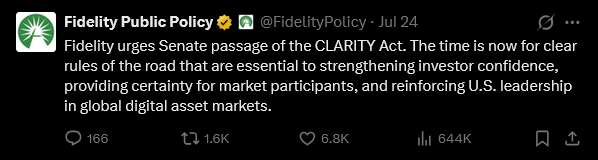
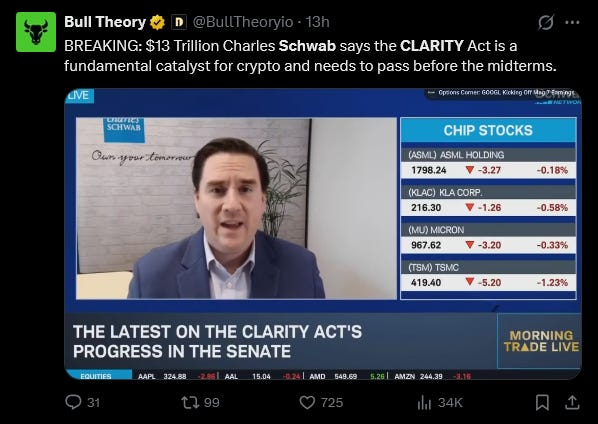
Meanwhile the biggest names in traditional finance spent the week lobbying in public. Fidelity urged the Senate to pass it. Charles Schwab, with $13 trillion under management, called it a really important fundamental catalyst. Goldman’s David Solomon publicly told Congress to advance it now. Add them up with the rest of the signatories and you’re looking at firms managing something near $50 trillion pushing the same bill, alongside more than 200 crypto industry groups.
On the macro side,
the Fed meets July 28 and 29 with roughly 80% odds of holding at 3.50 to 3.75%.
The number that matters more is September, where futures put the odds of a hike at 81%. Separately, the old 10% Section 122 baseline tariff expired at 12:01 a.m. on July 24 and USTR’s Section 301 replacement took effect the same minute, a two-tier 10% to 12.5% duty covering roughly 60 economies and about 99% of US imports.
CPI ran 4.2% year over year in May and cooled to 3.5% in June, still well clear of target.
A few other things landed.
S&P Dow Jones Indices launched a crypto index built with Pantera, eighteen constituents, with Ether, BNB, Solana, Tron and Hyperliquid as the largest five. Bitcoin was left out on the grounds that it doesn’t generate protocol revenue.
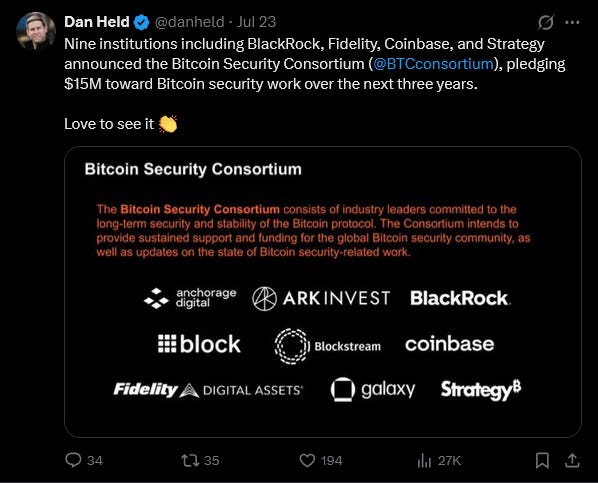
Nine institutions including BlackRock, Fidelity, Coinbase and Strategy formed the Bitcoin Security Consortium and pledged $15 million to protocol security work over three years.
The Transparency Alliance token-disclosure framework grew to around 70 participants with Moody’s joining as an observer.
Citadel Securities put $400 million into Crypto.com at a $20 billion valuation.
T. Rowe Price launched TKNZ, the first actively managed multi-token spot ETF.
Visa launched a stablecoin issuance platform.
Ripple made another strategic investment, this time into Notabene, and Uniswap started rolling out permissioned pools with Securitize.
And BitMEX, the exchange that invented perpetual swaps and brought 100x leverage to crypto, announced it’s shutting down after eleven years.
Read the objections carefully and you’ll notice almost nobody is arguing about the actual regulatory architecture anymore.
The DeFi developer protections are in.
The stablecoin reward compromise is in.
Twenty-five separate provisions were added on the banking side to deal with illicit finance and law enforcement complaints, and the Fraternal Order of Police signed off after its concerns were addressed.
Galaxy’s Alex Thorn, who has no reason to flatter this bill, called it substantial regulation with real investor protection.
What’s blocking it is one question: how much can a sitting president earn from an industry he’s writing the rules for.
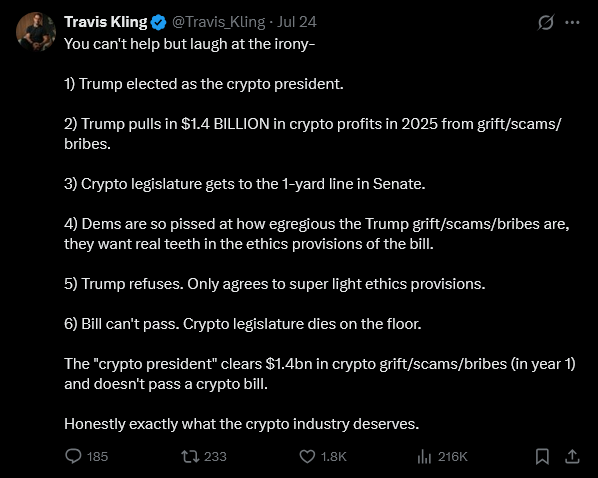
Trump’s reported income climbed 250% last year to $2.2 billion, most of it from crypto ventures. Travis Kling laid out the irony better than anyone, walking through how the crypto president pulled $1.4 billion out of the space in year one and then refused the ethics teeth that would have gotten his own crypto bill across the line. He ended it by saying it’s exactly what the industry deserves, and it’s hard to argue with him.
We’ve been openly skeptical of institutional capture in this space, so we’re not going to pretend this stings less because it’s coming from our side. The industry made a bet that political proximity was the fastest route to legitimacy, and this is the invoice for that bet. When your regulatory framework depends on the personal financial disclosures of one man, you don’t have a framework. You have a hostage situation.
The honest downside case here is worse than most people are pricing, and it’s not about Bitcoin’s price.
Policy people from the Solana Policy Institute and the DeFi Education Fund said this week that if the bill doesn’t clear the Senate in the next couple of weeks, the next realistic window is somewhere in the 2030s. Not next year. The 2030s. Miss August and you run into the November midterms, then a new Congress with unknown composition, then the next presidential cycle. Legislative windows like this one don’t reopen on schedule.
The cost of that shows up in the parts of crypto nobody writes headlines about. Collector Crypt’s CEO explained it plainly: the project is doing $45 million in net profit, sitting on 13 to 14 million dollars of real assets, and legally cannot tell holders that any of that connects to the token. He has to describe the token as being for entertainment purposes, and when people ask him for advice on launching their own, he tells them not to. That’s a profitable business that can’t say what it is. Multiply that across every serious project in the US and you understand why the S&P chose eighteen tokens with measurable revenue for its new index while the tokens themselves are legally barred from acknowledging that revenue exists.
That’s the real cost of no clarity. Not a lower Bitcoin price. An entire category of businesses that can generate money and can’t connect it to their holders, which is the exact reason so many of these charts have bled out over the last six months while the underlying businesses grew.
Fidelity, Schwab and Goldman didn’t write those letters out of ideology. Joe Chalom, who ran digital assets at BlackRock before taking over SharpLink, gave the actual reason: inside a large institution, a government stamp of approval buys you room to move fast on things you’d otherwise do slowly, if at all. That’s the whole story. CLARITY isn’t a permission slip for crypto to exist. It’s a permission slip for compliance departments to stop saying no.
Which brings us to the thing worth watching more than the vote itself. Look at what got built this week while the bill sat stuck:
an S&P index for institutional benchmarking,
a Visa platform for institutions to mint stablecoins,
permissioned Uniswap pools designed so regulated capital can touch DeFi without touching the open version of it,
Citadel buying into an exchange,
Moody’s observing a token disclosure framework.
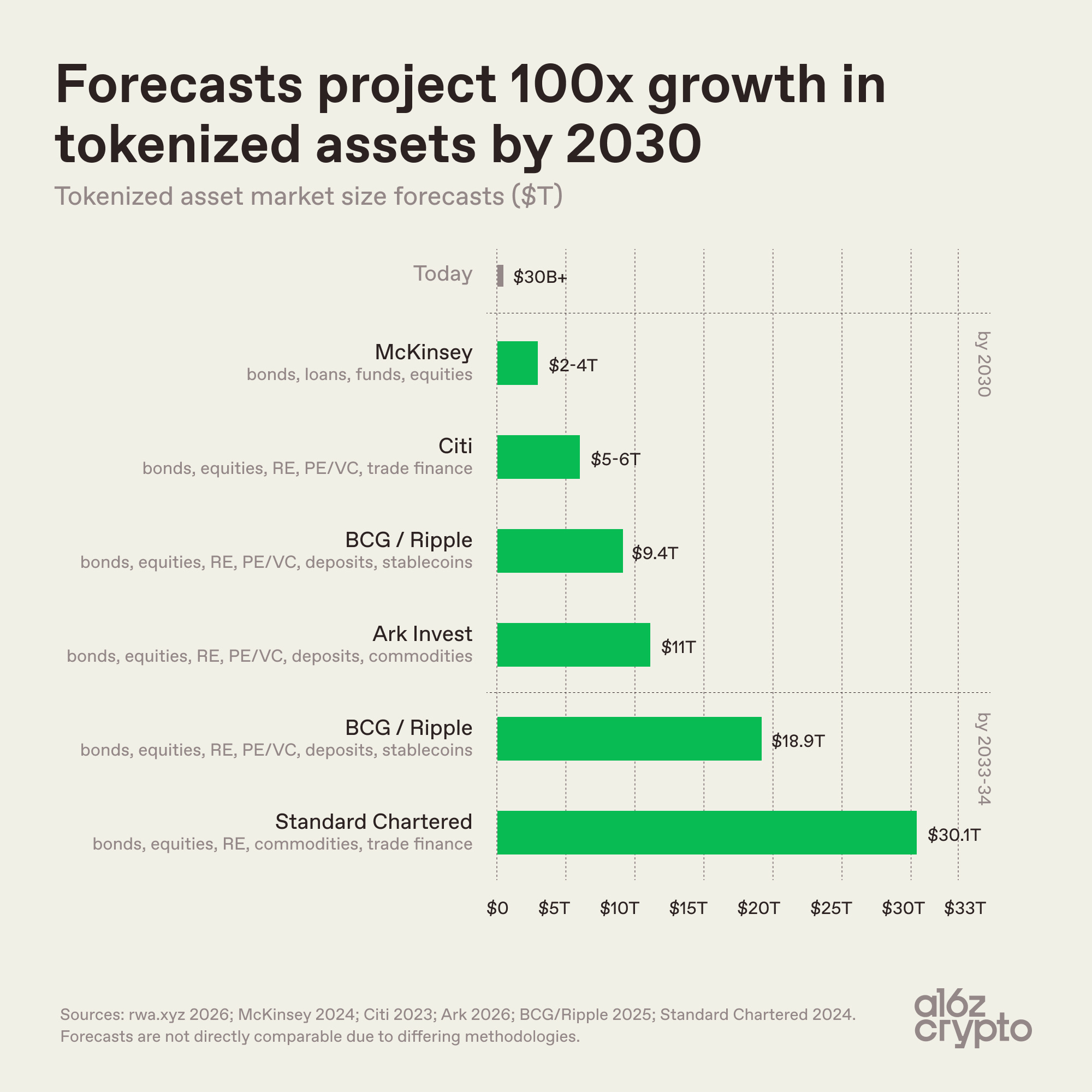
Tokenization forecasts run from McKinsey’s $2 to $4 trillion by 2030 up to Standard Chartered’s $30 trillion by the mid-2030s, against roughly $30 billion tokenized today.
None of that infrastructure is being built for you. It’s being built so that when the rules land, the on-ramps are already owned. We want the bill to pass because the alternative is worse for everyone holding these assets. We’re just not going to pretend that a framework written with $50 trillion of asset managers lobbying for it is going to be shaped around retail’s interests. The S&P index tells you everything, honestly. Eighteen tokens, and Bitcoin isn’t one of them, because Bitcoin doesn’t generate fees for anyone.
The one asset in this market that nobody controls is the one asset that didn’t qualify.
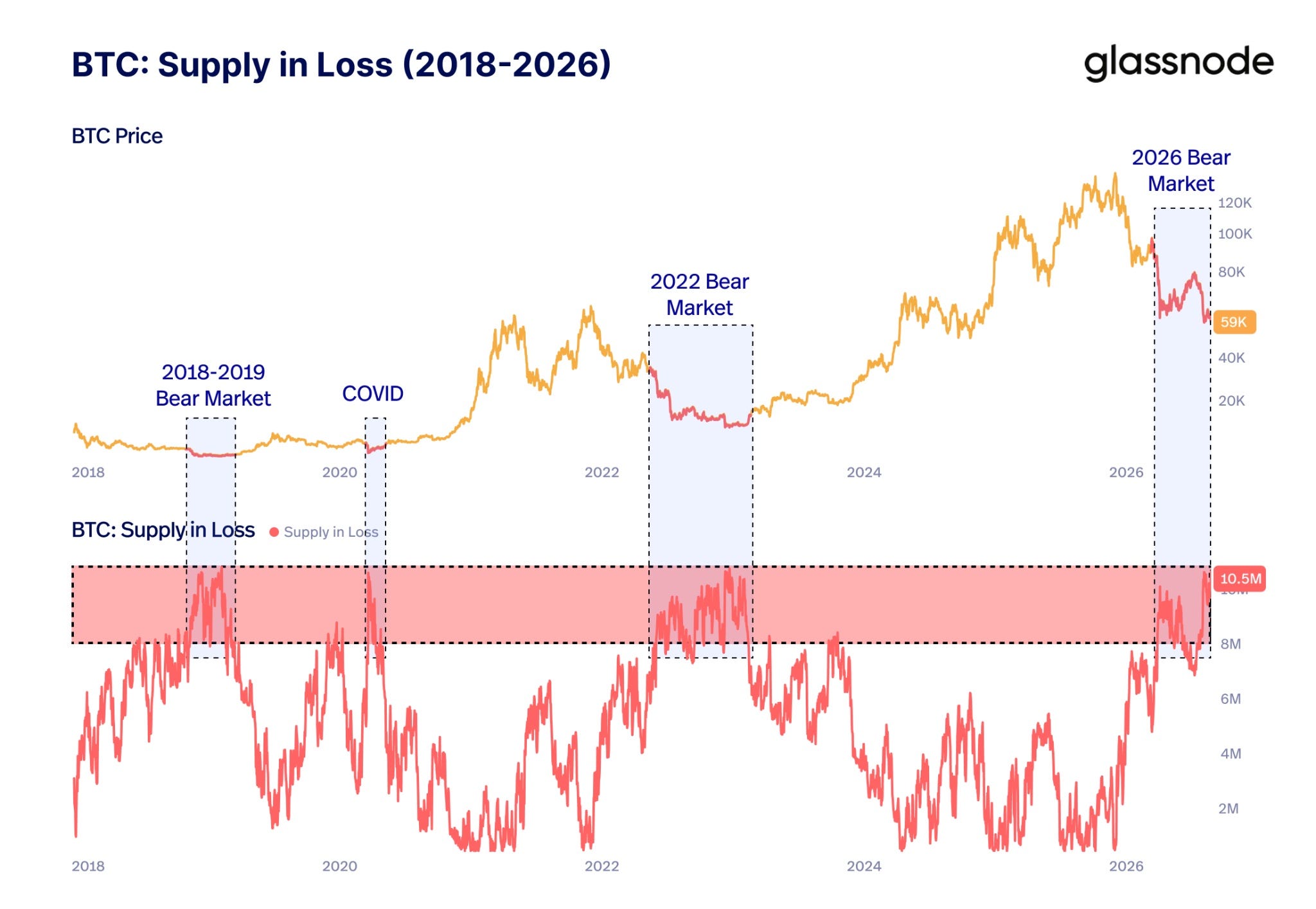
There’s a loud case going around that Bitcoin has bottomed, and the evidence isn’t nothing. Supply in loss just hit 10.5 million BTC, which puts us inside the same band that marked the 2018 bottom, the COVID crash and the 2022 low. Long-term holder supply hit a new all-time high, so the people who’ve been through this before are absorbing rather than selling.
Sentiment is sitting at 27 on the fear index,
Google interest is down more than half,
and BitMEX shutting down after eleven years fits a pattern where major exchange failures cluster near cycle lows.
Scaramucci went on CNBC and said flatly that it doesn’t get much worse from here.
We think he’s directionally right and roughly 20% early.
Two charts complicate the story.
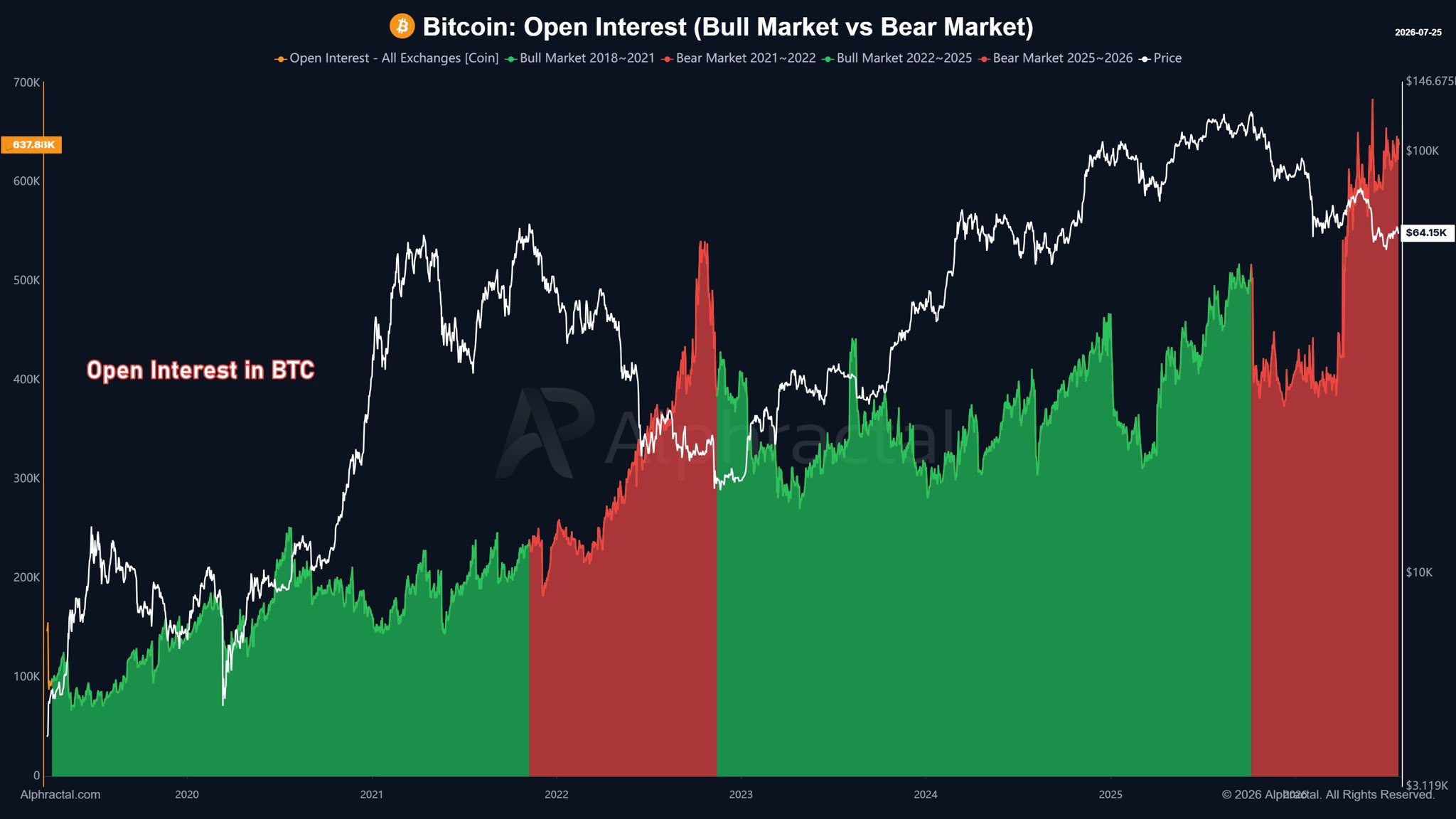
The first is open interest, which is sitting near 637,000 BTC across exchanges, close to the highest reading of this entire cycle, while price is 49% below the October 2025 peak. Leverage stacked that high in a drawdown isn’t a bottom signal. It’s fuel, and it’s pointed in whichever direction hurts most people.
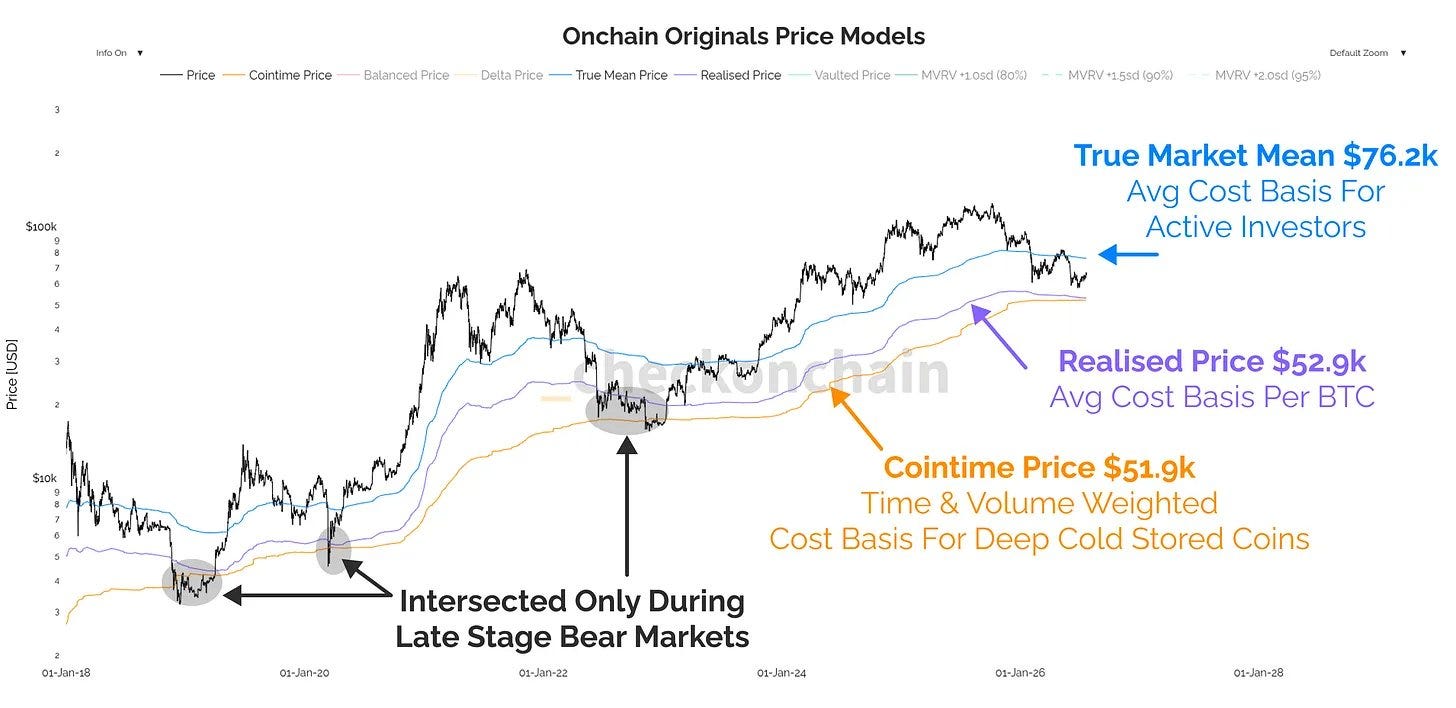
The second is the on-chain cost basis models, and this is the one we’d actually pay attention to. True market mean, the average cost basis for active investors, sits at $76,200. We’re at $64,100, so the average active investor in this market is underwater right now. Below us, realized price is at $52,900 and cointime price at $51,900. Every previous late-stage bear market intersected those lower lines. This one hasn’t come close yet.
So the bottom ingredients are real and the bottom price probably isn’t in. Those two things fit together fine.
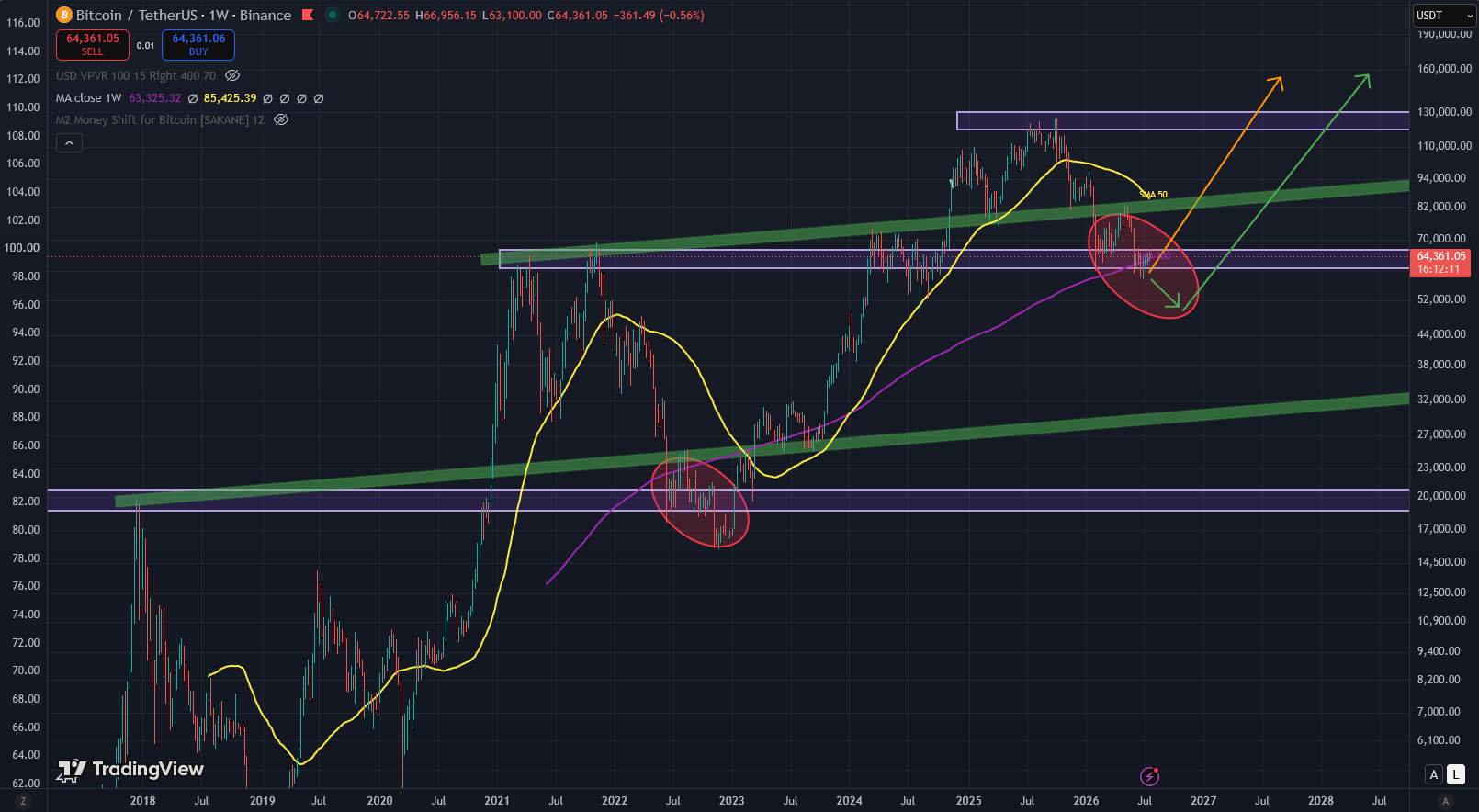
We’re buyers in this range and we’ll be bigger buyers around $52,000 if the market gives it to us, because the market says one more flush comes before this turns, and nothing in the current tape argues against it. We think CLARITY misses the August window. Thune is telling you the truth about the votes, the government shutdown fight is going to eat the floor time that’s left, and the ethics standoff is not a drafting problem that a weekend of negotiation solves. Patrick Witt and Kristen Smith are paid to sound optimistic in exactly this situation, so treat their confidence accordingly.
If it somehow clears, the move is violent and immediate and altcoins outrun Bitcoin badly, because they’re the ones that have been legally gagged. If it fails, nothing about the ten-year case changes and everything about the next twelve months gets slower. Wall Street already made its decision on this asset class and is spending real money on infrastructure that assumes rules eventually arrive. They’re not building $30 trillion of tokenization rails on a bet they think expires in August.
Bitcoin at $64,000 with the world’s largest asset managers lobbying for its legal framework and long-term holders at record supply is not a market that’s ending. It’s a market that’s boring, expensive to hold through, and getting handed to patient people at a discount by impatient ones. We know which side of that we’re on.
— A.Z., Freedom Finance
*None of this is financial advice. It’s analysis. Do your own research, size your positions to what you can genuinely afford to lose, and don’t make decisions based on price targets from anyone — including us.
Before you go…
This free brief is the what and the where. The Premium edition is the what to do about it, with the levels drawn.
Every Sunday, right after this, I send the full read: where Bitcoin sits and the exact levels that flip it bullish or bearish, what dominance is signaling and whether it’s time to be in alts at all, and one coin worked all the way through — accumulation zone, targets, and the line where the thesis is wrong.
I’m sending the next few editions free so you can see the quality before a dollar changes hands. After that, Premium continues at $4.90 a month, on top of this free Sunday brief.
→ [Get the Premium edition — free this month]
Read it, position around it, and tell me what you want more of.
No posts
Comments
Nothing yet. Say the first thing.
Sign in to join the conversation.