
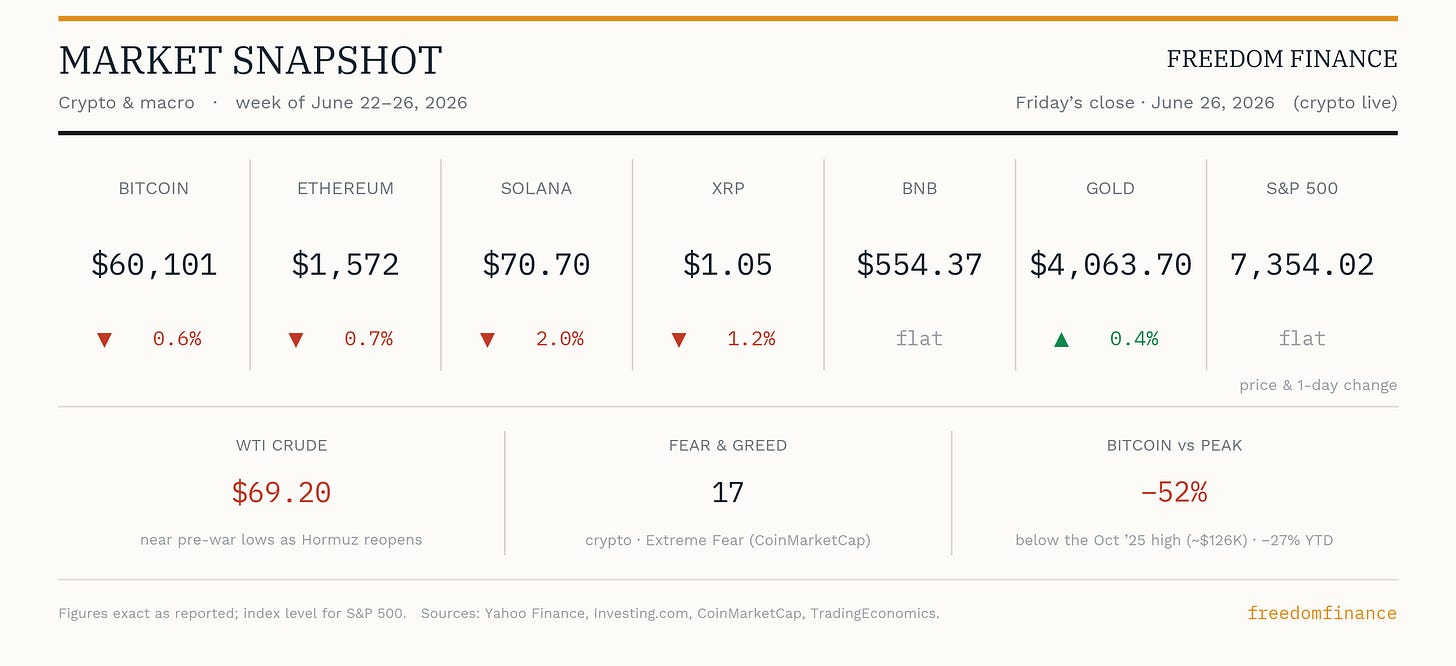
Bitcoin spent the back half of June falling through floors everyone assumed would hold. It slipped under $60,000 on the 24th, then kept going, touching roughly $58,000 on the 26th — the lowest it’s traded since 2024. Around $1.26 billion in leveraged positions got wiped out across more than 209,000 traders in a single 24-hour stretch, almost all of them longs. Ethereum had it worse, sliding to about $1,567, its weakest level of the entire cycle. The Crypto Fear & Greed Index fell into the teens and just sat there.
The trigger came from outside crypto entirely. On Thursday, core PCE — the inflation reading the Fed actually watches — landed at 3.4% year over year, the hottest since October 2023, with headline PCE at 4.1%. That dropped on top of the new Fed chair, Kevin Warsh, whose first meeting on the 17th stripped the “we’ll probably cut” language out of the Fed’s statement and put hikes back on the table. Nine of eighteen officials now pencil in at least one rate increase in 2026. Trump appointed Warsh expecting cuts; his committee is openly discussing the opposite.
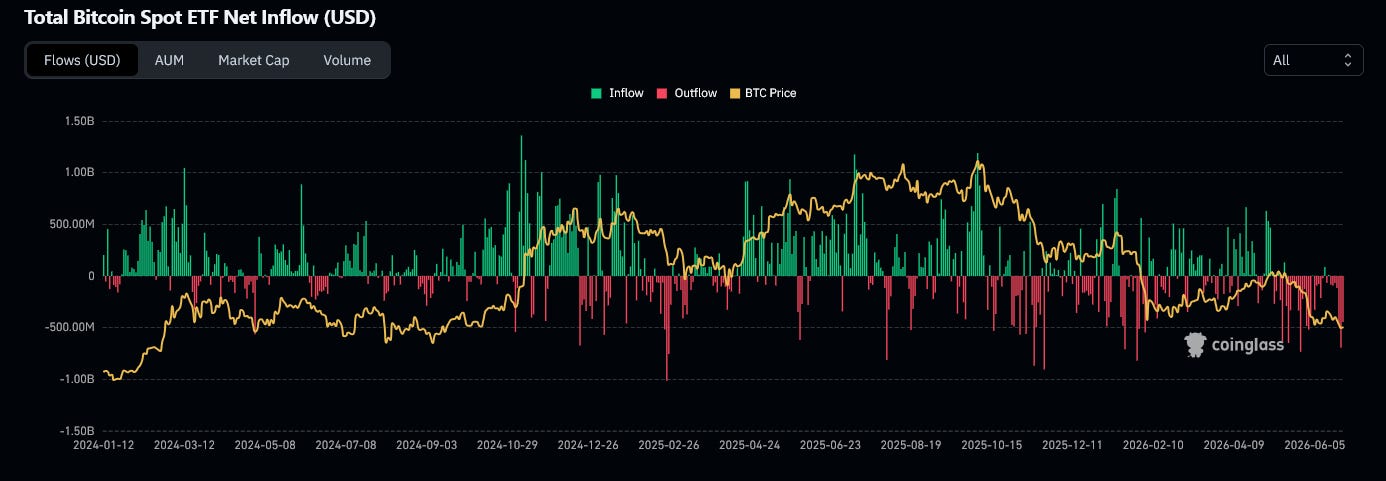
The structural bleed ran underneath all of it. Spot Bitcoin ETFs logged their seventh straight week of outflows, and the money parked in those funds has shrunk to about $77.5 billion from nearly $113 billion at the end of 2025. When investors redeem, the issuers have to sell real Bitcoin into the market, which piles supply on at exactly the moment demand is thinnest.
What made this one sting more than usual is what fell alongside it. Gold dropped under $4,000 an ounce. Oil broke below $70 a barrel, its lowest since before the Iran war, now that the Strait of Hormuz is reopening and the ceasefire is mostly holding. The whole “hard assets protect you from a debasing dollar” trade that carried 2025 came apart in the same window, while the money kept pouring into AI and tech. Nvidia briefly slipped under a $5 trillion market cap, and crypto fell almost in lockstep with it.
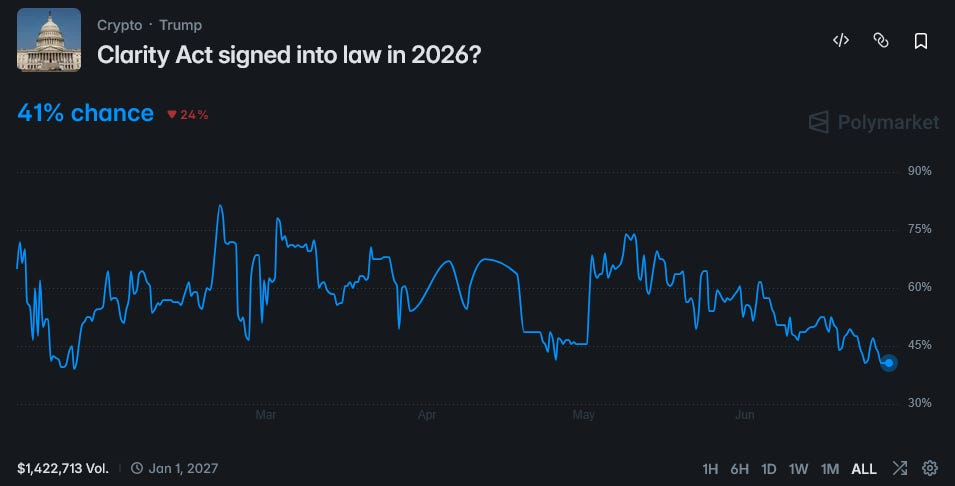
On the policy side, the CLARITY Act — the market-structure bill that was supposed to be crypto’s big 2026 win — kept losing ground. Polymarket traders now put its odds of passing this year near 41%, down from 74% a month ago, after Senate talks over ethics provisions and a law-enforcement carve-out broke down with the August recess closing in.
A few things happened inside crypto that had nothing to do with the Fed.
Corporate treasuries kept buying the dip — Strategy added 520 BTC, Strive added 759 — and on Friday BitMine joined the Russell 1000 as the largest Ethereum treasury company, which parks a crypto-heavy stock in front of trillions in index money.
Ethereum got its own bad headline on the 23rd, when the Ethereum Foundation cut roughly 20% of its staff and 40% of its 2026 budget, and ETH dropped 5% that day.
And in Europe, the MiCA compliance deadline hits July 1, with Binance pulling services in several EU markets after failing to secure a license, while Coinbase and OKX wave sign-up bonuses at its users.
Scroll your feed long enough and you’d think the funeral already happened. Same eulogy everywhere: crypto is dead, the cycle’s over, go home. Here’s the problem with timelines, though — feelings aren’t signals. The crowd screaming into the void is reacting to a price chart, and the price chart is the one piece of information every single person already has. The stuff that actually marked the last three bottoms was quieter, and it was sitting in the on-chain data the entire time.
Start with the simplest question in this whole mess: who’s left to sell?
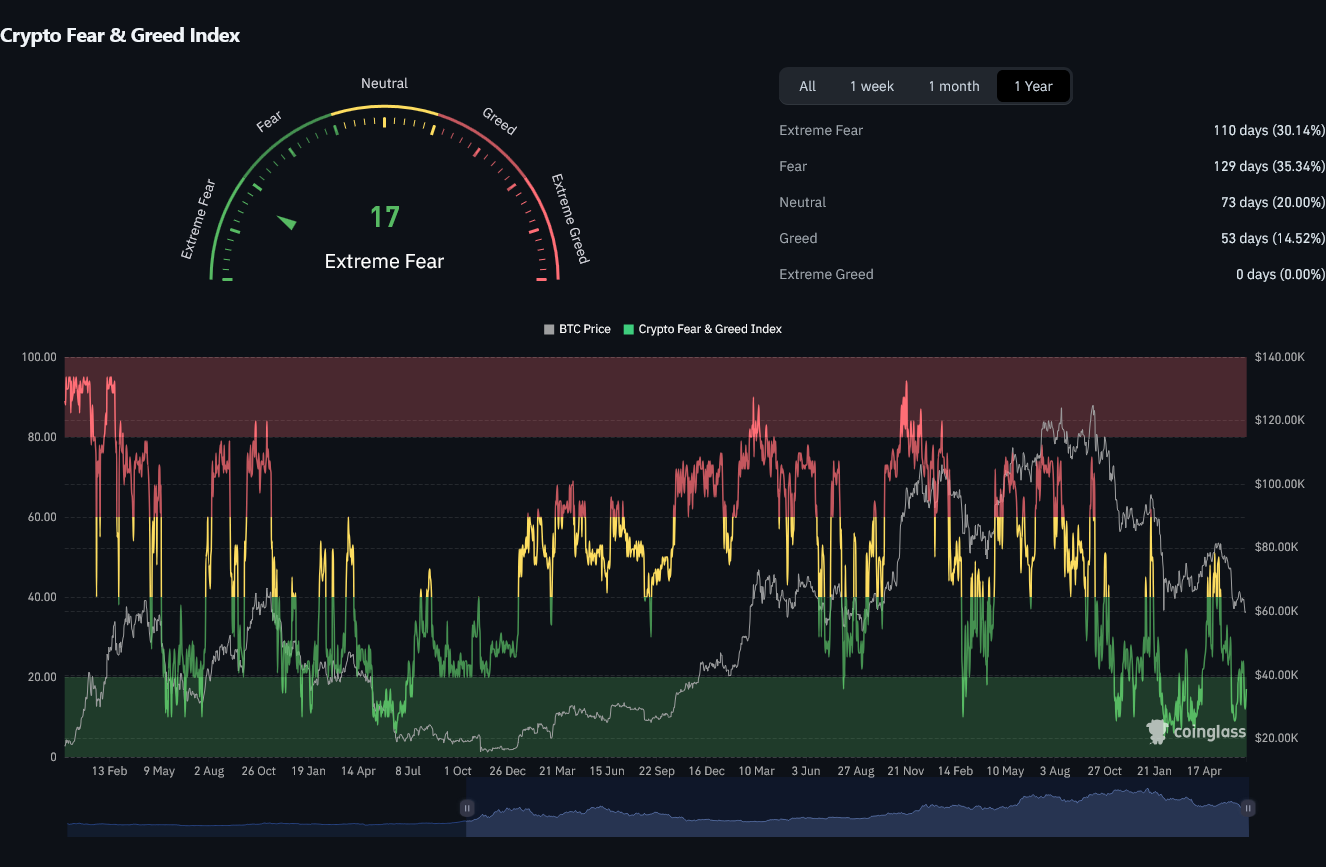
Extreme fear reads like a mood ring, but it does real mechanical work. When the index stays pinned in the teens for weeks — it’s at 17 right now, it touched single digits twice this month, and over the past year it has spent 110 days in “extreme fear” and exactly zero in “extreme greed” — it’s telling you something concrete. The people willing to dump at these prices have mostly already done it.
The nervous money that bails at the first 20% drop is gone, and its coins have changed hands to people who don’t rattle as easily. That thins out the sell side. And a thin sell side is how you get those violent green days that seem to come from nowhere: a little buy pressure hits a market with almost nothing left to absorb it.
The valuation picture says the same thing.
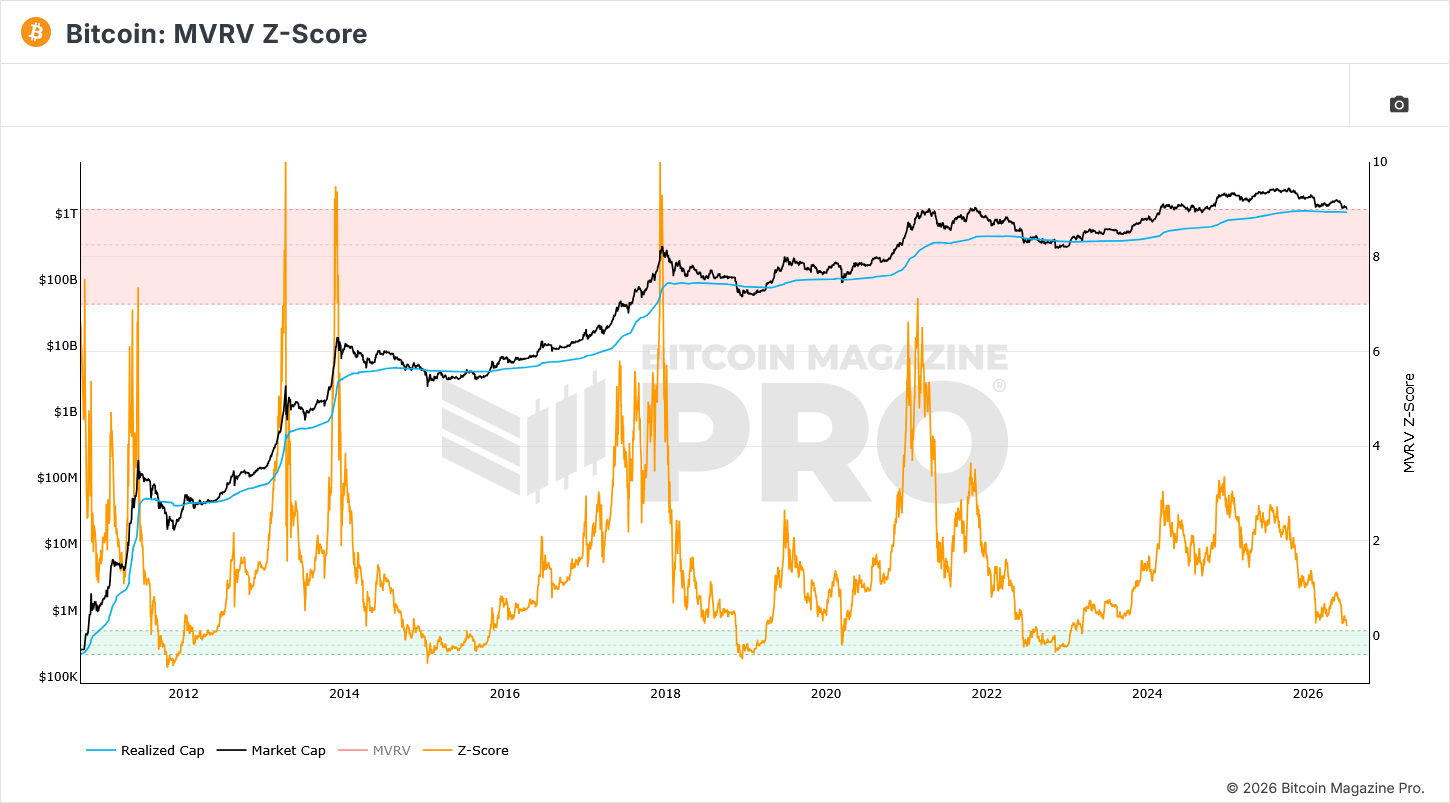
The MVRV Z-score — which is a fancy way of measuring how far the market price has stretched from what the average holder actually paid — has compressed down toward the 0.2 to 0.3 zone. The average cost basis across the network sits around $53,600, so at $58–60K the typical holder isn’t sitting on much of a cushion. Every time this score has dropped into that low green band, it’s been the neighborhood where the best long-term entries showed up.
Now the part a cheerleader would skip. “Approaching” the accumulation band is not the same as standing in it. Every generational bottom we can point to — December 2018, the March 2020 crash, the FTX implosion in late 2022 — went negative on this score first. We’re close. We’re not there. That gap is important, and anyone selling you certainty here is selling you something.
Two more signals fill in the picture, and they’re both ugly in the way that usually comes before good entries.
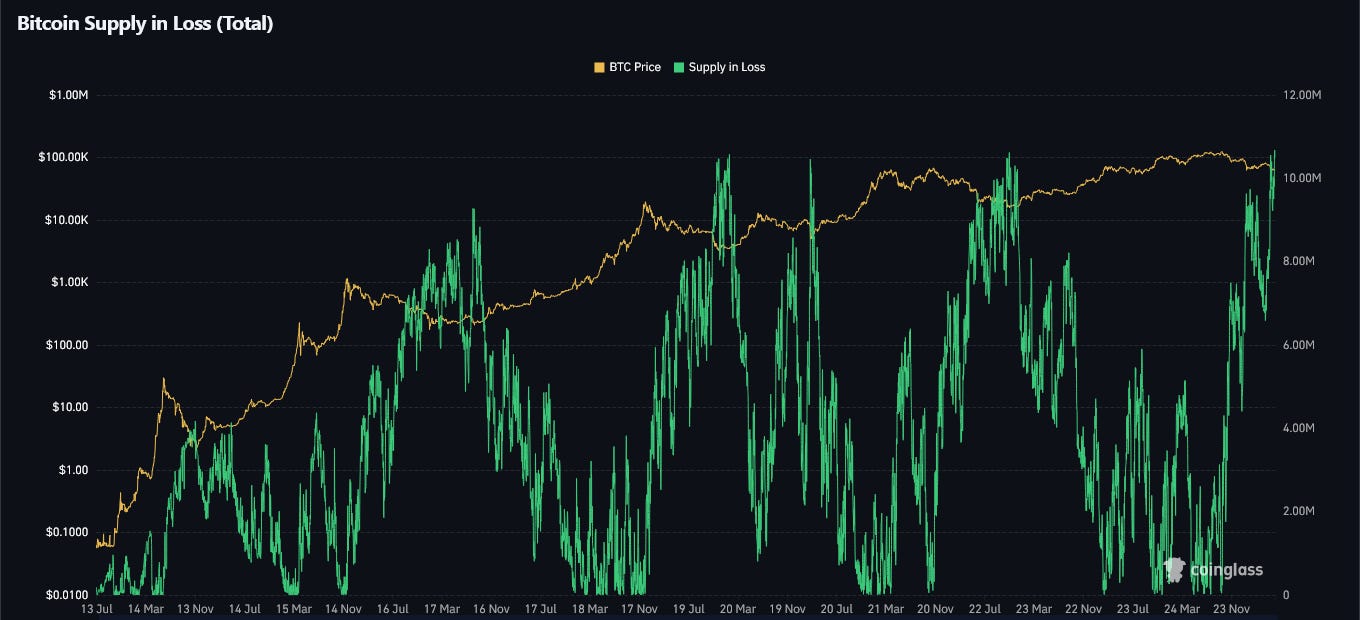
Roughly 11 million Bitcoin are now sitting at a loss; at one point this month more than half the entire supply was underwater. That 50% line has been crossed at every major bottom since 2015.
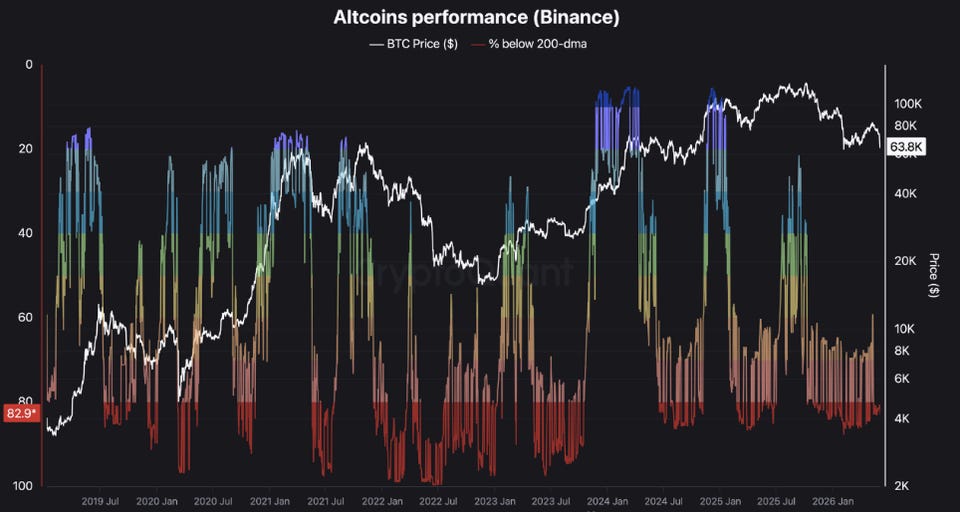
Out in the altcoin market it’s even more washed out — around 83% of the top alts are trading below their 200-day moving average. You can’t wash out what’s already been wrung dry. When that many coins have already taken their 60–80% haircuts, the eventual snapback tends to be the kind that leaves people flat-footed.
This is where the honest case for more pain lives, and it deserves real estate, not a footnote.
The Puell Multiple, a miner-revenue gauge, is hovering around 0.73. If it drops under 0.50 and Bitcoin loses $55,000, miners can get squeezed into selling just to keep the lights on, and that flavor of forced selling feeds on itself.
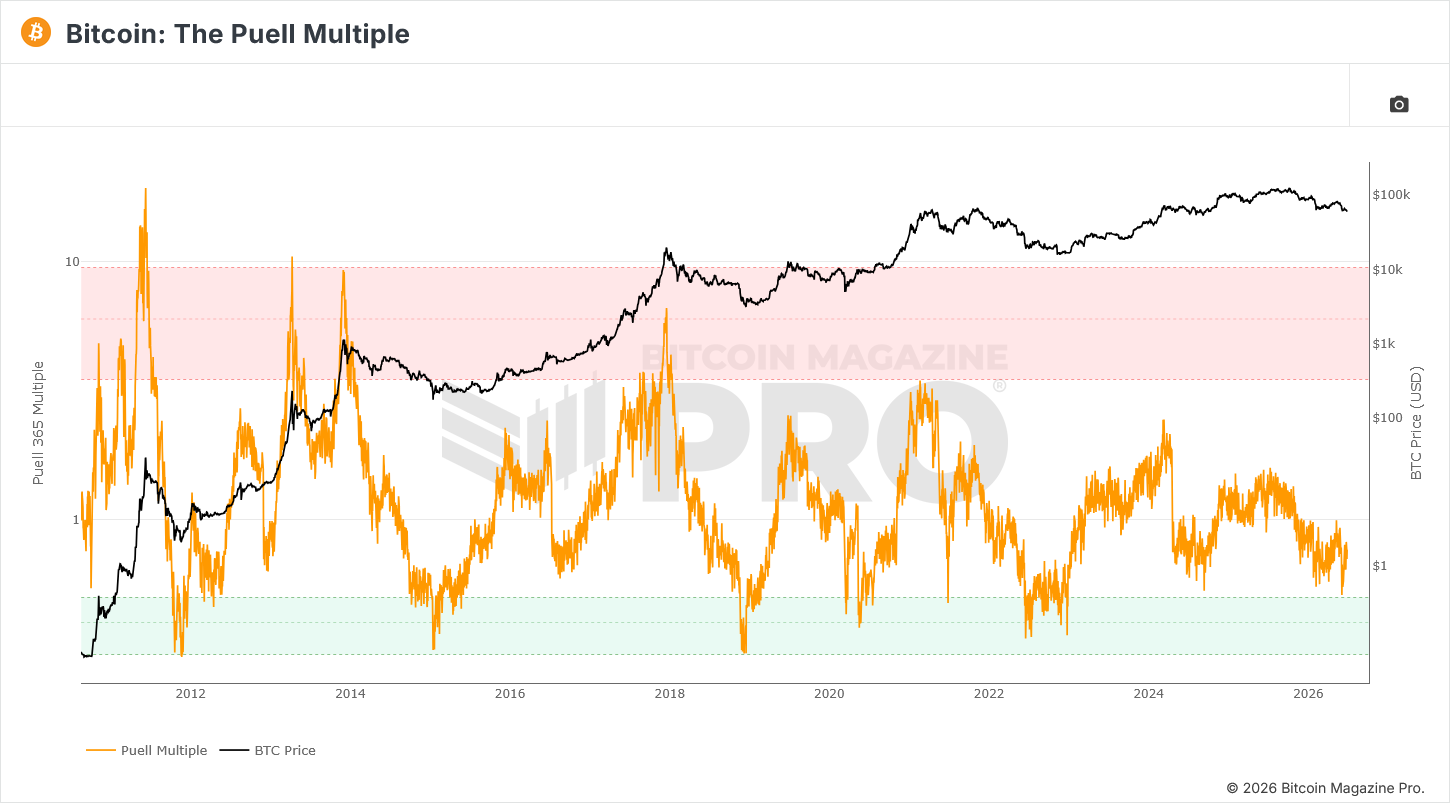
Katie Stockton, who reads charts for a living, has been blunt: Bitcoin failed at its 200-day average and is parked on a key Fibonacci level, and if $59K gives way she sees support down in the low $40,000s. She won’t rule out the old-fashioned 75–80% drawdown either. CryptoQuant’s analysts make a related point — the realized losses so far are a fraction of what full capitulation looked like in 2022. None of that is doom for the sake of doom. It’s the other half of the same five charts.
And the macro backdrop is genuinely hostile, more than it was even a few weeks ago. The story used to be “the Fed won’t cut.” It’s become worse than that — the Fed might hike. With the 10-year Treasury paying 4.47%, there’s now a real, risk-free reason to skip a volatile asset that pays you nothing, and the speculative money that might have rotated into crypto is busy chasing the AI melt-up instead. A non-yielding asset has a rough time competing when the price of money is climbing.
So why are the people with the longest time horizons getting louder instead of quieter?
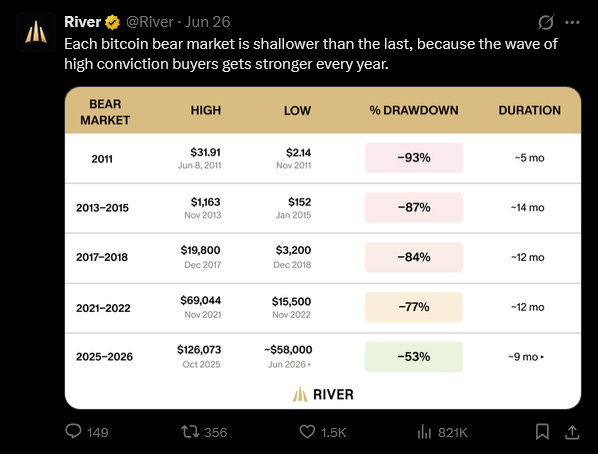
Look at the shape of Bitcoin’s bear markets rather than just this one. 2011 was a 93% drawdown. 2015, 87%. 2018, 84%. 2021–22, 77%. This one, so far, about 53%. Each cycle the floor caves in less, because the buyer base underneath it gets deeper and steadier every year. There were no ETFs, no corporate treasuries, no BlackRock standing under the 2018 bottom.
Adam Back, who’s been here since before most of us showed up, makes the point that Bitcoin just touched its long-term moving average around $62,000 — the same thing that’s marked the end of every prior bear — while the supply on exchanges keeps falling and institutional buying stays aimed almost entirely at Bitcoin. He’s calling these relatively cheap levels and a generational entry, and he’s not the type to say that lightly.
Then there’s the bigger frame, the one that’s easy to lose when you’re glaring at a red candle. Tom Lee spent most of 2026 wrong and finally said so out loud, but his actual thesis never broke: crypto is downstream of AI, the same way memory chips looked like a has-been story in 2024 right before they went parabolic in 2026.
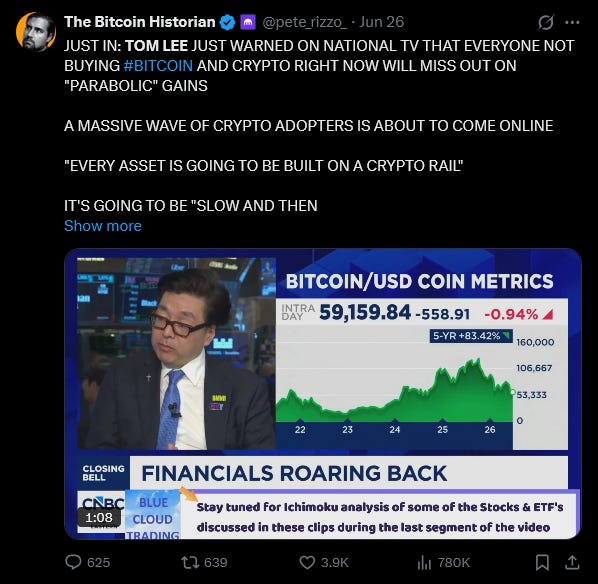
The plumbing keeps getting built no matter what the price does. BlackRock is tokenizing nearly every asset it can get its hands on. Franklin Templeton’s CEO describes blockchain as the future infrastructure of traditional finance — a single source of truth, contracts that execute themselves, settlement with no middleman taking a cut. Lee’s line is that it’s “slow and then sudden,” and the slow part is precisely when nobody’s paying attention.
There’s a liquidity argument under all of it too. Last cycle, Bitcoin still managed a 7x while AI vacuumed up the capital and the animal spirits, while gold and silver went parabolic, and while the Fed shrank its balance sheet by 27%.
Now look at what’s lining up:
enormous fiscal deficits, the kind that historically end in some version of yield-curve control,
a Fed balance sheet that expands again instead of contracting,
and a crypto regulatory framework that finally gets built out.
If Bitcoin can 7x with the Fed leaning against it the whole way, it’s a fair question what the same asset does when the liquidity tide turns back the other direction.
Here’s the synthesis the permabulls and the doomers both manage to miss: two things are true at once.
This can still have one more gut-punch in it — an FTX-style flush toward the low $40,000s that finally shakes out the last underwater holders. And four of the five deepest bottom signals we’ve ever recorded are already lit up. Bottoms aren’t a moment, they’re a process. A messy, sideways, multi-month grind where the signals stack up long before the chart goes green.
In November 2022 every one of these flashed, and Bitcoin still chopped for months before it ripped. The people who got rich doing this didn’t nail the exact low. They accumulated while it was cheap, ugly, and a little embarrassing to bring up at dinner.
So where do we land?
This is accumulation territory for anyone with a real time horizon and the stomach to be early. We’re not going to insult you by calling the precise bottom — nobody rings a bell, and that Puell landmine under $55K is real. But buying into this kind of weakness has paid better, every single time, than piling into the thing everyone’s already crowded around, and right now everyone is crowded around AI.
Two things tell us whether we’re right:
the Fed, which is the one variable that can drag this out longer than anyone wants,
and Bitcoin dominance, because the day it rolls over is the day capital starts rotating back into those coiled-up alts.
The doomers on your feed will be the last to notice. They always are — by the time they’re cheering again, they’ll have already handed their cheap coins to the people who didn’t flinch.
— A.Z., Freedom Finance
*None of this is financial advice. It’s analysis. Do your own research, size your positions to what you can genuinely afford to lose, and don’t make decisions based on price targets from anyone — including us.
P.S. I put together a mini-book on the #1 thing that wrecks altcoin investors — timing.
It’s called “The Altcoin Season Playbook.”
Inside: the 5 repeatable signals that show when altseason is starting, when it’s ending, and when you’re about to become someone else’s exit liquidity.
It’s practical — rotation maps, entry/exit checklists, and the same red-flag indicators that have flashed at the top of every cycle.
No posts
Comments
Nothing yet. Say the first thing.
Sign in to join the conversation.