
I’ve been mostly focused the last two months on building out a web app for Free Blocks. Josh and I started with Google Workspace and Slack1 extensions because we wanted to test how useful calendar availability tools would be in contexts people are familiar with. The response has been good and we’ve learned a lot from listening to feedback. Some things we’ve learned:
Availability lives in multiple places. Many people have multiple calendars they use for different contexts (work, personal, side hustles, etc.). Some are housed by the same app but in different “sub” contexts (ex. multiple calendars in Google Calendar or different accounts with Google Calendar), others are from different vendors completely (Office 365 v. Google Calendar).
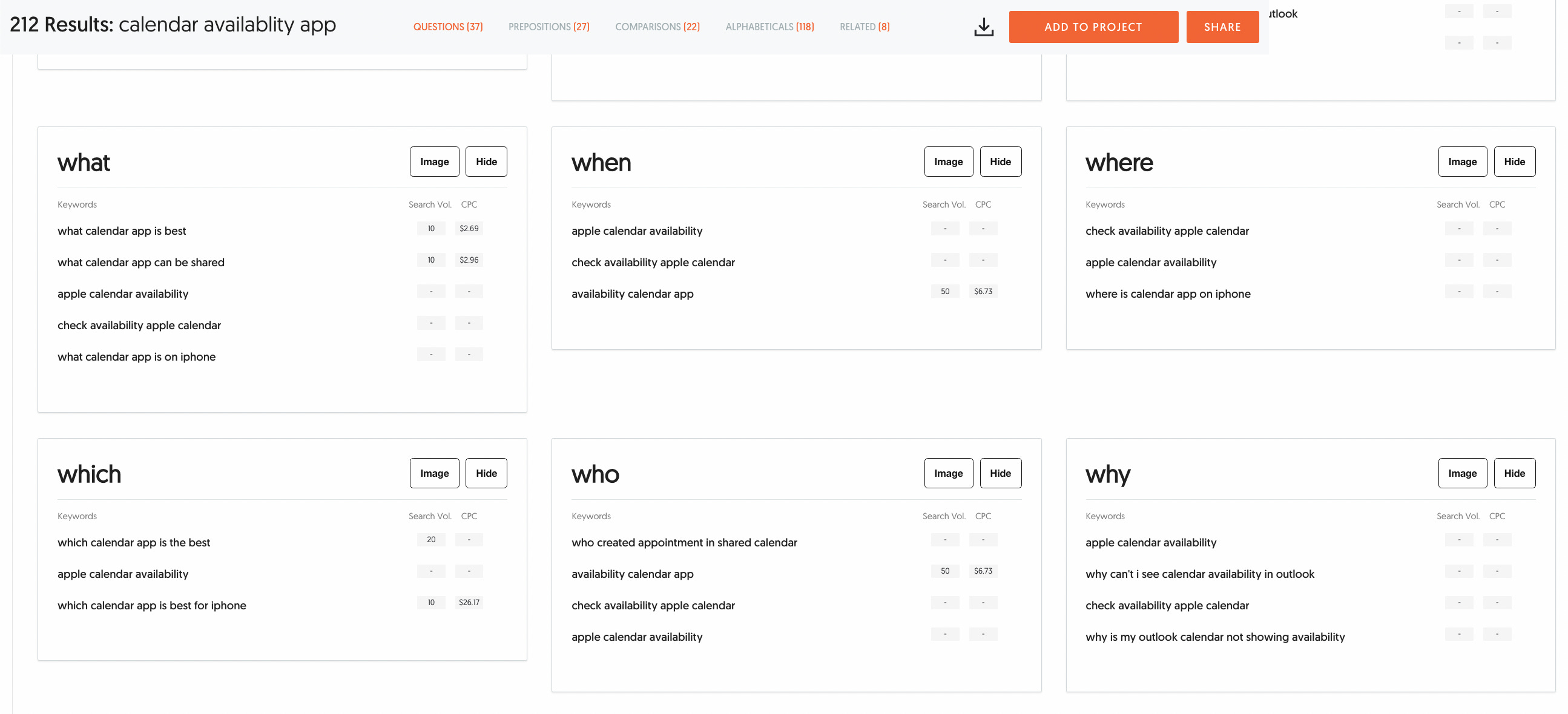
Calendar questions on search abound and advertisers are paying high CPCs to get noticed. Google Search analytics from answerthepublic.com reveal that people are unsure of what software handles this problem well, and advertisers are willing to pay huge premiums to lead them in the right direction ($26.17 cost per click estimate on “which calendar app is best for iPhone”):
Calendars are not the whole truth. Working hour overrides and full day blocks are popular features on our Google Workspace extension. Just because you have free slots on your calendar doesn’t mean you want them filled. Other apps we’ve looked at have interesting features built around allowing downtime / context switching time after meetings and guaranteeing a specific amount of free time a day.
Viewers of availability don’t want “nothing available” as an answer. I have a semi-popular daily fantasy sports optimizer open source project and I get all manner of questions on why the optimizer returns “no solution found”. The answer every time is related to constraints. If you only allow Patrick Mahomes as your starting fantasy QB, the solution space for possible lineups narrows massively. If you have ten people and are trying to find calendar availability across a two day time period, your “solution” odds are worse than three people and seven days. Relaxing more constraints most of the time turns out to be the thing the user needs to do to find solutions to problems, and good software should recommend which constrains to drop. This is a tough problem, but also it feels like there are some easy answers. As a human, I’ll schedule over recurring one on ones or “focus time” if I think a meeting is business critical and high return on time. Software should recommend the same.
Booking pages are not a complete solution. We’ve all got the same email from vendors, recruiters and sales folks: “Schedule time with the link below”. You then have to check your calendar for when you’re free and compare with the times the booking page shows you. Internal meetings generally don’t leverage booking pages to start. Not every audience should have the same booking page, and maintaining many sets of settings as a booking page owner is difficult. This is also a hard problem but there are opinionated solutions we’re thinking of.
A web application is the best way to address these points because we’re not beholden to any vendor’s SDK or app store requirements. We can build anything we want and have it work for a range of devices and use the underlying data stores to talk to our Slack, Google Workspace and in the future other applications.
I’m hoping we can release some type of MVP in the next few weeks that hits on one or more of the ideas above. If you’re interested in beta testing or have thoughts on what we should build, please email me at ben.brostoff@freeblocksapp.com.
Still in Slack’s app store approval process; we submitted December 28th and have been through a few rounds of feedback.
No posts
Comments
Nothing yet. Say the first thing.
Sign in to join the conversation.