
WHITE PRIVILEGE RUNS ON BLACK AND BROWN OBEDIENCE
And the reward for obedience is victim status
Nafees Alam
The concept of white privilege has become one of the most familiar ideas in American life. It shows up in corporate trainings, university classrooms, and church basements. The claim is simple on its face. White people carry unearned advantages that travel with them through the world because of the color of their skin. Peggy McIntosh gave us the enduring image of an invisible knapsack stocked with special provisions that its owner never had to earn. To be counted as decent in this framework, a person is expected to see the knapsack, name it, and help empty it.
I want to look at a part of this framework that almost no one discusses. The idea of white privilege cannot stand by itself. It rests on a second claim that is seldom stated plainly, and that second claim makes a demand of black and brown people. It demands our obedience.
Follow the logic. If whiteness grants advantage, then the absence of whiteness grants its opposite. The white person is lifted by race. The black or brown person is, by the same reasoning, held down by race. These two claims are welded together. You cannot assert the first without asserting the second. When a person says that white people are privileged, that person has already announced, in the same breath, that I am not privileged and that I cannot be, so long as my skin stays the color it is.
This is where the framework asks something of me that it never states out loud. For the doctrine to hold in public, black and brown people have to agree to it in public. We have to say the words. We have to affirm that we lack privilege on account of our race and that we could never possess it. The confession is the entry fee. Without our participation, white privilege is only a theory that one group holds about itself. With our participation, it becomes a settled fact about all of us.
Now add the incentive, because the incentive explains why so many of us comply. The confession does not come for free. It comes with a reward, and the reward is victimhood status. In the current moral economy, suffering is a currency, and a person who can lay claim to racial injury can spend it. It buys sympathy, standing, and a kind of unearned authority in any room where these ideas hold sway. The more disadvantaged you present yourself to be, the more moral credit you accumulate. Many black and brown people have been coerced into the doctrine not by argument but by this payout. They believe the propaganda because believing it pays.
Look closely at what the payout rewards. It rewards the claim that I lack agency. To collect the full value of victimhood, I have to present myself as acted upon rather than acting, as blocked rather than capable, as a product of forces I cannot move. Agency is the one thing the framework cannot afford to grant me, because a black or brown person with agency is a black or brown person whose outcomes are partly his own doing, and that possibility deflates the entire theory. So the incentive runs in the wrong direction. It pushes us to advertise our helplessness and to hide our strength.
Lower expectations follow as night follows day. When a young black or brown person is taught that the deck is stacked against him, he learns to expect less of himself, and the adults around him learn to expect less of him, too. The soft bigotry of low expectations is not a slogan here. It is the operating logic. A student who is told his race caps his ceiling has been handed a reason to stop reaching for the ceiling. The framework calls this compassion. It functions as sabotage.
The cruelest turn comes when we begin to police one another. I call it the Carlton Banks effect, after the character from The Fresh Prince of Bel-Air. Carlton was ambitious, articulate, well mannered, and driven, and for those very qualities he was mocked as a sellout, as not black enough, as a boy who had betrayed his own. That was fiction, but the pattern is real and it is everywhere. When the reward system pays for disadvantage, the black or brown person who succeeds without complaint becomes a threat to everyone still collecting the payout. His success proves that the ceiling can be pushed. So he must be pulled back down. We call him a token. We say he has internalized whiteness. We accuse him of forgetting where he came from.
Sit with what this means. White privilege, the thing we claim to be fighting, is kept alive most efficiently by black and brown people who police each other into being less instead of more. The hierarchy no longer needs an outside enforcer. We enforce it ourselves. We hold the line against our own ambition and punish the ones who break ranks by rising. A system that gets its subjects to guard their own cage has achieved something no overseer ever could.
The remedy is simple. Let black and brown people describe their own lives in their own words, and stop paying them to describe those lives as small. A black or brown person should be free to say that race sits at the center of his story and free to say that it sits at the edge. He should be free to claim agency, to expect much of himself, and to celebrate the neighbor who climbs. The moment we reward helplessness and punish drive, we have kept racial hierarchy alive under new management, and we have done the work of the oppressor for him. Obedience and justice are different things, and a confession bought with victimhood points tells us nothing true about the person who gives it.
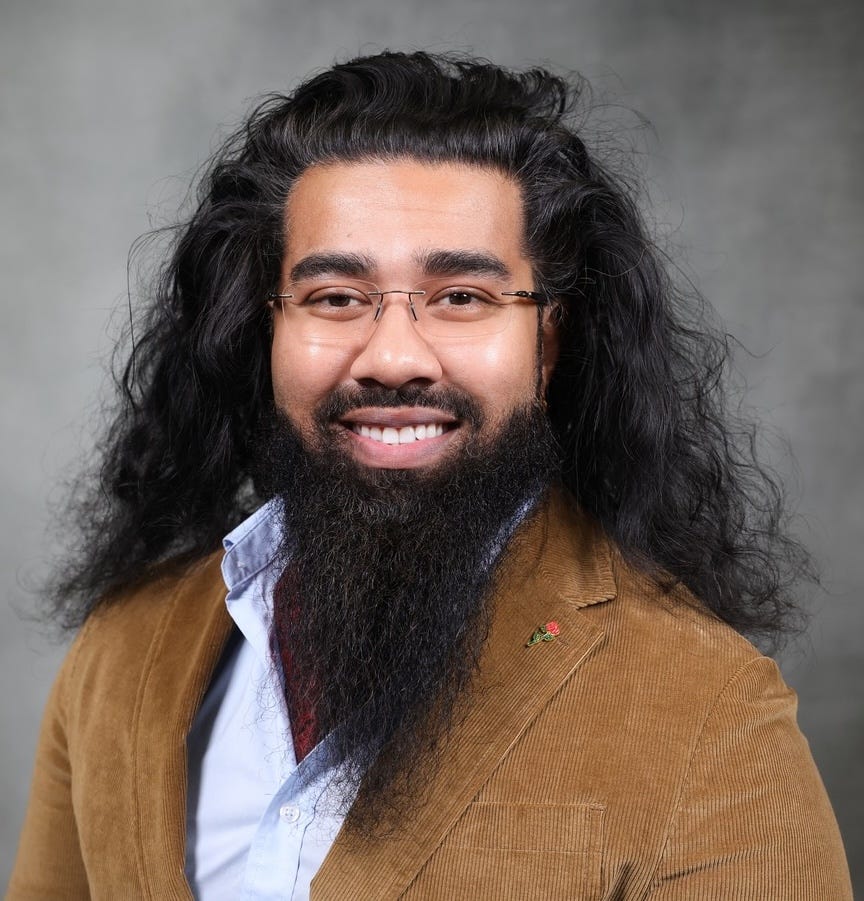
Dr. Nafees Alam is a professor of social work, holding a PhD from Yeshiva University, and is licensed in multiple states. His scholarship focuses on viewpoint and political diversity in higher education and the greater society. He sits on the board of Free Black Thought. His previous articles for JFBT were “Neo-White Supremacy and the Assumption of Black/Brown Inferiority,” “From ‘Masculinity Can Be Toxic’ to ‘Masculinity Is Toxic’,” “‘Antiracism’ That Erases Black History,” and “Act Your Race.” He was a guest on the FBT Podcast in September of 2025. Follow him on Twitter/X.
No posts
Comments
Nothing yet. Say the first thing.
Sign in to join the conversation.