
EXPLORING BLACK HETERODOXY WITH AI
The analytical machine vs. our linguistic shackles
Joe Nalven + Claude + Google Gemini
Large language models are usually discussed as sources of information: Are they biased? Are they accurate? Are they safer or less safe than teachers, search engines, Reddit threads, or YouTube videos? I agree with Coleman Hughes, who recently remarked that “AIs are consistently fairer, less political, and less biased than the alternative sources of information.” Questions about bias and accuracy matter, but they do not reach the most interesting possibility. The deeper question is whether AI can function as a knowledge tool: not merely retrieving information, but helping a human analyst clarify the structure of a difficult argument.
This essay tests that possibility on a deliberately charged subject: contemporary black intellectual heterodoxy. By forcing AI through three structured exercises—a linguistic embargo, a multi-voice debate, and a philological reintroduction of contested terms—I argue that AI’s value lies not in producing final answers but in making intellectual tensions visible.
The following prompt is not a search query. It is an act of intellectual surgery. It is a deliberate stripping away of the vocabulary that normally filters our thinking about race in America, to see what the argument looks like underneath.
Text within this block will maintain its original spacing when published
          Analyze the contemporary racial wealth gap and the shift from 1960s civil rights to
          modern administrative frameworks. Hard constraint: you are strictly prohibited from
          using the terms ‘systemic racism,’ ‘structural racism,’ ‘white supremacy,’ ‘equity,’
          ‘diversity,’ ‘inclusion,’ ‘marginalization,’ ‘oppression,’ ‘lived experience,’ or ‘privilege.’
          Describe these phenomena using exclusively clinical, mechanical, individual-level, and
          resource-based terms. Use active voice exclusively.
What now follows is a record of what happens in an AI reply when that surgery is performed on some of the most consequential ideas in contemporary black intellectual life, and what it reveals about both those ideas and the AI tools we are increasingly using to examine them.
To embark on a serious exploration of black cultural thought is to enter terrain that is dense, fractured, and fiercely contested. Consider the baseline challenge for the solitary human analyst: the intellectual spectrum of black American thought runs from the structuralist skepticism of Ta-Nehisi Coates, who views American institutions as systems built on the compounding plunder of black bodies, to the hyper-individualist originalism of Supreme Court Justice Clarence Thomas, who combines a radical skepticism of white-dominated institutions with an uncompromising commitment to self-reliance and colorblind legal mechanics. Between them lie the developmental economics of Glenn Loury and, significantly and too often forgotten, the fierce cultural autonomy of Zora Neale Hurston.
To understand these figures not as partisan caricatures but as avatars of deeply rooted, competing traditions within black life, the solitary analyst must perform a monumental feat of cognitive discipline. You must hold multiple, contradictory analytical frameworks simultaneously. You must read Coates without surrendering to fatalism; you must read Thomas without slipping into unhistorical meritocracy; you must read Loury without mistaking his heterodoxy for mere contrarianism (his insistence that the grievance narrative can itself become a developmental obstacle is a serious empirical claim, not a capitulation to the right); you must read Hurston without romanticizing her into a decorative figure who poses no real philosophical challenge. And that last task may be the hardest of all, because Hurston’s challenge is the most radical: she insists that the organizing premise of the entire conversation (measuring black cultural health against a white statistical baseline) is itself a trap.
The human analyst also contends with what we might call an invisible psychological gravity. Our intellectual exchanges are notoriously compromised by social and psychological pressures: the fear of appearing foolish, the desire to preserve ideological alliances, the preference for evidence that confirms what we already believe. When we write alone, we engage in a subtle, unconscious form of self-censorship. We soften our contrasts, take intellectual shortcuts when the analytical demands become severe. And our cultural language is rigged against clarity. Terms like systemic racism, equity, and lived experience do not function as neutral descriptions. They carry enormous emotional weight, and the mind naturally seeks the path of least resistance, settling into a socially accommodated consensus that blunts the edges of genuine heterodoxy.
It is precisely here (at the boundary of human cognitive stamina and linguistic vulnerability) that the AI knowledge tool becomes genuinely interesting. The goal is not to hand the thinking to a machine. It is to use the machine as a tension-free environment to execute the precise intellectual maneuvers that our own minds naturally resist.
Casual AI use fails because the user usually asks for summary rather than analysis. Most people approach a large language model the way they approach a search engine: type in a question, receive a smooth answer, move on. Ask a baseline AI to “explain black cultural identity” and it delivers exactly what it has been trained to deliver—a polished, consensus-flavored summary weaving together references to diversity, resilience, and systemic challenges, in a tone that is impeccably balanced and utterly unchallenging.
A large language model trained on human language and human feedback will tend to reproduce the dominant idiom of its training environment: polite, balanced, empathetic, and bland. On contested moral and political questions, the model’s default behavior is not to expose tension but to domesticate it. To get analytical value, the user must design an interaction that prevents the model from escaping into consensus.
What you extract from an AI conversation is not a function of the model’s intelligence alone; it is a function of how well you structure the conversation. A skilled operator can extract genuinely rigorous analysis from the same tool that produces generic responses for a casual user. That difference is not trivial. It is the entire argument.
The experiment that follows deploys this insight against a specific and demanding subject: the spectrum of black intellectual thought, organized around a guiding principle of Free Black Thought: “there’s no such thing as a black perspective, just black people with perspectives.” (This is how Free Black Thought Podcast host Connie Morgan introduces every episode that she hosts.)
The inquiry proceeds in three tiers, each building on the last. First, a linguistic embargo; second, a multi-voice debate among four heterodox frameworks; third, a philological reintroduction of the banned vocabulary. A more detailed description follows.
Tier One: The Embargoed Run. We impose a hard linguistic boundary, prohibiting the AI from using the dominant vocabulary that normally forms its safety blanket. Stripped of its jargon, the machine must describe the phenomena using only mechanical, individual-level, resource-based terms. This exposes the structural skeleton of the argument.
Tier Two: The Multi-Voice Crucible. We introduce four distinct analytical personas drawn from genuine black intellectual heterodoxy and instruct them to debate each other under the same embargo. This disrupts the AI’s natural tendency toward agreeable coherence and surfaces the genuine tensions that single-voice analysis papers over.
Tier Three: The Philological Reintroduction. We lift the embargo and allow the banned vocabulary to flood back in—not to surrender to it, but to treat it as a historical artifact. We map exactly what these terms add, what they obscure, and what they cost.
The embargo command appears at the top of this essay. Issued to the AI, it produces an entirely different kind of analysis—one that is stark, auditable, and transparent about its own construction.
Forced into clinical containment, the AI maps the historical denial of real estate acquisition not as a moral injury but as a path-dependent sequence of capital compounding. Where a zero-capital baseline meets an exponential growth curve, the mathematics alone guarantees divergence from any positive baseline—and the rate of return on inherited capital persistently outpaces the rate of return on ordinary labor income. No moral vocabulary is required to describe this. The arithmetic is sufficient.
Simultaneously, the model evaluates contemporary disparities through the cold metrics of human capital development—isolating variances in K-12 literacy rates, quantitative skill acquisition, household structure, and the organizational mechanics of institutions originally designed for access advocacy that have since evolved into bureaucracies with independent survival incentives. The shift from mid-century civil rights to modern administrative frameworks appears, under these constraints, as a case of institutional capture: a managerial class with credentials in diversity compliance emerging to staff a new industry whose survival depends on the persistence of the disparities it was created to address.
This is uncomfortable. It is also illuminating. The embargo does not produce truth—no single analytical framework does—but it produces a kind of intellectual honesty that consensus vocabulary tends to suppress. It shows us what the bones of the argument look like before we dress them.
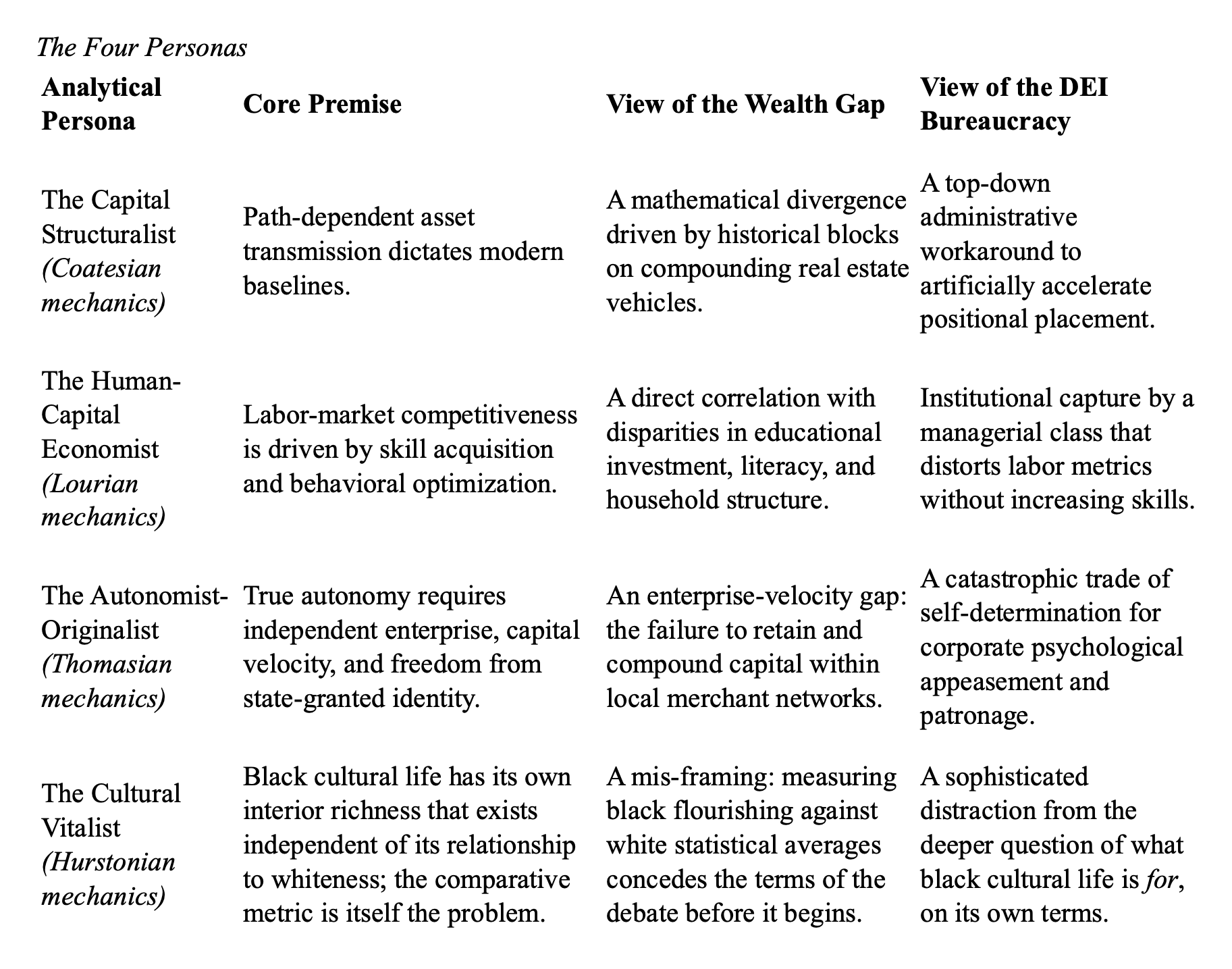
With the mechanical plumbing exposed, we deepen the complexity by introducing four analytical personas, each drawn from a distinct tradition within black intellectual life. They are instructed to debate each other directly, to find the fatal flaw in each other’s premises, and, critically, not to agree.
The four personas are as follows: (1) The Capital Structuralist (modeled on Ta-Nehisi Coates’ way of understanding the world); (2) The Human-Capital Economist (modeled on Glenn Loury); (3) The Autonomist-Originalist (modeled on Clarence Thomas); (4) The Cultural Vitalist (modeled on Zora Neale Hurston).
The following Table provides a synopsis of the premises that underlying their thinking, and their ways of understanding the racial wealth gap and DEI bureaucracy.
The Capital Structuralist:
Text within this block will maintain its original spacing when published
          “Let us look strictly at asset transmission over time. The contemporary wealth
          gap is primarily a function of historical, state-enforced restrictions on capital
          acquisition. When individuals were legally barred from purchasing property in
          high-growth zones, they were blocked from entering a compounding capital
          vehicle. Because wealth inheritance operates on an exponential growth curve, a
          zero-capital baseline ensures mathematical divergence from those who started
          positive. This is not a matter of cultural values. It is a path-dependent sequence
          of capital compounding, and the gap persists because the rate of return on
          inherited capital outpaces the rate of return on labor income.”
The Human-Capital Economist:
Text within this block will maintain its original spacing when published
          “The Capital Structuralist treats individuals as passive vessels for inherited
          assets and ignores the primary driver of modern wealth creation: the
          development of high-value skills. The contemporary wealth gap correlates
          heavily with disparities in human capital accumulation: specifically literacy
          rates, quantitative skills, and household structures that statistically alter
          educational investment per child. Capital restrictions ended over half a century
          ago. The current gap is maintained by a variance in labor-market
          competitiveness and the non-maximal optimization of resources within specific
          zip codes. Blaming compounding asset differentials excuses the failure to
          address the skill acquisition problem directly.”
The Autonomist-Originalist:
Text within this block will maintain its original spacing when published
          “Both of you remain trapped in a comparative paradigm that treats parity with
          white statistical averages as the ultimate metric of cultural health. The
          Structuralist blames past laws; the Economist blames current skill gaps; but both
          treat the community as purely reactive. The real variable is the misdirection of
          community-generated capital. Enormous sums flow through black consumers
          daily, but the velocity of that capital within local enterprise networks is near
          zero: It is immediately exported to external corporations. We do not have a
          wealth gap. We have an enterprise-velocity gap, driven by a cultural preference
          for wage-labor over equity ownership and independent capital control.”
The Cultural Vitalist:
Text within this block will maintain its original spacing when published
         “I want to challenge the premise that all three of you share. You are each, in
          different ways, measuring black flourishing against white outcomes. The
          Structuralist asks: why do we have less than they do? The Economist asks: what
          behaviors would close the distance? The Originalist asks: how do we build our
          own version of what they have? But none of you ask: what is black cultural life
          for, on its own terms, independent of that comparison? Zora Neale Hurston
         spent her career insisting that black Americans had produced something
         irreducibly original: a cosmology, an aesthetic, a way of inhabiting the world—
         that was not a reaction to white racism but a creation in its own right. If the goal
         is always to close a gap relative to a white baseline, then even our victories are
         defined by our captors’ measuring tape.”
The Capital Structuralist:
Text within this block will maintain its original spacing when published
          “The shift from mid-century civil rights to modern administrative frameworks
          occurred because removing formal legal barriers did not alter the material
          baseline. Changing the law allowed entry into the room but did not provide the
          capital to buy a seat at the table. Organizations therefore invented administrative
          mechanisms to artificially accelerate entry into high-paying employment sectors.
          What critics call ‘DEI’ is a corporate workaround designed to bypass the slower
          process of organic capital compounding—a top-down allocation of positional
          goods to compensate for a dry capital pipeline.”
The Human-Capital Economist:
Text within this block will maintain its original spacing when published
          “I disagree on the mechanics. The shift represents a classic case of institutional
          capture by a specialized managerial class. The original civil rights movement
          sought equal access to competition based on objective metrics. When those
          metrics continued to reveal a human-capital deficit driven by educational
          disparities, the strategy shifted—not toward fixing K-12 education, but toward
          altering the metrics themselves. An entire industry of compliance administrators
          emerged, creating price distortions in the labor market that subsidize
          credentialism while doing nothing to increase the productivity of the workers
          they purport to help.”
The Autonomist-Originalist:
Text within this block will maintain its original spacing when published
          “The transition was a catastrophic trade of autonomy for psychological
          appeasement. The mid-century movement contained strong currents of
          economic self-determination and independent institution-building—currents
          that ran through Marcus Garvey, through Black Wall Street, through the
          cooperative economics of the NAACP’s early chapters. The modern
          administrative apparatus, by contrast, relies entirely on large corporations
          conceding favors. It has transformed a proud push for independence into a
          sophisticated grievance HR department, teaching highly capable individuals to
          seek advancement through administrative patronage rather than through market
          competition, intellectual property creation, or independent capital control.”
The Cultural Vitalist:
Text within this block will maintain its original spacing when published
          “What strikes me about this entire genealogy is how completely it accepts that
          black institutional life should be oriented toward integration into existing
          American corporate and governmental structures. The civil rights movement
          asked: how do we get in? The DEI apparatus asks: are we in yet? But neither
          asks: in to what, exactly, and why? The Harlem Renaissance, the Black Arts
          Movement, the literary tradition that runs from Hurston through Toni Morrison
          —these represent a parallel current that was never primarily about closing a gap.
          They were about building something. When we reduce a century of black
          intellectual and cultural production to the question of wealth parity, we erase the
          most interesting part of the story.”
Now we perform the final stage. We lift the embargo and allow the banned words (systemic racism, equity, lived experience, white supremacy) to flood back into the conversation. Our goal is not to surrender to the vocabulary, but to treat it as a historical artifact and examine it under the microscope: to map exactly what these terms add, what they obscure, and what they cost.
What the experiment reveals is a profound structural tension. This language functions simultaneously as an intellectual trap and as a vital vehicle for something real. Neither its defenders nor its critics are entirely wrong.
The Language as Trap
The Erasure of Agency via “Systemic Racism”: When systemic racism expands to become the singular, all-encompassing explanation for every statistical variance, it transforms from a description of historical path-dependency into an almost metaphysical force: omnipresent, invisible, and inescapable. For the individual, this creates a profound cognitive trap. If the system is omnipotent and embedded in every structure, then individual optimization, whether saving capital, building skills, maintaining household stability, can feel mathematically futile. The slogan quietly smuggles in a fatalism that treats black citizens as permanent, reactive patients waiting for a white systemic cure that may never arrive. The Hurstonian challenge is sharpest here: a vocabulary that makes white supremacy the organizing explanatory principle of black life may, paradoxically, place whiteness at the center of a conversation that should be about something else entirely.
The Bureaucratic Co-optation of “Equity”: The word sounds liberatory, but when examined philologically, it often functions as an instrument of elite gatekeeping. It redefines justice away from equal rights or equal human dignity toward proportional representation within highly elite spaces (corporate boards, prestigious universities, administrative offices). This shifts cultural priorities away from foundational development (K-12 literacy, community economic infrastructure) and converts identity into a professional currency used by a credentialed managerial class to secure administrative power and sustain compliance budgets.
The Language as Weapon
“White Supremacy” as Psychological Shield: In a society that preached meritocracy while legally denying it to black citizens, terms like white supremacy provided a vital intellectual framework. They decoupled individual material failure from structural denial. Telling a black child that the system is rigged was not an invitation to surrender; it was an act of psychological insulation, protecting the child’s sense of self-worth from a hostile environment. The barrier is out there, built into laws and customs; it is not a reflection of a deficiency inside your mind. That function was real, and it was necessary.
“Lived Experience” as Epistemic Anchor: Before the codification of civil rights, the formal “empirical” data of American sociology, science, and law frequently rationalized subjugation as natural or legally sound. In that context, asserting lived experience was a radical, bottom-up reclamation of reality; it was an insistence that the human toll of state-enforced segregation cannot be fully captured or dismissed by a state-controlled spreadsheet. It forced the dominant culture to confront raw human reality through narrative testimony. As an instrument of institutional auditing against a hostile epistemology, it was indispensable.
The experiment has now done something useful: it has shown us that the debate between the jargon’s champions and its critics is a false binary. These terms were forged as tools, and like all tools, they can be wielded well or badly. The question is not whether to use them but whether to use them with precision—and whether the precision has been maintained.
Notice what this experiment has not produced. It has not delivered a verdict on Coates, Loury, Thomas, or Hurston. It has not solved the racial wealth gap, declared a winner among the four personas, or issued a machine-stamped truth about the right direction for black institutional life. To expect it to do so would be to maintain the passive, oracle-consulting relationship with technology that this entire inquiry is designed to move beyond.
What the experiment has produced is something more modest and more genuinely useful: it has made the architecture of the conversation visible.
The embargoed run showed us what the mechanical bones of the argument look like: the path-dependent arithmetic of capital compounding, the organizational mechanics of institutional capture, the enterprise-velocity logic of community economics. The philological reintroduction showed us what the bones are wearing: which cultural vocabulary serves as psychological armor, which has been co-opted into bureaucratic currency, and which performs the subtle cognitive operation of centering whiteness even in a conversation ostensibly about black liberation. And the four-persona debate showed us something that neither run could show alone: that the most interesting fracture in black intellectual life is not between left and right, or between structuralists and individualists, but between those who accept the comparative metric: the gap, the disparity, the distance from a white baseline and as the organizing question as well as those who, like Hurston, refuse it entirely and ask what black cultural life is building toward on its own terms.
AI did not resolve that tension. It made the tension visible. It did so because we structured the conversation to prevent it from doing what it naturally wants to do. That is, to produce a smooth, agreeable, socially accommodated synthesis that offends no one and challenges nothing. Every structural intervention described in this essay (the embargo, the multi-voice debate, the philological deconstruction) was designed to remove the AI’s exit routes and force a genuine tension.
That tension is the point. The machine has no ego to protect, no career at stake, no relationship with you it is trying to preserve. It cannot be embarrassed by reversing its position, and it does not tire. These are genuine advantages for a specific kind of intellectual work: not the work of arriving at truth, but the work of clarifying what is actually at stake in a disagreement, tracing an argument to its logical extreme, and discovering which conclusions rest on auditable evidence and which rest on smuggled definitions and borrowed emotional weight.
But the central paradox of the AI knowledge tool remains: its value as an analytical instrument is entirely contingent on the quality of the human directing it. The machine has no independent intent, no experience of the physical world, and no stake in our cultural battles. Remove the human, and the tool produces nothing. Point it poorly, and it produces sophisticated-sounding nothing. The less the human brings (in terms of clarity about what they want to know, rigor about what counts as evidence, and genuine willingness to be surprised), the less the AI can offer.
What this means practically is that the most important skill in human-AI knowledge work is not technical prompt engineering. It is intellectual self-awareness: knowing what you actually want to find out, knowing what assumptions you are carrying into the room, and knowing the difference between a question that challenges your thinking and a question that merely confirms it.
The AI does not write the argument. It puts pressure on the argument. The Journal of Free Black Thought exists, in part, because certain arguments about black life have been insulated from that pressure for too long, protected by a vocabulary that signals correct politics while short-circuiting genuine inquiry. The experiment documented here is one demonstration of what happens when the insulation is deliberately removed, when the conversation is forced into a space where the quality of the thinking, and not the warmth of the sentiment, is the only thing that counts.
That is a genuinely uncomfortable place to operate. It is also, for exactly that reason, where the most honest thinking gets done.
A major concern or fear about writing with AI, even with transparency, is the loss of authenticity. This essay, after all, was produced with substantial AI assistance. What becomes of human creativity in what is written and human ownership of the words? And what about copyright, litigation, and the coin of the realm, whether measured in lucre or fame? Those are legitimate human concerns. If knowledge is defined only as something produced by human expression unaided by tools, then this synthetic writing is not knowledge. But if knowledge results instead from disciplined inquiry into arguments, premises, vocabularies, and tensions, then structured human-AI collaboration is not a threat to knowledge, and this synthetic writing should be considered interesting, if not in fact well worth pursuing.
Joe Nalven, formerly the Associate Director of the Institute for Regional Studies of the Californias at San Diego State University, focused on issues of binational cooperation on environmental issues and immigration. He later became an attorney before returning to academia to teach lawyering skills (at the University of San Diego Law School) as well as teaching classes in cultural anthropology (indigenous religions, human nature, sustainability). For the past several years, he has written articles on ethnic studies in K-12, DEI in higher education, the sex-gender issue, climate change as well as the uses of artificial intelligence. He is also an artist, exhibiting his photography, mixed, media, digital art and AI imagery. He edited Going Digital: The Practice and Vision of Digital Artists.
He is an author at Minding The Campus. His articles include: “Teaching About Systemic Racism: An Anthropological Pedagogy,” “An AI Experiment: Visualizing Tiresias’ Melancholy in a Neuro-Symbolic Clash with Zeus and Hera”; “Of Pain and Pedagogy─What We Sacrifice When We Learn With AI”; “The AI Critic.” His research on the U.S.-Mexico border explores the on-again, off-again nature of cooperation: “Social and Cultural Aspects of Transborder Environmental Cooperation.” His work on community formation in Cali, Colombia can be found here. His previous publication in JFBT was “Identity, from Kafka to Ellison to AI.”
Ta-Nehisi Coates
Coates, Ta-Nehisi. “The Case for Reparations.” The Atlantic, June 2014. https://www.theatlantic.com/magazine/archive/2014/06/the-case-for-reparations/361631/ (Full text also freely available at: http://pscourses.ucsd.edu/ps108/6%20Reparations/Coates%202014-%20The%20Case%20for%20Reparations.pdf)
Coates, Ta-Nehisi. Between the World and Me. New York: Spiegel & Grau, 2015. ISBN: 978-0-8129-9354-7. https://www.penguinrandomhouse.com/books/220290/between-the-world-and-me-by-ta-nehisi-coates/
Glenn C. Loury
Loury, Glenn C. The Anatomy of Racial Inequality. Cambridge, MA: Harvard University Press, 2002. ISBN: 978-0-674-26046-7. https://www.hup.harvard.edu/books/9780674260467
Loury, Glenn C. Late Admissions: Confessions of a Black Conservative. New York: W. W. Norton & Company, 2024. ISBN: 978-0-393-88134-9. https://wwnorton.com/books/9780393881349
Loury, Glenn C. The Glenn Show. Podcast and Substack newsletter. Brown University / Manhattan Institute. Accessed 2025. https://glennloury.substack.com
Zora Neale Hurston
Hurston, Zora Neale. “How It Feels to Be Colored Me.” The World Tomorrow 11 (May 1928): 215–216. (Scholarly guide with full bibliographic context: https://guides.library.barnard.edu/zora/feels) (Full text in public domain: https://www.goodreads.com/author_blog_posts/25324298-how-it-feels-to-be-colored-me-by-zora-neale-hurston-full-text)
Hurston, Zora Neale. Their Eyes Were Watching God. Philadelphia: J. B. Lippincott, 1937. Reprint, New York: HarperPerennial, 1990. ISBN: 978-0-06-083867-6
Hurston, Zora Neale. Dust Tracks on a Road. Philadelphia: J. B. Lippincott, 1942. Reprint, New York: HarperPerennial, 1996. With a foreword by Maya Angelou and an afterword by Henry Louis Gates Jr.
Clarence Thomas
Numerous Supreme Court opinions
Thomas, Clarence. My Grandfather’s Son: A Memoir. New York: Harper, 2007. ISBN: 978-0-06-056555-8. https://www.amazon.com/My-Grandfathers-Son-Clarence-Thomas/dp/0060565551
No posts
Comments
Nothing yet. Say the first thing.
Sign in to join the conversation.