
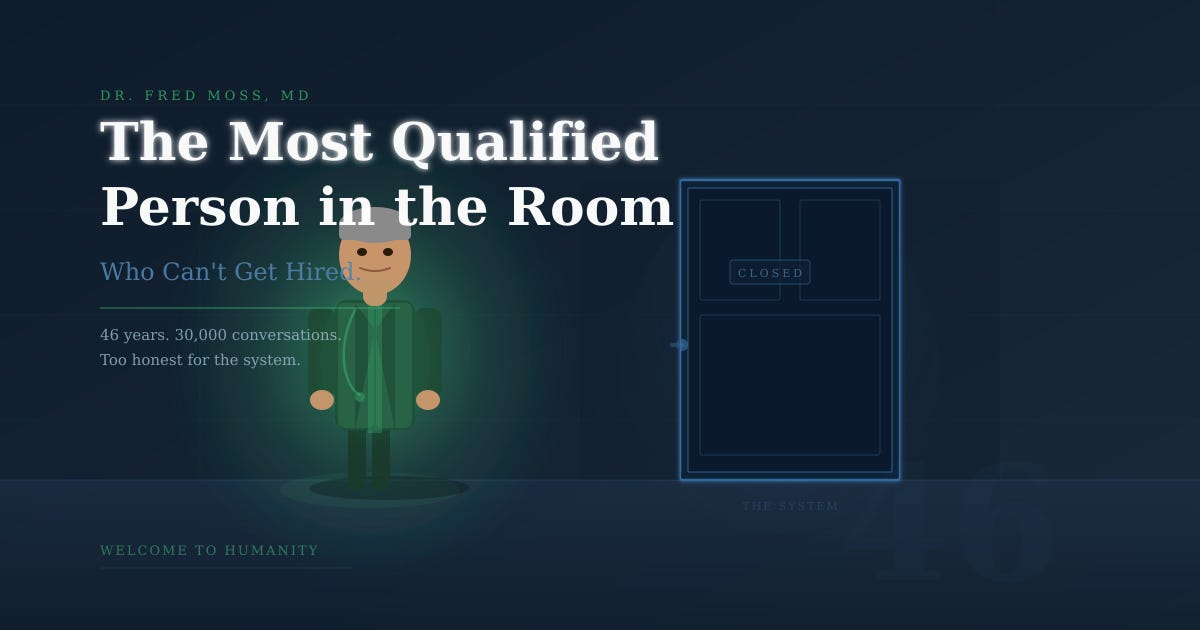
I am a board-certified psychiatrist with 46 years in mental health. Thirty-seven of those years as a physician. Nine before that as a child care worker, walking the halls of institutions before I ever had a white coat.
In those years I worked inpatient units, outpatient clinics, nursing homes, residential facilities, partial hospital programs, rehabilitation centers, orphanages, jails, prisons, and homeless shelters. I have sat across from patients in multiple states, across every demographic, from children to the very old. I estimate I have had somewhere in the neighborhood of 30,000 conversations with people in distress.
I cannot get hired.
Not because I am unqualified. Not because my license has been suspended. Not because my reviews are poor or my outcomes are weak. I cannot get hired because I am, in the language of the system, too honest. I have seen too much, understood too deeply, and arrived at conclusions that the industry that trained me cannot afford to acknowledge.
Here is what I know: the psychiatric diagnosis does not, in most cases, move the patient forward. It moves the patient into a category. And once a person has been categorized, something remarkable and terrible happens. They begin to organize their identity around that category. I call this diagnostic adoption. The moment a person says “I am bipolar” rather than “I experienced a period of extreme mood shifts” is the moment the treatment stops being a path toward healing and begins to be a way of managing what is now assumed to be permanent.
This is not an accident. The structure of mental health care as it is currently designed produces ongoing patients, not healed people. I am not making an accusation so much as I am describing a system that functions exactly as its incentives direct it to function.
A therapist who resolves a patient’s suffering has lost a revenue source. A prescriber who tapers and discontinues a medication has made a choice that requires significant justification in the current framework. The default pathway, when a medication appears not to be working, is not to question whether the diagnosis was accurate or whether the medication was appropriate. The default is to increase the dose, add another medication, or reclassify the diagnosis as treatment-resistant. I have watched this happen thousands of times. It is the norm, not the exception.
And here is the question that I now ask openly, having left conventional practice: is it possible that some portion of the symptoms we are treating are being perpetuated, in whole or in part, by the treatment programs we have designed?
I am not anti-medication. I am not anti-therapy. I am not opposed to diagnosis in every context. What I am opposed to is a system that has quietly traded healing for management, and that has made this trade so structurally complete that it has become nearly impossible to practice any other way within the institutional setting.
Which brings me back to where I started: I cannot get hired.
Every job listing I encounter in psychiatry requires me to assess patients, determine what is diagnostically wrong with them, assign a formal code, and build a treatment plan that will perpetuate engagement with the system. You cannot receive reimbursement from a third-party payer for declaring someone fundamentally okay. There is no wellness code in psychiatry. There is no billing mechanism for “this person is a human being experiencing an extremely difficult set of life circumstances and what they most need is genuine connection and time.”
So the system roars forward. And I stand outside of it.
What I believe, and what my 46 years have convinced me of, is this: the most powerful healing force in the history of our species is human connection. Not a specific technique. Not a particular modality. Not a pill or a protocol. Connection itself, the felt sense of being genuinely heard and genuinely seen by another person, produces changes in us that no pharmaceutical has ever been able to replicate.
You do not need a degree for this. You do not need initials after your name. And here is the uncomfortable truth: there is a reasonable argument to be made that too many years in a classroom, learning to categorize and clinically distance, actually makes a person less effective at the thing that heals.
I am not the most qualified psychiatrist in the room anymore, by that standard. I may be the most qualified person in the room for something the room does not yet have a billing code for.
That is the tragedy. And also, I think, the opening.
The world does not need more of what has been done. The world needs someone who has been inside the machine long enough to understand exactly how it works and exactly where it fails. That is not a disqualification. That is, I would argue, the most important credential available.
I am done waiting for the system to offer me a seat at its table. I am building a different table.
Welcome to Humanity.
No posts
Comments
Nothing yet. Say the first thing.
Sign in to join the conversation.