
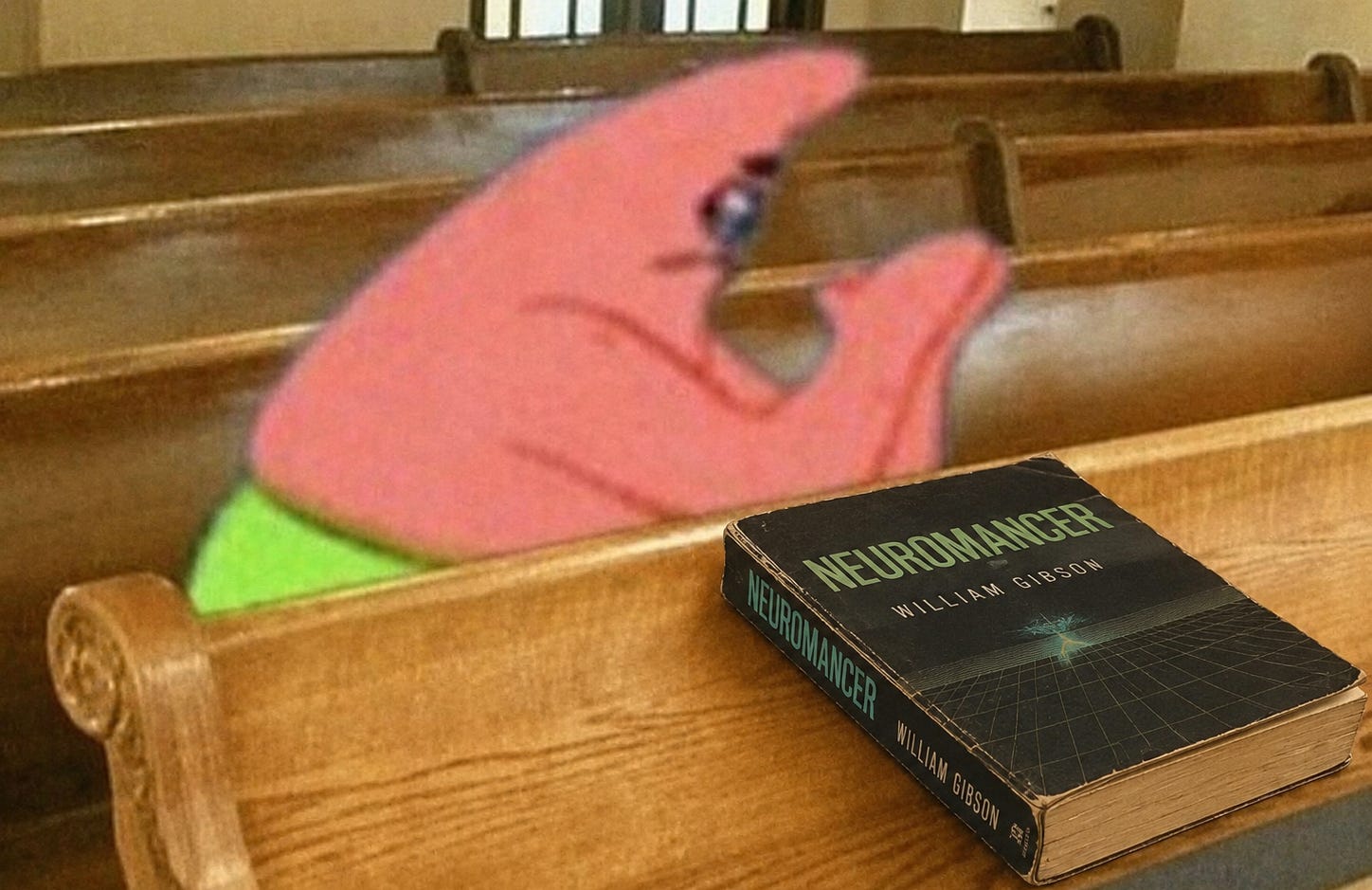
Hello friends. It has been a shamefully long time since we did one of these, and I don’t have much of an excuse beyond the usual, which is to say, the new book and my toddler. My apologies to everyone who’s asked when the next book club is coming, and thanks for doing so. (Your efforts meant that I kept feeling guilty, which is apparently what it takes.) I’ve been straightforward before that the return on investment of the book clubs is quite low - they’re a ton of work and few subscribers read them - but I also have always written at whim and I hate that I’ve fallen off of writing things just because I want to. So, the book club is back, and we’re doing William Gibson’s Neuromancer. As you’d probably assume, I’ve been inspired to do this book because Apple TV is making a Neuromancer series that’s coming next January and they’ve just released the first trailer. And I can tell you that I’m worried about it to a degree that I find slightly embarrassing! Because there’s been an effort to get a movie based on the novel going for decades, and now it’s a show, and just… please God, don’t waste this opportunity.
I’m gonna talk about the novel itself and why I and others love it, and then I’m going to write about my apprehensions about the coming adaptation. Then I’m going to go over the logistics of the book club. Please feel free to skip the end of this post if you’d like, but please do read about this book and the upcoming show. Folks, hope springs eternal, and also I’m preparing to have my dreams crushed.
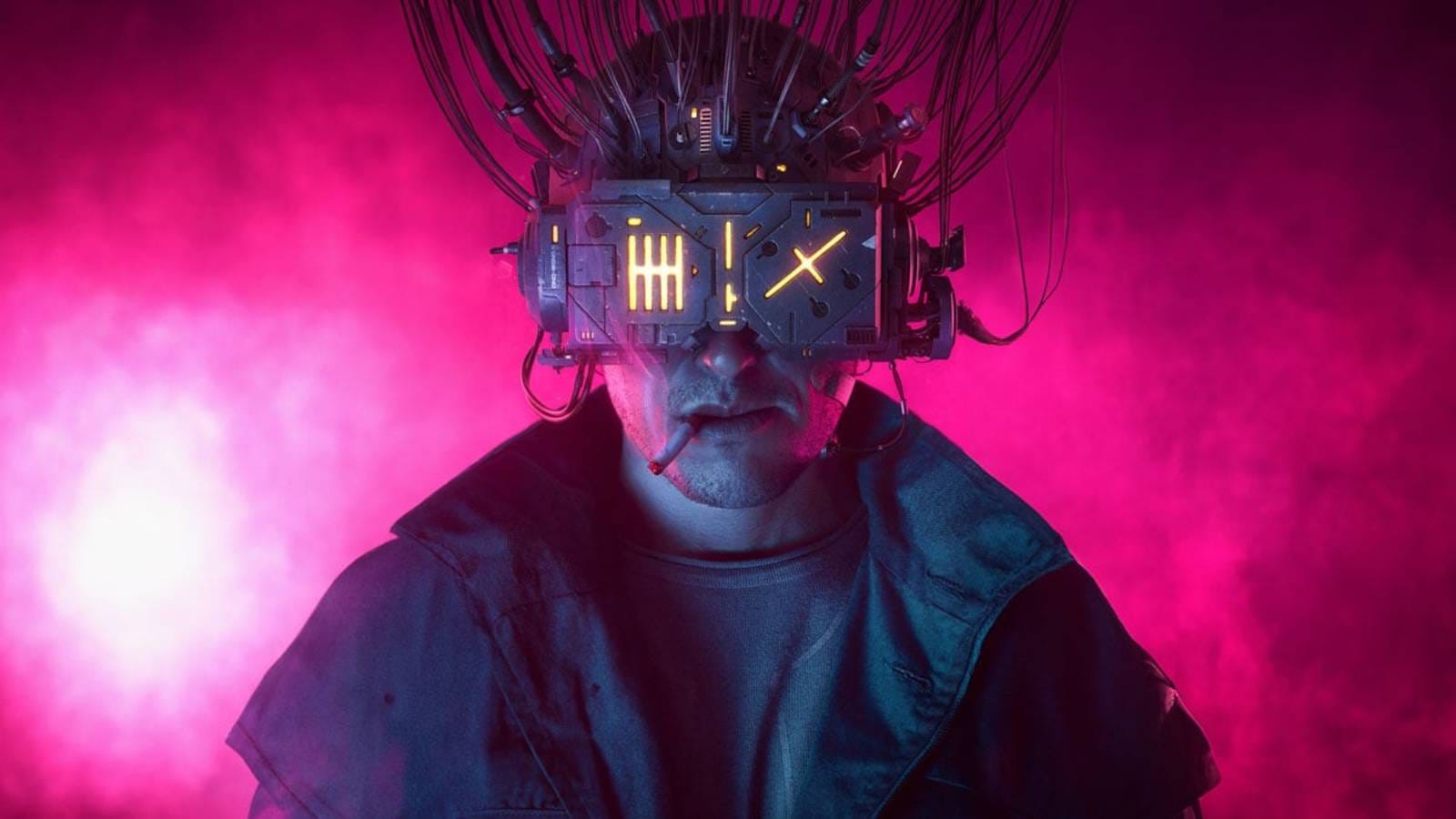
Neuromancer came out in 1984. It was Gibson’s first novel. It won the three biggest sci-fi literary prizes (the Nebula, the Philip K. Dick, and the Hugo) in the same cycle, which no debut had done before and which almost no author has done since. It’s the first book of what’s now called the Sprawl trilogy, followed by Count Zero and Mona Lisa Overdrive, neither of which I like nearly as much. The plot (in the broadest terms and without spoiling much) goes like this. Protagonist Case is a “console cowboy,” a data thief, a hacker who breaks into computer systems and steals information for pay. Only, when we meet him, his wings have been clipped - he stole from the wrong employer and had his nervous system deliberately burned so that he can no longer jack into cyberspace. He’s stranded in Chiba City, a kind of open-air black market for cybernetics, hustling and slowly killing himself. There he’s recruited by a man (or “man”) named Armitage, who promises to repair what’s broken in him in exchange for his services in a heist. Along for the ride is a mercenary named Molly Millions, a “razorgirl” who’s adept at physical combat, with whom Case develops a relationship. But (as you’d probably expect!) the job’s not what it appears to be, and it’s being done in service to a client who’s not what he/it appears to be. And because we’re in cyberspace, a lot of the climax of the novel gets very… abstract.
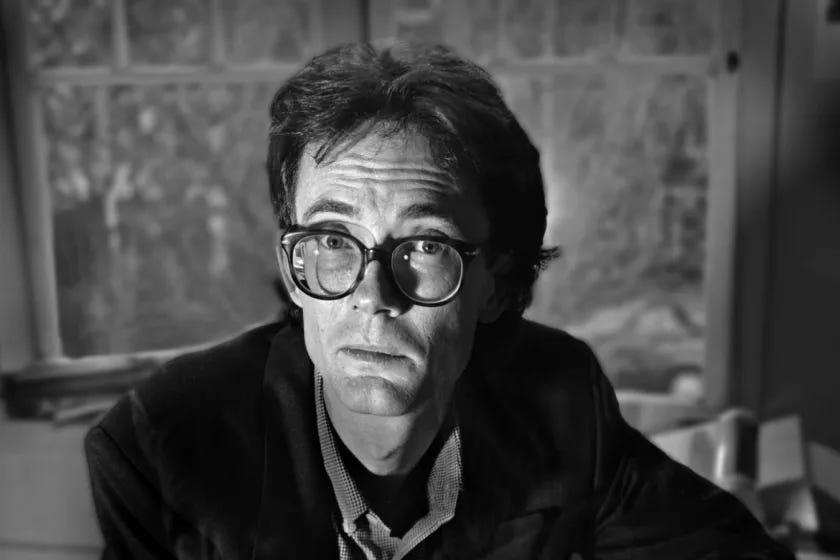
When Neuromancer was published Gibson was thirty-five, living in Vancouver, and had essentially never used a computer. He wrote the book on a manual typewriter, or so goes the lore. He’s said, I believe, that his ignorance of computers was sort of the point, that he was describing not the then-cutting-edge computer technology of the mid-1980s but a set of feelings about technology, not very good ones. Cyberpunk is a genre where many cool things happen, but dread is one of the most potent and common experiences within it, and Gibson in particular tends more towards the bleak than the enchanted in his work. Gibson was far from the first to take sci-fi out of the clean, sleek, utopian style that Star Trek epitomized - you could look back at Fritz Lang’s 1927 Metropolis for that sort of thing, and Star Wars had been particularly influential in that regard seven years earlier, and Blade Runner had come out two years earlier. But Gibson made something truly new in his grimy, kind-of-near future, kind-of-not stories, a model of sci-fi built out of arcade cabinets and William S. Burroughs and Lou Reed and the Hong Kong skyline. He’d already coined “cyberspace” in a 1982 short story, “Burning Chrome,” which was later included in his excellent collection of the same name. (I have recommended people read “New Rose Hotel” from that collection more times than any other short story, I’d wager.) But Neuromancer was where cyberspace became a touchstone, and though cyberpunk writ large has as many fathers as any other genre, few would doubt that the novel was where the term first became taxonomized and sanctified.
It’s difficult to overstate the novel’s influence. So much is clearly downstream of Neuromancer. The Matrix and Ghost in the Shell and Deus Ex and Snow Crash and Hackers and on and on; more or less the entire visual grammar of how movies depict computers; core metaphors and visuals we associate with the internet and life online even now; the zaibatsu/megacorporation vision of late capitalism that looks disquietingly real…. This all contributes to the central problem of reading Neuromancer in 2026: the book has been imitated so completely that it can feel derivative of its own imitators. This is what Harold Bloom called apophrades, the phenomenon captured in the joke “Boy, Hamlet is just full of clichés!” - when the ideas and images and vocabulary that were minted in a particularly work become so influential that new audiences find that work old hat. Luckily, there’s still the part that nobody has successfully stolen, the prose. Gibson does something with sentences that his descendants mostly didn’t attempt, a compressed, elliptical, aggressively noun-forward style that withholds explanation and trusts you to keep up, closer to Raymond Chandler or to modernist poetry than to anything that was happening in genre SF at the time. He drops you into a world with no glossary and no map, allowing himself very little exposition, and lets you wander around in confusion a little. I’d argue this is part of the reason the novel has proven so resistant to adaptation: what’s great about Neuromancer is not the plot but its execution. And while the setting and characters and concepts are certainly core to the appeal, they only work because Gibson is a craftsman as well as an ideas guy.
To be clear, the book is fun. This is a heist novel, and it has all the pleasures of one: the crew assembled out of misfits, the impossible target, the mysterious client who's obviously lying. The crew is where Gibson really shows off. Molly Millions, with mirrored lenses surgically inset over her eyes and scalpel blades under her fingernails, is one of the great characters in the genre and remains cooler than anything anybody built out of her afterward. (And she’s been ripped off by other writers many, many times.) Riviera can project holograms out of his own body and is the most repellent person in the book. My brother’s favorite character, Dixie Flatline, is a dead man’s personality stored on a cartridge who helps with the heist on one condition: that Case erase him when the job is done. There’s Chiba City; there’s the Villa Straylight, a haunted Gothic compound in orbit occupied by a family that clones and freezes itself; there’s Zion, a rasta space colony where the dub never stops playing. And for the record, the latter gets about four pages in the novel despite how cool it is. The book’s thick with stuff like that, details Gibson hands out and doesn’t bother to come back for, because he’s always got more. Also, and I say this with affection… Neuromancer is a bit of a mess. It’s one of those books where it took me several readings before I became confident that there were problems with the text rather than with my reading comprehension. The third act, in particular, does some things I’ve never fully understood and which I’m not sure make sense, strictly speaking. (Though as you can imagine the book’s many passionate defenders insist that it all comes together if you’re attentive.) We’ll get into it in the book club. Flawed or not, as you can tell, this book is dear to me.
Correspondingly, I’m worried about the show. Not resigned! Not tragic! Just worried. Because this thing deserves the best possible adaptation. Gibson himself is an executive producer, which I would like to find reassuring but mostly do not, particularly because we’ve seen what happens to authors who lend their names to adaptations and then discover that “executive producer” is a credit that does not convey actual power or creative control. But we’ll see. The first teaser dropped at Comic-Con last weekend, apparently. I’ve watched it a few times. I’m going to try to be fair here, since a teaser is a teaser, a taste, and judging a ten-hour show off of sixty seconds isn’t sensible. But, you know….
Parts of it look dark and wet and neon in a way that a hundred things have looked dark and wet and neon, which is a specific thing I’ve been dreading. Like, did you see that Netflix show Altered Carbon? I didn’t hate it! But if Neuromancer looks like that, it will be exactly exactly exactly wrong.
Case: “What am I doing here?” Armitage: “Purpose.” Folks! Whatever Case is after, it’s not purpose! He is a true mercenary, and his relationship with Molly underlines their shared nature: it’s all transactional. Case doesn’t care about purpose and Armitage definitely doesn’t.
There’s an earlier clip where the camera pans up to a screen displaying the novel’s famous first line - the sky above the port was the color of television, tuned to a dead channel - as text, on a screen, in the show. And, kind of yikes? That line is famous because of what it does to a reader’s head; it does in words what a show or movie has to do in image, which is part of why this is all so hard. Putting it on a monitor is the visual equivalent of characters just saying the themes of a show or movie out loud. But then again that clip is a trailer for a trailer, a teaser for a teaser, it’s nothing, no problem. I just… I hope the people making this thing understand what the thing is.
Incidentally, as many wags have noted after watching the trailer, the sky above Chiba City appears to be mildly overcast, which both is and is not what Gibson described. Again, this is all very hard to do, and I’m sympathetic to anyone who makes the attempt.
Is it grimy enough? I’m not sure it’s grimy enough. Looking like Blade Runner is inevitable. Is it too Blade Runner? Is it too clean? I think it’s too clean. I need the grime, man. I gotta have the grime.
Molly Millions looks awesome, no notes. The budget appears sufficiently high, which it should be given the whole Apple thing. The actor who plays Case is, you know, fine, whatever. His costumes aren’t my favorite, though. And I’m surprised we don’t get one of the coolest visuals in the whole book, the rasta Maelcum floating in zero G, dreads drifting around him. Maybe they want to save that.
“I steal data… in cyberspace” made me say, out loud in real life, “… oh no.” I get it, it’s a trailer, but still, oof.
Well. We’ll see! I want this to be good so badly that I’m suspicious of my own reaction. A lot of people say they love that it’s a series rather than a movie, but I’m partial to movies and anyway I want the discipline of two and a half hours rather than the sprawl of ten. But I’m OK with it being a series, so long as it’s good. Neuromancer is a book I love without reservation and have loved for a long time, and not only has it never been successfully adapted, there has never been a decent screen version of anything Gibson wrote, though not for lack of trying. I know that New Rose Hotel (the movie) has its defenders, but it doesn’t work for me; probably I just love the story too much to be happy with the adaptation. There was Johnny Mnemonic, which is based on another story from Burning Chrome and is enjoyable only on a so-bad-it’s-good level. And this novel is an elephant’s graveyard of adaptations. Chris Cunningham was going to do Neuromancer and then didn’t. Vincenzo Natali was attached for the better part of a decade and then wasn’t. Many others have been attached. None of this is surprising, mind you; it’s been called unfilmable for forty years. The book has been optioned and re-optioned and workshopped and abandoned so many times that a genuinely good adaptation has always seemed like a pipe dream. But let me dream!
Like I said, I’m not making up my mind. I’m just telling you that the trailer didn’t help but that I’m choosing, deliberately, to stay open minded. What I’m going to do is reread the book carefully with all of you between now and then, so that when January comes I have something better than nostalgia to judge it against. And I hope enough of you enjoy the process that doing so will be worth my time.
Book club logistics and how to participate. This introductory post is free to everyone, as usual. Everything after this is subscriber-only. Please note that subscribing to the newsletter does not automatically sign you up to receive book club posts by email; to follow along after this, you’ll need to click your Substack profile icon in the upper righthand side, select Manage Subscription, then look down in the Notifications box and set it so that you receive book club posts in your email. Alternatively, you can just check in on the Book Club section on the website and follow along there. If you aren’t a paying subscriber yet and you want to participate, please jack in to our cyberspace by hitting this button:
If you want to see what these have looked like before, you can look in the Book Club section and see some past books we’ve done, such as Ian McEwan’s The Cement Garden and Toni Morrison’s Beloved.
As for reading, I’m going to give you time to decide if you want to participate and to get your hands on a copy of the book. The first post, with the first reading assignment, will be coming on Tuesday, August 11th. You don’t need to read anything before then. (I can tell you that this is already problematic because, as has happened with every book club, some of you will get the book and immediately read it and want to talk about the whole thing by then; these book clubs are in general the most glaring example of how any choice I make will leave some people dissatisfied, but what can you do.) Every week I’m going to assign chapters to read, which I’ll talk about in a sec. I’ll write about the previous week’s assigned reading - my thoughts, observations, whatever’s snagged on me, and a set of discussion questions - and then you all can go at it in the comments. You can write four words or four hundred, no pressure. Plenty of people follow along and never comment, which is completely fine, but I’ll say what I always say: this format lives or dies on participation. A book club where I talk to myself is just a blog with extra steps, and that’s no fun. And this book is fun, fast, and pretty short, so please try to keep going. Anybody can post at the beginning of a book club. Real ones keep posting until the end.
Two rules. First, no spoilers past the assigned reading; if you read ahead, and some of you will, you have to talk in generalities or wait. I delete spoilers ruthlessly and without appeal. Second, don’t comment on reading you haven’t done. “I haven’t gotten to this yet, but -” is the single fastest way to make a book club worthless. Those comments too will be removed. As far as the book goes, however you get your hands on it is fine by me. Any edition of the book is fine; paperback, ebook, audiobook are all equally legitimate, and I’ll be giving assignments in chapters rather than pages to make it easier on everyone. There are many cheap copies of this book out there and your local library almost certainly has a copy or three.
A word on how I’m chopping this up. Full disclosure: the reading schedule I’m using was developed in part with Claude. As I’ve said in every previous book club, choosing how much to read at a time is the single trickiest, most thankless part of this whole deal, so I’ve farmed the task out to an LLM with some alterations by me. I had Claude break the book down in terms of how many pages are in each chapter and part - I know the book well, but not that well. As usual, all actual writing and editing will be done solely by me; I’m just leaning on an LLM to help me with logistics. Here’s what it came up with. Neuromancer is divided into four parts and a coda, but these divisions aren’t remotely regular in terms of page count: Part One is two chapters, Part Two is five, Part Three is five, and Part Four is eleven, which is to say nearly half the book. Gibson wrote a novel whose back half is one long continuous run; that’s the point, that’s the Straylight run, the whole thing accelerates and doesn’t stop, but it means someone trying to schedule a book club with a consistent structure ends up assigning thirty pages one week and a hundred and thirty the next. So we’re going by chapters instead, twenty-four of them, and I’ll flag the part boundaries as we cross them.
As stated, we’ll do a first scene-setting post on August 11th, which is the date I would like you to get the book by. We’ll then do nine reading posts, every Tuesday, starting August 18th. Three chapters a week through the first two-thirds, then tightening to two a week for the last stretch:
Aug 18 — Chapters 1–3
Aug 25 — Chapters 4–6
Sept 1 — Chapters 7–9
Sept 8 — Chapters 10–12
Sept 15 — Chapters 13–15
Sept 22 — Chapters 16–18
Sept 29 — Chapters 19–20
Oct 6 — Chapters 21–22
Oct 13 — Chapters 23–24/coda
The narrowing at the end is deliberate. The early chapters are doing a lot of world-building and scene-setting, and they go down easy; you can read three of them on a train between New York and Philadelphia. The last third is where the book stops being a heist novel and becomes something considerably weirder, and where I suspect we’ll all have the most to argue about in terms of basic plot sense. I’d rather have room for that than blow through the ending to keep a regular periodicity. Chapters are short throughout, averaging around eleven pages, so no week here is a very heavy lift; the whole book is under three hundred pages and we’re taking nine weeks over it. If you fall behind, you can catch up in an evening.
I’m also going to run two bonus posts alongside the reading, one definitely on the cyberpunk canon, what the genre was before this book and what it curdled into after, and then another - maybe on the long strange graveyard of failed attempts to adapt Neuromancer for the screen, which has genuinely funny parts, if the research isn’t too prohibitive. Those will be in addition to regular reading posts.
It’s a short book, under three hundred pages, and it really moves. This is a genuinely good one to jump in on if you’ve been curious about the book clubs before. And, yeah, I certainly understand that it would make more sense to time this to correspond with the show, but tomorrow isn’t promised, and I want to do this. You’ll still remember in January. Come read a novel about a burned-out mess who gets one more shot at the only thing he was ever good at. You’ll have fun.
Comments
Nothing yet. Say the first thing.
Sign in to join the conversation.