
I’m tempted to say that Brooklyn was an odd place to ride out Covid, but I guess it was an odd experience everywhere. Besides, my life was pretty damn strange in those days, too, pandemic notwithstanding.
I was two and a half years into a different kind of lockdown, self-inflicted. I had not written anything for anyone in that time, save for a couple of health updates, and I was spending almost all of my time alone. Then March of 2020 started and I was suddenly in good company in that regard. I started lockdown with a job and had lost it before it was three months old, but then I had long known that the axe was going to fall. For some time “leadership” at Brooklyn College had been letting me know they were looking for a graceful, litigation-avoiding way to push me out the door. I’ve been told by people who know these things that I would have had a good ADA case, had I wanted to pursue one; certainly my boss had made enough cracks about my mind state, called me weird, had complained incessantly about my focus, memory, and fatigue after I had told the provost’s office that I needed accommodation for the focus, memory issues, and fatigue associated with my medications. They had said “You betcha!” and then they were drawing up my dismissal paperwork. You’d think Brooklyn College would be as progressive as it gets, with that sort of thing, but then institutions never really see themselves. Anyway: I had been genuinely bad at that job, both when medicated and not, and I was miserable there, and I was not in a fighting mood. I was utterly broke and getting broker by the day, but a lawsuit on my own behalf felt absurd. I did not feel that I deserved to be represented, not in a court of law or anywhere else, whatever the merits of the case. I applied for Medicaid.
Hard to believe now but people were touchy about masking even outdoors, back then. I’m not used to being a moderate about anything but I guess you could call me something of a centrist squish when it came to the coronavirus. The government did pretty good, all things considered, given the situation. I think the evidence shows that the vaccines were both safe and remarkably effective at preventing illness and death, and the lockdowns were justifiable in the moment; at the same time, the establishment consistently overstated its case about everything, from the origins of the disease to the risks to young and healthy people…. Well, it appears that we will be prosecuting these issues until the end of time and yet have already confined it all to the dim mists of the half-remembered, and no one cares what I think about such things anyway. So be it. A shut-down New York was its own kind of bizarre. I guess that technically the state’s lockdown lasted 11 weeks, but you know how it went long after the official end of things, and people would visit a very particular kind of unspoken judgment on you if they thought you were somehow not compliant. Well, I guess in this sense it was easy: I did not have anyone to see. I had not been seeing many people for years, only the faces of strangers as I walked by, and the only thing that had really changed was that they were now half-faces. My enduring sense memory of the pandemic will always be the particular misery of hot breath condensing and soaking a paper surgical mask on a cold morning. For the first time since I was nine years old I went weeks without ever once putting on my glasses.
I celebrated my firing by walking from my apartment in Lefferts Gardens to Times Square. Seems wild to me now, but if memory serves it only took me about three hours or so. This was all before they finally moved bikes off of the pedestrian level of the Brooklyn Bridge - that bikers ever tried to navigate the throngs there seems insane to me now - and with no tourists the crossing was much more pleasant. I drank coffee I had brewed myself from a paper cup. And, yes, Manhattan during lockdown was some Vanilla Sky shit; Times Square had strong I Am Legend vibes. The more precious part of my brain wants to say that the silence echoed off of the canyon walls, but of course silence can’t echo and calling skyscrapered streets canyons is a cliche, and anyway it wasn’t really silent. I must admit though that it felt like the sheer alien auditory emptiness itself was somehow filling the space. Those famous garish Times Square electronic displays were still going, the day I went, images of $5,000 handbags and Samsung phones, either literal Gap ads or ads trying hard to invoke the Gap aesthetic. I attempted to fit this into a larger commentary on the way of things, some sort of Baudrillard take or whatever, then remembered that I was five years out of grad school.
There was nothing to do - I had gone looking for nothing and found it - so I took an Uber home. One of those elaborate, dubious plexiglass barriers had been erected between the front seat and the back and there was electrician’s tape holding it together. The driver’s mask had the Burberry plaid pattern on it; he adjusted it incessantly, although I suspect this might have been more about needing a nicotine fix than fear of the novel coronavirus. I looked out the window as we moved south and saw people filling the streets of Chinatown, peddlers selling fake designer handbags defiantly engaged in street commerce.
When I got home I had to walk Miles, my dog.
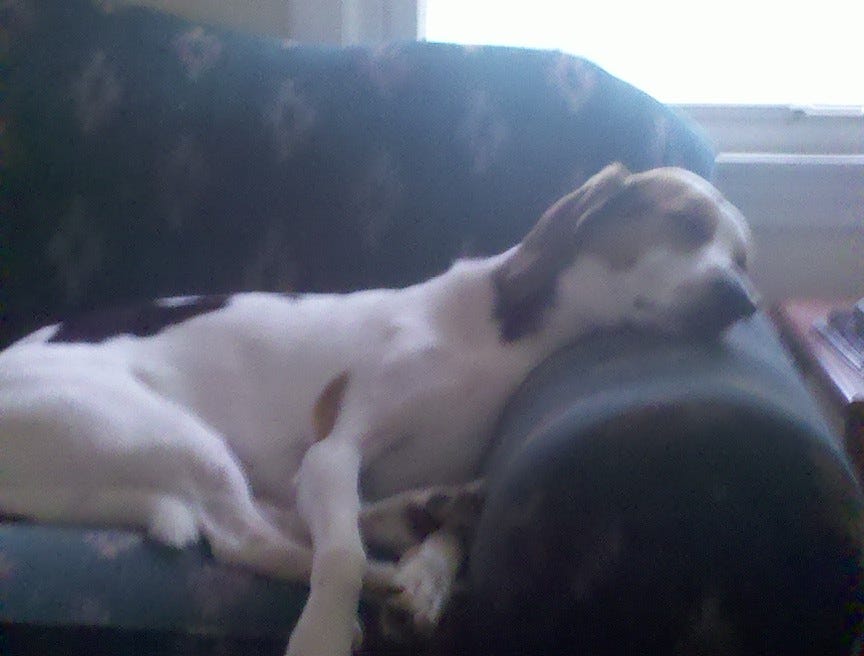
I was still walking in Prospect Park a lot, in those days. The park was about a 20 minute walk from my apartment, so I went all the time. I moved to the city on a gorgeous September day, and after my brother and I dropped the U-Haul off in Park Slope we got back to my apartment through the park; cookouts and attractive young people tossing frisbees around at early twilight felt like a warm welcoming to the next great stage of my life. The ensuing five years would prove to be among the hardest I ever experienced, but what can you do? Well, I had an energetic, sweet, almost unbearably anxious hound dog that I had brought with me, and my cat Suavecito, who’s still with us. Miles was the gentlest creature I’ve ever known. Not once in the thirteen years of his life did I ever see him growl at a human being in anger, let alone bite anybody. He would whimper and worry and whine to a degree that sometimes made me crazy and always made me feel guilty, a state of affairs I tried to address a thousand times before giving up. I had come to understand, eventually, that Miles had a nature, that he was what he was, and so was I. One thing we shared was a love of Prospect Park.
Miles had gotten terribly sick when I was still in grad school, out of nowhere. It was summer. We were relaxing in bed in the cozy apartment I rented in Lafayette when his body gave a little shudder. He looked confused for a moment, then began baying in the most horrible pain I could imagine. It was terrifying. It turned out that he was having a stroke, brought on by a not-uncommon blood disorder. His antibodies were attacking his red blood cells which in turn thickened his blood and caused the stroke. I spent a little over a decade without a car, from early in grad school through to near the end of my time in Brooklyn, but by a miracle of good timing my friend Ellery had left his car behind with me over break while he went home to Oregon. I’ve often wondered what would have happened if I hadn’t had the car, how I would have possibly gotten him to the animal hospital. I put him in the back seat but his body spasmed so badly that he fell into the footwell. I spent a few agonizing minutes wondering if I should pull over and fish him out or if it was best to just get him to the vet. Before I could decide, we were there, and I carried him howling inside.
They took him into the back and then left me in an exam room so I wouldn’t have to hear his cries, but I still could. He went on for an hour. Finally they brought me in to see him; he was lying in a state of absolute exhaustion, the only time I’d ever come to him and gotten no reaction. They said, you know, he’s probably gonna die. But eight days later I took him home. I had to raise money on the internet to pay for his care, and I’m forever grateful for it. He took so many medications and there were so many times in the next couple of years when we almost ended it out of compassion. He looked physically unfirm for the rest of his life. But I played nursemaid and spent a fortune on pill pockets, which he devoured despite always seeming to be aware of the deception, and he bopped along with his usual spirit and relearned how to walk and he gradually got stronger and I was struck many times by the simple dignity of a creature who would never think to say “Why me?” And then we moved to concrete Brooklyn and he had to adjust - nowhere to poop, you understand, or so he felt at first - and unsurprisingly he loved the park, and we took big looping walks all around it, walks that had grown more frequent when my life fell apart and I suddenly had no one to talk to. And then the world was shut down and then I had lost my job and there was every reason to take him for more walks there. But I didn’t, which in hindsight was evidence of the fact that on some level I knew what was coming.
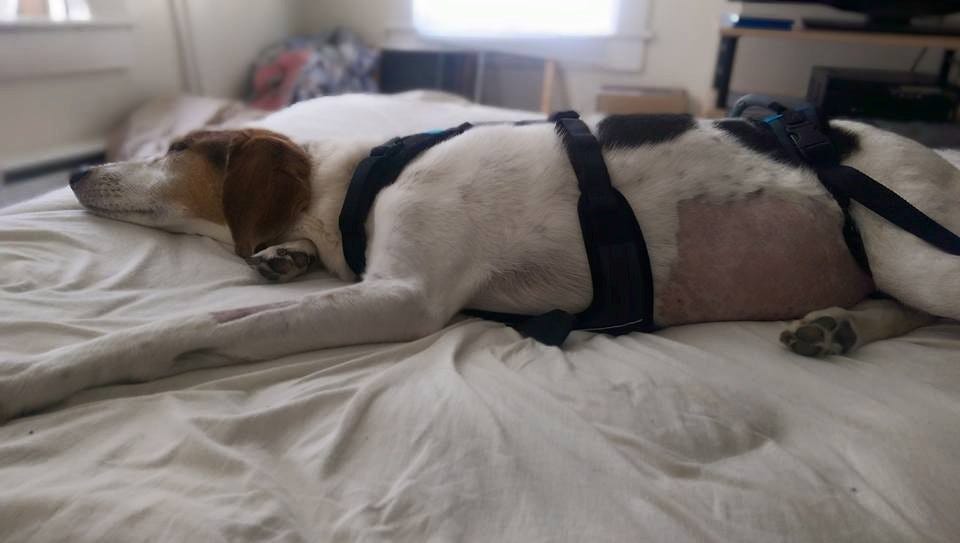
Then he was sick again. He had been slowing down, growing more tentative, taking more breaks on long walks. We lived on the fourth floor in Brooklyn and I had usually just taken him up the stairs but by the beginning of that year I was exclusively bringing him up the elevator; I told myself it was for the sake of my own old soon to be 40-year-old knees. But then I was leaving him behind to go for my walks in Prospect Park, and at some point I had to admit to myself that this meant something. I had been taking him to the vet every week for months in Indiana, and I took him to a vet in Crown Heights now. That vet was in walking distance because it had to be, since there was no other way to bring him anywhere. But certainly with a full time job and somehow no more spending money than in grad school and no car, yeah, he went to the vet much less often. And anyway, until then he seemed to be doing well. He wasn’t. The vet told me, after I had gently and slowly coaxed him to our destination, that he was dying - not of the immune-mediated hemolytic anemia that he had fought for so long but of cancer. There were things they could try, the socially-distanced vet told me through a mask and face shield, but I could not afford them and they would not work. We scheduled his last appointment. I struggled to put it in my phone’s calendar, couldn’t bear to decide what to write down.
Within the span of a couple of months, I had gotten Covid, I had lost my job, my beloved friend Nick had died and no one had been able to see him, and now my Miles was gone. All of this was happening in a period in my life in which I had done the exhausting work of controlling my bipolar disorder and then had been forced to confront the question of whether my life was in fact worth saving. It had been almost three years since I had my last, ruinous episode; I was medicated and stable and sober and nothing else in my life had gotten the slightest bit better. I had started applying for jobs and I had read a checklist about how best to do so on LinkedIn and the first bullet said something like “Conduct an audit of your internet presence” and the tug of gallows humor overcame me. There was an remained a vocal cohort of people who felt that I should never again enjoy anything good in my life, and they have hung on with a persistence that surprises me to this day even though it shouldn’t. I sent dozens and dozens of job applications that year and knew all along that they would go unanswered. And now I was losing Miles, who in his last days wanted what he always wanted, which was to be near me. To be near everyone, really; he always loved a crowd and I knew that I had let him down by not giving him a family to be a part of. But he wanted to be near me and that I could provide.
I took him back to the vet. I had been very worried that I would have to carry him for large chunks of the trip and I wondered whether the animal taxis were running during lockdown. But he was surprisingly spry that day. The vet was a tiny little storefront operation and because of Covid we could not wait inside, so I clutched him in my arms, big hairy heavy awkward mass, and some people walked by and saw us standing there and seemed surprised but did not react. They called me in and I carried him to an examination room in the back. The vet was a kind white lady, not one I had met before, and there was a bearded Black tech of some kind; he seemed surprisingly young, and then I idly wondered why his youth should be surprising. She put some sort of IV in his leg. It took a long time, longer than I thought it would. I was sitting on the linoleum breathing into my black N95 while he went. The drugs confused him and he kept looking back behind him, kept repetitively craning his head around to look behind him. I cried and the young tech said “Good, good,” he encouraged me to cry and I did, and the vet made soothing noises while she held him. And then he was gone. They left me with him for a few minutes. I took his collar and held his paw and then decided that I shouldn’t be there much longer. When I left I was still crying and as I walked back out onto Franklin Avenue some guy passing by saw me crying and gave me a look like I was crazy. I thought, geez, it’s a vet, maybe you’d figure out what as happening. Then I walked home.
I got him when I was 25. I couldn’t really remember what life was like without him. It was all very hard, obviously. And of course it was also a relief. He had been sick for so long. I did not want to admit to the relief.
You go through various eras in life and you identify them one way going in (my new glorious New York life) and a different way going out (my sad descent into psychosis, my destroyed career, my shattered friendships). Some of these overlap; Miles was with me for several eras but my Miles era was also its own era. It happens that my Miles era was a collection of some of the worst times of my life, although the times before him were pretty fucking hard too, since events have a way of piling on top of events. I wish he had been able overlap with the era of knowing my wife, who I was to meet a month after he died, under pandemic circumstances that were themselves strange and foreign and which I did not understand at the time. And I wish he had made it to this house and I wish he had met my son, who has inaugurated an era that will last the rest of my life, an era of purpose and repetitive joy. But you never really know what part of your life you’re in when you’re in it. I have lately been trying to address the reality that I am not going to be able to be a writer much longer. I believe in this new book and I think it’s necessary and can succeed, but also the usual suspects are already working against it on their little networks. I really sincerely thought that I could move on to writing books and leave the opinionating behind and that maybe I could finally move out of the shadow of what had happened in New York, and what the past six years have demonstrated definitively is that I can’t. They won’t let me go.
I’m not feeling sorry for myself. I’m just saying that with media and publishing being what they are, now, you just can’t succeed without the blessings of people who are very dedicated to not blessing anything I do. I never did stop applying to jobs, you know, and they’ve never stopped not responding. It’s been hundreds of applications since 2020 and I think maybe a dozen of them have bothered to email and say no. I’m prepared to do something else. I’m prepared to do anything else, really. I have mouths to feed. This era is much, much better for me than the last, in many ways, but one thing about having a family is that the old reliable “I’ll survive somehow, I can survive anything” that I’ve called on out of necessity since high school doesn’t cut it anymore. Now I have responsibilities, and I will fulfill them. I’m just still figuring out how. Every book I’ve written has been review bombed on Goodreads and book section editors actively refuse to assign them for review and when I write freelance pieces for high-profile places the social media people don’t want to promote them and I can’t bear to play out the string on this newsletter forever, watching the subscription money gradually dwindle. Doesn’t matter if it’s fair or not, that’s my reality. So I have to find something else to do.
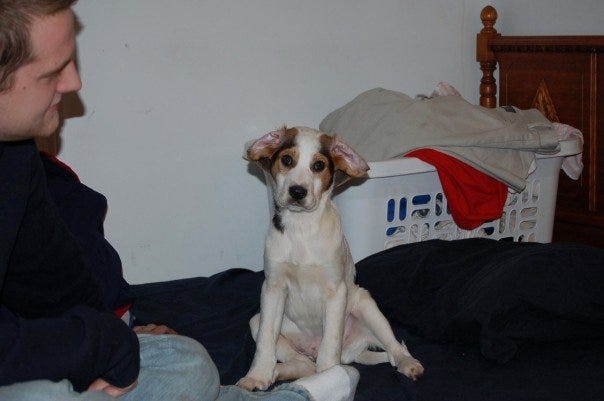
The only real trouble is that I have to figure these things out without the crutch of needing nothing because I’ve had nothing, without turning to the parts of myself that have sat in locked wards and in jail and slowly dying in lonely apartments and thus are strong, and when I think about those strengths I think about the hard times and about my old hound dog, who was all I needed. Miles was the most constant companion, my own perfect Argos, and everyone said he had the saddest face they had ever seen. I knew though that his sadness was a function of his wisdom and his wisdom an expression of his gentleness, that he was a creature put on Earth to pad quietly through public spaces, accepting every one of us, acceptance on four legs. When I picked him up from the Humane Society the worker there chuckled and said “His name is Miles,” which I took to mean that he knew people always change the names of dogs they rescue, especially puppies, but I looked at his little squirming form when I got home and I said, yes, that’s exactly right. His name is Miles. It’s a gentle name, don’t you think? And his gentleness, his equanimity and acceptance, his unhurried wander through the second half of his days, his days of medication and infirmity…. He did not suffer. He labored. He labored with the work of life. And so do I, without him. But I will have my next era. For my wife and my son I will. As it always does my family will rise again. Through the fire and through the flames. Through the fire and through the flames.
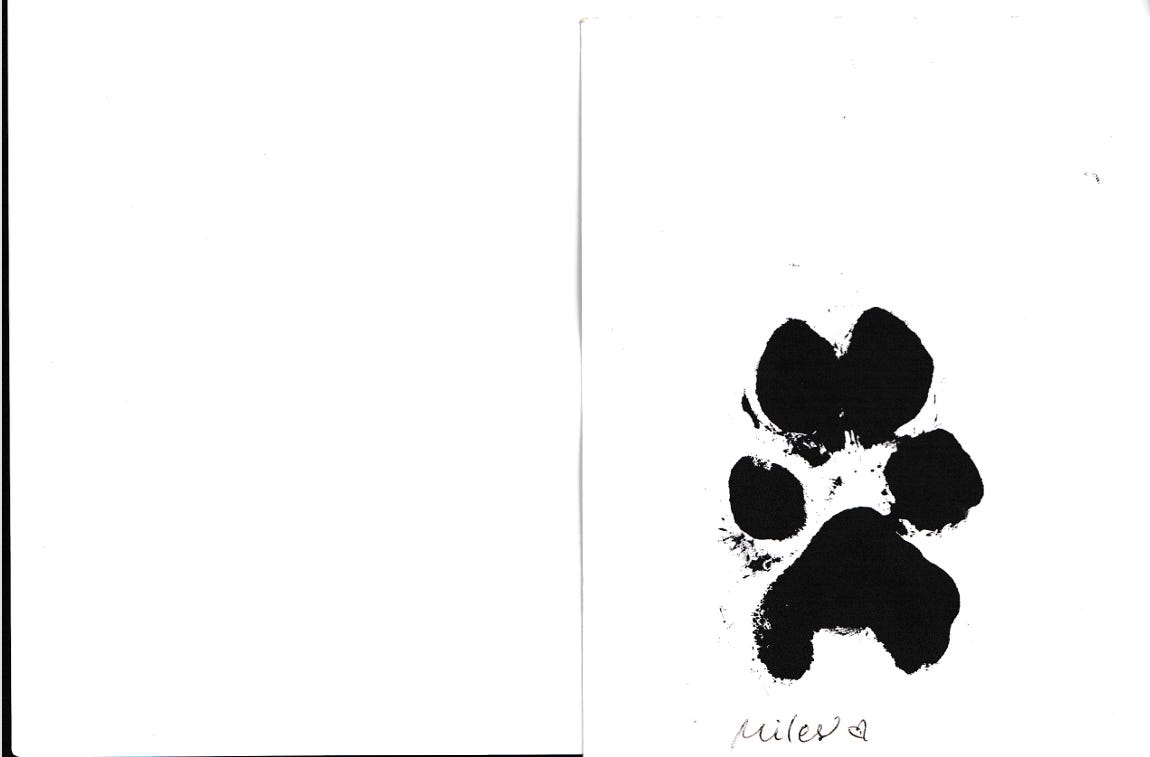
A month later they sent me an ink print of Miles’s paw and his ashes in a wooden container. I’m still surprised when he’s not waiting for me when I come home.
Comments
Nothing yet. Say the first thing.
Sign in to join the conversation.