
📝 Thanks for reading Fran Magazine, a blog by Fran Hoepfner (me). This month, I’m on vacation, so I’m pleased to run a series of guest essays by Friends of Fran Magazine™. Thank you to Fran Magazine summer intern Ishikaa Kothari for steering the ship (Fran Magazine is a boat, in addition to a blog) and please enjoy a month of other people’s writing.
Weston Leo Richey is a poet, writer, and academic who previously wrote for Fran Magazine about Vampire Weekend. They were also one of the poets Fran went to grad school with but notably not one who tormented her.
Your subscriptions are welcome and encouraged for regular updates sent to your inbox (email, Substack, or both).
Here’s one of the first Russian words I learned: ужас (oozhahs). One uses this word, I was told, “to describe the indescribable state of chaos and terror that arises.” Think, The horror, the horror! My life was ужас before I first learned the word to describe it. About two years ago, as my literature PhD program began to wane, I decided my life in Austin was effectively over. My dissertation was well underway, but I felt isolated as I spent more and more time alone doing research. Ужас. Outside of teaching and infrequent talks with friends who were, like me, endlessly busy, I didn’t see people much. Ужас. Texas’s political landscape had begun its tilt toward right-wing freefall. All of it, ужас.
But I don’t begin with ужас to complain. Instead, I return to this little Russian word because of the fact that I know Russian words at all. Into the maelstrom of disaffection came a new bit of chaos, miraculous and improbable—like whirlwind, like lightning. In late 2024, I met a Russian literature doctoral student who first arrived in the U.S. the year prior, born and raised in Moscow. Forget cultural differences; our biggest divide was our intuitive approach to scholarship—he was cerebral, systematic, and formalist to my affective, impressionistic, and poststructuralist. The way he tells it, our first time hanging out almost led to a fight.
Naturally, he eventually became my best friend.
But it didn’t stop there. He introduced me to his best friend in Moscow who is now one of my friends across the globe; then he introduced me to another Russian friend, a professor here at UT; then another; then…. This chain of people, from my bestie to my loosest acquaintance-ie, welcomed me into their lives with a warmth that startled me at first—you like me? Really? Provincial, introverted, uninteresting me?
I’ve buried a lede: I never got Russian literature and I still don’t. You wouldn’t expect me to say this looking at my Goodreads—my most recent reads are littered names like Turgenev, Bulgakov, Sorokin, Sokolov, Tolstoy…a list steeped in Russophilia—but the truth is for much of my life, I beefed with Russians and their writing for no real reason at all. One of my friends tortures me these days with this little ditty I sent him a decade ago as a precocious undergraduate:
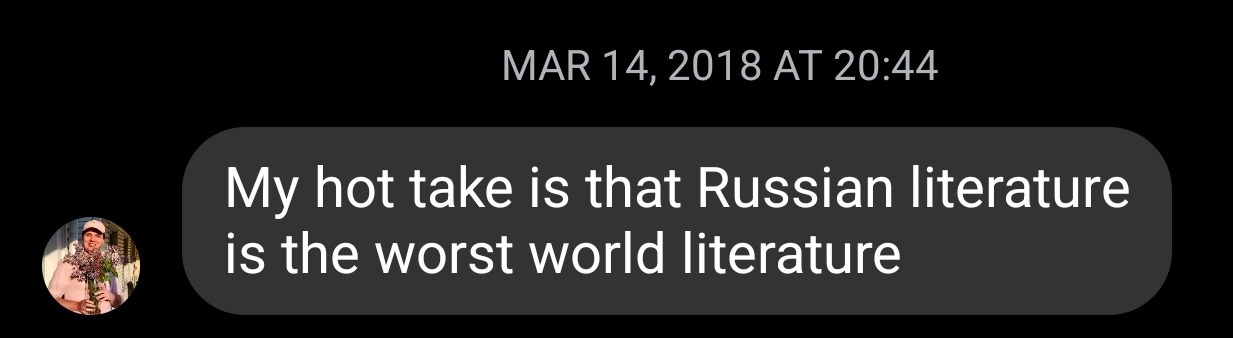
This is, of course, a crazy thing to say and, for me, operatic in its irony. Language and books are the sharpest ways I know how to relate and to feel close to others. In growing close to my best friend, I wanted to better understand the cultural context that shaped him and the other new people in my life. He and they, in a sense, adopted me; I wanted to belong to this world which now embraced me. Before I knew it, I was deep into a personal project of reading Russian literature and I am now even learning Russian. The Disneyfied version of this story would end here with the headline Uncle Sam’s Most Ignorant Nephew Learns to Appreciate Russian Culture by Befriending Russian Alien. Ta da.
But I still don’t get Russian literature even as I have come to adore it. This is what I find most uncomfortable about that bogus message I sent: not that I was wrong and that Russian literature is good, actually (though I was and it is), but instead that I accepted there are such noble and stately things as national literatures at all. Despite the innocuous ways one might talk about a national literature—a shared language, a shared history, and so on—the truth is uglier. In the wake of Russia’s 2022 invasion of Ukraine, we have seen a public reckoning with what we in the business call literary nationalism, or the way we use literature to nation-build. We could look to maybe its most famous writer, Fyodor Dostoevsky’s aggrandizement of Russia as messianic among Slavic countries as providing ideological ammunition for Vladimir Putin’s imperial dreams; we could look beyond Dostoevsky to trace a longer lineage of nationalist thinking in how writers like Alexander Pushkin or Mikhail Lermentov “helped shape, transport, and ingrain Russia’s imperial ideology and nationalist worldview”; and we can even look closer to home to see how “American literature,” my own specialty, emerges as part of a project reinforcing the U.S. as a new nation.
I’ve grown deeply skeptical of national literatures. When I first set out to write this piece, I imagined it would be something like a fun summer listicle: “The Top Ten Things Reading the Russians Has Taught Me!” But as I reflect on my experience reading Russian literature—about which I’m an amateur—the first thing I would say it has taught me is that there is no coherent Russian literary aesthetic. I have read Russian works extending from the mid-nineteenth century to the 2020s, across genres and aesthetic forms, and the more I go searching after unifying qualities the more I come to see there’s no there there. Let’s take two books for example, which I read back-to-back: War and Peace by Leo Tolstoy and The Slynx by Tatyana Tolstaya, Tolstoy’s distantly-related descendent. In some ways, this is unfair. Despite belonging to the same language tradition and indeed family, both writers work across chasms of period and genre—Tolstoy’s nineteenth century to Tolstaya’s twenty-first, Tolstoy’s epic realist fiction to Tolstaya’s tight, grimy science fiction. I could continue—Tolstoy projects a warmth that contrasts sharply with Tolstaya’s jagged, cold images, Tolstoy is thoroughly invested in universalist and humanist thematic preoccupations where Tolstaya, despite a reflexive interest in expressive culture, wallows in the posthuman, and so on. Were you to accuse me of playing dirty pool and to swap out Tolstaya for a real Russian classic like The Master and Margarita by Mikhail Bulgakov, we’re getting closer to some conceptual parity, but not quite. Bulgakov drips with a knowing acerbity and plays fantastical dress-up with the serious themes thrumming within his novel in a way almost unrecognizable to Tolstoy, an author painfully sincere and earnest and grave even in lightness.
And yet my Russian TBR grows, with my friends’ help and on my own, even as I know I am participating in something both politically and practically hard to define. The tension is part of the fun but also makes me squirm. With my deep interpersonal attachments on one side and my ethical and intellectual eyebrow-raise on the other, Russian literature has become the place where what is most real to me—my bonds, the power of art to bond—and what is least real—nationhood, category—collide. And I’m not the only one. Russian literature has been having a bit of a moment on bookish social media, with Dostoevsky being the most popular entrée. I myself follow a clique of Bookstagram accounts whose raison d’être is Russian literature and who break the tradition down in terms of schema and archetype like it’s a fact of nature. The point isn’t that we are, all of us, duping ourselves into endorsing a lie. Instead, there is something we keep going back for.
What, then, does throwing ourselves headlong into such a fantasy offer us? What are we looking for?
In the early days of reading à la Russe, I confess, there were no huge hits—two of my choices, Envy by Yuri Olyesha and An Evening with Claire by Gaito Gazdanov, struck me as metallicly-cold and overly rhapsodic, respectively. But when I eventually read A School for Fools by Sasha Sokolov, something clicked. Across the novel’s 170ish pages, I felt the ache that animates my desire to work with expressive culture in the first place as the novel’s narrator, in shattered, staggering narrative, reaches for contact through splintered syntax and diction. Form played even as voice, childlike in its sincerity, wanted straightforwardly, almost desperately. Part of me wants to point and say this, this, this is the thing Russian literature has offered me. Indeed, were I to go down the list of the Russian texts I’ve most loved, this pattern persists. Anatoly Marienhof’s Cynics tells a formally, well, cynical story of the Russian Revolution intertwined with the increasingly intense and spiraling romance between its protagonists; Elena Kostyuchenko’s I Love Russia collects mournful reportage that remains faithfully attached to an increasingly hostile home; and Vladimir Sorokin’s Blue Lard, now one of my favorite novels of all time, presses on cruelty, obscenity, and on-the-nose parody of canonical Russian writers so hard until tenderness leaks out, savage, from the cracks.
Anyone who knows me knows these are simply my preoccupations. The trick of Russian literature—and maybe even all national literatures—is that it likes to lie about itself. When I search “russian literature” on Instagram, the posts are uniformly about Tolstoy and Dostoevsky, with the most attention-grabbing exception defining itself by its choice not to talk about either. In a Reddit thread on one of my regrettable online haunts, r/literature, one user remarks that “when someone says ‘Russian literature’ they generally mean that handful of writers who all were born or died in the same century and were conversant with each other.” Russian literature in the popular imagination lays claim to an almost imperial unbounded blob across all of time, while it really lives on the twin wingspans between the nineteenth and twentieth century and between Moscow and St. Petersburg. But I quote that anonymous Reddit user above to suggest Russian literature is not only thought of narrowly but relationally, and undergirding about everything in this piece so far, I wager, has been a bid to connect. The most narrow canon of Russian literature is itself a network of relationships.
Relatability, some have argued, takes center stage in the bookish Internet’s aesthetic sensibility, and I wonder if this very urge to relate drives online fascination with Russian literature. While one or two of the users I follow on Russian Bookstagram are themselves Russian, most people I’ve encountered in these online spaces seem to either have no tie to Russia whatsoever or, like me, a tie via my relationships—a close friend, a teacher, a partner, and so on. For enthusiasts, Russian literature seems to do double duty. On one hand, the works themselves offer the chance to relate to what we read. On the other hand, when we mutually indulge the mirage of national literature, we create a common language of feelings with which to relate to each other. People I follow make thirst posts about Rodion Raskolnikov’s face card, my friends stress about Natasha Rostova’s boy problems, and I get to share an emotional landscape with someone I care about.
That, perhaps, is the biggest upshot to the bookish Internet’s eternal return to the national literary tradition as the fantastical foundation on which to build such relations: we want the feeling of a literary world. Turning to Russian literature—or French, or German, or English, or…—is an attempt to share with others something durable about our emotional lives. This is why Redditors will so often turn to the idea that French literature is fundamentally romantic or English literature is obsessed with love or Russian literature drips with melancholy and тоска (toska), that mythic and allegedly exclusively Slavic brand of yearning. If not simply a book but an entire tradition can embody an emotional state, then there exists an affective world to which we can relate, and so a world to which we might belong. This dream gathers ironies, of course, but one is worth ending on. While we chase after community in the affective fiction of nationhood, we end up finding community in so many other, more real places—our Internet mutuals, our acquaintances, our loved ones. Whether we are ready to throw the ladder of national literature away having climbed up it, I can’t say
But if immersing myself in Russian literature has inducted me into an emotional world, it is far from the glowering, severe gaze many assign to “the Russians,” whatever such a collective phrase, vicious in its depersonalization, means. The truth is much simpler. A few days ago, when I was talking to him about this piece and the way people revere Russian literature online, my best friend, the Russian Alien rolled his eyes and said, “Тоска is such bullshit. Everyone feels this way,” and we both laughed. We laugh because of course there is a melancholy thrumming inside, say, Ivan Turgenev’s Smoke—for Turgenev, that sadness did not stay pent up in Petersburg but roamed to Baden-Baden. And really, if reading à la Russe has taught me anything, it’s that the emotions that underpin our idea of national literature are as fuzzy and as messy as the borders on which the idea depends. In other words, it’s ужас. Much of life is ужас. Before my Russian friends, it was ужас, and even after, it’s still often ужас. The difference between then and now is I know someone else feels like I do and I know how they say it.
How are you staving off ужас these days?
No posts
Comments
Nothing yet. Say the first thing.
Sign in to join the conversation.