
i. I want this post to be about how my titles are simultaneously serious and playful, but I’m stumbling over the limited notion we have of seriousness, which appears to mean humorless and absent of whimsy. So, I’m going to ask you to keep in mind the possibility that these opposite ways of being can coexist as I try to tell you about the titles I’ve given to my boxed assemblages.
ii. I used to refer to my titles as keys to the artwork, but I think this was a misdirection. A key suggests that there is something to be unlocked like a puzzle or a riddle. This is not the analogy I’d want to apply to my art since it implies that there may be a solution or a direct answer to a question. If not a key, are my titles a door? That doesn’t sound quite right either. I think the concept of guide works at getting to the function of my titles. An artwork’s title should be a docent, some knowledgeable person to walk beside you as you wander through the piece, sometimes getting lost in it, but always able to return to this someone who can reorient you before going on. A good docent will have an idea of the sights to be seen, can be companionable, and can sometimes stray from the beaten path if you seem up for it, but at the same time will not let you wander off on your own accord, or will at least discourage it.
iii. Titling one’s visual art is often an onerous task. The simple act of creating a visual art piece can be seen as an avoidance of verbal expression. But there is a cultural demand that a finished piece have a title. Some artists take the route of “Untitled” or “Composition No.__”, but this seems more like a cop-out than a valid way of addressing the problem. Besides, I like how a title can give an indication of the intent of the artist and potentially direct the viewing of a piece, and that is why I indulge. A title, where the words are activated in the mind of the viewer can also be a companion to the visuals of the artwork (see docent above).
iv. I was going to say that my practice of assigning titles has evolved with my stylistic development, but I just now looked over a list of my early artwork, and unlike the development of my work (see my last Substack entry), my practice of titling has remained consistent.
v. The majority of my titles are of two types—single-word titles and titles found in text clippings. Though I haven’t used any single words for titles in recent years I have named many of my pieces this way—just recall the last two Substack posts on *Façade* and Palace. Palace exemplifies what I like about one-word titles: we can get an idea of the word when we try to associate it with what we are seeing in the assemblage, and there really isn’t anything overtly about the actual architectural entity of a palace. When we isolate a word from the context of a sentence or phrase, it holds on to its power and open interpretation as to which meanings might apply. Profound playfulness thrives in this realm of ambiguity. Double meanings are the root of much humor, as in puns or double entendres. By assigning a word to one of my assemblages, it forces the viewer to have to think about which meaning or meanings might apply.
vi. Ambiguity is a key that opens the lock to imaginative thought. When something is ambiguous, it means it hasn’t been nailed down to a specific definition and is reliant on the context to decipher any meaning, Ambiguity in communication is troublesome and unhelpful, but in prose, it’s often beautiful. When confronted with uncertainty, we can say that an ambiguous term is hopelessly obscure and can never be solved, or we can try to enter the world that it has opened up and explore the possibilities.
vii. When I find a text clipping that simply confirms all the vibes I’m feeling from a piece, it always makes me smile. I’m warmed by the ideas and associations that cascade into my mind as, almost literally, the pieces fall into place. By applying a snippet of text clipped from some old magazine to the title of a piece, I’m not just titling the work but practicing the same aesthetic principles that went into creating the work itself. It’s the nature of collage and found art. Collage and assemblage are fundamentally playful. It’s easy for folks to laugh at the kind of texts I use. Often these texts are written awkwardly or in an archaic style. Typically these writings are seen as unintentional humor, but what if they can also contain unintended beauty?1 That’s what I’m aiming for in my found titles. When I think I’ve found a title in a text snippet I listen for its hidden poetry and the cadence of the words. For example, one of my favorites—We Dragged the Beggar out of the Muck and He Was a Fearsome Thing to Fight— strikes me as a brilliant metaphor for the push and pull of the ideas in that piece.
viii. The next largest category would be coined phrases. Coining a phrase probably provides the most joy I get directly from the playfulness of naming. One of my favorites is Clapping For Tinkerbell2 (You can find the webpage for this artwork with an internet search for “clapping” +” Tinkerbell” + “Turek.” Or you can just go to this link: Clapping For Tinkerbell. ) A few other made-up phrases that are my artwork titles and hit the mark for me are Doctrine of the Catacombs, Love and Climate, and Vulnerable to Grape-shot at Close Range. There was no labor exerted to come up with these titles, as they inspiringly popped into my head. Which is probably why I especially enjoy them.
ix. I typically find titles at some point during the construction of the piece, but once in a while, I finish a piece without one. When this happens, I’ll try to give it some space and spend a day to a week contemplating the interrelation of the parts and I try to listen to the stories these images are telling me. This always works, and as a sideways testament that it does, I can’t recall which pieces I struggled with. Conversely, there are rare times when I come up with titles before I even start a piece. This usually happens with a series of works that have an overarching concept. Examples would be the series *Anatomy Lesson* and another set of pieces, Twelve Prophecies. The first five Anatomy Lesson pieces are numbered 1–5 with subtitles of lines from a poem by Georg Trakl. The Twelve Prophecies are numbered 1–12 and do have text clippings which might act as subtitles, but I chose to just let them be numbered.
x. My book assemblage titles are complicated by the fact that these artworks are built within book covers from actual books, which are obviously already titled. The only thing I can say is that, with a few exceptions, I try to not choose titles that might be directly associated with the given book title. I think of these book covers as a practical utility—they simply contain the assemblage within. I can’t deny that someone may interpret a relationship between the visual material of the assemblage and the original book title, but if there is a connection, it is coincidence or playful happenstance. If you haven’t already done so, this would be a great opportunity to see all of these book assemblages and check out my given titles as compared to the book titles: Altered Book Art.
xi. A less playful use of my single-word titles is how they reveal an underlying reality. Titles can be a statement of essential principles or a hypostasis (in the literary or philosophical use of the term). I find these hypostatic titles can also steer viewers away from their own expectations and redirect them into the work itself as they try to relate the title to what they are seeing, bringing into question just what they are actually looking at. My titles for Home, Whorl, and Theogony evoke whole worlds. I’ve even bumped up against ostentatiousness with the titles Beauty and Sublime, but these are philosophical concepts that I’m genuinely obsessed with, so the titles are apropos of the assemblages’ subject matter. Single-word titles perform a trick; like the magic words of an incantation, they can resolve the artwork down to its ineffable nature, almost becoming single-word poems. My perennial goal is to spark the imagination, and I find that single words have an edge on this as compared to phrases. We are forced to use our minds to complete the thought when given just one word.
xii. I believe that language is a growing, ever-evolving thing with accepted definitions of words changing over time. I’d also argue that play is the prime mover in these changes. Many writers have toyed with definitions, only to have them stick for generations afterward. The best example would be Shakespeare who practiced this in abundance in his plays.
xiii. I hope you can see by my titles that, as an artist, I’m forever at play. But this play is not an idle time frivolity. It has every intention of being serious, where every artistic gesture is done with an eye to consequences. This is not often how we speak of seriousness, which typically comes with an austerity, and you don’t mess around when you’re serious. As generally understood, this is the seriousness of an engineer or physician. For instance, I don’t think you’d want a surgeon to be playful while operating on you, but rather with the seriousness of holding your life or death in the balance. So we tend to visualize seriousness as dour, dark, and profound. As an artist, my take on seriousness has a more apt metaphor in music. A composer may write a serious piece of music, but in order for it to be realized—made into sound by musicians—it must be played. Were it not for the playful side of seriousness, we would not have music or, I would add by extension, visual art.
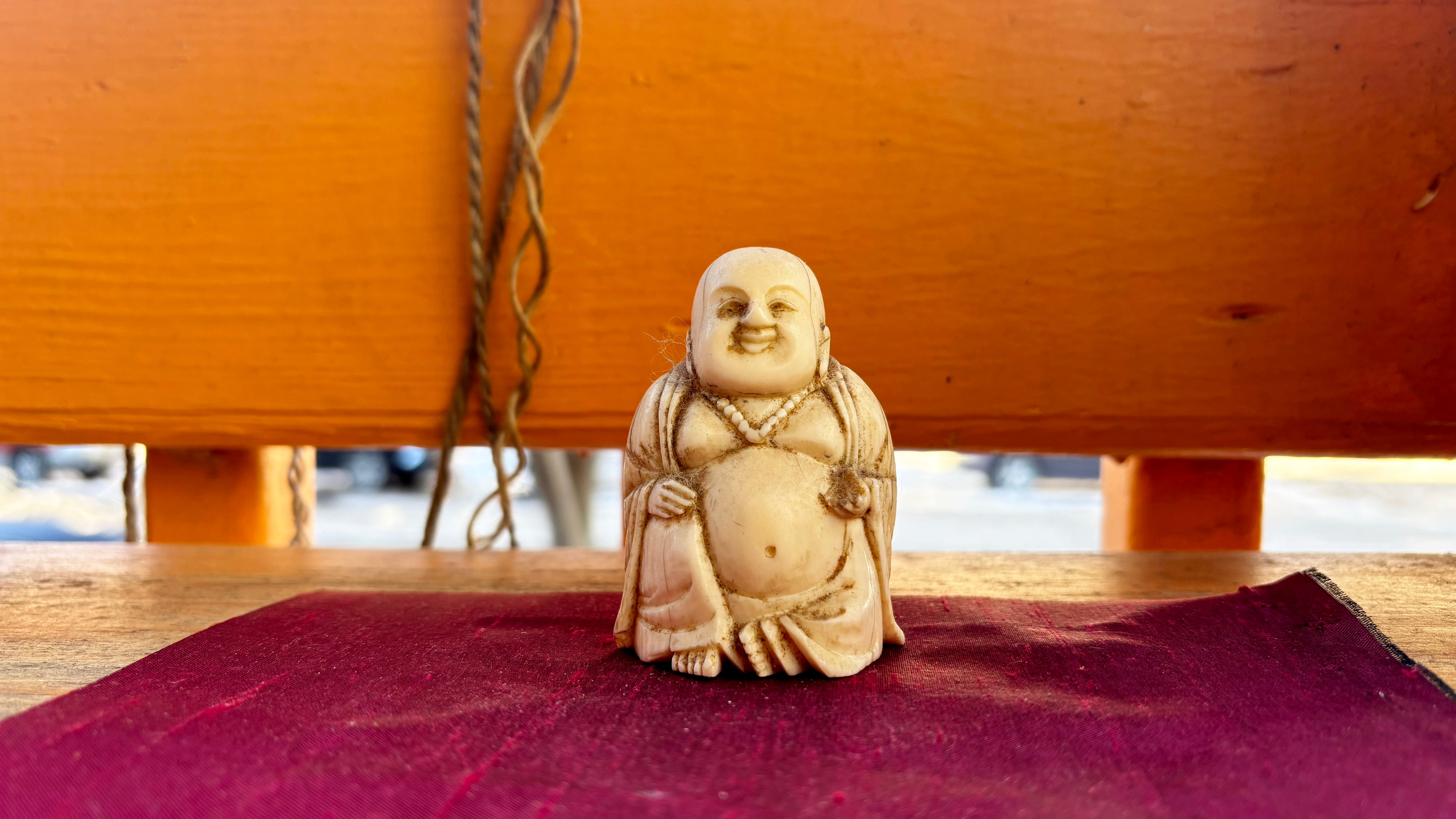
One of the objects on my father’s work desk was a small ivory carving of the Laughing Buddha. He told me the stories of this Buddha, and I remember being fascinated. It would be an understatement to say that these Laughing Buddha stories, as told by my father, were formative. Suffice it to say I grew up with the idea that something as serious as a religious icon can simultaneously be playful at its core. I’m grateful to have been instilled with this idea, and I try to carry on the tradition.
Cheers.
See more in Philip K. Dick’s concept of Trash Stratum. Or in William S. Burroughs cut-ups.
In writing this post I noticed that the correct name for this Disney character is two words, Tinker Bell. I named my piece in 2010 as one-word, which feels correct in my conception of that character. Clap if you believe in me.
No posts
Comments
Nothing yet. Say the first thing.
Sign in to join the conversation.