
Scoptophilia is a classic triptych consisting of three identically sized boxes, each measuring 18″ tall, 10″ wide, and 5″ deep and painted in a textured pale pink. The boxes all have a similar inner frame made from a dark-blue upholstery cloth with a sparse floral pattern. The internal structures differ, with the side boxes sharing the same format, in a nod to the wing panels of a traditional triptych, but the center box is distinct with its own visual symmetry that gravitationally draws attention to itself as the central element of the three-box composition. The inner architecture of the center box consists of a central pillar with mirrored sides. The mirrors are angled to create a reflection of the inner sides when the box is viewed straight on. A horizontal cross section intersects the central pillar at about one-quarter of the way from the top. Above this cross partition, a top section is divided by the central column into two compartments. The backgrounds of each of these sections are similar black-and-white photos of nude models posed back to with their heads turned to look over their shoulders. Mirrors angled off the centerpiece reflect these images. The left section contains a plastic cowboy figure and a plastic flower, and the right section contains a plastic Indian figure and a similar plastic flower.
The inner sides of the whole box, both top and bottom sections, are collaged with a sixties-era black-and-white photo of a nude model. The ceiling of this top section is covered with a black-and-white photo of three women in their undergarments. Covering the top of the central pillar is a comic book panel featuring a man and woman embracing. The caption of the drawing reads, “I felt my heart being smothered against his as he snatched me with his vise-like grip…” And a cartoon dialog bubble has the man saying, “Playtime’s over, doll. Time you grew up and got in your real groove.” The lower segment of the center column is covered with a black-and-white photo of a woman in a bathing suit lying prostrate on a beach. A spiky seashell is mounted at her feet at the base of the column. 1960s nudie playing cards are collaged to the back of the bottom section, running along the central pillar with two cards on either side of the center column.
In the foreground, mounted on the bottom, are two clear plastic rectangular containers, each holding a black-and-white photo of a woman’s face. These are placed equidistant to either side of the central column, and each has a miniature green pool ball mounted on top. Positioned on the floor of this box are two odd-looking plastic flowers. The main horizontal cross section of this box features a close-up color photo of a pair of women’s eyes looking askance. It is the center image of the assemblage. On either side of this photo are recesses with mirror panels deep into the back of the box. Each of these compartments contains a miniature red pool ball. Mounted above and below the cross section are letter tiles that spell out, “The Look of Love.”
The left and right boxes of the triptych are identically structured, and the images, though not identical, are of the same sort, so I will describe them together. These side boxes are structured with a recess fronted by five inch-wide panels, which together form a colonnade, slightly obscuring the background. Each of these panels is collaged with black-and-white drawings of underdressed women in awkward poses. The background of this compartment is a handout of a commercial airplane’s emergency procedure instructions. Directly below this top section is a clear glass shelf holding a plastic flower. Behind this shelf is a mirror that is angled to reflect down to the floor of the assemblage. The remaining background of the box is covered with a black-and-white photo of a man and a woman posed in an embrace. Bisecting this photo is another glass shelf, also holding an individual plastic flower. The sides are built out, forming partitions that make this space narrow. These side partitions are each covered with a nude model in see-through tights, posed so as to show off her legs and bum. The partitions also have a small recess, visible from the side, backed with a mirror panel, and containing a toy plastic cowboy or Indian figure. On each side are three nudie playing cards collaged in a column and situated before the vertical partition and behind the front frame. The left and right boxes have the same clear plastic rectangular containers as the center box and are oriented similarly. These containers, however, do not contain photos but are filled with swatches of brown fur. Each of these containers is topped with a cowboy and Indian figurine, with the Indian on the left and the cowboy on the right. The floor of each of the side boxes features a color drawing of a scantily clad woman.
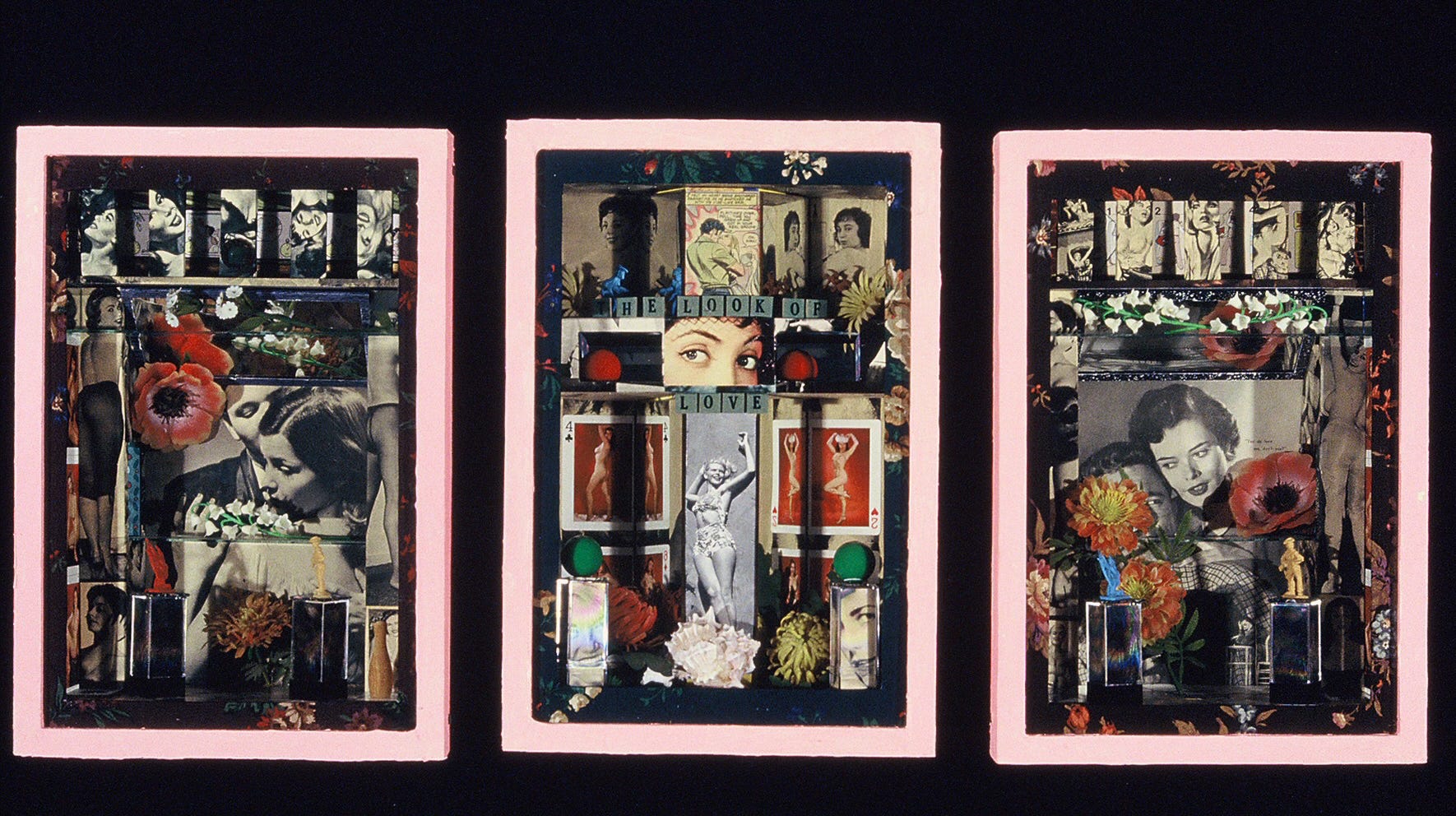
There are several things that distinguish Scoptophilia from most of my other boxed assemblage pieces. The obvious difference is one of the materials used—1950s and ’60s girlie magazines. I typically avoid using images with strong cultural or psychological associations, which is why I don’t, for the most part, use depictions of celebrities, culturally iconic images, or religious or sexual content. My goal in any assemblage is to present the images in a way that takes us beyond the surface appearances and then has us consider marginal associations or provokes unfamiliar thoughts. Conventional nude images are difficult to use in this way since they tend to evoke core feelings. Ironically, it is the same strong reaction that these images evoke—and I usually avoid—that makes them perfect for this assemblage’s topic of visual obsession.
It’s almost as if I’m short-circuiting my usual approach of trying to engage contemplation because the main subject matter is the act of looking— a process that obviously has to precede thinking about it. Scoptophilia is a term with mostly psychological references, but I try to define it here more generally as the love of looking or an obsession or self-absorption with our own visual gazing. This looking, defined as a simple acknowledgment of a thing, is generally the stage of visual comprehension where most folks cease considering an artwork. So, in a sense, this failure to see into an artwork and mull it over is a subtext of this piece. I know that I’ve spoken before about the difference between looking and seeing, and it’s a fairly common trope in my work, including this assemblage, that’s emphasized with the abundant use of mirrors. I believe this work has more mirror surface area than any of my other pieces.
In an earlier draft of this post, I wrote about additional themes in this piece, but it felt a little too “explainy.” I think that these visual motifs, conveyed by the structure and images, are the more obvious subject matter, so I’ll let you find your own path to them.
There are two immaterial things about Scoptophilia that intrigue me. One is that this piece is physically the largest boxed assemblage I’ve made. Each box of the set was roughly the individual size of the other boxed assemblages I was producing when I started this, in 1991, so with the triptych format basically multiplying that size by three, it just became my largest work. Seeing this piece now after working for so many years on works considerably smaller, I can appreciate it as an oddity. It’s almost like an author who, early on, wrote a thousand-page novel but now mainly writes short stories.
Another thing of note is the length of time it took me to finish this piece. Looking back on the years when it was a work in progress, I remember now that I had gone through two living space moves, which entailed packing up my at-home studio. Some of those were lean years for artwork because, among other things, I was without a studio space.1
I’ve previously spoken about how it sometimes takes a while for me to finish a work, and this one fell into that pattern where basically I get about three-quarters of the way into a piece and then encounter a creative snag. I know it needs something—an image or an object—to really make it sing, but I don’t want to force it, and if enlightenment of what the next steps will be fails to come after a few weeks, I’ll move on to other active assemblages, and the next thing I know, months will have gone by. Luckily, I can pull an unfinished artwork out of hibernation, sit with it afresh, and time-travel into my past mind and the thoughts I may have been thinking. More often than not, new ideas arise, and I find the additional items or images that help complete the composition. Once I start work on a piece, I get a sense of how long it will take to mature. Some works seem to rely on future thoughts or ideas that I’m currently incapable of forming, and there’s either a sense that I just need to wait, or sometimes I simply lose the thread of a thought. It’s the kind of situation where you just have to go on to other things and hope that, out of the blue, that lost idea will come to the forefront of your mind. I respect that the images I’m putting together will sometimes need to sit with each other before they reveal what’s needed to complete the visual thought. They don’t always communicate this to me in haste.
I’d like to mention that this artwork is available for acquisition. I may have shown it once when I had my art gallery, but other than that, it’s been in storage for these twenty-odd years. As with the proverbial falling tree in the woods, it needs to be heard (in this case, seen) to exist.
I just looked at my artwork list, and between 1994 and 1998, I completed only four pieces
No posts
Comments
Nothing yet. Say the first thing.
Sign in to join the conversation.