
Good morning traders, let’s get started.
This was a rare week of massive gains.
Ahead of FOMC and big tech earnings, facing a highly uncertain market direction and elevated AI trade crowding, we went fully to cash early, maintained patience, and avoided participating in the rapid selloffs driven by deleveraging and sentiment deterioration in prior weeks.
After FOMC landed and the market completed its risk release, at the moment of extreme fear, we reassessed two key variables: first, the directional shift in rates trading, and second, the evolution of value distribution across the AI supply chain. We concluded that market focus was shifting from “AI capital investment” to “AI commercialization delivery” — the next phase’s real beneficiaries would no longer be just semiconductors and hardware supply chains, but platform companies capable of converting AI investment into revenue and cash flow.
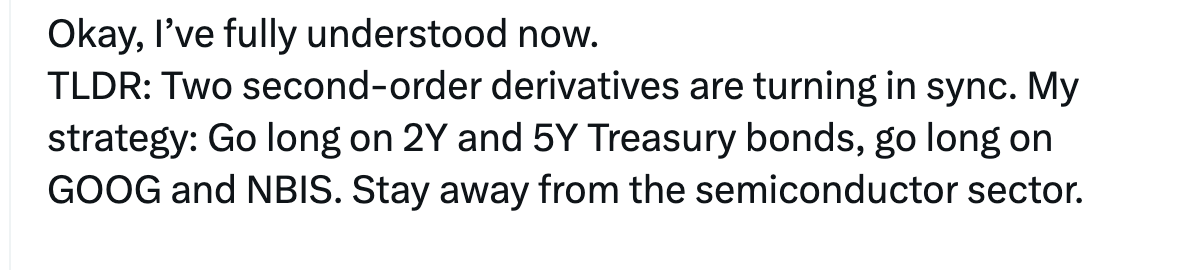
We therefore began positioning in cloud-related assets, buying NBIS and GOOGL. Subsequently, as the AI commercialization logic was further validated, we added ORCL and FTNT.
Meanwhile, the short Apple position we opened the prior week went from a floating loss to a massive gain.
These trades have all received favorable market feedback. We have already taken profits on some positions, while continuing to hold GOOGL and FTNT, awaiting further release of AI commercialization and enterprise software security demand.
Abundant patience and sharp judgment are the foundation of my ability to consistently generate excess returns in the market.
In our Discord, I post my latest thoughts daily, and there are many experienced traders in the group constantly sharing their insights. If you haven’t joined the subscriber chat yet, click the link to join us: https://sidestack.io/franktrading
Enough said, let’s move on to the next section.
This week SPX rose approximately 1.05%, closing near 7490; NDX edged up about 0.52%, DJI gained about 1.04%, and RUT was essentially flat at just +0.01%. If you only look at index closing prices, this looks like a mundane rebound; but if you look at the process, this week was the most information-dense and volatile week of the year. FOMC, four major tech earnings, and the coordinated US-Japan FX intervention on the yen all landed within four trading days — each event alone could have shifted market direction. The calm at the index level masked extreme repricing at the sector and stock level.
The most core structural change this week was not the Fed holding rates steady, but Warsh’s “market rates can substitute for formal rate hikes” framework shifting risk from the front end to the long end. The 2-year yield fell 5 basis points this week to 4.28%, but the 30-year surged 11 basis points to 5.27%, with the 2s30s spread widening from 83bp to 99bp. This was not a dovish FOMC triggering an across-the-curve rally — it was a credibility discount beginning to be priced into the long end. The market told Warsh in its own way: you don’t hike, we’ll do it for you — just on the long end.
The most important market theme this week was “AI monetization verification.” Four major tech companies reported earnings in the same week, producing the most extreme Mag-7 internal divergence of the year. MSFT surged 21.8% on the week, AMZN gained 17.0%, while META fell 6.5% and AAPL dropped 7.2%. The market voted with real money: only paying for AI revenue that has already been monetized, no longer paying for capex stories.
This week’s FOMC was not an ordinary hold. If you only look at the result — the 3.5-3.75% rate unchanged — there’s not much to say. But if you look at the process, the vote structure, every word Warsh said at the press conference, and the market’s reaction over the following two days, you’ll find this meeting may be the most important policy inflection point of the year. It’s not that the rate changed — it’s that the reaction function contract between the Fed and the market was redefined.
9-3 Vote: Formal Confirmation of Deep Committee Divisions
Three dissenting members voted for a 25bp hike — Hammack (Cleveland), Kashkari (Minneapolis), and Logan (Dallas). Three dissents are extremely rare in recent years. More importantly, Kashkari’s defection — the previously dovish Kashkari joining the hawkish camp — is particularly striking. He wrote in a rate hike at the June SEP, and now went further by directly voting for immediate action. This is a strong signal: even the most dovish members are becoming uneasy about the persistence of supply-side inflation.
Nomura’s assessment was spot-on: Kashkari is increasingly worried that supply-side shocks are entrenching high inflation. When the hawkish camp expands beyond regular hawks like Logan and Hammack to include former doves like Kashkari, it means the committee’s median is shifting hawkish. Even though Warsh himself is dovish, the committee’s hawkish undertone is deepening — and this contradiction itself is the largest source of future policy path uncertainty.
Warsh did four things at the press conference that surprised the market.
First, he downplayed AI-related price pressures, comparing memory and logic chip price increases to a “streetlight effect” — meaning these prices get attention only because they’re visible, not because they represent broad inflation dynamics. This analogy is problematic. If AI-related semiconductor price increases begin transmitting downstream — laptops, memory cards, server costs — then it’s not a “streetlight effect” but a genuine cost push.
Second, he attributed the long-end rate rise to economic strength rather than market rate hike expectations — “economic output is solid, capex and productivity are strong.” This is half right, half wrong. The long-end rate rise did partly come from growth resilience, but the 30-year yield jumping on FOMC day was clearly not a reaction to GDP — it was a reaction to Warsh’s communication style.
Third, and most critically, he hinted that market rates rising could substitute for formal rate hikes. “Rates are already higher than at the June meeting,” “the market hasn’t paused.” This was the most important policy signal of this FOMC. Its implication: Warsh believes that if long-end rates rising spontaneously has already tightened financial conditions, the Fed doesn’t need to raise the policy rate to achieve the same effect. In other words, the market is doing the Fed’s tightening work for it.
Fourth, he suggested managing inflation expectations through more credible commitment to the inflation target, rather than solely through rate hikes. This indicates Warsh prefers expectation management over direct action — but the prerequisite for expectation management is Fed credibility, and this FOMC was consuming exactly that.
Morgan Stanley criticized Warsh using the Hamilton musical line — “Talk Less, Smile More.” Morgan Stanley argued that Warsh wants the market to “play the ball, not the referee,” but the Fed is not a neutral referee — it’s an important market participant. When the Fed deliberately hides its reaction function, the result is exactly what we saw this week: chaos, volatility, higher risk premia, and damaged Fed credibility. Warsh’s “talk less” strategy backfired — the volatility it introduced was precisely what it was trying to avoid.
Market Reaction
The market’s reaction to the FOMC was layered, with each layer transmitting different information.
The front end reacted first. The 2-year yield fell from 4.26% to 4.22% on FOMC day (July 29), as the market initially interpreted it as a dovish surprise — Warsh didn’t set an explicit threshold for a September hike. The 3-month yield fell from 3.90% to 3.83%, meaning the front-end pricing of hike probability actually declined.
But the long end went in the completely opposite direction. The 30-year yield jumped on FOMC day, and continued rising to 5.27% on Friday — up 11bp for the week. The 10-year rose from 4.61% to 4.75%, up 6bp for the week. The 2s30s spread widened from 83bp to 99bp — a 16bp steepening in a single week.
The market told Warsh in its own way: you don’t hike, we’ll do it for you — just on the long end.
The mechanism is this: when the Fed chair hints that “market rates can substitute for hikes,” the market demands higher term premia to compensate for policy uncertainty. Because if the Fed’s tightening tool shifts from a controllable policy rate to an uncontrollable market rate, long-end rate volatility increases — and the greater the volatility, the higher the compensation investors demand. This is the essence of the 30-year yield jump: not inflation expectations spiraling out of control (breakevens did jump, but remained in the 2.2-2.3% range), but term premia repricing the Fed’s policy uncertainty.
Warsh’s excessive dovishness paradoxically raises the risk of rate hikes. The logic chain: Warsh dovish → market breakevens jump → long-term inflation expectations face de-anchoring risk → “even mild evidence of inflation re-acceleration could trigger Fed tightening.” In other words, the more dovish Warsh is, the less the market believes the Fed will control inflation, the higher the inflation compensation the market demands, and the more the Fed is ultimately forced to act aggressively to restore credibility. This is a reflexive loop.
Among the banks, Goldman Sachs and Morgan Stanley maintain their “on hold for the year” view — they believe inflation will continue to soften in coming months. Nomura explicitly states the risk skews toward hikes — Warsh’s dovish posture actually increases the probability of hiking. Bank of America is the most pessimistic, arguing the Fed is creating a credibility crisis and will eventually be forced into hikes by the market.
The disagreement among the four banks is not about whether inflation will decline (most agree it will), but about whether Warsh’s communication strategy will create self-fulfilling inflation expectations through breakeven de-anchoring. If breakevens continue to rise, Nomura and BofA’s scenarios materialize; if core PCE stays below 0.2% in August-September, Goldman and Morgan Stanley’s scenarios materialize. Friday’s ECI at +0.9% above expectations was the first warning sign — wage inflation stickiness persists, and Warsh’s “streetlight effect” argument may be too cavalier.
Impact on Trading Framework
Comments
Nothing yet. Say the first thing.
Sign in to join the conversation.