
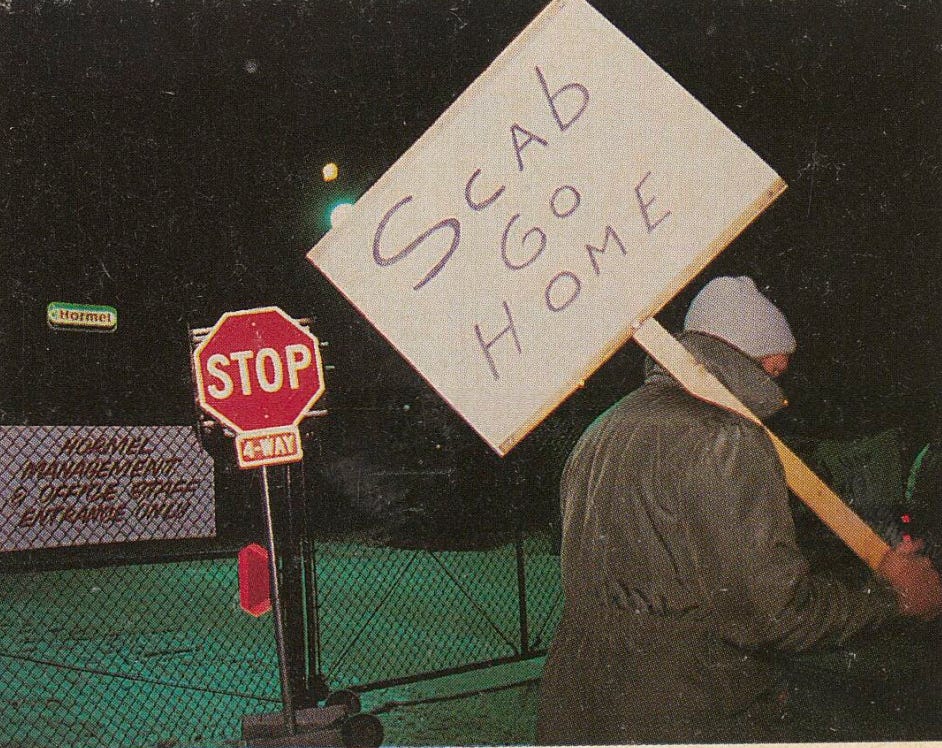
Our interview today is with Rusty Carter, union ironworker and founder of The Wealthy Ironworker — a website where he publishes work on “life principles, economics, skilled trade advocacy." We spoke about what makes a job a good job, the breakdown of the social contract, and the way out of hopelessness. Rusty has contributed previously to frankradio - HERE and HERE.
This interview was conducted by Noelle Forougi for franknews, and condensed for clarity. Help keep franknews free and for the public by subscribing below.
I’d love to hear about your work and have you introduce yourself.
My name is Rusty Carter. I’m a union ironworker, and have been, basically, my whole adult life. I got into the trade, actually, by accident, actually…
How did that happen?
I did the thing a lot of people are told: you got to go to college and get a good job. So I did. I went to community college, but I had a kid very young, and between working and school, something had to give. College was what gave.
In my area there are a lot of shipyards, so I was working in one, just doing whatever. Right around 2000, tower work started happening all over the place, with towers going up for lines and cell phone antennas. The company I was with had a telecom division, and I got started doing that, got used to heights, got used to rigging.
Eventually I got tired of traveling, since I had a young kid, so I came back home, found out about the ironworkers, went down and talked to them, and it wasn’t long before I got a call, went to work, and have been working ever since. That was about 24 years ago.
What about the job keeps you there?
It has provided me, quite frankly, with a good life. My wife and I have been married 15 years; she’s been a stay-at-home mom the whole time, homeschooling our kids and taking them all kinds of places. It afforded us a lot of freedom.
I’m very pro-union, so I’m always looking for ways to mentor, develop, and promote the message, not in a militant way, just an educational one. I’ve found the vast majority of people just don’t know. Some anti-union folks are like talking to a rock, you’re not getting through to them, but there’s a whole host of people who simply don’t know. Or they’ve fallen for a lot of propaganda.
I wish labor history was actually taught in school, because then people would really understand what we take for granted when it comes to the 40-hour work week, or the fact that you got weekends, or the fact that there’s no child labor, or, you know, safety is an enormous thing that was never really prioritized by companies and owners.
Even individuals who are not represented by a union will benefit from other people around them being in a union. You saw this, even before the UAW won concessions from the Big Three up north, every single US southern automaker, some of them even before the announcement came out, they were like, “We’re raising wages, we’re raising wages.” Hyundai increased by like 25% over the next four years. Why are they doing this? They were trying to stave off is union elections, because those employees are going, “Hmm, look at this, those guys up there are making money because they are in a union.”
But interestingly enough, every single one of those southern automakers is union in their home countries, Germany, Japan, South Korea. They’re all represented by a union, except here in the southern United States.
Whats the difference?
Well there’s sectoral bargaining, where an entire sector can do some bargaining, and then there’s, like, industrial-type bargaining, where it’s very site-specific. And then, quite frankly, there are some governments, that are anti-union – which is where we are. There’s a lot more, the governments across the world, that seem to be far more invested in the success of the economy.
We have it completely backwards here in the United States. The economy is the thing American people need to support, as opposed to the economy working for the American people, the vast majority of us.
I read a stat that said currently only about 40% of American workers have jobs that “pay a decent wage, provide fair treatment, offer some degree of autonomy, and include advancement opportunities, and nearly half believe they would struggle to find one.” It seems like the end result of what you were just describing – a country that’s bound to the market and not necessarily bound to a social contract of making sure people are able to find wage jobs.
I’d be curious to see the age breakdown of that stat. I would guess it is a lot of young people. The social contract we expect is, in a nutshell: “I want better for my children than I had.” That has broken down.
But we tell young people, “Just work harder,” with no concept of reality today. You have a whole litany of individuals telling you that you shouldn’t have a livable wage in service industry jobs, because they’re supposed to be stepping stones. If these jobs are just stepping stones, you’ve gutted the middle class through NAFTA, TPP, globalization, the offshoring of a lot of manufacturing jobs. What jobs are they supposed to go to?
Yeah, where are they supposed to go?
It’s like the Roman satirist Juvenal said, “If you give the people bread and circuses, and they’ll never revolt.” If I just keep you fed and I give you a little bit of entertainment distraction via social media, you won’t buck the system, you won’t even try to converse with other people.
It’s tough. Yeah, I want to double back to something you said. The same article I got that 40% stat from said the top three private-sector occupations of the next decade will be home health and personal health aides, fast food counter workers, and retail salespeople. From what I understand, unionization rates in those fields are much lower, which feeds into the idea that these are somehow less “good” jobs.
But it’s interesting, because if you go back in history and look at the manufacturing careers we’re so nostalgic for now, back when America had a strong, homegrown domestic production economy, those jobs were only good because people fought for them, fought to make them union-protected. So it’s strange that we’re in a moment where AI is coming for white-collar work, manufacturing’s already been offshored, and despite Trump’s efforts, I don’t think it’s coming back. If the future of work is these service sectors, they seem like exactly the jobs that need to be unionized, but we’re reluctant to push for that, because they’re seen as not “good” jobs to begin with.
I think we need to basically reframe the way we look at what constitutes a good job, and look at, we want fellow Americans to be able to support their families and not have to work two or three different jobs for this express purpose. To be blunt with you, if there were two things still in existence today, the post-World War Two capitalist market and American patriotism, you would still have, even to this day, a robust manufacturing base and a whole litany of individuals with great jobs. But we don’t have capitalism, we have corporatism, we have crony capitalism, and it’s being exploited to a significant degree, and that creates a systemic problem.
Now, as young people feel like they don’t have any hope, you’re going to start to see that, and that’s the most dangerous type of person in the room, the ones who feel like they don’t have anything left to lose. That’s why young people, in a nutshell, are so pro-union, because they see the system as boxed in, they see it as not working for them, and quite frankly, the only real, substantive, potential change they could have is to come together.
So these service industry jobs, I would expect you’re going to start to see a lot of pushback. You’re already seeing it, since, you know, October of 2022, when you started to see what they called Striketober. That’s continuing on, and you’re starting to see an uptick in union activity, because all these people feel like they have no other avenue to turn. And guess what, they’re absolutely right, they don’t.
Yeah I hope that is the route hopelessness breeds. I recently saw a tweet, it was somebody, like, “Well, it’s not the government’s job to feed you.” And then somebody responded that was basically like, “What’s the point of having a society if we’re not making sure our neighbors aren’t going hungry?”
And I think it’s sort of a similar ethos of, like, what’s the point of a society if my neighbor has to work three jobs to live here?
Yeah, the only hope is the collective power of the people. That’s what’s actually going to drive change in this country, if we’re going to have any at all.
No posts
Comments
Nothing yet. Say the first thing.
Sign in to join the conversation.