
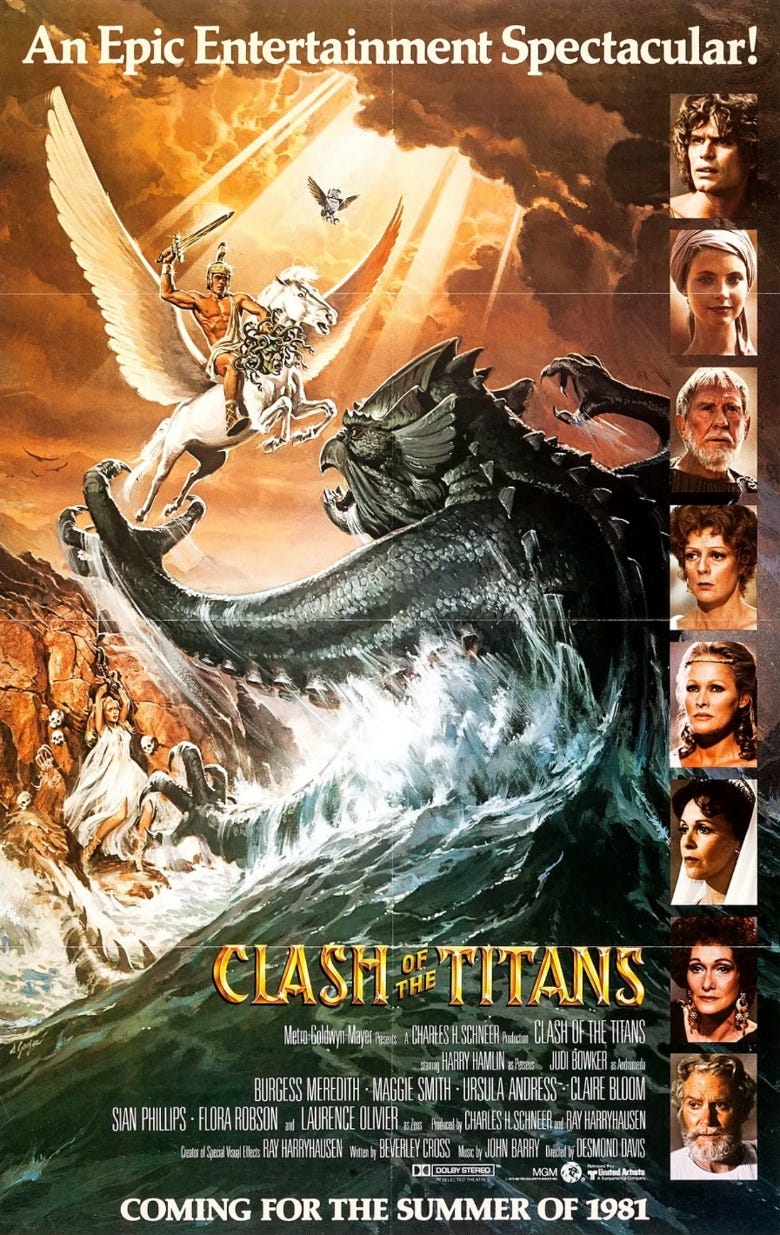
On my garage wall hangs a Raiders of the Lost Ark poster, and every time I pass it I’m a kid again in the summer of 1981. Everyone remembers Indiana Jones from that June weekend. But Raiders opened alongside another film I’ve recently remembered.
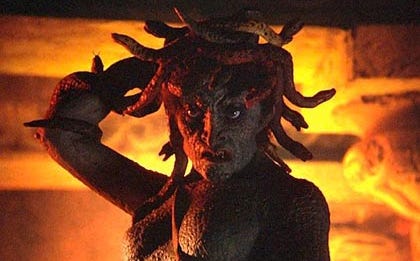
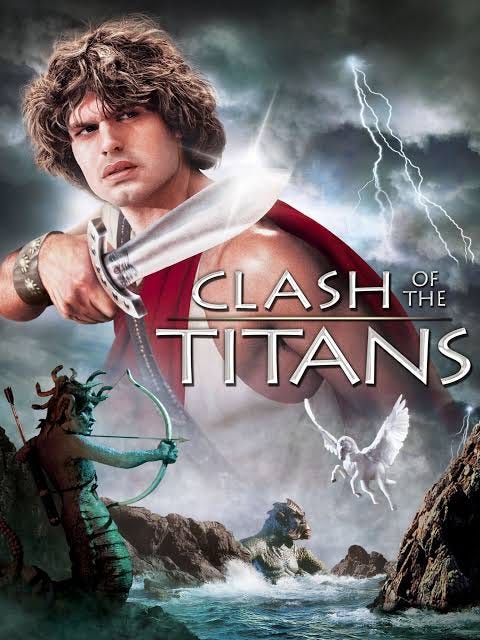
Clash of the Titans brought the myth of Perseus to the screen: Medusa coiled in her ruined temple, the Kraken rising from the sea while a city screamed, Perseus riding Pegasus in flight. I saw it in the theater and read the Alan Dean Foster paperback, then watched it endlessly on HBO, until I knew the dialogue and the scenes by heart.
The film carried the creature work of Ray Harryhausen, his last feature, an entire mythology built and moved by hand, years before Lord of the Rings showed us fantasy at scale.
What gripped me beyond the sheer adventure was the difficulty of the tasks, and what they cost. Perseus sets out for the one thing that can stop the Kraken: the head of Medusa, whose gaze turns everyone to stone. He takes with him a mirrored shield and steady nerve.
But his path is not easy, or given, even with help. Calibos, twisted and vengeful and divinely favored in his own right, stalks him the whole way, punctures the sack, spills the Gorgon’s blood, and from it giant scorpions rise up and fall on the party. Companions die. His friends die. Perseus confronts and kills Calibos and staggers out having lost nearly everyone, and still has to reach Joppa, and still has to face the Kraken, half-dead and aided only by an equally spent Pegasus, before he can free the princess chained to the rock.
The old sources give Perseus a cleaner victory. In the Beverley Cross screenplay and (1981) film, it costs him much more, and that’s what’s always stayed with me. The gods, or fortune, hand you gifts and talents, but no god swings the blade. The deed is yours, and so is the price, and you do it anyway.
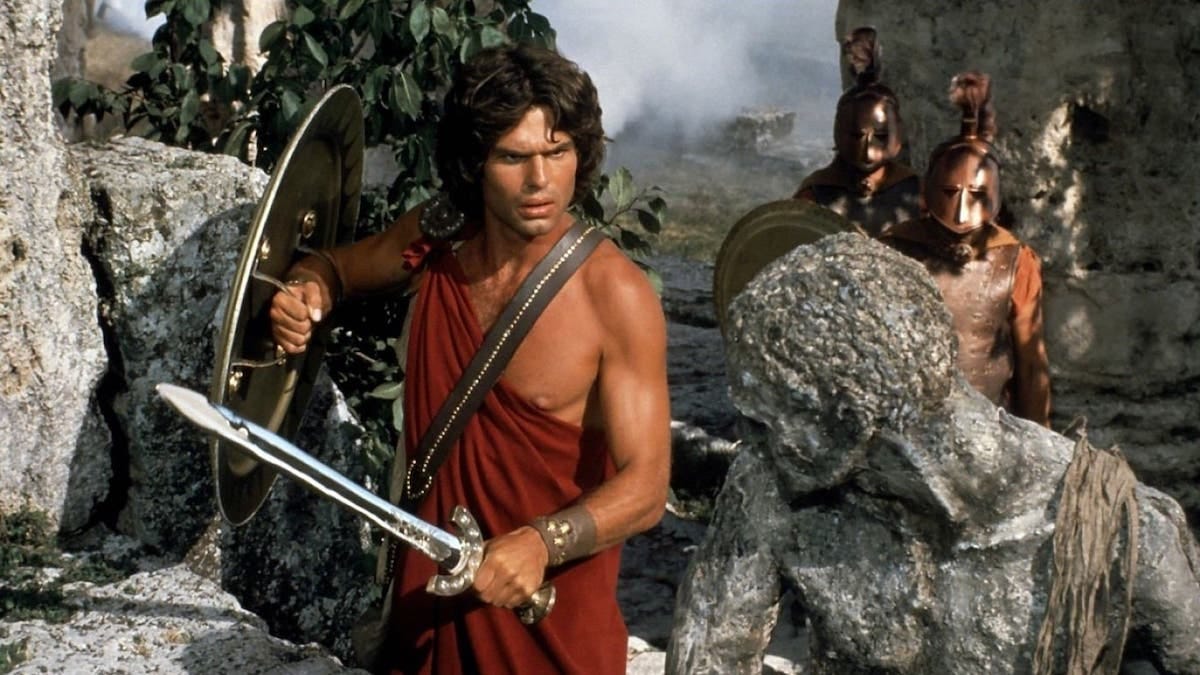
“How may a mortal man face and defeat the Kraken?”
Perseus asks this of three Stygian Witches, who answer him only begrudgingly, and only to reveal how harrowing his task will be. We all know this feeling. The project too large to see the end of. The conversation you keep avoiding. The hard thing you have never done before and have to do anyway. It can feel impossible, with no way through. The advice that comes (if it does) only makes clear the difficulty ahead.
There is a moment in Clash when the goddess Thetis, watching Perseus, turns uneasy. “What if courage and imagination became everyday mortal qualities? What will become of us?” Zeus answers, “We would no longer be needed.” The gods knew it. The deed was never theirs. It was ours.
I was reminded of all of it a few weeks ago, watching the Odyssey: there was the same wonder I felt at ten, the same edge-of-your-seat danger, the same big deeds to complete, Perseus with his sword, now Odysseus making his way home.
That’s the power of myth, and of the old stories. They do not end. They must always be retold. Whether the task is to defeat a titan, break eternal chains, or find the long way home.
No posts
Comments
Nothing yet. Say the first thing.
Sign in to join the conversation.