

“Once I started looking for the patterns, I couldn’t stop seeing them.”
One reader wrote that after last week’s exercise related to watching Trump’s “speech.”
And it perfectly captured what many others have been telling me.
The speech didn’t change.
Their lens did.
The speech suddenly became predictable because they had learned what to look for. That’s the strange thing about patterns. Once you recognize one, you can’t unsee it. My workbook, Staying Positive in a Negative World, was designed to teach exactly that skill.
They weren’t seeing a different speech.
They were seeing the same speech differently.
Which raises a rather uncomfortable question.
How could something become so obvious in just one evening that society has struggled to describe for ten years?
If you enjoy psychology that helps explain what's happening in the world — not just today's headlines — subscribe to The Gaslight Report. New essays every week.
This piece isn’t about Trump's latest desperate, collapsing attempt to regain his mojo and preserve his mask. It’s a story about what happens when the institutions we depend on to recognize danger all develop blind spots of their own.
If you’re new here...
Over the past year we've explored projection , grandiosity, and what I call ‘reality laundering.‘ You don’t have to read them first, but if you’d like more background, those are a few helpful links. And if you’d rather watch than read, here’s a short video that catches you up before we start connecting this week’s dots.
Let’s get one thing out of the way.
This isn’t another “the media is the enemy” rant.
After all, journalism did its job.
It reported the scandals.
The indictments.
The lawsuits.
The lies.
The election interference.
January 6.
Every tree was carefully documented.
What almost nobody described was the forest.
Because modern journalism asks,
“What happened today?”
But Psychology asks,
“Why does it keep happening?”
There’s been no shortage of facts.
There’s a shortage of awareness and a lack of pattern recognition.
One lie is news.
A thousand lies is a verdict.
One act of projection is interesting.
The hundredth projection is a pattern.
But the public is seldom invited to step back and look at the whole picture.
Recognizing the pattern doesn’t change the evidence.
It changes what the evidence means.
That’s exactly what many of you experienced during last week’s exercise.
The facts didn’t change.
Your interpretation did.
Here’s part of my frustration with Journalism:
"Unprecedented" loses its headline appeal after a few repeats, let alone a few thousand. Yet it continues. In fact, as I’ve previously written, the antics of a Malignant Narcissist get pretty damn predictable.
Eventually, despite their best efforts to repress or ignore, the obvious question became impossible to avoid.
What could possibly explain this extraordinary consistency?
That’s not asking for a psychiatric diagnosis. It’s an analytical question.
Think about how journalists routinely ask:
Is there a pattern of corruption?
Is there a pattern of discrimination?
Is there a pattern of financial fraud?
Nobody objects to looking for patterns in those domains.
Yet when the pattern involves personality and behavior, many news organizations are way more hesitant to frame it that way. Instead, they treat each disturbing outburst as a fresh controversy rather than asking whether the controversies themselves reflect an enduring psychological pattern. That should be the headline.
Journalism wasn’t the only profession wrestling with a challenging question.
Psychiatry had one too.
In 1973 The Goldwater Rule made perfect sense.
Psychiatry should never become a political weapon.
Psychiatrists became so worried about saying too much that the public was left hearing almost nothing at all.
Ironically, the profession dedicated to recognizing behavioral patterns became remarkably reluctant to talk about one unfolding in front of hundreds of millions of eyewitnesses.
But it collided with two things Psychiatry could never have anticipated.
Neuroscience.
The Internet.
The Goldwater Rule was written in an era when psychiatrists knew little about public figures beyond a few speeches, newspaper interviews, and carefully managed public appearances. It was also an era where Psychiatry was purely a subjective field of practice based on Freudian theories and rife with inconsistencies and controversies.
Donald Trump changed the equation.
Psychiatrists are correct. No qualified clinician (that we know of) has observed him for an hour in an official doctor’s office.
But we’ve observed him in reality for decades. After the Goldwater fiasco, the profession reasonably concluded that, at that point in time, diagnosing public figures from afar was a bad idea. It protected against political abuse and reminded clinicians that real diagnoses belong in professional spaces, not on the nightly news.
The problem is that somewhere along the way, many people stopped distinguishing between diagnosing a person and describing a pattern.
Those aren’t the same thing.
You don’t have to diagnose someone to notice that they’ve never admitted they lost an election.
You don’t need a $500 office visit to recognize chronic grandiosity, projection, or an inability to tolerate criticism.
You don’t need to diagnose someone to notice that they have never admitted making a mistake.
Ever.
Or an almost supernatural inability to experience shame.
Millions of people can observe those things.
That’s called...
Observation.
You don’t have to speculate about someone’s childhood to observe what millions of people are watching with their own eyes.
Yet the conversation often stopped before it began.
The result wasn’t simply professional absence.
A dangerous vacuum developed in the public vocabulary.
If you’re enjoying this article, please share, restack and like it. It’s an important way to support this work.
The usefulness of the Goldwater Rule is a specific issue about clinical process.
But there’s a bigger question that’s uncomfortable to talk about.
If a president develops heart disease, cardiologists are expected to comment.
If a president develops Parkinson’s disease, neurologists weigh in.
If dementia becomes a concern, suddenly everyone wants brain scans, neuropsychological testing, and expert opinions.
But suggest that decades-long disordered behavioral patterns might also be worth discussing scientifically...
...and everybody suddenly discovers their inner bioethicist.
That discomfort has deep roots.
Here’s why.
Most diseases attack something from the outside.
Heart disease is a normal heart that becomes diseased.
Liver disease is a normal liver that becomes diseased.
Even a brain disease like dementia implies a normal brain that becomes diseased.
The growing interest in Trump showing progressing signs of dementia, notably FTD, and how that is increasing the interest in his Malignant Narcissism, is very revealing and makes my point.
Not because dementia caused people to accept the Malignant Narcissism data.
But because it shifted the frame.
For years, many people heard:
“Trump has a personality disorder.”
That sounded like politics.
But when they heard:
“Trump may have a neurodegenerative disorder.”
That sounded like medicine.
Once the conversation moved into a medical frame, people became more open to asking broader questions about the brain, behavior, and judgment. Some then revisited personality explanations they had previously dismissed.
You see, personality just feels different.
Pathological Narcissism isn’t a disease.
It’s a disorder.
It isn’t something we have.
It’s something we are.
It’s saying someone is defective at their core.
Which means discussing a disordered personality can feel less like describing an illness and more like judging a human being.
Ever since René Descartes, Western culture has tended to treat the mind and body as though they occupy different worlds. That’s a profound philosophical question. But it’s not related to the functional processes of behavior and thinking.
Somewhere along the way we decided there was a moral difference between saying,
“His hippocampus is deteriorating,”
and
“His capacity for empathy appears profoundly impaired.”
Both are observations about brain function.
One feels clinical.
The other feels personal.
One is saying the car needs work.
The other is saying the driver needs work.
Vacuums rarely stay empty.
When experts become reluctant to explain what people are seeing, the less competent happily step in.
Not with psychology.
With slogans.
Witch hunt.
Deep State.
Fake news.
Hoax.
They’re coming after you.
Only I can save you.
The human brain hates uncertainty. Give it a confusing world, and it will grab the first explanation that feels emotionally satisfying.
That isn’t a conservative phenomenon.
It’s a human one.
But authoritarian movements are more susceptible and authoritarian leaders understand this instinct remarkably well.
Complexity becomes weakness.
Nuance becomes elitism.
Evidence becomes optional.
Loyalty becomes truth.
If the ambiguity of reality feels too threatening, certainty starts looking like wisdom.
That’s fertile ground for anyone promising simple answers and familiar enemies.
If you enjoy and find value in my work, consider supporting it by becoming a paid subscriber, and also receive valuable bonus content with each issue.
Notice what happened.
Journalism supplied facts.
Psychiatry stepped back from showing the facts as patterns.
Politics filled the silence with emotionally compelling stories.
None of these developments required a conspiracy.
Just three systems, each following rules that usually serve society well, becoming poorly matched to a problem they had never really encountered before.
And the guardrails failed.
Not because everyone suddenly became incompetent.
Because institutions continued solving yesterday’s problems with yesterday’s skills, while today’s problem slipped through every one of those cracks.
Maybe we keep asking the wrong question.
Maybe the mystery isn’t Donald Trump.
After all, Malignant Narcissists do malignant narcissist things.
Maybe the real mystery is why so many intelligent people, respected institutions, and professional traditions struggled to describe what millions of Americans were watching unfold in real time.
Maybe we didn’t even fail to see the behavior.
We didn’t lack evidence.
We didn’t even lack the vocabulary.
What we lacked was the institutional and societal courage to put the two together.
And when a society can’t comfortably describe a recurring pattern...
That pattern gets a very long head start.
The best conversations start when people have a shared vocabulary. If this helped give you one, consider sharing it.
Also please hit restack and like. It really helps get information out to people.
Last week’s exercise was about more than just Donald Trump, his unfitness, and danger to the world.
It was about teaching you what to notice.
Because once you learn to recognize these patterns in a presidential speech...
You’ll recognize them in a boardroom.
On social media.
In a workplace,
Maybe even at your own dinner table.
Fortunately, recognizing patterns isn’t a personality trait.
It’s something you can learn.
Once you step back and see the pattern, it’s very difficult to unsee it.
That’s exactly why I created the workbook.
Not to teach you just about Donald Trump.
To teach you how to recognize recurring psychological patterns — wherever they appear.
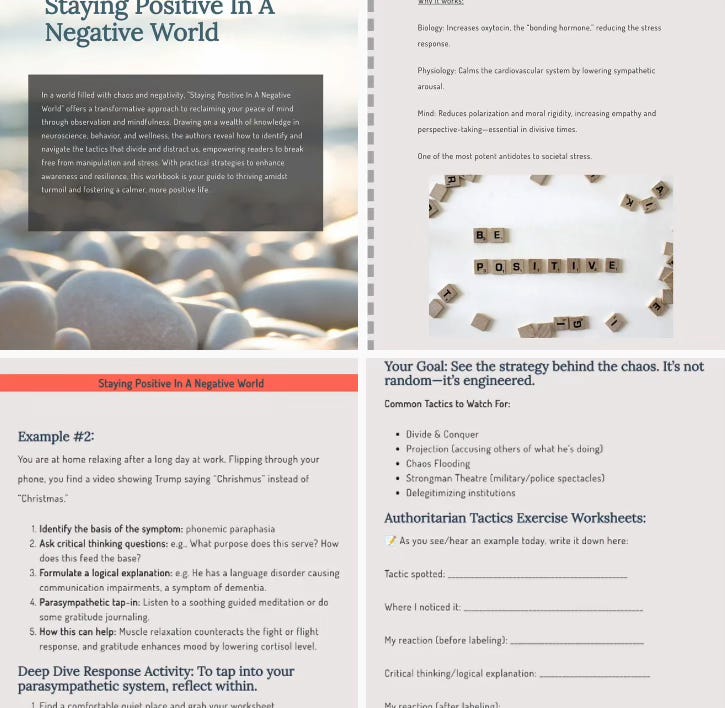
My workbook “Staying Positive in a Negative World” with Therese Paul, M.S., R.D., C.P.C. isn’t designed to tell you what to think. It’s designed to teach you how to observe. The checklists, exercises, and examples help you organize what you see in the news and in all aspects of your life into recognizable patterns instead of getting lost in the daily chaos.
My hope is that the workbook helps you step outside the emotional whirlwind, and become an observer instead of a participant.
Here’s a peek:
Click Here To Get The Workbook
When you purchase the workbook, it’s immediately available to save, use, download, or print. Paid subscribers already support this work, so they receive the workbook at a 60% discount when purchasing it. It’s simply a way of thanking you for your support.
Comments
Nothing yet. Say the first thing.
Sign in to join the conversation.