
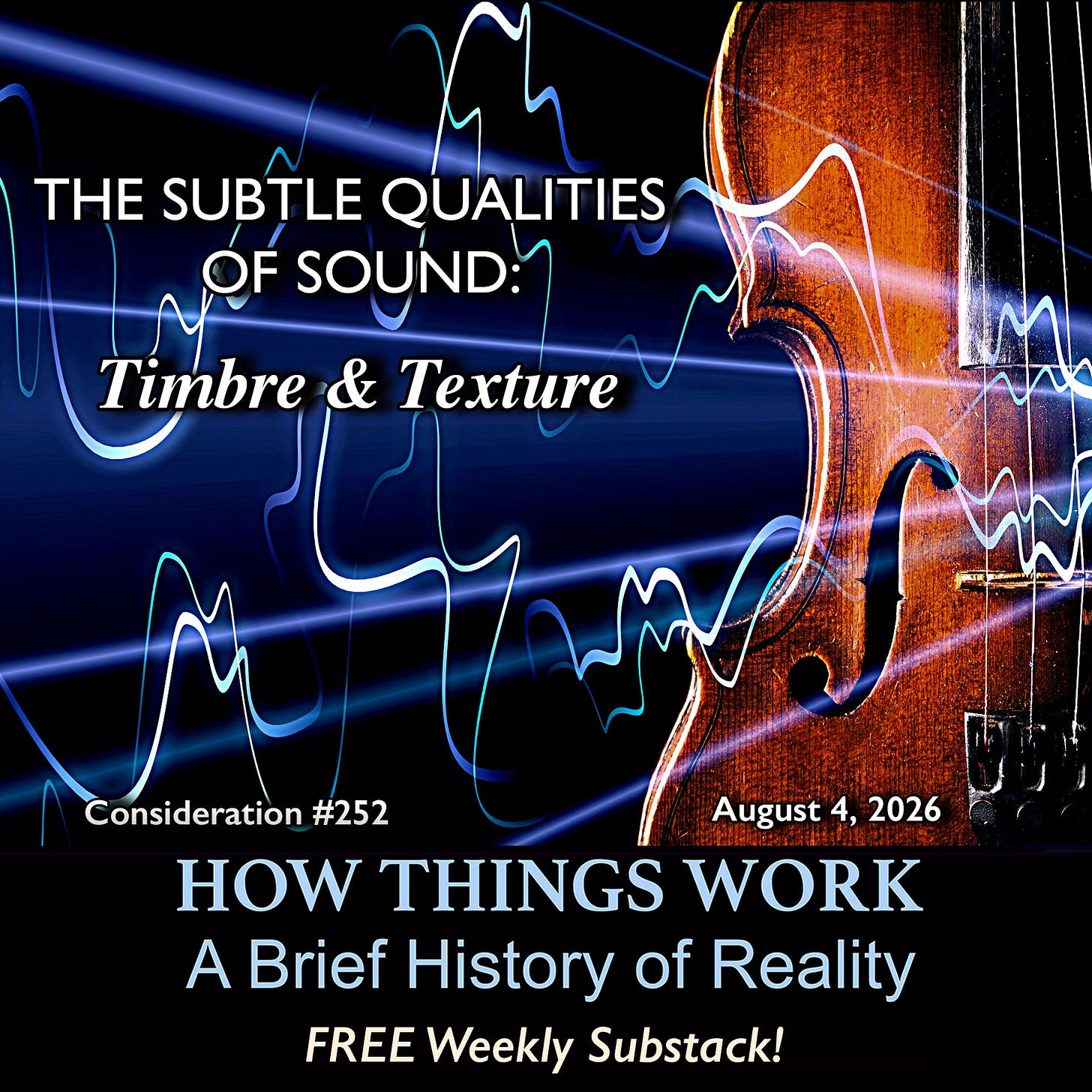
Tuesday August 4, 2026
“Music is liquid architecture; architecture is frozen music.” — Goethe
Welcome Everybody!
How is it that we can listen to an orchestra and hear each of the instruments as completely separate and distinct? We hear and recognize the trumpet section as unique from the violin or clarinet section. Human beings do more than just “hear sounds,” they hear a large amount of recognizable individual sounds that are also recognized as simply a part of a much bigger “whole” called an orchestra. This is what allows us to “hear” sound as “music.” This capability lies beyond the mere distinction of mathematical frequency.
It involves the more subtle aspects of sound called Timbre and Texture.
Timbre is a characteristic of sound produced by soundwaves in which the waves exhibit unique harmonic qualities and overtones or harmonics based on the composition and quality of the source that produces the waves. In other words, the sound of a wave is affected by the instrument that produces it. Therefore, a trumpet sounds different than a viola.
“The sounds are different because the instruments creating them are different.”
A trumpet is a brass instrument using vibrations generated from the lips of the player to produce sound; a viola is a wooden instrument with strings that are vibrated by a bow to produce sound. The sounds are different because the nature and composition of the instruments creating them are different. The trumpet has an “aggressive,” “brassy,” tone, or sound. Whereas the viola might be described as “sweet” and “warm.” Timbre is connected to the original harmonics discovered by Pythagoras.
“Timbre is one of the characteristics exhibited by the sound wave and is used for differentiating characteristics of a tone. According to experts, the change in timbre is observed when there is 4dB change either in mid or high harmonics and for low harmonics, 10dB change is required.
Timbre is a quality of a musical sound which is used for differentiating two sounds when they are in the same frequency. Every sound that we hear is dependent on its source. Sound timbre is defined by the characteristic sound waveform which is dependent on the material through which it is produced…
Any sound consists of more than one frequencies and most of these additional frequencies are known as harmonics. The fundamental frequency is the lowest frequency waveform which is known as pitch of the note in music. For any sound to possess timbre, it must have one fundamental frequency and seven or more additional harmonics.”
– BYJU’S.com (Timbre)
Timbre is what allows us to immediately distinguish an electric guitar from a harp; even though both are stringed instruments. Timber does not affect the frequency of sound; it affects the quality of sound. Timbre is one of the qualities that allows us to recognize and understand “music.”
“Texture describes the overall feeling of the musical experience.”
Texture represents the overall aural context and structure creating the overall experience of a sound or musical performance. Musical textures are often described in terms of being warm, cold, rich, light, strong, delicate, thick, thin, reedy, brassy, bright and dull.
Texture describes the overall feeling of the musical experience. It represents the structure chosen to execute the musical idea; therefore, becoming an integral expression of that idea.
“In music, texture is basically a way to describe how the music or sound is organized. It can be thought of as how many layers a piece of music has – it’s how much stuff is going on at once. Tempo, melody, harmony, rhythm, and timbre can all have an effect on texture, and so texture is closely related to the overall quality and sound of music…
…the most common terms to describe texture in music all describe how many voices, or parts, a piece of music has, and how the melodic part relates to the harmonic parts. These terms are monophonic, homophonic, and polyphonic which we’ll take a look at next.
MONOPHONIC
Monophonic texture is the simplest of the three main types of texture in music. It consists of one melody, or tune, played or sung by a single person, or in unison. There is no harmonic accompaniment, and no other music being made except for the melody…
HOMOPHONIC
Just like mono meant “one”, homo means “same” or “similar”, so this type of texture is one where you can have multiple different notes playing, but they’re all based around the same melody.
This is the most common type of texture in Western music, and it covers the vast majority of pop songs, where a singer sings a melody over a guitar or piano as accompaniment…
POLYPHONIC
The word poly means “many” or “multiple” in Greek, and therefore polyphonic texture is when there are multiple independent melody lines occurring at once.
Think of it as two (or more) parts basically doing their own thing…
Also, a piece of music can have many different textures throughout. For example, it can start with a single melody (monophony), then add in a harmonic accompaniment (homophony), and then even add a second melody towards the end (polyphony).”
– Hello Music Theory.com (What Is Texture In Music? A Complete Guide)
Texture is a quality of sound that allows us to recognize, understand, and create complex music beyond simple melodies. Texture makes it possible to distinguish completely separate musical ideas that are simultaneously connected to one main musical idea. It is a key factor in the development of Western music.
The essence of sound is based on frequency, but the qualities of sound are based on other empirical factors such as timbre and texture. These are the qualities that allow us to distinguish “sound” from “music.” However, although these qualities are prerequisites for distinguishing the sounds making up what we call music; it is ultimately the mind that puts it all together.
Music is a manifestation of the empirical vibrations of sound and the mathematic metaphysical relationships of mind.
Next week we will consider the physical and metaphysical aspects of hearing…
Thanks for reading How Things Work: A Brief History of Reality! This post is public so feel free to share it.
Check out Book I “Dualism: Recognizing the Patterns of Realty”
Excerpt from this week’s podcast: “Untangling the Consequence of Realness”
0:00
-0:35
Excerpt from this week’s Reality by a Thread: “Sun Tzu – The Five Constants of War”
“…his insights about what war include, how and when it should be waged, who is impacted most by its consequences, and where there are natural advantages and disadvantages in battle and make up the thirteen chapters of his masterwork The Art of War… It is unlikely that you will find a great military strategist who does not have a copy of The Art of War either on their desk or in their personal library; it is the bible of warfare.”
– Frank Elkins (Reality by a Thread – August 6, 2026)
All for less than a couple of cafe lattes every month at a local coffee shop! And You Will Have Something Interesting to Talk About With Your Friends at the Coffee Shop!!
Only $7.00 a month or $70.00 a year! UPGRADE NOW!
Click Image to Learn More…

Click Image to Access Free Podcasts…

Click Image to check out the entire “How Things Work” series!

No posts
Comments
Nothing yet. Say the first thing.
Sign in to join the conversation.