
Tuesday August 11, 2026
“The deep links between musical form and physical form may be unveiled by understanding how both kinds of knowledge-music and physics-arise together in human brains and nowhere else. After all, brains, regardless of how mysterious they are, are the most complex structures in the universe.”
― Stephon Alexander, The Jazz of Physics: The Secret Link Between Music and the Structure of the Universe
Welcome Everybody!
There are vibrations, sound, and hearing; and they are not all the same things. The “tree falling in the woods” analogy serves as a perfect example.
“If a tree falls in the woods, and there is no one there to hear it; does it make a sound? There is a clear and distinct answer to this question: No. When a tree falls in the woods it does not necessarily create a sound, it does, however, create vibrations.
Sound occurs when these vibrations create a physical sensation in the ear, which is then processed through the brain and evaluated by the mind, thereby creating a ‘sound’ that we interpret and recognize as a ‘fallen tree’. Therefore, with no physical apparatus, such as an ear, to ‘hear’ the vibrations; no ‘sound’ occurs. This basic lesson is important to understand for understanding how we recreate music in the analog world.”
– HTW Book I Dualism
The reason that understanding this analogy is so important is because it is one of the first ‘analog’ or ‘empirical’ examples of how things work that directly points to one of the key aspects related to quantum mechanics; the observer. Without an “observer” to “hear” the actual “vibrations” physically created by the tree’s fall nothing is actually “heard” and therefore no sound occurred; simply unobserved vibrations.
The Physics of Sound: Spatial Location
How do we know where a sound is coming from? It has to do with having two ears that can compare the various aspects of sound, therefore allowing us to utilize those distinctions in determining the source of the sound. It also allows us to experience “stereophonic” music that is balanced in a complete horizontal perspective from left to right, and front to back.
“Our ears and our brains enable us to locate sound based on our perception…”
We “hear” the trumpet in the upper left start their solo as the string section envelopes the soloist from behind. Music is not flat. It surrounds us. Our ears and our brains enable us to locate sound based on our perception of how and when the soundwaves reach them.
“Our ears play a larger role than we might think in helping us sense the world around us. We all know that we use our ears to hear, but they also help us keep balance, know up from down, and know the location of sounds. This last point is something we often don’t think about when it comes to hearing, but we experience it every day!
Our brains and ears work in tandem to help us process sounds in a three-dimensional world. One fact about sound that we might not often think about is that it travels. Because it travels in sound waves, it hits our two ears at different times, depending on the direction it is coming from.
Sound waves also have different strengths that fade as they travel, so the sound will be louder to the first ear it hits compared to the second. Our brains synthesize the sounds gained from either ear to produce one, whole sound. At the same time, they take the nuances gathered from either ear to indicate where the noise is located. The brain and ears are amazing!”
– ClarityAudiology (What Is Sound Localization)
So, the physics of hearing are related to space as well as sound; sound is a part of how we experience space. The physics of sound are specifically designed for interaction with an empirical world. The duality of the senses is reflected in both practical and rational ways.
We use sound to navigate our natural environment; it is functional. But we also use sound, in the form of music, for enjoyment, mood elevation, and enlightenment; it is rational.
The Metaphysics of Sound: Hearing
So, you might say that what we call “hearing” is really a two-stage process. First, we recognize, or perceive, physical soundwaves through a physical construct called the ears. Then, these physical soundwaves are decoded and interpreted by a physical construct called the brain to produce the experience we call sound.
It is believed that the sense of hearing is a faculty of evolution designed for survival. It makes us aware of predators and helps us to hunt for prey. However, how does any of that explain music? Is there perhaps a third stage in the process of “hearing?”
“Music is not just a cacophony of jumbled noises…”
Human beings do not simply react to sound; they use reason and logic to explore it. The complexities involved in the physical processing of sound would be impressive enough; but how does any of it explain our ability to compose counterpoint, symphonies, or even commercial popular music?
Music is not just a cacophony of jumbled noises, or preconditioned responses to specific threatening sound stimuli; it makes sense to us. We read it, we write it, we perform it, and we enjoy it.
Pythagoras believed that music reflected the essence of reality. And the essence of music was mathematics. The ability to understand mathematics involved a non-physical type of “a priori” knowledge interpreted through a non-physical construct called the Rational Mind.
“…music makes no sense to other animals.”
Music was more than just a physical sensation or perception; it was an abstract mathematical expression of the Rational Mind. And it could only be understood through the Rational Mind. Therefore, music makes no sense to other animals. Human beings are the only animals on earth with the capacity to appreciate music because they are the only animals on earth that are capable of accessing the rationality of music.
Music is more than something physical; it is also something metaphysical.
Like light, there are ranges of sound frequencies that are not perceivable through our senses. Ultrasound involves sound waves with frequencies above 20,000 Hz. It is now commonly used in diagnostic medicine.
Infrasound involves frequencies below 20 Hz. Although inaudible to human beings, it is the frequency that animals such as whales and elephants use to communicate. It is also used to detect volcanic eruptions, which fall into the infrasound frequency range. These are the frequencies that cannot be observed through music or sound; they hint at the more mysterious frequencies of creation.
“…human beings are only capable of hearing ‘some’ of this cosmic symphony.”
In essence, the entire universe is constituted of various frequencies; which means that the universe is an infinitely layered musical composition waiting for a conscious observer to “hear” it. At this point in our development, human beings are the only conscious observer capable of hearing “some” of this cosmic symphony; but we are beginning to recognize more of the many frequencies that are beyond the music we can hear.
Next week we begin our consideration into the mathematics of music that eventually lead to string theory…
Thanks for reading How Things Work: A Brief History of Reality! This post is public so feel free to share it.
Check out Book II Part-1 “Science”
Excerpt from this week’s podcast: “Untangling the 10 Commandments: Part-1”
0:00
-0:50
Excerpt from this week’s Reality by a Thread: “The Nature, Strategy, and Cost of War”
“This week we begin our consideration of Sun Tzu’s most critical insights about war. These practical lessons regarding the nature of war have also been used in the corporate wars of business. Like wise generals, wise C.E.Os are likely to have a copy of The Art of War in their computer library. Ultimately, these lessons are about the management and implementation of power.
The most critical dynamic implementation of empirical power is called war.”
– Frank Elkins (Reality by a Thread – August 13, 2026)
All for less than a couple of cafe lattes every month at a local coffee shop! And You Will Have Something Interesting to Talk About With Your Friends at the Coffee Shop!!
Only $7.00 a month or $70.00 a year! UPGRADE NOW!
Click Image to Learn More…

Click Image to Access Free Podcasts…
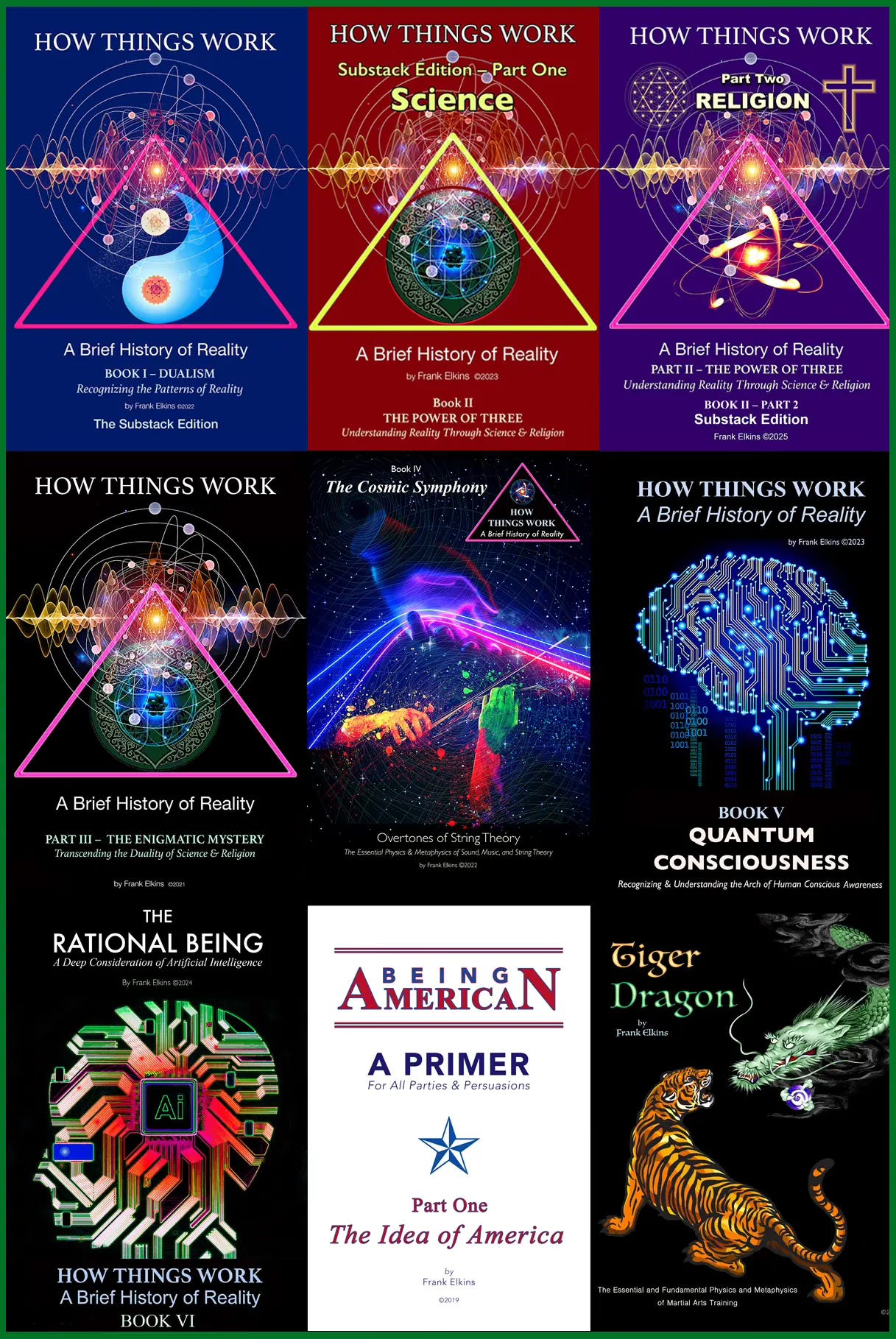
Click Image to check out the entire “How Things Work” series!
No posts
Comments
Nothing yet. Say the first thing.
Sign in to join the conversation.