
Before we dive in today, I just wanted to say thank you to everyone who has recently read, shared, or subscribed to the newsletter.
I received the following notification from Substack last week, and it made me quite happy.

(For new readers, please note that I don’t write about “crypto,” just Bitcoin.)
I very much appreciate your attention. I don’t take it for granted and I work hard to offer you thoughtful and human-crafted writing each week.
On that note, let’s dive into this week’s edition of the newsletter.
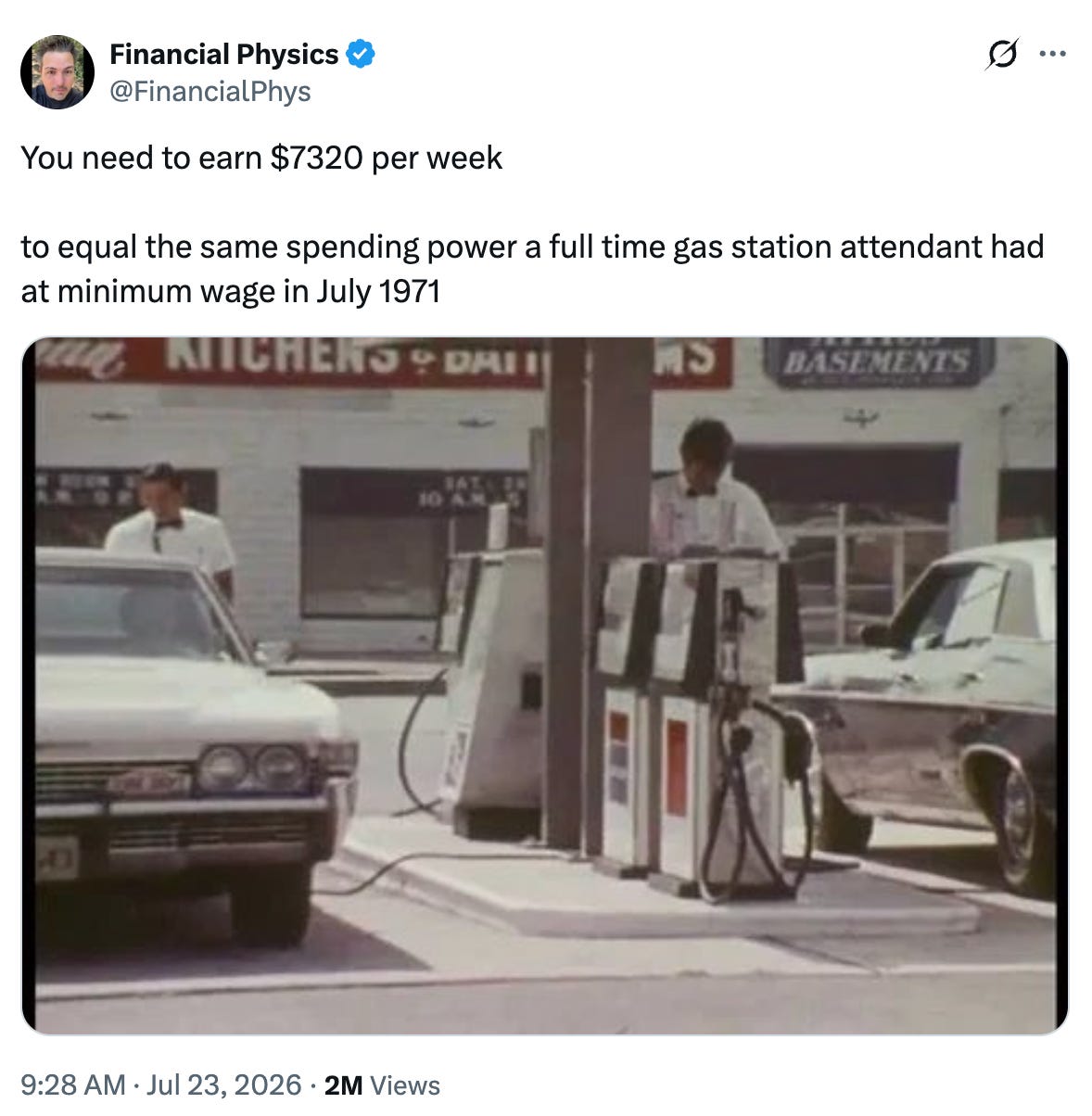
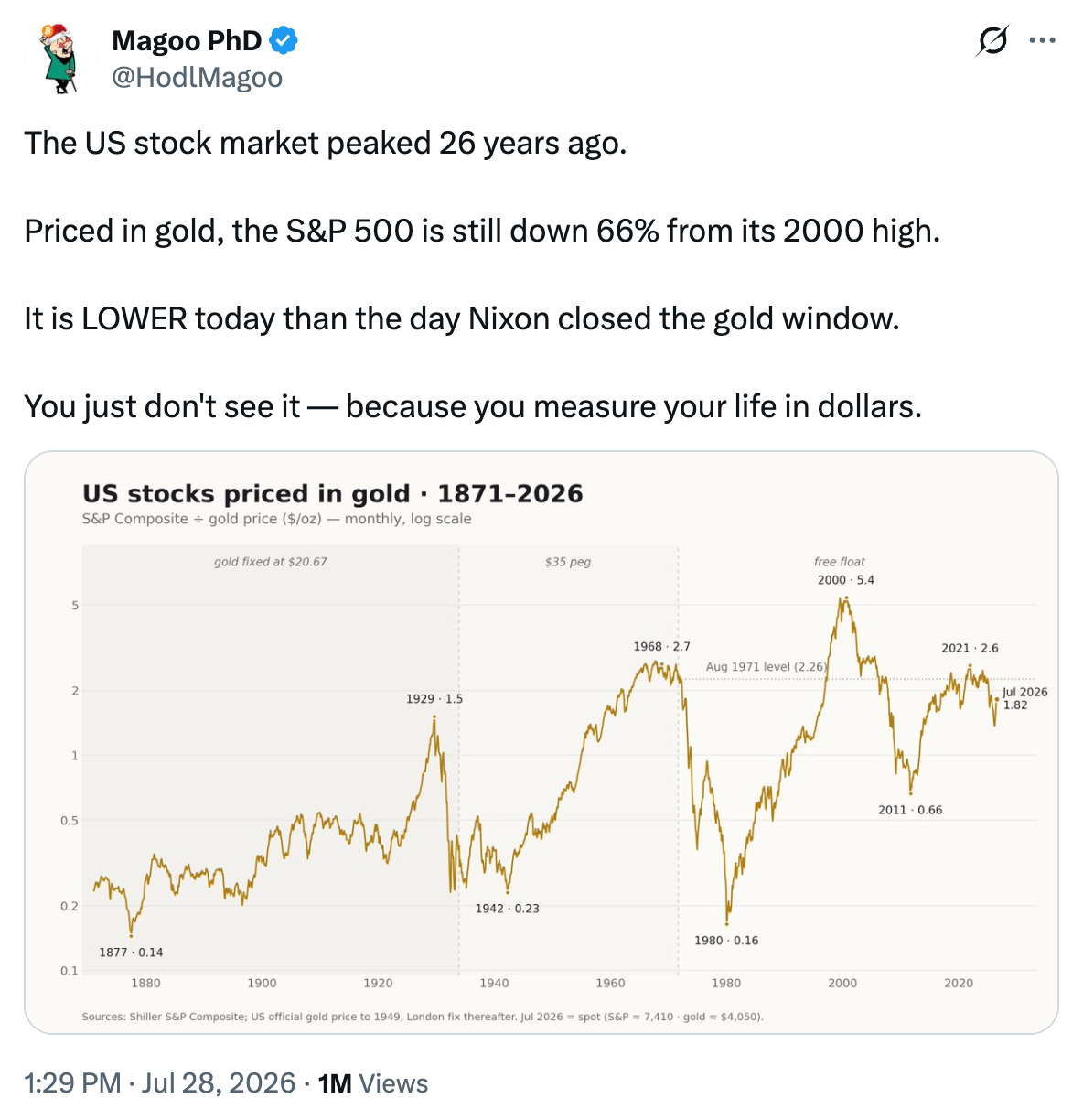
Two week’s ago, I came across the following post on X:
I found it quite intriguing and double clicked on it to learn more.
In the first comment of this post, the author explained how $64 dollars per week in July 1971, a month before the United States went off the gold standard, bought someone the approximately same amount of gold as $7,320 does as of July 2026 (when gold was priced between $4,000 and $4,100 per troy ounce).
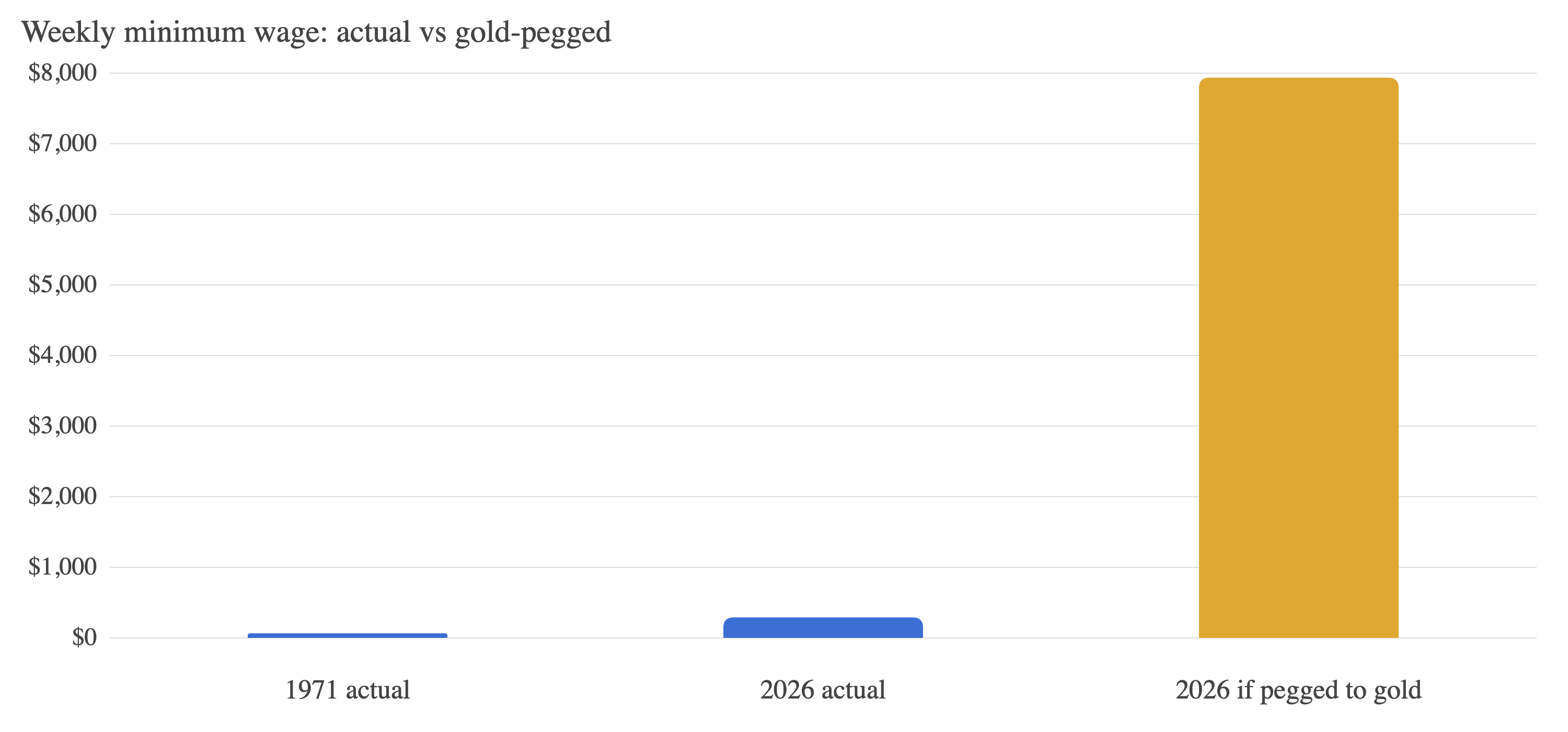
In July 1971, $64 was a week’s take home pay for a minimum wage worker, who earned $1.60 per hour back then. At the time, a troy ounce of gold cost $35, meaning that a minimum wage earner could purchase almost two troy ounces of gold with a week’s paycheck.
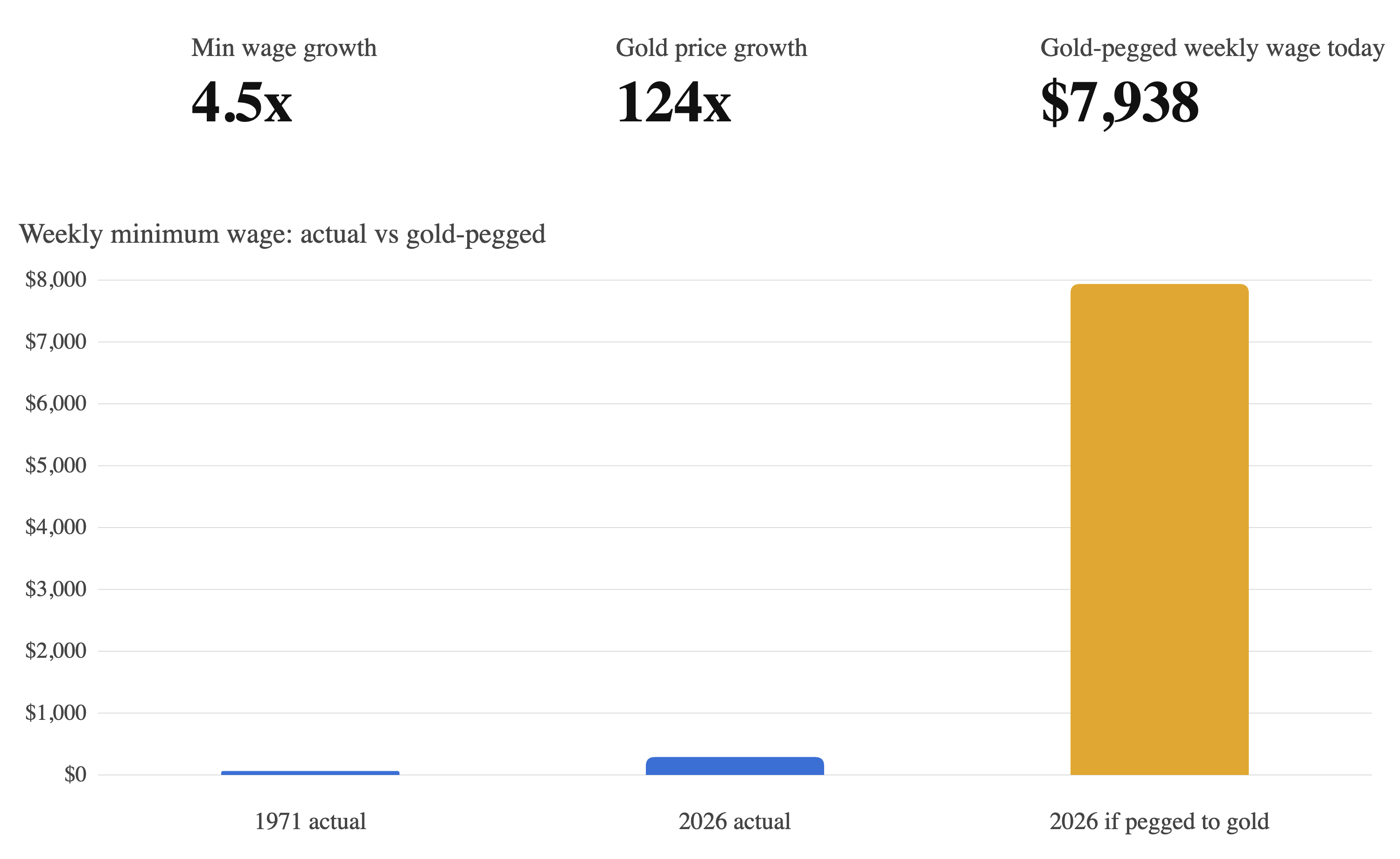
As of August 2026, the federal minimum wage in the United States is $7.25 per hour, bringing weekly take home pay to $290. Currently, a troy ounce of gold costs $4,341.60. This means that it would take almost 30 weeks of work for a minimum wage employee to purchase the same two troy ounces of gold.
Let me repeat (and slightly rephrase) that:
In July 1971, one could acquire two troy ounces of gold with one week’s paycheck while earning minimum wage, while, today, it would take 30x the amount of labor to obtain the same amount of gold.
Put another way, for a minimum wage worker to be able to purchase two troy ounces of gold per week today, they would have to earn approximately $7,937.60 per week, which comes out to about $198.44 per hour.
Why does this matter?
Good question.
In the edition of this newsletter below, I broke down what inflation looks like when measured in gold, since gold has been the most reliable store of value across the last 5,000 years.
The Real Rate Of Inflation
·
Jan 28

In Ancient Roman times, one could purchase a high-quality, hand-tailored toga for an ounce of gold.
As I wrote above, a hand-tailored toga cost approximately an ounce of gold in Ancient Rome. Today, a hand-tailored suit in New York City (NYC) costs approximately the same amount.
It’s also been said that an ounce of gold could by approximately 350 hand-made loaves of bread in Ancient Rome. This comes out to about $12 per hand-made loaf today in NYC (which is admittedly a little high as a hand-made loaf of bread at a bakery in NYC costs between $7 and $11 or so).
The point I’m trying to make is that while prices consistently rise in fiat terms (or, put another way, fiat currencies continue to give you less and less purchasing power), they stay relatively consistent when priced in gold across time.
The ones who suffer from the U.S. dollar not being pegged to gold are those of the lowest socioeconomic status among us because they often don’t have discretionary funds to put towards saving in gold or other assets that preserve wealth, and they often save whatever they can in cash.
What is more, the federal minimum wage in the U.S. has only increased at a small fraction of the rate that the price of gold has increased since 1971, meaning that minimum wage earners are earning exponentially less than they were from a purchasing power standpoint than they were in 1971.
From July 1971 until present day, the federal minimum wage in U.S. dollar terms has grown approximately 4.5x while the price of gold in U.S. dollars has gone up 124x.
Quite sad.
And it isn’t only minimum wage earners who’ve been drastically affected.
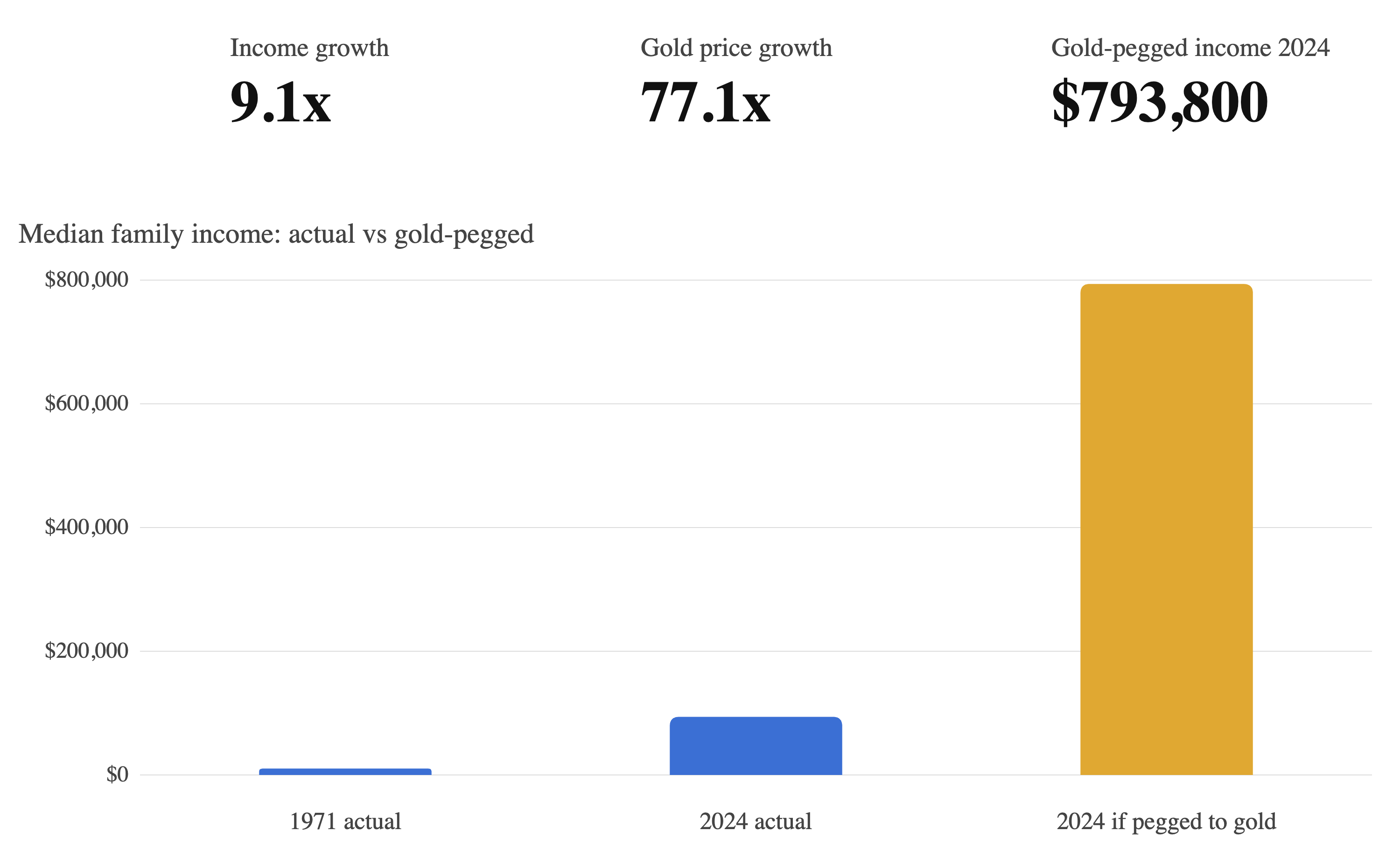
According to the U.S. Census Bureau, in July 1971, the median family income was $10,290. And according to the U.S. Census Bureau and Federal Reserve Economic Data (FRED) the median family income in the U.S. as of 2024 is somewhere between $83,730 and $105,800.
If the median family income rose at the same rate as the price of gold, it would have been $793,800 as of 2024.
What we’ve seen is median family income grow 9.1x in U.S. dollar terms from 1971 until 2024, while the price of gold has increased 77.1x.
I share this because over the last 55 years, many, especially those who own few to no assets, have experienced the the decimation of the value of their time and labor.
Most people don’t fully realize this though, because they only tend to think of money in nominal terms, not in the amount of purchase power a certain amount of money gives them.
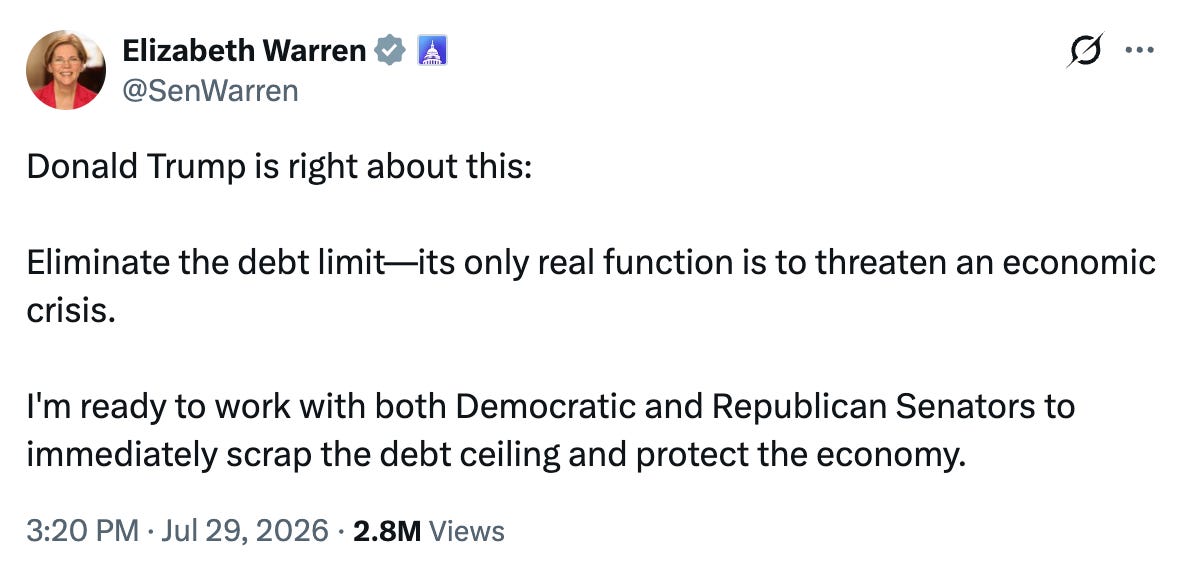
Plus, they’re told by the likes of Senator Elizabeth Warren (D-MA) that it’s just those pesky greedy corporations that are driving prices up. Sen. Warren has never once publicly mentioned anything about the damage that the U.S. Federal Reserve and U.S. Treasury has done to the fabric of American society via its money printing an debt issuance, respectively.
In fact, Sen. Warren wants there to be no limit to the amount of debt the U.S. can issue.
Truly insane.
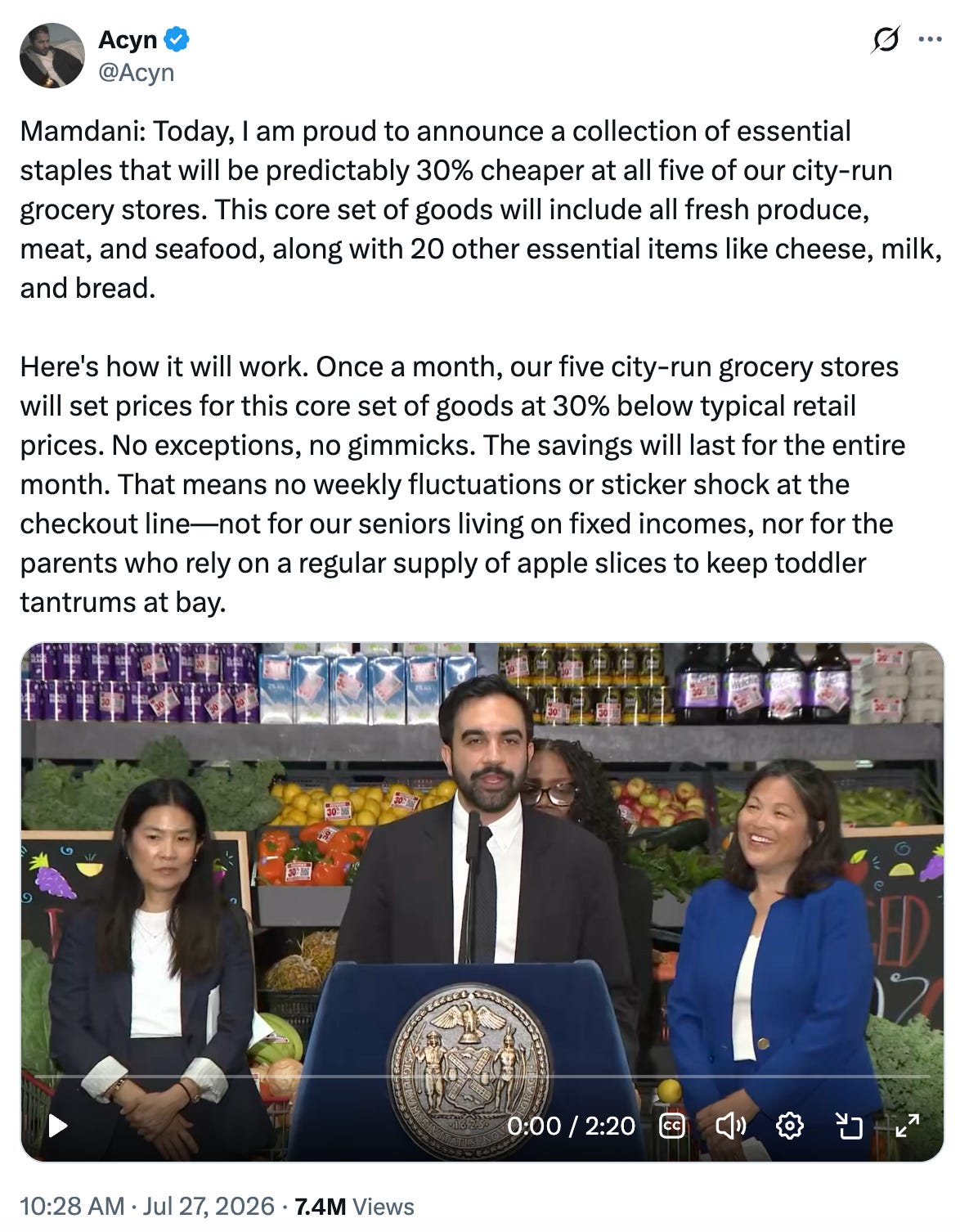
And when things get this insane, more and more people gravitate towards other insane ideas, like lets-have-the-state-control-everything-style socialism.
For the record, I’m not against the rich paying their fair share in taxes, and I’m mostly a centrist when it comes to political views. However, I am against the state intervening in places where the market should be solving the issue.
And before I continue, I will say that I don’t blame the poor for wanting grocery stores that offer food at a 30% discount. People are hurting, and I can both sympathize and empathize with that.
I can also zoom out and view things from a systems perspective, though, and what Mamdani is now trying is a version of something that has have always ended very badly historically.
State-run grocery stores and/or price controls inevitably lead to shortages, as they artificially increase demand, while creating an economic scenario where producers and those on the supply chain aren’t earning enough to sustain their businesses.
State-run stores also hurt local businesses, which are major contributors to the tax base.
Let me try to paint this picture in the simplest terms possible.
Let’s say you own a cafe and sell coffee at $3 per cup. Then, the government comes along and says “everyone should be able to afford coffee, so we’re going to sell it at state-run cafes at $2 per cup.”
Now, more and more people go to the state-run cafes, putting the private cafes out of business and putting economic strain on the suppliers of the coffee beans and others on the supply chain for the state-run cafes. This leads to shortages, which, in turn leads to the closing of more and more cafes, which, in turn, leads to a shrinking of tax revenue.
When you mess with prices, the inevitable result is scarcity or shortages.
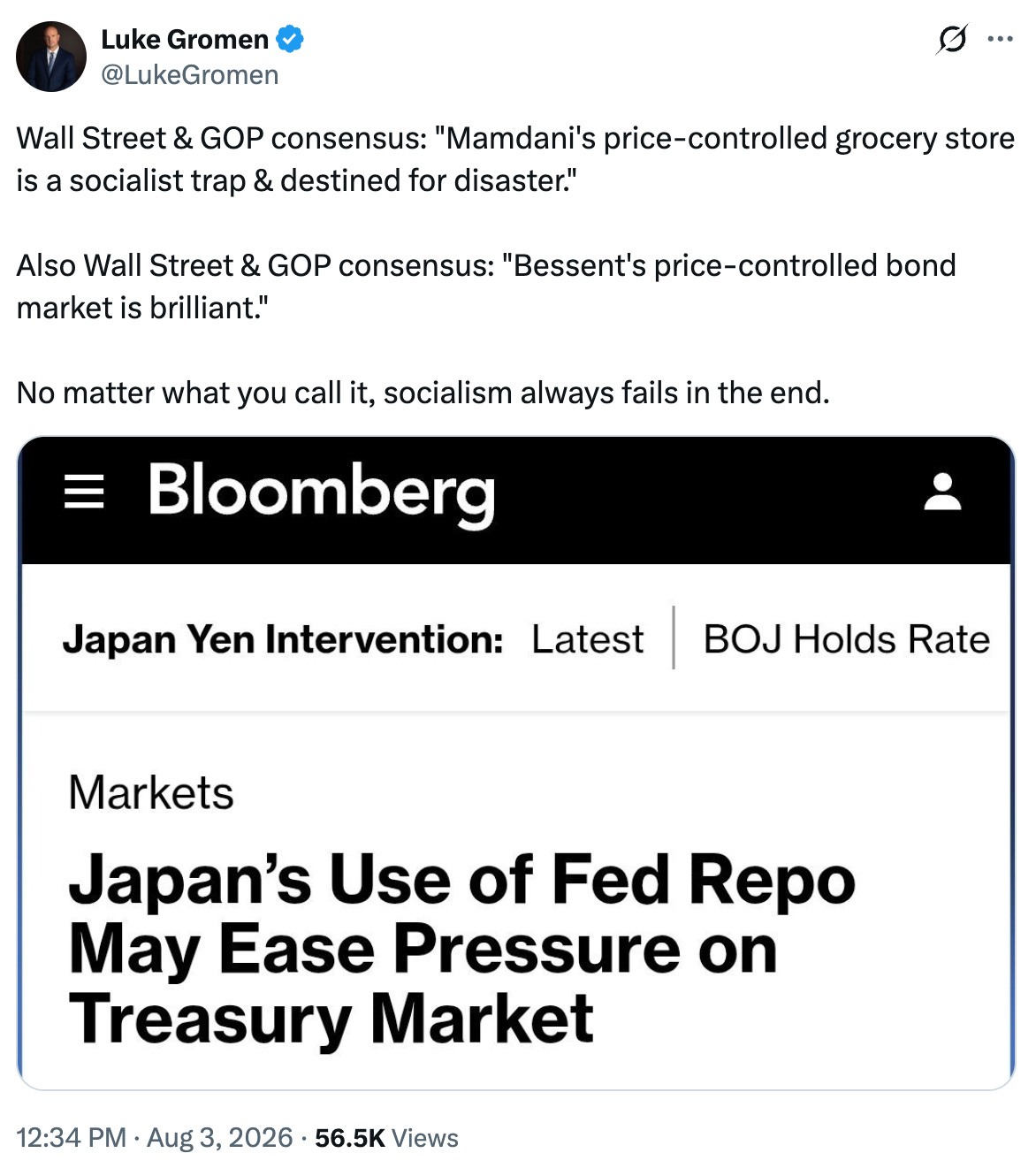
That said, the reason I’m personally not so quick to criticize Mamdani is because I think we live in a system of socialism for the rich where banks get bailouts and markets are controlled and propped by bureaucrats, and I think that style of socialism leads to the poor, young, and disenfranchised demanding their own style of socialism.
But I’m getting off track.
I write this edition of the newsletter because 1.) I believe the devaluation and people’s time and labor via money printing and excessive debt issuance is the primary factor that has led to the wealth divide and subsequent social unrest in the U.S. and 2.) I don’t believe the Mamdani’s approach nor the approach of D.C. bureaucrats who intervene in markets are good or sustainable approaches and that both will end in collapse.
And, the solution to these unsustainable practices, IMO, is Bitcoin.
Some refer to bitcoin as digital gold, but it’s actually much better than that.
It’s finite supply makes it like gold in that it’s scarce, and because it’s scarce — perfectly scarce, at that — it’s a good tool for preserving value across time and space. And the more people who use it, the better of a tool for this purpose it becomes.
Bitcoin is also politically agnostic. It isn’t just for those on the political left or those on the political right — it’s for anyone.
With that said, it does fit into the agendas of both the left (e.g., it’s a great tool for financial inclusion) and the right (e.g., it enables self sovereignty and helps one “pull oneself up by the bootstraps”).
Beyond these characteristics, it’s also a money that can be sent permissionlessly from one person to another globally without an intermediary.
This gives it tremendous value and also makes it easier for businesses to pay talent anywhere in the world for their work.
I advocate for Bitcoin because I don’t believe the answers to many of the issues we’re currently facing here in the U.S. and also globally are going to come from within the system.
The system — which includes those on both the political left and right — is incentivized to perpetuate itself, and it’s currently best serving only those at the financial top of it.
And those at the top continue to benefit from it as they can continue borrowing money that continues to be debased at low rates to support their lifestyle while the numerous assets they hold continue to increase in value, mostly as a result of currency debasement.
Those who’ve been disenfranchised via fiat currency debasement are re-enfranchised on a bitcoin standard.
So long as Bitcoin remains decentralized and secure, it has the potential to offer people a more dignified life — one in which their time and labor is respected and one in which they can economize and work hard to create a better life for themselves again.
I’m going to skip the market section for this week, because this post took a bit out of me.
If you found it helpful, please feel free to send some sats over Lightning to frank@primal.net.
Thank you for reading, as always, and here’s to a great week ahead!
Best,
Frank
No posts
Comments
Nothing yet. Say the first thing.
Sign in to join the conversation.