
Rain and hail are pouring down the back side of La Coullotte Ridge as I stand soaked and shivering beneath a grove of Aspens. We’re racing at about 7,800’ across a 30-mile ridge in Southwest Alberta, near British Columbia. The pressure in my ears hasn’t equalized and the raindrops mix with my heartbeats, echoing like I’m underwater. Now the shivering is extreme. I need to move.
It’s Friday afternoon in the mountains and Dad has one more gift to pass on.
Modern culture avoids failure. It’s treated as a character flaw. It’s not OK to be struggling. If you failed, you mustn’t have known what you are doing. What a fool.
Meanwhile Social Media highlight reels celebrate the finished product whilst hiding the thousands of attempts it took to get there. We are conditioned to expect success without setbacks. That’s not how life works.
Growing up in Dublin I was encouraged to explore. To try things that probably wouldn’t work. They usually didn’t. But it was fun to try and maybe learn something new. And Dad was always there to encourage me and give me new ideas.
Dad and I got into Crowsnest at 10PM MDT on Wednesday night after a long day of traveling from the East Coast. Camp was dead quiet and I followed the instructions on how to self-check in. We were staying at Castle Mountain campgrounds which would serve as the Start/Finish of the Divide 200, a two hundred mile ultramarathon in the remote backcountry of Alberta. This is the 3rd year of this race and they’re still ironing out the kinks.
5AM Thursday morning I went outside to check the temperatures. It felt fine in just pants and a t-shirt on this empty night. I hiked up into the hills nearby. The moon was waning gibbous and there was plenty of light. The sun would be up soon.
The forest shifted as I hiked down the trail. Something was staying just out of reach. I soaked up the peace by a nearby stream and tried to imagine the nights to come.
“It’ll be grand” said Dad and I agreed.
We walked back without a word as the camp slept and went back to bed.
Race Day arrived and I went down to the race HQ to have breakfast. We’d received emails, even pre-paid for the food. When I asked Brian the race director where breakfast was, he told me “they’d forgotten to make it.” I didn’t realize it then, but this would be the first domino.
Ultrarunning is no different than life; small preparation failures can compound into major disasters.
I put the lack of food behind me and wandered around nervously for the next hour, checking my gear and chatting with other runners and crew.
A single butterfly landed on the sunlit corner of a wooden picnic table and warmed its wings in the dawn.
8AM Friday - We took off into the hills. I set out running and just tried to settle down. The start of races is always full of anxiety and tension, it’s nice to just get the body moving and let everything settle.
“Take it handy” said Dad. And I probably should’ve listened.
Dad was an accomplished cross-country runner in his day having been raised on the hills of Thurles, Tipperary. He grew up pushing a boneshaker through the winding roads of Upperchurch and had visited Alberta Canada and these very mountains back in 2005 so this was nothing new for him.
I did NOT take it handy. Without realizing it I was racing, something you never want to do on the first day. I was running 9 and 10min miles across fairly smooth trails and feeling good. It felt nice to be out in the woods after a year of anticipation for this event. I reached the first climb and started bombing up the hill. But this was not a hill, it was a mountain. The grade was 20% with spikes up to 40% and it lasted miles.
After about an hour of climbing we broke out above tree-line and saw for the first time the ridge above Crowsnest and Castle Mountain. I was hungry and blood sugar was low. My stomach and heart rate collided and I threw up for the first time. It was morning still, just a few hours into the race.
“Not to worry” says Dad. “Not a bother” says I and continued to push further into the race.
We climbed. And climbed. And within another hour I’d thrown up again. I decided I’d better eat so I forced some calories down and pressed on. I won’t bore you with the details but for the next 24 hours I repeated this process of throwing up, forcing calories down, feeling good for 5 mins and then it came back up. Continuously.
I got up on top of one of the peaks and took a rest. Here on this peak scree and shale and rock overlooking all of Alberta I met the most ambitious spider I’d ever come across. He (or she) had spun a web inside a hole in a rock, hoping to catch some insect or some such at 8,000’.
I said out loud “he won’t catch too many flies up here”. And Dad agreed.
We continued on, back down the ridge and sliding and surfing the shale and the scree and I realized the game; Climb a peak, throw up, enjoy the incredible view and head back down into the saddle, climb up the next peak and continue. We’d be up and down these all day.
Up on the ridge line, death is cloaked in beauty. Course markers sit feet from cliff walls where the edge rolls back so you can’t see how close you are to meeting your maker. It would’ve been so easy to just step off into The End.
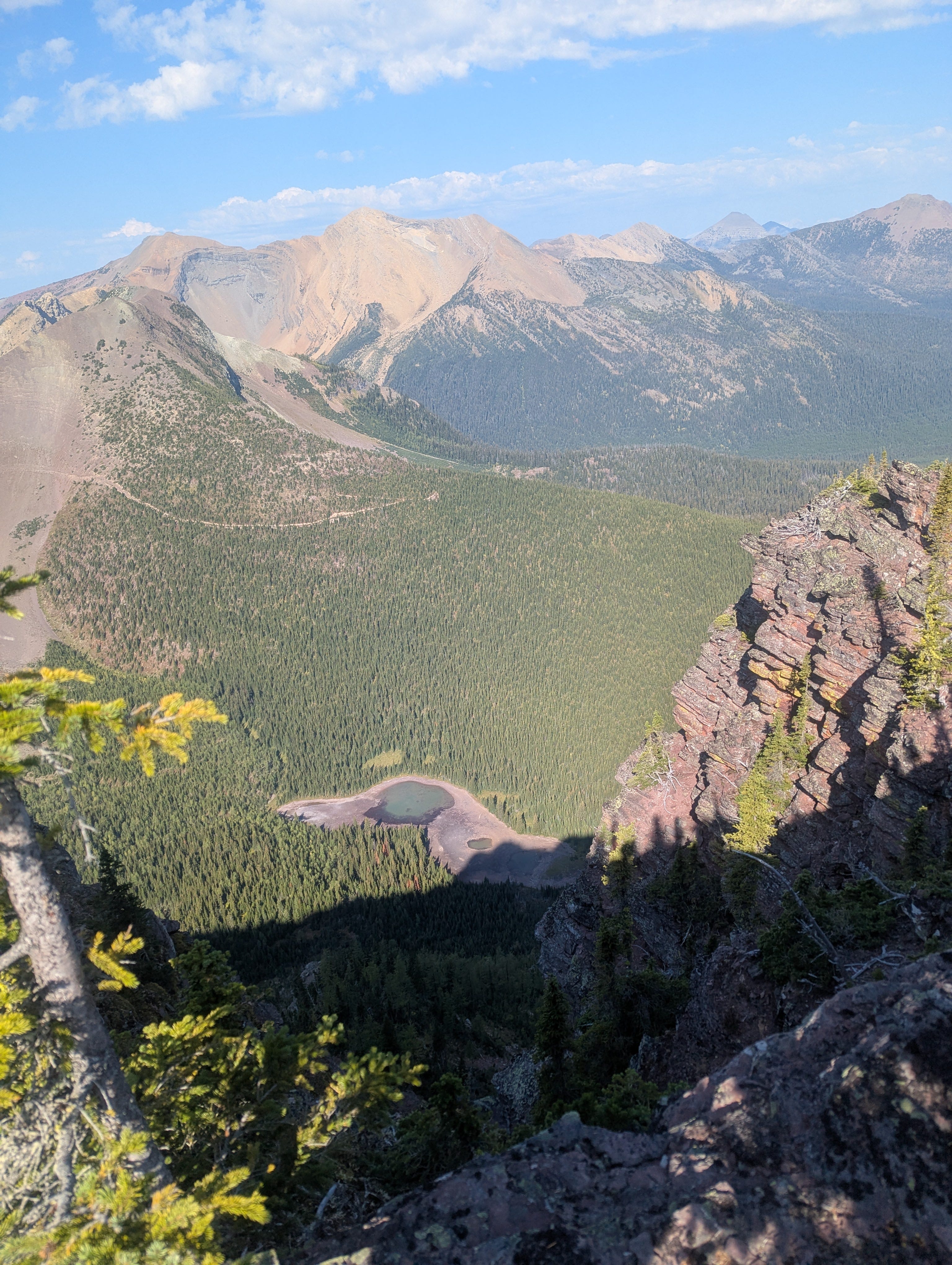
“It’s just like the Dublin mountains,” joked Dad, hearkening back to days when we’d cut turf in Wicklow to heat the house for the winter. Dad would coax the Renault 4 as it struggled through Enniskerry and the Sally Gap with the trailer bouncing along in tow.
Here in the Canadian Rockies, I said the thing that’s become my personal cliché: “Jaysus we’re a long way from Donnycarney” and Dad gave a quiet chuckle.
This terrain is remote and Safety and Rescue would need to hike in. There’s no helicopter if things take a turn. No one is coming to save you. I was a long way from my comfort zone but managing risk is part of my life and thankfully I had Dad along for the ride.
We climbed through the night, up Whistler and Table Mountain and back down. I couldn’t take any calories in and things weren’t improving so at checkpoint 4, I finally called for the medic. They took blood pressure, then blood sugar. After pricking my finger, no blood would come out. I was dried up. It took five minutes of coaxing for the tiniest drop to collect.
As I sat motionless, trying not to throw up, the sun moved across the sky and warmed my legs. Another tiny butterfly lit upon the grass, maybe the same one from the morning? and here, with my body broken and my spirit fully emptied out I thought life doesn’t get any better than this does it?
I had reached my Failure Point. My race was over. After 24 hours, I couldn’t continue without putting other people at risk for my safety and that’s where I called it. I took a ride back to camp and informed the race officials I would be DNF’ing.
In 2012, I got the call that Dad had passed away. We carried him from the church to the graveyard in Upperchurch and we lowered him down. My cousin thrust a shovel in my hands. I felt like I could see through the lid of the coffin. It felt wrong but I took the shovel and did what was expected and it wasn’t 5 minutes before he was covered by the cold. And the dark.
As immigrants, we lose our families not in death but in small tiny pieces. In the Goodbyes. When we walk out the front door to the airport. When we board the plane and again when the call comes to “come home as soon as you can”. The funerals aren’t real, just part of another visit, another plane, and a thousand more “goodbyes.”
Dad was never the center of attention in life, but he found ways to let you know he was there if you needed him. And he still does. This trip and the race and experience overall genuinely scared me but I felt him close. In all the little things.
This was a failure. I didn’t finish the course. I made mistakes. I wasn’t fit enough, wasn’t prepared, Etc. Etc. It’s part of the process. And when the goal is huge, reaching Failure is kind of the point.
Let’s normalize trying hard things. It’s ok to Fail if you’re aiming Big! Share this post and be the Hero your team needs.
Failure is a tool I can use if I can accept it. If I’m not failing occasionally, it probably means I’m not choosing hard enough goals. If I lean in I can make the failure productive. Through Introspection I can learn. Rebuild. And maybe come back stronger or with a new approach next time.
Dad led by example and taught me that the point isn’t to avoid failure—it’s to fail at things worth failing at. To take your idea and make it real. To build webs in impossible places because sometimes, when the wind is right, you catch something extraordinary.
What’s been your biggest failure? Is it something you regret? Or revel in? Did it break you? Or did you learn from it? Share your biggest failure in the comments - not the sanitized LinkedIn version, the real one that left you sitting in the dirt wondering what just happened.
I know myself. I have good people around me. And I have my father’s legacy. Dad and I will go back to those mountains and on to new mountains. We will try again. And we’ll fail again. Fail better.
A great friend (PC), one of my oldest and best reminded me when I got back, “the only failure is in the not-trying”. He’s not wrong.
For now, I’m just happy to live in the little things—butterflies on grass, ambitious spiders in unlikely places and the echo of a quiet chuckle whenever I feel like I’m a long way from home.
Dad, I would send you this post but I don’t know your forwarding address.*
*With thanks to Richard Feynman
Comments
Nothing yet. Say the first thing.
Sign in to join the conversation.