
Why this essay? Something significant shifted in our valley this week. I’m not quite sure WHY, so this essay lays out where my thinking’s at about bioregionalism as an emerging form of the next iteration of human coordination. My simple but rather bold claim is that each bioregion that can tell their story from a TIMN perspective, establishes itself as a node in the emergent global network of Mycelial Coordination.1
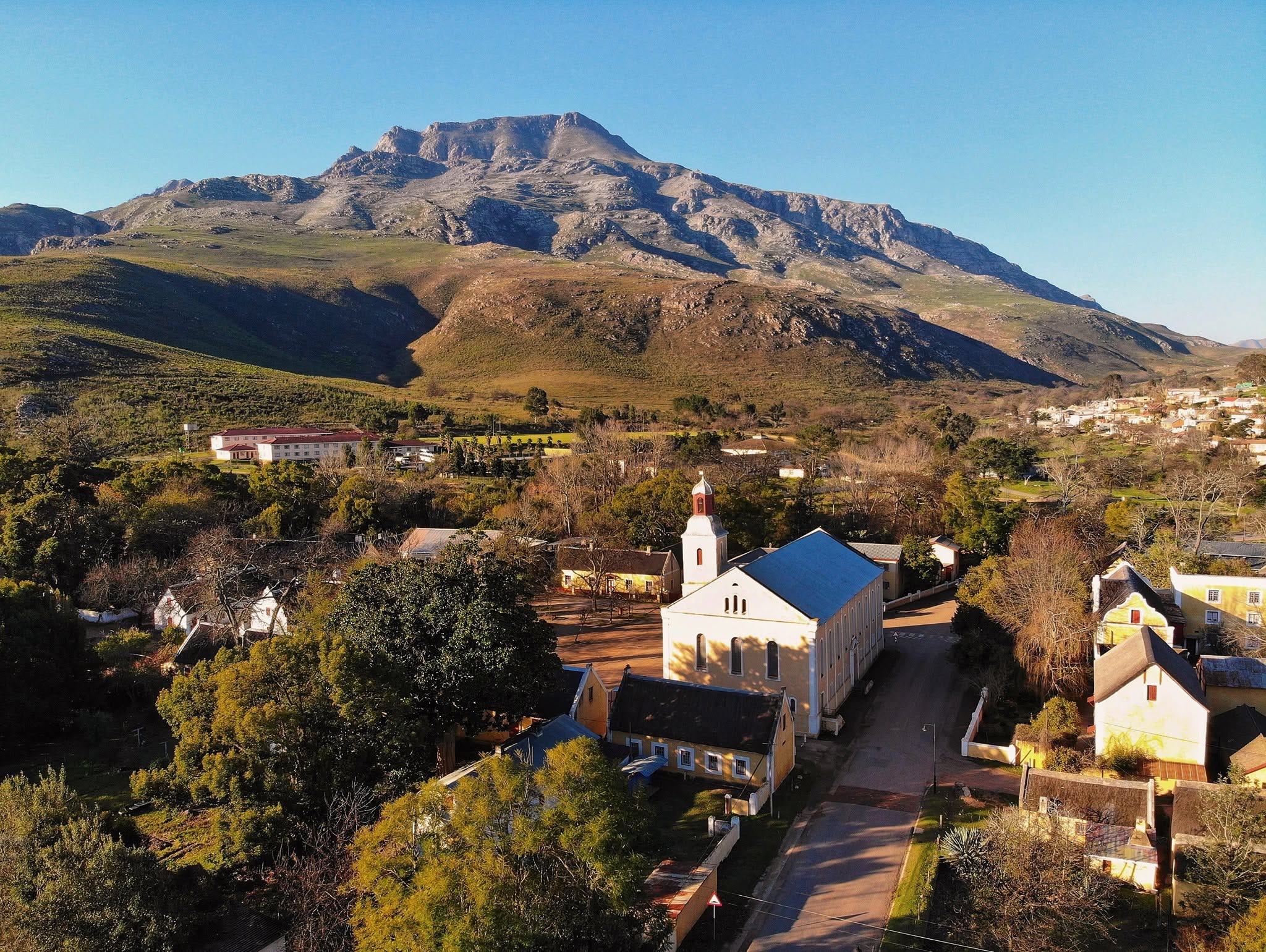
First a little context about the work I’m involved with in the Valley of Grace (Genadendal), Western Cape, South Africa. A small group of people came together in 2014 with a vision for the valley in which everyone thrived. With a more than 80% unemployment rate and the associated social ills that come with poverty, this seemed like a tall order. The group has changed shape over the years as people come and go, but the vision has remained consistent. Today I’m the only person left from the original group.
Over the past three years, we’ve partnered with an organization called Ranyaka Community Transformation, which is an urban planning non-profit and development agency. Through a series of community engagements we’ve mapped all 203 initiatives active in the valley and we managed to form a collaborative focussed on establishing a food forest on land made available by the Moravian Church. On the surface, this looks and feels like progress, but if I’m honest, it hasn’t exactly been plain sailing. We’ve constantly been hijacked by various groups who don’t like some aspect of the direction the community has told us they’d like to head in. In December 2025, when we thought we’d be able to conclude negotiations in what was to be the final community engagement meeting, the wheels again fell off. Some version of this pattern has repeated over the years, and I’ve heard from other bioregions that this is not uncommon. But the challenges aren’t the theme of this essay, so I won’t bore you with the (gory) details.
A few months ago, I was introduced to someone who was born in the valley but had spent most of his life elsewhere. Now that he’s retired from various corporate roles, he’s returned to the valley. As we got to know each other and trust developed, we started seeing the significant overlap between the work we’d been doing and what he wanted for the valley. More importantly, he knows the politics of the valley exceptionally well, through family members that kept him informed despite his absence. At some point I asked him whether there was perhaps a handful of (elderly) people who watch with bemusement what happens in the valley from the sidelines. In other words, are there people who know how complex the politics are and refuse to get involved in any initiatives because they don’t see any hope of getting anywhere. Turns out he did know of such a group. I suggested we meet.
That meeting took place on Friday, July 3rd, and the meeting went exceptionally well (rare for a first-time meeting with local community members). They were so inspired that we met again the very next day, and two more people joined. We then met again on Tuesday, July 7th, this time for a hike and drive through the valley. With each engagement, their excitement mounted. We had another meeting yesterday, Saturday, July 12th. This time, they’d brought a legal person with them who could advise on the formation of community cooperatives and trusts. This speed of engagement has never before happened in the valley, and these were all people I’d never met before. This is what I meant when I opened the essay saying something significant shifted in our valley.
The obvious question is, Why the sudden excitement, considering we’ve been plugging away at this for over a decade?
I believe it’s simply because we narrated the (tumultuous) history of the valley in a way that has never been told before. Using TIMN, I showed how forms of human coordination had evolved fairly precisely in the valley, summarized from extensive historical records of our valley:
Pre-1737: The Tribal Kinship Pool - This period consisted of Khoekhoen herding and Soaqua hunting-gathering economies in the Riviersonderend range. It includes rock art, cave sites, and archaeological evidence that establish thousands of years of kinship-based coordination before European contact.
1737 - 1838: The Institutional Phase - Includes a long history of how a Moravian missionary established what came to be the largest human settlement at the time, outside Cape Town. Also shows how the building of a forge enabled the first form of Market to emerge with the making of hand-crafted Herrnhut knives, which entered the colonial Market from a community-led workshop and cooperative. Includes the release of 39,000 enslaved people at the Cape after slavery was abolished, many of whom came to the valley.
1860s - 1960s: The Rise and Slow Demise of the Market Phase - Thanks to the Industrial Revolution, British industrial goods started arriving by steamship, displacing local crafts. The Market phase begins dismantling the mission economy by price competition. Out-migration to cities begins and in 1950, the Group Areas Act forcibly removes non-white residents from their land.
1990s - today: The Network Phase (which really should be called something more akin to what unfolded, perhaps iNtegration Phase - Apartheid was a legislated false-tribe overlaid on the Market phase; its removal was the precondition for any real +N to become possible in the valley or the country. Mandela was released from prison in 1990, became president in 1994, and visited the valley in 1995, after which he renamed the presidential residence from Westbrooke to Genadendal. The ending of apartheid was the first time in South Africa that different races began collaborating. The TIMN sequence had been completed.
More importantly, I framed the progression as leading towards an Economics of Belonging, which transcends all forms of TIMN coordination. I made it clear that the choice facing all of us was whether we accept or reject the responsibility of making this visible to others in the valley, particularly school leavers.
This reframing of the valley’s struggles as merely the necessary baby steps to get us to the cusp of a new form of coordination that, if accomplished with integrity, could restore the valley to a destination that attracts people from all over the world.
I’ll be writing more about an Economics of Belonging in future. It’s essentially an economic system in which a community creates an institution that holds a common pool, governs how people contribute to it, and protects each member's right to draw from its output. This is the arrangement the Moravian mission economy ran for a century, the arrangement Mondragon has run at industrial scale since 1956, the arrangement Ostrom documented across centuries of surviving commons, and the arrangement the stokvel already practices in almost every South African township.2 It is old material, tested, and legible in law.
For this week, I just wanted you to know that a new narrative has very significantly and rapidly shifted the energy. We very quickly put an invitation together which we haven’t started circulating widely yet. But those who have seen it are super-inspired to get involved. You can get a sneak peek of the draft invitation here.
I don’t yet know whether this kind of narrative would be useful to other bioregions, but I suspect it might. If you’re doing any kind of bioregional work, I’d be delighted to help you craft your own TIMN narrative.
That’s all for this week.
Next week I’ll start unpacking how we’re thinking about Transformative Tourism and how we’re pitching it to national government as a strategy that can be rolled out across the country.
Until then, remember to love the ones you’re with, and frame on!
Michael 💚
TIMN is David Ronfeldt’s model of how human coordination has evolved over time through Tribes, Institutions, Markets and Networks. While I’ve known about the model for more than two decades, it has become increasingly relevant in our work. See https://bit.ly/3FypJx8
A stokvel is a community-led savings or investment syndicate where members regularly contribute fixed sums to a common pool. Rooted in South African culture, these invitation-only clubs rely on trust and mutual support, with funds paid out to members either in rotation or toward a shared financial goal.
No posts
Comments
Nothing yet. Say the first thing.
Sign in to join the conversation.