
Why this essay? I’m a big fan of Will Ruddick’s work on Commitment Pooling.1 However, I’ve not been able to find any examples of it working at a scale larger than small, rural communities. During a meeting with our local municipality this week, a profound example popped up, unplanned and unexpected by anyone who was there. This essay explains what happened. While it’s completely specific to our local situation, I think you’ll find some resources that may prove helpful, especially if you’re curious about models emerging while everything around us implodes.
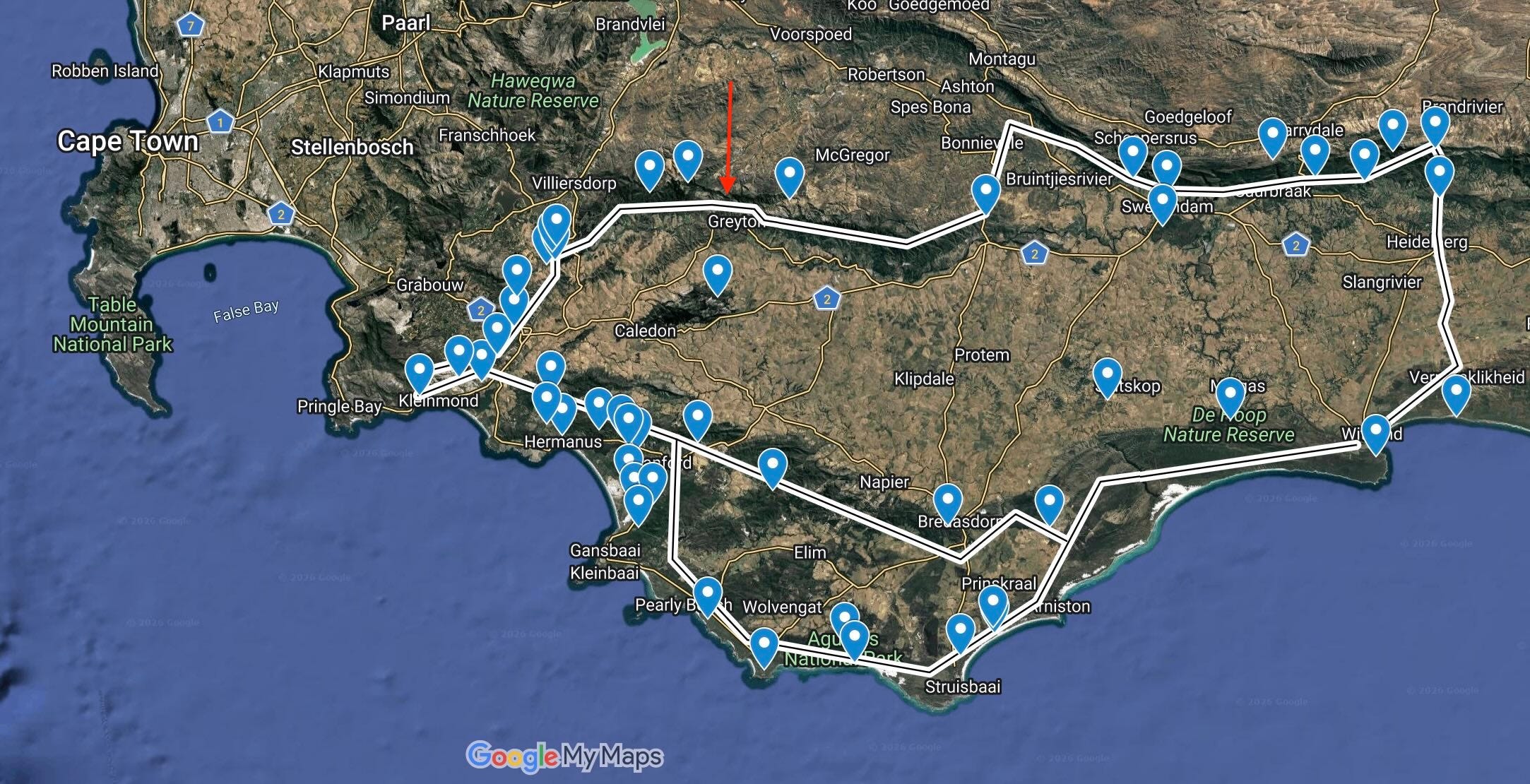
A few context-setting snippets so that the remainder of the essay makes sense.
Our local municipality is the Theewaterskloof Municipality. From now on I’ll refer to it as TWKM.2 Our valley is called Ward 2 and there are a total of 13 wards in TWKM. Our local municipality forms part of a district municipality called the Overberg (ODM).3 It gets a little more complicated after that, so I’ll just say that we are nested in the wider Western Cape government (WCG).4 You can see how Ward 2 is nested in these various structures in a handy interactive South African district map.5 The important bit about this context is that it’s all geopolitical nesting — what I’ve laid out has nothing to do with bioregionalism.6
Our local municipality (TWKM) is one of many municipalities in South Africa operating under a Municipal Finance Recovery Service.7 In essence, the municipality is bankrupt, as a result of high levels of fraud and corruption across all levels of government in South Africa. The context is that service delivery in all these municipalities is essentially non-existent, leading to common complaints from all businesses in affected areas. Personally, I view this as a wider global reality of the final phase of the Cycle of Globalization, rather than something to debate or question.8
The Western Cape government (WCG) has made various commitments to double the number of international visitors. One proposal aims to do so by 2035.9 The other, a Tourism Growth Fund, is more aggressive and aims to do so by 2030.10 The context is that Cape Town, the primary destination, cannot handle this increased volume because of extant pressure on its already-inadequate infrastructure.11
Our valley (Ward 2 of TWKM) has no official representative body. While there’s too much nuance to unpack here, there is a distinct racial divide between residents of a predominantly white tourist hub (Greyton) and a predominantly Khoisan heritage hub (Genadendal and settlements). The two towns are only 5kms apart, but may as well exist in different universes. To address this absence of representation, I am currently convening the Ward 2 Business Forum. You’ll find an explanation of why a business focus, as well as a link to our website in the footnote.12
Ronfeldt’s TIMN framework is an important pillar in our valley’s revitalization strategy.13 We’ll be publicly launching the Valley of Grace Destination Management Plan in October this year, but there’s a top secret website preview in the footnote.14
The meeting I attended this week was framed as a TWKM business partnership meeting. While hosted by the municipality, they made it clear that the onus lay on businesses to establish ways of solving challenges without municipal funding. They were playing the role of enablers and connectors, a to-be-expected signal of +N in the TIMN model. The meeting was part of the Western Cape government’s Economic Development Partnership program, again another signal of +N.15 The meeting opened with us all introducing ourselves, including an explanation of why we were there. Almost every participant started with a complaint around service delivery. There were three main themes: slow emergency responses and poor service at the only hospital in the area; transport, which covered lack of public transport as well as the state of paved and unpaved roads; lack of progress on a regional airport, which has been in discussion for at least 15 years.
The energy of the meeting shifted significantly when I asked what commitments we could make to WCG to help them ease the inevitable infrastructure pressures that a doubling of international tourists would represent. It shifted the conversation from “what do we need” to “what can we offer.”
OK, that’s a heck of a lot of context setting. Now let’s dive into what happened in the meeting and explain the map at the top of this essay. Thanks for hanging in there.
The shift from “what do we need” to “what can we offer” took about a minute. The consequences took the rest of the meeting, and are still unfolding in emails, calls, follow-ups, and quiet side conversations all this week.
Someone brought up the leopard cameras in our Nature Reserve, run by the Landmark Foundation.16 Someone else mentioned the Genadendal indigenous nursery, run by the Zonderend Water Users Association.17 A third voice named the Bot River biodiversity wine estates. Then Grootbos on the coast.18 Then CapeNature’s stewardship program, then Wild Restoration, then the Nuwejaars Wetlands. Within twenty minutes the room had assembled, out loud, a picture of the Overberg that none of us had ever seen mapped in one place before.19
By the end of the meeting the map at the top of Part 1 was underway. It shows forty-plus institutions, tourism operators, funders, and NGOs already running conservation and restoration work across four corridor segments from Witsand on the coast to Villiersdorp inland. The map’s power comes from putting long-existing entities on the same page for the first time.
Ronfeldt’s four coordination forms sit inside each other. In our meeting all four were visible in the same room.
The complaints were +I. This was the trap keeping us waiting for institutions to deliver on roads, transport, and hospital services they can no longer fund.
The individual businesses in the room were +M. Each was engaged in fierce competition for their share of tourist spend, their share of grant funding, or their share of attention.
The Municipal Finance Recovery Service is +I trying to save +M from itself.
And what emerged when the question changed was +N. All of a sudden, forty-plus existing operators shifted their focus toward a shared offer.
Commitment Pooling has different forms too, and this is where Ruddick’s work helps us understand what unfolded in the room.
Most writing about Commitment Pooling I’ve come across describes horizontal exchange. It takes the form of peers pooling with peers, inside a community, with commitments circulating among members. Ruddick’s work in Kenya is horizontal in this sense, and so is the ancestral Mweria tradition it’s modeled on.
What the Ward 2 Business Forum stumbled into on Wednesday morning is vertical.
The pool forms horizontally across the four corridor segments. It then points upward, offered as a proposition to the Western Cape Government that stands to see international arrivals double by 2030 and knows Cape Town cannot absorb the increase.
The offer is straightforward. The Overberg already contains most of the pieces of the destination the province says it wants to build. Coordinate with the corridor and the doubling target becomes achievable while easing the pressure on Cape Town’s infrastructure. Fail to coordinate with the corridor and the province meets its target by breaking its capital city.
That is a coordination move the province has no formal framework for receiving yet. The Economic Development Partnership program and the Partnering Platform suggest they are feeling around for one.
Every institution we depend on is failing at some level. School boards, medical systems, city councils, healthcare networks, or provincial departments are all experiencing the limits of late-stage globalization. The reflex is to escalate the complaint upward, hoping +I logic will repair itself or swoop in as a savior. It rarely does.
The alternative is to ask what your initiative actually has to offer, and to whom it will appear irresistible. Complaining about the status quo may be justified, but it keeps us trapped in +I dependency. Committing whatever we have to offer shifts the entire possibility space into +N logic. The same words, spoken in different coordination forms, land in entirely different worlds. Institutions respond very differently to an offer than they would otherwise respond to a demand they’re completely unable to fulfill.
Whether WCG can receive what’s being offered. The +N form has to survive its encounter with +I logic, and that survival isn’t guaranteed.
Whether the shift can be replicated. I happened to ask a specific question at a specific moment in a specific audience and the response unlocked thinking we had no idea even existed. I’m entirely unsure whether the same outcome will result, given a very different setting.
Whether the Commitment Pool that emerged can maintain integrity when money starts moving through it. Ruddick calls the failure mode “+M capture risk.” A regenerative corridor can quietly concentrate benefits among lodge owners while passing over the communities on whose land the fynbos actually grows. Grootbos is both a world class benchmark and a warning at the same time. Whatever we build will need internal accountability structures, or the +M pattern will reproduce itself.
That’s all for this week.
Next week I’ll dive deeper into the Transformative Tourism pitch, as well as provide feedback from a meeting happening this week with representatives from national tourism.
Until then, remember to love the ones you’re with, and frame on!
Michael 💚
Commitment Pooling is a mechanism for curating and fairly exchanging resources within communities. It is based on the idea that commitments can be effectively pooled to create a more equitable and collaborative economic system, and echoes traditional mutual service practices like Mwethia. The concept is based on Promise Theory. You can learn more about Commitment Pooling here https://bit.ly/CommPool, which includes a brief explainer video and a 2024 paper from Ruddick.
Bioregionalism “Refers both to geographical terrain and a terrain of consciousness — to a place and the ideas that have developed about how to live in that place.” It is distinctly different to geopolitical boundaries, which are artificially drawn across geopolitical maps. See https://bit.ly/B10Reg
I provide a summary of the Cycle of Globalization at this section of the Threshold Guide essay.
The Tourism Growth Fund is designed to unlock private and third-party investment, strengthen destination and product competitiveness, and support tourism enterprises to grow, create jobs and help double international arrivals to the Western Cape by 2030. https://www.westerncape.gov.za/edat/tourism-growth-fund
There are numerous prosocial activities in our valley, all of which are doing admirable work. That said, I am more and more convinced that commercially-motivated bodies are going to play a crucial role in helping us navigate the transition. You can find the website where I’m framing this approach, while avoiding all and any mention of collapse at https://bf.valleyofgrace.co.za. You’ll also see how I’m framing Regenerative Tourism as a key pillar of the transition.
If you’re not familiar with TIMN from my earlier writing, it’s essentially the evolution of human coordination through four distinct phases: Tribes, Institutions, Markets, and now the emerging form of bioregional Nodes or Networks. To dive into the original research from David Ronfeldt, see https://bit.ly/TIM-N
It’s only top secret because we are still finalizing some of the sensitivities between the two distinctly different settlement in our valley. An important disclaimer will pop up when you visit the Valley of Grace’s prelaunch website: https://valleyofgrace.co.za/launch
The South African government has developed a +N platform, although of course they don’t refer to it using TIMN framework. I find the evolution quite profound. Later in the essay, you’ll see the link to Commitment Pooling. See the platform at https://partneringplatform.co.za
Grootbos is a luxury 5-star private nature reserve (Leonardo DiCaprio has stayed there) spanning 3,500 hectares between mountains and the sea near Gansbaai, approximately 75–80 km southwest of Greyton, featuring indigenous fynbos and ancient milkwood forests. https://www.grootbos.com
The resulting partnership proposal can be found in this Google doc. We’re still refining it, but considering how quickly things are moving, I think this isn’t bad for a morning’s collective work. Feel free to take the principles from it and adapt for your own use.
No posts
Comments
Nothing yet. Say the first thing.
Sign in to join the conversation.