
Why this essay? In a much shorter piece than my usual missives, this essay plants a seed in the emerging field of regenerative movements that addresses the well-known issue known as lack of funding. By planting a seed, you’ll be able to add your own experience in ways that move the field forward. There are opportunities for collaboration at the end. Please reach out if anything resonates.
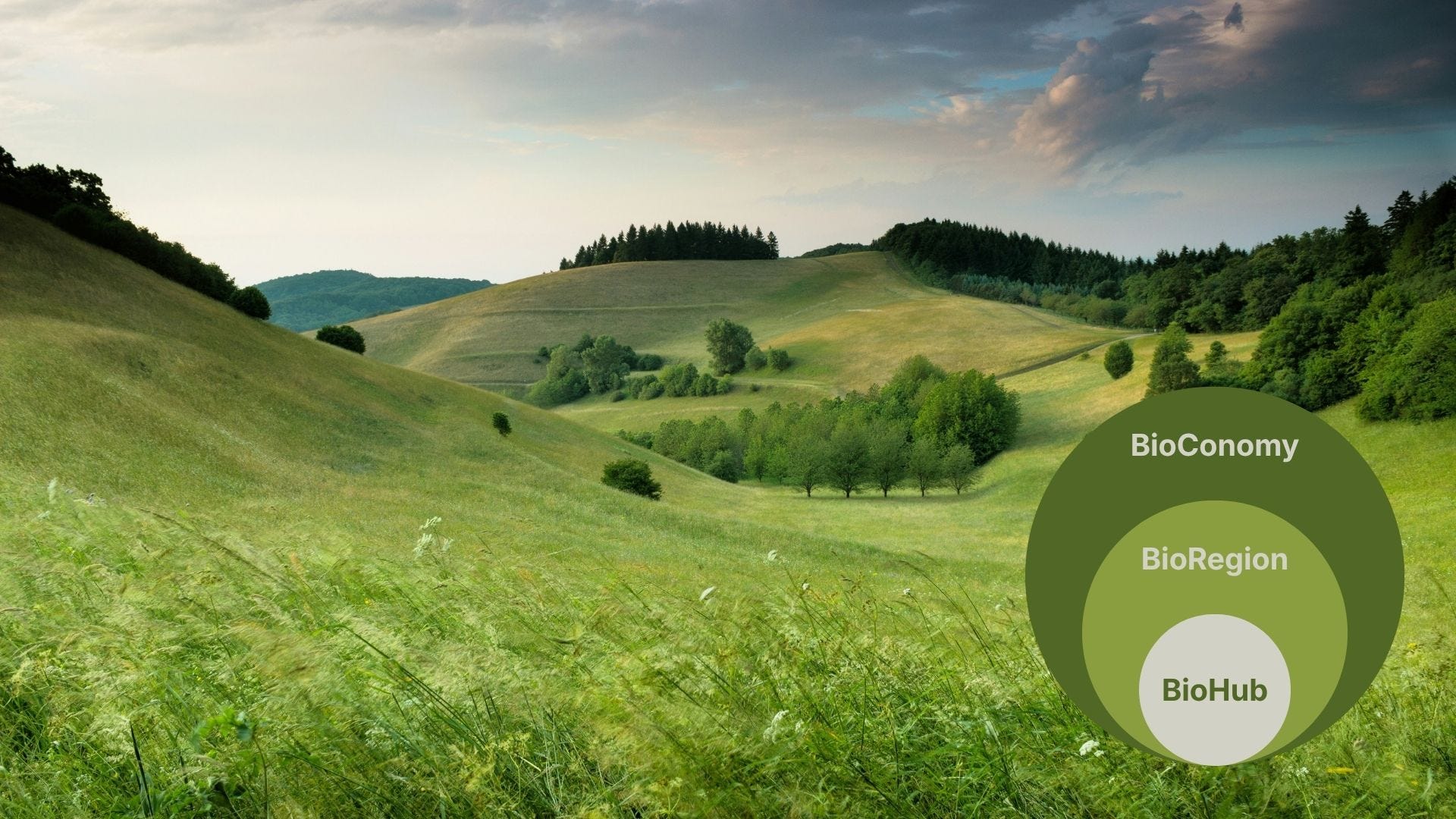
BioConomy: Distinctly different from a bioeconomy (lowercase), the BioConomy is the economic system that emerges when BioRegions focus their productive activity around biological resources, ecological restoration, and the carrying capacity of their landscapes, coordinated by one or more BioHubs. The BioConomy is the outermost layer of the BioStack, the nested three-layer structure through which bioregional coordination transitions from Throughput Economics to Regenerative Economics.1
Throughput Economics: Economic activity organized around the conversion of natural resources into goods, capital, and waste at increasing speed and scale. Throughput Economics built industrial civilization, modern medicine, global communications, and the material infrastructure on which every living person depends. For most of its history it operated on the steep ascending portion of a growth curve. The structural logic is extract, produce, discard, and grow. A throughput system that has overshot the carrying capacity of its substrate no longer produces net gains; it consumes the base on which its earlier gains depended.
Regenerative Economics: Economic activity organized around maintaining and restoring the substrate on which all production depends: soil, water, biological complexity, social cohesion, and the coordination capacity to steward them across time. Regenerative Economics encompasses regenerative agriculture, bioregional economics, commons governance, cooperative enterprise, community currencies, landscape restoration, and related disciplines. The structural logic is retain, restore, circulate, and coordinate. They are phases of the same civilizational growth curve: Throughput Economics built the material infrastructure during the ascending phase; Regenerative Economics organizes the maintenance of that infrastructure and its ecological base as the growth curve reaches its carrying capacity.2
The distinction between Throughput and Regenerative Economics enables us to sidestep the traditional moral distinction that extractive systems are bad and regenerative systems are good. Instead, the distinction is one of maturity.3
Longtime readers of this Substack will know that I’ve been engaging with the bioregional field as an enquiry into the evolution of forms of human coordination, rather than the specifics of what the field does. This inquiry has been informed by David Ronfeldt’s TIMN model, which explains that groups of people have variously formed in Tribes, Institutions, Markets, and Networks.4
As part of that enquiry, I’ve tracked the History of Bioregioning from the mid-1800s to include major developments usually excluded from field discussions.5 This includes themes like Bildung,6 Rudolph Steiner’s autonomous cultural/political/economic spheres,7 and long-standing cooperatives like Mondragon (1956) and SEKEM (1977). As part of tracking this history, I’ve noticed a significant quickening of developments in the mid-2020s i.e. now, even as, or perhaps because of how quickly the traditional +M form of coordination is breaking down.
I started teaching Will Ruddick’s Grassroots Economics to my daughter’s Waldorf-inspired class 6 this week.8 This experience has led to the development of BioConomy as a 5-year project-based learning curriculum for her high-school education, which will start in 2028.9
Longtime followers of my work will also know that I’ve at times been somewhat critical of the bioregional field, calling it fragile and underfunded, saying that we have a positioning problem in that we cannot expect the institutions we critique to fund their own downfall. I’ve stepped on some toes on that journey. I’ve also written about the gap between the maturity of legal, financial, reputational, and relational structures when compared to the +M form.
In my earlier work, I launched initiatives that attempted to fund the regen field: The Transition Collective (March 2024) and ERF, the Ecosystem for Regenerative Funding (June 2023). Both were spectacular failures in the traditional sense, but the experience taught me many valuable lessons.
The past two months has seen a significant shift in focus for me personally. I’m now engaging much more with wider ecosystem players in our BioRegion — the Valley of Grace, 90 minutes from Cape Town. While I’ve been deeply engaged in various community engagement activities over the past decade in our valley, I’ve never considered the direct impact our actions can have on the Cape Town water supply (significantly upstream from our valley). This has really opened my eyes to the huge opportunities opening up in the bioregional field that shift our efforts from being needy to being needed.
I’ve provided all that context to say that the introduction of the term BioConomy has a reasonable amount of depth behind it.
It was necessary context to get to the point of announcing the launch of https://bioconomy.earth.
While there’s only a basic website there currently, it felt right to mention this now as an invitation for collaboration. The website joins a growing seedbed of related activities, each reaching toward the evolution of the next form of human coordination. I’ve listed relevant domain names below, as well as the dates they were registered, so you can get a sense of the collective consciousness unfolding through the simple act of registering a domain name. I haven’t provided live links, because the trend is what I’d like to highlight, more than the content or theme of each website:
one.earth (2015) - redirects to oneearth.org/navigator (1996)
sanctuary.earth (2016)
bioregions.earth (2017)
bioregional.earth (2022)
regenerativa.earth (2022)
anura.earth (2023)
biofi.earth (2024)
ecohubs.community (2025)
bioregioning.earth (2026)
biohub.earth (2026)
biohubs.earth (2026)
bioconomy.earth (2026)
The BioConomy framework is very early. I believe the definitions are stable enough to hold their ground and the architecture has depth behind it (at least 13 years of thinking deeply about this stuff). But the work of making it useful to people in real bioregions, with actual soil and defined budgets, requires more mental capacity than I can offer.
I’m looking for five kinds of collaborators:
The first is those who can pressure-test the framework itself. The distinction between Throughput Economics and Regenerative Economics as phases of the same growth curve carries a lot of historical, structural work, and I’d like to know where the logic breaks down. If you teach ecological economics, or practice bioregional governance, or you’ve spent years inside the regenerative finance space and can see what I’m missing, please let’s talk. The framework is licensed CC BY-SA 4.0 because it needs to be refined in the open, by people who know the bits I don’t.
The second is practitioners who want to test the AI tools for their own BioRegion. There are three AI-assisted templates on bioconomy.earth: BioHub Identity, BioRegion Establishment, and BioConomy Value Proposition. They’re designed to help a group in any bioregion work through the structural questions that precede funding, governance, and action. They are prototypes. I’d like to chat with those willing to run them in their own places and tell me what works, what confuses, and what the templates assume that turns out not to be true on the ground. I’ve tested them all in our bioregion and they work well, but my own bias may be getting in the way. If you’re working at the bioregional scale anywhere in the world and are willing to spend a few hours testing, please reach out.
The third is educators. I mentioned that this work has led to a 5-year project-based learning curriculum for my daughter’s high school education, starting in 2028. The curriculum uses the BioConomy as the through-line: real bioregional challenges, real coordination problems, real ecological data, structured across five years of increasingly complex engagement. I’m not a curriculum designer. I’m a parent with a thesis and a curious (and maybe willing) school. If you work in project-based learning, regenerative education, or place-based pedagogy and want to help shape this, I’d be grateful for a partnership, in whatever form that might take. Waldorf, Montessori, and unschooling practitioners who see the connection are especially welcome.
The fourth is someone who can help me speak to the investment community. I certainly don’t want to pitch anyone, but I think there is work to be done to translate. It feels to me as if the BioConomy framework names something the impact investing world is circling without yet having the vocabulary for: the structural difference between making extractive capital flow to better destinations (which is useful) and building a coordination substrate where regeneration is the default economic logic (which is different). Katapult Future Fest, where Metabolic launched the BioHubs paper in May this year, is the kind of venue where this conversation belongs. If you work in regenerative finance, family office advisory, or systems-change philanthropy and you see how the Throughput/Regeneration distinction reframes what you’re already doing, let’s talk about how to bring it to that audience.
The fifth is one I can’t fully describe yet. The BioConomy exists at the intersection of fields that don’t usually share the same space: monetary architecture, catchment hydrology, cooperative law, developmental psychology, indigenous governance, regenerative agriculture, and likely a whole host more. Every time I present this work, someone arrives from a discipline I hadn’t considered before and shows me a connection I couldn’t have found on my own. (Oh, and I’m also frequently told my thinking is too big picture and that I should simplify, but I’m afraid that’s just not my calling.) If you’ve read this far and something resonates with work you’re doing that doesn’t fit neatly into the categories above, reach out anyway. I’ve found that the most useful collaborations in this field have come from people I didn’t know were there.
That’s all for this week, but it’s not the last you’ll be hearing about BioConomy.
Over the coming weeks I’ll provide the BioConomy Framework, as well as AI tools that help you refine your BioHub and BioRegion within the context of a BioConomy.
Until then, remember to love the ones you’re with, and frame on!
Michael 💚
The capitalization nomenclature of BioHub was established in the 2026 whitepaper published by Metabolic: BioHubs: A Pathway to Regional Resilience: https://biohubs.earth. I have extended the nomenclature to BioRegion and BioConomy to distinguish between any physical place and a coordination node specifically where the primary focus is Regenerative Economics.
From the paper: “Our use of ‘BioHub’ is a practical choice to clearly identify the specific subset of initiatives that are the focus of this paper, building on the use of the term we have used and observed among practitioners.”
The writers were Eva Gladek (Metabolic), Serena Joury (Metabolic), Amy Beilharz (Artistree), Analise Roland (Anura Capital), and Nico Branas Michaelsen (Basin Collective).
Regenerative Economics was, as far as I know, coined by steady-state theorist Herman Daly in 1999. It was popularized by former JPMorgan managing director John Fullerton in a 2015 paper. However, I prefer Carol Sanford’s (? - November 27, 2024) more indigenous perspective put forth in a somewhat lengthy series of essays, The Regenerative Economic Shaper. The Shaper was written in the form of a perspective paper, which is a paper that explores a new or unique viewpoint with regard to a specific topic. Unlike white papers, which are authoritative reports intended to help readers understand an issue or make a decision, perspective papers don’t use documentation in support of their arguments. Rather, they are based on the observations, ideas, and concepts of the authors. See https://bit.ly/RegenEcon.
Here I’m leaning on the work of Elisabet Sahtouris, who showed me that immature living systems compete whereas mature systems collaborate. See The Sahtouris Maturation Cycle: https://bit.ly/Mat-Cyc
See the full history in this summary table, which also provides full links to each significant development: https://bit.ly/Hist-BioReg
Bildung is the lifelong process of personal development of an individual which comes close to the English or French term “formation” (from the Latin forma = format, layout) which etymologically means giving shape or form to something. Bildung is a concept of transformative civic, moral, and aesthetic education - sometimes called education of the whole person, education of the sentiments, or education of the soul. It started with Nordic Folk High Schools and has more recently been popularized by Lene Rachel Andersen in her 2017 book, The Nordic Secret: https://bit.ly/NordSec.
Grassroots Economics: Reflection and Practice is a 2025 book by Will Ruddick. It explores community currencies, local resource pooling, and decentralized financial systems built on more than a decade of fieldwork in Africa. See https://bit.ly/4aT1oim
Project-Based Learning (PBL) is a teaching method where students learn by actively engaging in real-world and personally meaningful projects. Instead of memorizing facts, students investigate complex, open-ended questions and challenges, developing deep content knowledge alongside critical thinking, collaboration, and communication skills. For the approach, see https://bit.ly/PbLearn. If you’re interested in helping to develop this curriculum, please make contact.
No posts
Comments
Nothing yet. Say the first thing.
Sign in to join the conversation.