
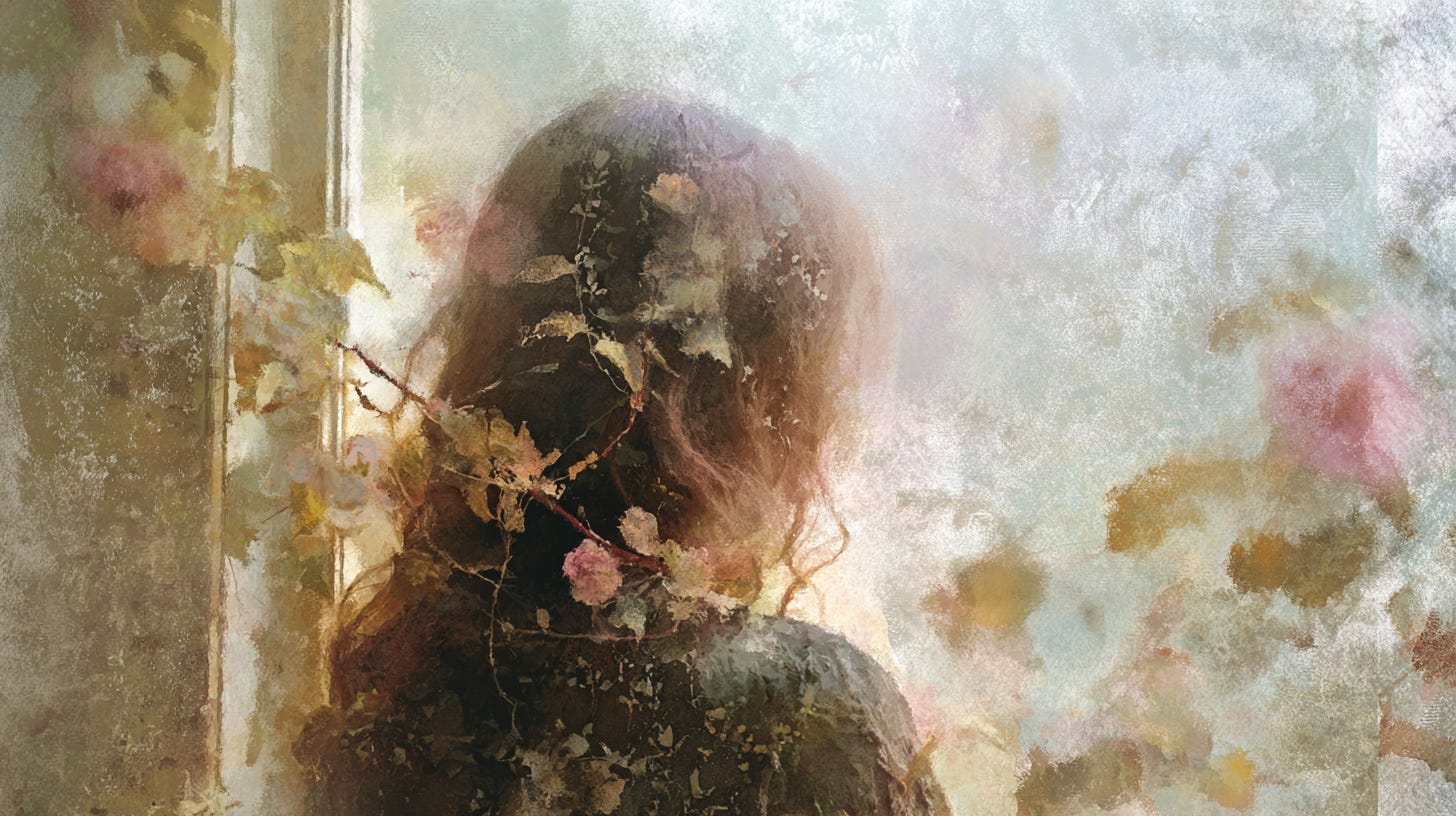
“When Mary Lennox was sent to Misselthwaite Manor to live with her uncle, everybody said she was the most disagreeable-looking child ever seen. It was true, too. She had a little thin face and a little thin body, thin light hair and a sour expression.”
So begins Frances Hodgson Burnett’s The Secret Garden, with a portrait of a child who is, in every meaningful sense, shut down. Raised by servants in India, shunned by socialite parents who wanted her kept out of sight, Mary is given everything she wants and nothing she needs. She is selfish, bratty, and alone.
Neuroscience has a name for the state Mary is living in. When not actively engaged in a task, our brains shift to a network called the default mode network, a system that builds and maintains our mental model of the world. Psychologists Norman Farb and Zindel Segal call this model the house of habit. In their book Better in Every Sense, they describe how, within a few repetitions of any experience, the default mode network recognizes patterns and constructs an internal architecture from them. We then use this map to anticipate what we’ll encounter in similar future situations. Think of the first time behind the wheel of a car: every ounce of attention was required to check mirrors, stay in the lane, gauge the pressure on the brake. But within weeks, driving becomes automatic. We travel long distances and barely remember the trip. The house of habit is the engine of this efficiency, condensing millions of bits of sensory information into predictions so we don’t have to relearn the world each morning.
But when flattening a teeming, ever-changing world into a simpler map, things get lost in translation. If prediction crowds out perception, we stop taking in new information. We move through the world on autopilot, reacting to our map of reality rather than reality itself. Mary Lennox’s house of habit was built entirely around being provided for, and never around being loved. Her parents were so absent from her daily life that they barely existed in her mental model at all. So when they die in a cholera outbreak, Mary does not cry. Burnett describes a child whose mental model has no category for grief, because it has no category for love. Nobody was ever interested in her, so there is no reason to be interested in them.
When Mary is sent to live with her uncle at Misselthwaite Manor in the Yorkshire countryside, the inadequacy of her map becomes visible. She cannot dress herself. She is bewildered by the direct manner of Martha, the housemaid, and outraged that no one will wait on her. Everything she encounters—the wind on the moor, the plain food, the expectation that she might actually go outside—confounds the predictions her brain has spent years building. Her house of habit has no room for any of it.
The obvious assumption would be that Mary is trapped because her house of habit is too strong, the mental model too loud to hear anything else. When Farb and Segal studied patients with persistent, recurring depression, they similarly assumed that the default mode network would be overactive. It wasn’t. What they found, instead, was that a different network had gone quiet.1
The salience network is the system that registers what is actually happening in and around us. It takes in new sensory information, both inward through interoception2 and outward through our five senses. The depressed patients weren’t trapped because their mental models were too powerful. They were trapped because the mechanism that could disrupt those models had been dampened. The world, lush and vivid, was still there. But the door to it had been locked.
There is, as it happens, a literal locked door at Misselthwaite Manor. Somewhere beyond the gardens Mary can see, there is one she cannot enter, a walled garden that has been shut up for ten years, its key buried, its existence barely spoken of. Mary becomes consumed with curiosity about it. She is a neglected child circling a neglected garden, sensing without words that whatever is locked away in there has something to do with her.
Farb and Segal would say that curiosity is the first sign of the salience network waking up. Where the default mode network keeps us inside our map, the salience network scans for what is actually here. Their prescription for strengthening it is sense foraging, the practice of entering a sensory experience without expectation, without rushing to label or interpret, and simply allowing ourselves to take in the world through our senses. It means picking out the individual instruments in a familiar song, noticing the subtle bitter and bright notes in a cup of coffee, watching the currents and shifting shadows of grass rippling in the wind. The unlabeled experience, Farb and Segal argue, is what gives the salience network enough new input to interrupt the patterns the house of habit has cemented into place.
Mary’s first act of sense foraging appears as a flash of red against a cerulean sky. Out in the gardens one day, she sees a bird with a red breast, and he “actually gave Mary a queer feeling in her heart because he was so pretty and cheerful and seemed like a person.” Ben Weatherstaff, the gruff old gardener, tells her the robin is lonely, that the rest of his brood scattered and left him behind. Mary declares something she has never said before: “I’m lonely.”
She had not known it until she said it, until she saw the robin. But this is what happens when the salience network stirs to life. We see something outside ourselves clearly enough that it becomes a mirror. Once Mary has seen her own loneliness, she cannot unsee it. She starts paying attention to other things too, noticing how the wind on the moor fills her lungs and whips color into her cheeks. She finds she is hungry, truly hungry, for the first time in her life. She discovers she can talk to the gardener, to Martha the housemaid, to the moorland boy Dickon who seems to speak the language of every living creature.
Mary begins to seek out the robin. She follows him along the wall one windy day, and a gust blows aside the ivy to reveal a door handle hidden underneath. She finds the key, and slips into the secret garden. Inside, roses have grown wild and tangled, and everything looks as though it might be dead. But Dickon kneels beside her and shows her how to read the stems: “When it looks a bit greenish an’ juicy like that, it’s wick.” Wick is the Yorkshire dialect for alive. Mary is learning something about the garden, but also something about herself.
Dormancy is not death. There is still something wick inside.
What follows is the slow, physical work of clearing and tending. “She worked and dug and pulled up weeds steadily, only becoming more pleased with her work every hour instead of tiring of it…She found many more of the sprouting pale green points than she had ever hoped to find.” With each shoot she protects, she herself is growing in health, in curiosity, in the capacity to care about something beyond herself. “When her mind gradually filled itself with robins, and moorland cottages, and crabbed old gardeners… there was no room left for the disagreeable thoughts which affected her liver and her digestion and made her yellow and tired.” No one asks Mary to unlearn who she was. The garden simply gives her somewhere else to put her attention, and as Burnett writes, “where you tend a rose, a thistle cannot grow.”
This is not just metaphor. What is happening in Mary’s brain in these moments is remarkably literal. Farb describes the brain as a metabolic zero-sum system. There is only so much oxygen and glucose to go around, and attention determines where it flows. Our sensory networks occupy distinct neural neighborhoods, separate from the default mode network. When we pay attention to raw sensation, we engage those sensory regions directly, before the default mode network can pull the experience into interpretation or memory. Each time we return attention to pure sensory perception, we redirect the brain’s limited metabolic resources away from the house of habit and toward the networks that register the world as it actually is. This is why Mary’s transformation doesn’t come from insight or willpower. It comes from kneeling in dirt, from breathing moorland air, from watching a robin tilt its head.
Eventually, the garden enters full bloom. Roses rise “out of the grass, tangled round the sun-dial, wreathing the tree trunks and hanging from their branches, climbing up the walls and spreading over them with long garlands falling in cascades. They came alive day by day, hour by hour. Fair fresh leaves, and buds…tiny at first but swelling and working Magic until they burst and uncurled into cups of scent delicately spilling themselves over their brims and filling the garden air.”
And Mary, who arrived at Misselthwaite thin and sallow and sour, grows hearty and strong, her hair thick and healthy, her cheeks pink as a blush rose herself. “While the secret garden was coming alive…[a child was] coming alive with it.”
Burnett calls this force “the Magic,” the thing that makes bulbs push through frozen ground and roses climb over walls and a sickly child grow strong. All the children who find their way into the garden feel its presence. Mary’s cousin Colin explains, “Sometimes since I’ve been in the garden I’ve looked up through the trees at the sky and I have had a strange feeling of being happy as if something were pushing and drawing in my chest and making me breathe fast. Magic is always pushing and drawing and making things out of nothing. Everything is made out of Magic, leaves and trees, flowers and birds, badgers and foxes and squirrels and people. So it must be all around us. In this garden—in all the places.”
The Magic is all around us, wick and pushing and drawing, just waiting for us to open the door.
Thank you to Brigitte Kratz, Dana Allen, Kathy Ayers, Larry Urish and Matt Cyr for all the helpful feedback on this one!
In a 2022 fMRI study, Farb, Segal, and colleagues tracked 85 remitted depressed outpatients over two years in what became the largest neuroimaging trial to date of psychotherapy for depression relapse prevention. When participants were exposed to sad film clips designed to induce dysphoric mood, their brains showed a consistent pattern. Prefrontal regions activated while sensory and somatosensory regions went quiet. The researchers had expected the prefrontal hyperactivity to predict who relapsed. Instead, it was the sensory shutdown that proved decisive. Participants whose somatosensory cortex deactivated most strongly during sadness were the ones who relapsed, and this pattern persisted as a stable vulnerability marker regardless of which therapy they received. The finding reframed depression vulnerability. The danger wasn’t that the mental model was too loud, but that the sensory system had gone silent. See Farb, N.A.S., Desormeau, P., Anderson, A.K., and Segal, Z.V., “Static and Treatment-Responsive Brain Biomarkers of Depression Relapse Vulnerability Following Prophylactic Psychotherapy,” NeuroImage: Clinical 34 (2022); and Farb, N., and Segal, Z., Better in Every Sense (New York: Little, Brown Spark, 2024).
Interoception is the perception of internal bodily signals—heartbeat, breath, hunger, temperature, gut feelings. It is one of the primary channels through which the salience network registers what is happening in the present moment.
No posts
Comments
Nothing yet. Say the first thing.
Sign in to join the conversation.