

“Composability” is one of the most frequently used and least precisely defined terms in digital asset markets. In its original crypto context, the term generally refers to the ability of one onchain asset or protocol to integrate seamlessly with another: a token can be transferred, pooled, lent, collateralized, wrapped, or embedded into higher-order financial applications without requiring bespoke legal or technical arrangements at each step.
That definition is directionally correct for native digital assets. It is not sufficient for real-world assets.
For RWAs, and particularly for capex-heavy, cash-generating assets such as commercial vessels, telecom towers, power generation assets, and private credit exposures, composability cannot be reduced to transferability alone. The more relevant question is whether the economic rights, distribution mechanics, liquidity pathway, and compliance boundaries of an asset can be structured in a way that allows the asset to interact with onchain capital markets without compromising legal clarity or operational integrity.
This distinction is not semantic. It determines whether tokenization produces a usable financial primitive or merely a digital wrapper around an otherwise unchanged offchain instrument.
In purely crypto-native markets, ownership, transferability, and utility are often unified in a single token state. The holder of the token generally holds the asset, and the asset generally carries the relevant economic and governance properties. The token is both the instrument and the interface.
Real-world assets are structurally different. A tokenized claim on a ship, a tower, or a private credit pool does not merely represent a unit of balance. It may represent some combination of:
economic exposure,
rights to distributions,
legal claims on a special purpose vehicle,
governance or consent rights,
transfer restrictions,
eligibility requirements,
and disclosure obligations.
As a result, composability in RWAs depends not simply on whether a token can move, but on whether the rights associated with that token can be modularized and enforced coherently across different market environments.
This is especially important for assets whose value derives from operating cash flows rather than mark-to-market speculation. A vessel generates charter income. A telecom tower generates lease income. A power asset generates contracted or merchant revenue. A private credit instrument generates interest and principal repayments subject to underwriting and covenant performance. These are not abstract digital claims. They are structured cash-flow rights tied to real-world contracts, operators, and counterparties.
For such assets, true composability requires the separation and coordination of at least three layers:
exposure,
cash-flow entitlement,
eligibility and compliance enforcement.
Most tokenization models struggle because they attempt to compress these layers into a single instrument.
A fully permissioned token can be legally legible, but it generally exhibits low composability in open markets. Once strict wallet-level transfer controls are attached to the token itself, integration becomes narrow and bespoke. Most DeFi contracts cannot hold the token. Secondary liquidity becomes fragmented. The token may be compliant, but it is not broadly interoperable.
A fully permissionless token solves the liquidity problem at the cost of legal and economic ambiguity. If the token can circulate freely across any wallet or protocol, then questions immediately arise regarding who is entitled to distributions, whether the current holder is a recognized beneficial owner, and how cash flows should be routed when the token has moved beyond the verified investor set.
This is the central design tension in RWAs:
Open liquidity requires transferability; regulated yield requires controlled entitlement.
The mistake is to assume that these must always be embedded in the same token state.
A more rigorous way to think about RWA composability is to distinguish between two separate but related dimensions.
This refers to whether an asset’s economic exposure can circulate in onchain markets. Can it trade? Can it be priced continuously? Can it sit in liquidity pools, portfolio dashboards, or secondary market venues?
This refers to whether the right to receive the asset’s underlying income stream can be enforced, audited, and distributed in a manner consistent with legal and regulatory requirements.
For many classes of RWAs, these do not need to be unified in a single transfer state. In fact, separating them may produce a superior market structure.
That is particularly true for capex-heavy and contractual-cash-flow assets. Such assets benefit from broader transferability at the exposure layer, but they still require discipline at the entitlement layer. The market may benefit from permissionless price discovery even when the income right must remain conditional on verification.
This is where the design space becomes genuinely interesting.
Fractalized’s model is notable because it does not treat transferability and distribution eligibility as identical properties. Instead, it uses a two-tier architecture in which:
an unwrapped ERC-20 functions as the liquid, transferable exposure layer, and
a wrapped, KYC-gated token functions as the distribution-eligible layer for verified holders.
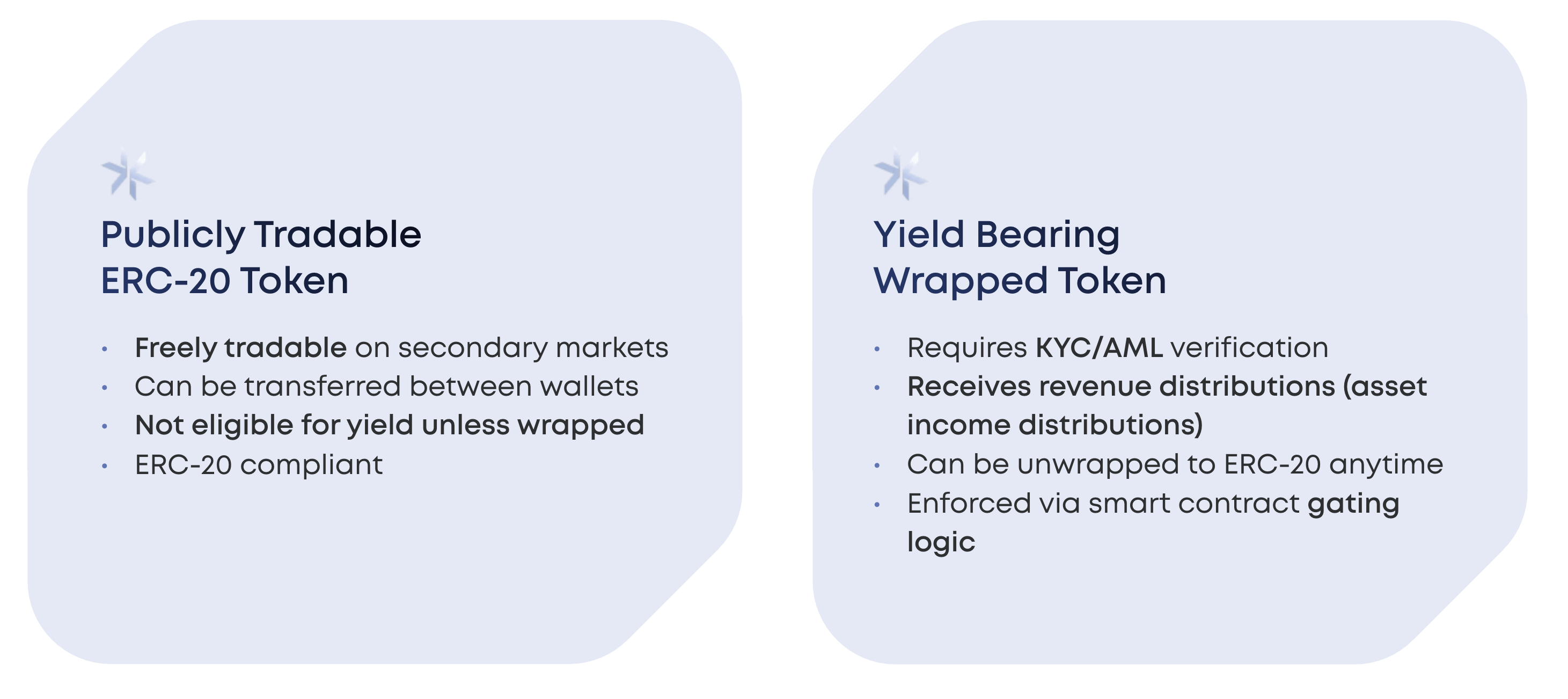
This architecture produces a more precise form of composability than a conventional permissioned token. It allows the market-facing representation of the asset to remain broadly usable in trading environments, while reserving income entitlement for holders who satisfy the relevant compliance requirements. We describe this directly as a two-tier token design in which a freely tradable ERC-20 is not yield-eligible unless wrapped, while the wrapped version is KYC/AML-gated and receives revenue distributions.
The significance of this model is conceptual as much as technical. It recognizes that the asset’s functions can be separated:
the transport layer carries market exposure,
the entitlement layer carries the income right.
This distinction matters for RWAs because it resolves a problem that standard token structures do not address well. A holder may wish to access liquidity without necessarily being the final eligible recipient of the next distribution. Conversely, a verified long-term holder may care less about continuous transferability than about stable and auditable income collection. By distinguishing these states, the system permits a more flexible market without collapsing the legal and operational distinctions that the underlying asset requires.
The relevance of this architecture becomes clearer when applied to real asset categories.
A ship, a tower, or an energy production asset is not merely a store of value. It is an operating asset with:
maintenance and operating costs,
counterparties,
reporting requirements,
financing structures,
and variable but contract-based cash-flow profiles.
The challenge in tokenizing these assets is not simply issuance. It is whether their income profile can be made accessible to digital markets without undermining either liquidity or enforceability.
A split-rights model offers a credible answer.
It allows broader market participation in the asset’s price exposure while maintaining controlled access to the underlying income stream. This is likely to be more durable than a monolithic token design for assets where distributions must be linked to verified ownership.
It is also more aligned with how institutional investors think about product architecture. In traditional capital markets, beneficial ownership, trading venue access, and distribution rights are not always collapsed into one operational layer. Real-world finance already relies on layered rights structures. Tokenization becomes more credible when it reflects that reality rather than pretending it does not exist.
Private credit is often easier to understand in tokenized form because it already resembles a financial cash-flow primitive: underwriting, periodic interest, principal return, covenant structure, and recoveries.
Yet even there, the same composability problem appears. The market wants broader liquidity and standard interfaces. The issuer wants controlled access, clear eligibility, and legally coherent distribution rights.
A split-rights architecture is therefore not specific to maritime or infrastructure assets. It generalizes to any asset class where:
the exposure may benefit from wider circulation,
but the entitlement to underlying cash flows cannot be treated as universally transferable without conditions.
This is one reason tokenized private credit is a particularly important category in the broader RWA landscape. It sits at the intersection of cash-flow predictability, institutional demand, and programmable structuring. But its scalability still depends on the same underlying question: how can liquidity and entitlement be separated without making the product confusing or fragile?
A model of this kind only works commercially if the complexity is hidden from the end user. A technically elegant rights architecture that creates operational friction at the interface layer is unlikely to achieve broad adoption.
That is why routing and product abstraction matter. Fractalized’s solution provides a one-click flow in which wrapping, unwrapping, liquidity pool execution, and stablecoin settlement occur beneath a simplified user interface.
The significance of this is not cosmetic. It means that the protocol can preserve a differentiated internal rights structure while presenting a coherent market-facing product.
For tokenized RWAs, this may be one of the more important lessons. Composability is not only a question of whether smart contracts can integrate with one another. It is also a question of whether the product can be distributed by wallets, fintech platforms, banks, and institutional allocators without imposing procedural complexity on users.
For native crypto assets, composability often refers to permissionless plug-and-play integration across protocols.
For RWAs, that definition is incomplete.
A more useful definition is the following:
Composability in RWAs is the capacity to separate, structure, and recombine exposure, entitlement, liquidity, and compliance in a way that allows real-world cash-flow assets to function as programmable financial building blocks.
Under that definition, the question is not whether a tokenized ship can be traded in the abstract. The question is whether:
the exposure can circulate efficiently,
the cash flows can be distributed to eligible holders,
the legal structure remains enforceable,
the market can price the asset with sufficient transparency,
and third-party platforms can integrate the product without redesigning its entire operational framework.
This is a significantly higher bar than token issuance. It is also a better description of the work required to make RWAs usable at scale.
The next phase of RWA infrastructure is unlikely to be defined by tokenization in the narrow sense of digitizing ownership claims. It is more likely to be defined by how well different platforms engineer the relationship between liquidity and rights.
For cash-generating assets, that means:
preserving access to open market liquidity where possible,
preserving controlled distribution rights where necessary,
and designing the bridge between those two states with institutional clarity.
Seen in this light, composability is more a question of product architecture than simply a feature of technical standards.
And for capital-intensive, cash-generating assets, product architecture is what determines whether tokenization remains a narrative or becomes a durable financial infrastructure layer.
Arnold & Porter. New Stablecoin Legislation: Analyzing the GENIUS Act. 2025.
CoinDesk. Wall Street Giant DTCC Picks Privacy-Focused Blockchain Canton Network for Tokenization. 2025.
Crypto.com Research. Tokenization of Real World Assets: The Golden Opportunity. 2025.
DefiLlama. Stablecoin Chains Data / API Documentation.
ESMA. Markets in Crypto-Assets Regulation (MiCA) Overview.
Ethereum Foundation / Ethereum.org. ERC-20 Token Standard.
Ethereum Foundation / Ethereum.org. ERC-4626 Tokenized Vault Standard.
J.P. Morgan. Kinexys Pilots First USD-Denominated Deposit Tokens. 2025.
RWA.xyz. A New Framework for Tokenized Assets: Distributed and Represented.
RWA.xyz. Market Overview.
RWA.xyz. Tokenized U.S. Treasuries Dashboard.
Reuters. Goldman, BNY Team Up to Launch Tokens Tied to Money Market Funds. 2025.
No posts
Comments
Nothing yet. Say the first thing.
Sign in to join the conversation.