
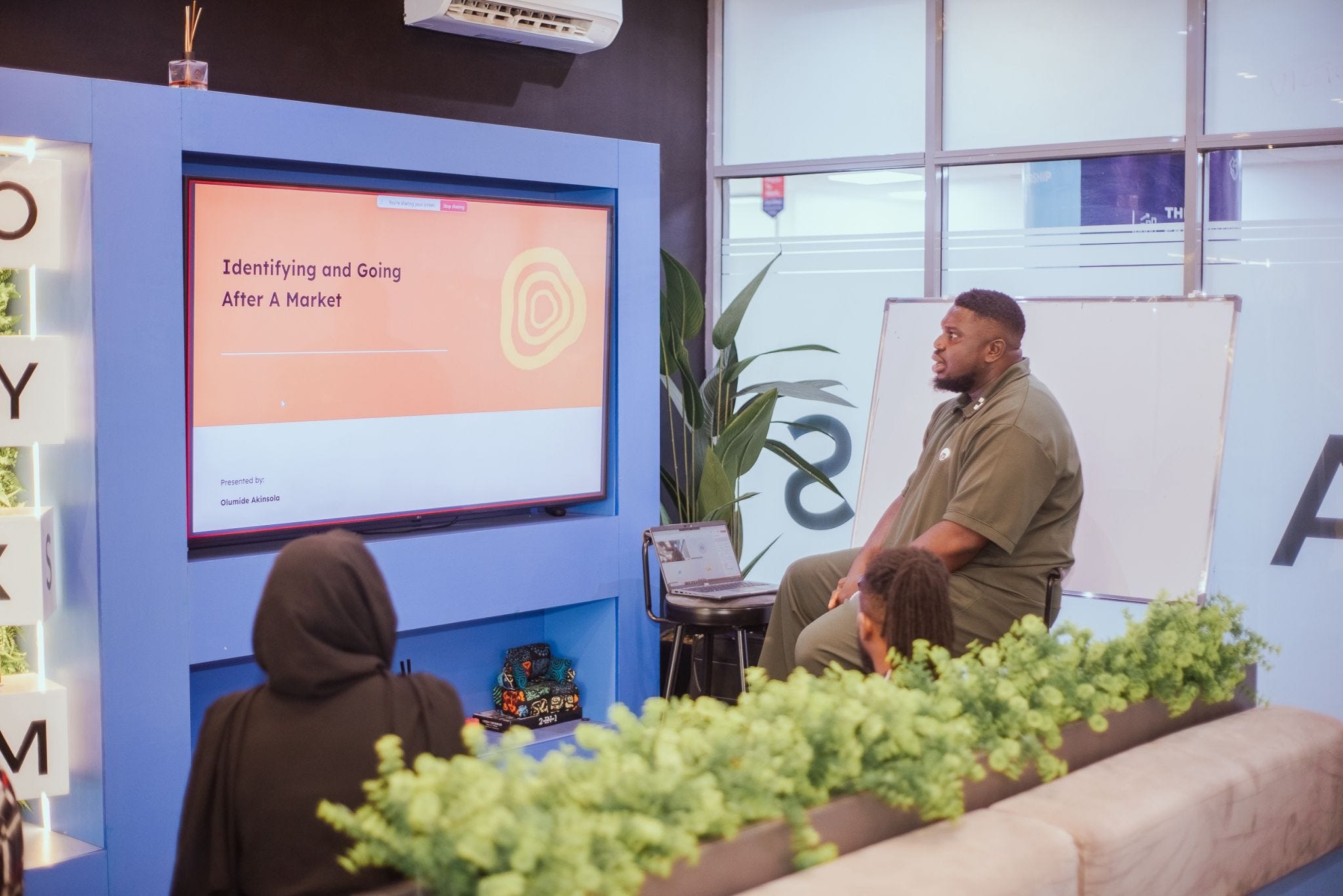
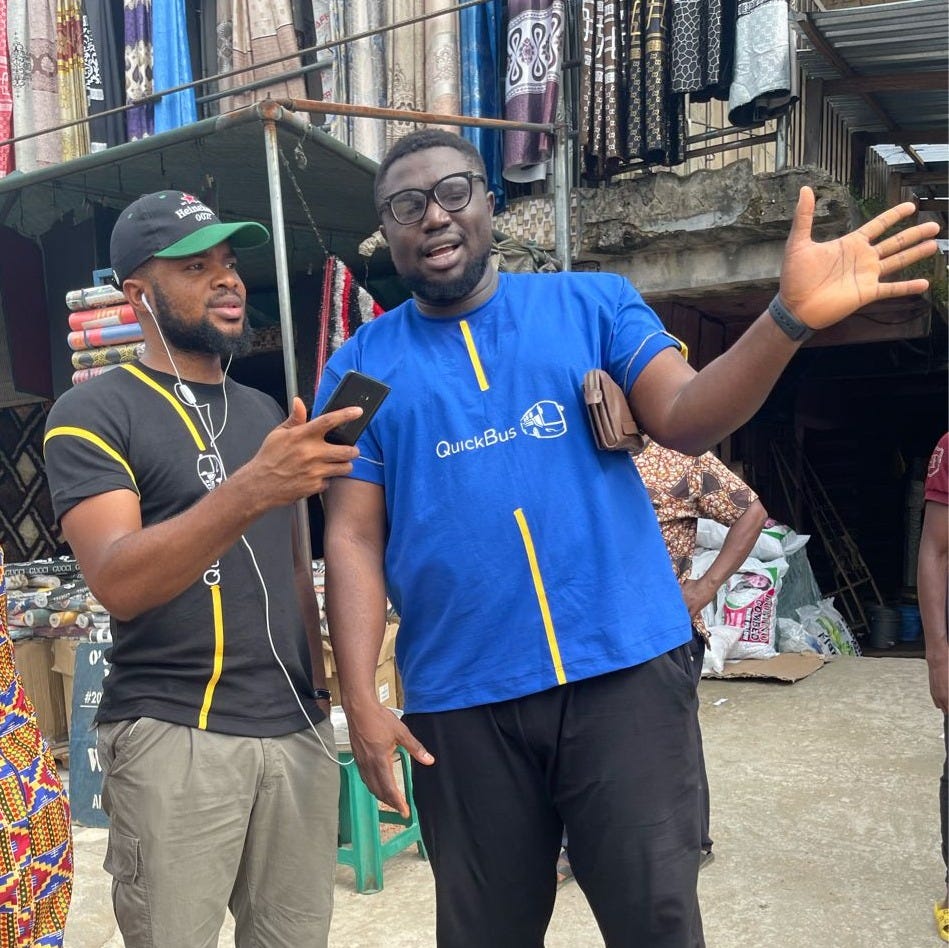
As the afternoon sun blazed over a dusty motor park somewhere in Eastern Nigeria, Olumide Akinsola could already feel sweat forming beneath his shirt. At over six feet tall, he towered over the crowd of traders, bus operators, and travellers who filled the motor park. He was there at the behest of his employer, QuickBus, asking questions that would change his preconceived notions about building a transport business.
This wasn’t his first time walking through markets to understand customers. But what he was about to discover in this motor park would lead to one of the most successful business model pivots in African transportation history.
Olumide’s education in African markets started in 2006 in Old Ibadan. He was 20 years old, earning 6,000 naira per month, and his job was simple: walk around the city selling admission forms for a new secondary school. “We had to dress corporately, carrying our briefcases with all the forms in them,” he remembered. “You literally walk all the way. If you took okadas (motorcycle taxis), you would go past some schools that you should enter.” For seven months, he and his partner covered every corner of Ibadan. She spoke Hausa, he spoke Yoruba, and together their tag team sold out the admission forms for the school.
***
The path that brought Olumide to that motor park began with a series of detours. After finishing secondary school in 2004, he wanted to become a neurosurgeon, inspired by Ben Carson’s Gifted Hands. But the Nigerian university system had other plans. His JAMB scores were decent – 224 on the first attempt, 237 on the second – but not enough for medicine at the universities he wanted. The waiting period was when he got the secondary school job. That job taught him his initial lesson in marketing. Walking through Dugbe Market and Aleshinloye Market in Ibadan, he discovered that selling was more about understanding the needs of his target audience and what they hoped to achieve from a product than having the perfect pitch.
“We went into markets, talked to all the women who sold lace and different things about the school,” he remembered. “You spoke Yoruba, you spoke whatever you needed to speak, to convince them to send their children to the school.” The school was so overwhelmed by applications from their efforts that it had to schedule four different entrance examinations.
When Olumide got into university to study biochemistry, he channelled his marketing instincts from selling admission forms into social media. In 2008, as Facebook was gaining traction among Nigerian students, he began helping fellow students sell different products through targeted marketing on Facebook and Twitter. His efforts caught the attention of a relative of the Oyo State governor, who reached out. The government wanted to create a platform for young people to come together, deliberate, form a power block, and influence government decisions.
“Every month we got people together from social media. We’d travel to one random city in Oyo State from Thursday till Sunday, just looking around, taking pictures, recording videos, telling stories of these places.” The work eventually evolved into a full consulting relationship with the state government on digital marketing and content strategy.
After graduating, Olumide found himself drawn to Lagos. The first time he came to the city was for an OAP audition at the music radio station, BeatFM. Although he did not get the job, that first visit was his introduction to the city. His real entry into Lagos came through an unexpected route: Twitter Premier League (TPL), a football banter community that organised actual matches between supporters of different teams. “I was tasked with creating the team of Chelsea supporters.” Through TPL, he met people across industries, building relationships that would later open doors. One of those connections, someone he’d met at TPL gatherings, would eventually call him about his first real business development job. “She called me randomly to say that I have this client who needs somebody to lead business development,” he said. The client turned out to be one of Lagos’s biggest event management companies.
The event’s job was brutal. For months, Olumide would leave Ibadan at dawn, take public transport to Lagos, work at the company in Lekki, then travel back to Ibadan the same evening. “I was doing that every day for like a 4–5 month period,” he recalled. His job was to sell tables at end-of-year corporate events, which taught him about B2B sales and dealing with corporate clients. His next gig after that was at Sugarban, a startup trying to build Nollywood’s equivalent of Netflix, but with a rental model instead of subscriptions. It was while working at Sugarban that Olumide found SafeBoda.
SafeBoda was on an ambitious expansion run. Launched in 2017, the motorcycle ride-hailing startup quickly became one of East Africa’s tech success stories. After raising $1.2 million in seed funding and proving the model in Uganda and Kenya, they were ready to expand across Africa. Nigeria represented their biggest opportunity: a massive market where motorcycle taxis were already integral to urban transportation, but completely fragmented and inefficient.
Initially, Olumide applied for an operations role, but SafeBoda’s leadership had bigger plans. “Babajide Duroshola (the SafeBoda Nigerian Country Manager) looked at my CV and said, ‘I think you’ll be a better fit for customer acquisition and marketing.’” The application process was rigorous, but Olumide’s unique combination of skills made him perfect for the job. His grassroots sales experience from canvassing the markets selling admission forms, government relations background, and deep knowledge of Ibadan made him the ideal candidate for launching SafeBoda in Ibadan, the company’s first market in Nigeria.

***
When Olumide joined SafeBoda in 2019, the company was still scoping out Ibadan as a market. His local knowledge proved immediately valuable. “Because of the experience that I’d had working in politics, I knew a lot of people in a lot of places. I was close to motorcycle rider associations. I knew all of the park heads. All of that became part of what I brought beyond just leading the marketing team and the customer acquisition team. Things like licences and permits were easy because I could walk into anybody’s office or drag one of my guys in the government.”
But Olumide’s biggest contribution was understanding that conventional startup marketing wouldn’t work in Ibadan. “In the two years that I spent at SafeBoda, we didn’t spend more than $10,000 on digital marketing. Digital marketing was not going to help us because people at the time were not that active on social media from a selling perspective.”
Instead, SafeBoda built a community before launching. They sponsored a massive December event, hosted a treasure hunt with an iPhone as the prize, and collected thousands of contacts. This community-building approach paid off when they launched in March 2020, right as COVID-19 hit. While other cities went into lockdown, Ibadan remained relatively open. “Everybody was waiting for SafeBoda. When it did launch, it took off like a rocket.”
Olumide’s success at SafeBoda was built on a strong partnership with Babajide Duroshola. They worked closely, aligned on decisions, and always presented a united front to the global team. Before every major meeting, they would agree on what to say and how to respond to pushback. That clarity showed in the results: over one million rides, more than 100,000 customers, and retention rates that stayed above 70%. But everything changed when Duroshola left.
Know someone who needs to see this? Go ahead and share.
The company’s culture shifted. Decision-making became slower, more political, and less collaborative. The close-knit team that once worked and celebrated together began to fall apart. Olumide knew it was time to move on. The next opportunity came through a former colleague who introduced him to QuickBus, another East African transport startup expanding to Nigeria. At first, he worked with them part-time, helping them understand the Nigerian market. Within three months, it became clear there was a fit. He was offered a full-time role as Vice President of Growth, overseeing expansion across Nigeria, Kenya, and South Africa.
***
QuickBus came to Nigeria with a model that worked beautifully in its other markets. “We thought we were a marketplace. We have a platform. You list supply, you recruit demand, you do marketing, get demand to meet supply, and then make money off that exchange,” Olumide said.
The first problem was obvious: “Nobody buys bus tickets online in Nigeria.” It wasn’t just a technology adoption issue, but a fundamental difference in how transportation worked. In Kenya and South Africa, buses ran on schedules. In Nigeria, “if the seats are not fully occupied, they are not going to leave.”
QuickBus’s first fix was building an agent network using a special app that let street-level POS agents sell tickets on behalf of the platform and collect cash from customers. They recruited about 1,000 agents across Eastern Nigeria. The pitch was straightforward: instead of heading to the motor park to book a seat, you could walk up to the nearest POS agent and get it done. For two months, it worked. Then sales started falling.
The dashboard showed the drop, but not the reason behind it. So Olumide did what he always did: he went back to the field. Working alongside Chidinma Chukwuemeka, QuickBus’s expansion and offline marketing manager who knew the eastern region well, he returned to the markets and motor parks, talking directly to agents. What they found turned their assumptions upside down. The problem wasn’t that people didn’t want to buy tickets. It was that the tickets they wanted weren’t available. The platform simply didn’t have enough routes. When they tried to fix this by bringing more bus operators onto the platform, the operators stopped them cold.
“We had assumed that getting more customers was going to get us in business with these guys. But they told us they don’t need more customers. They already have customers. Even the customers that they had, they couldn’t service.”
What the operators actually needed was something no booking platform had thought to offer: capital. “Problem number one: access to financing. They don’t have money. They want to build a new terminal. The bank is asking them for collateral. Problem number two was technology. A lot of fraud was happening within their systems. They couldn’t track anything. Problem number three was more customers.” QuickBus stopped trying to be a marketplace and became something closer to a financial partner. They created a new product called Cash Advance, offering operators up to three months of their total revenue upfront, in exchange for letting QuickBus take over their terminals and collect payments directly from customers.
What made the cash advance model revolutionary wasn’t just that it worked, but how it managed risk in an African context. “Some people took our money and they went and married a new wife, others bought houses,” Olumide recalled with a laugh. “But even if you did that, as long as your business kept running at the same rates that it was running before we introduced the money, we still got our money back.” The key insight was betting on current performance, not future growth. This approach was the opposite of typical venture capital thinking, which focuses on hockey stick growth and future revenue projections. Instead, QuickBus had built a model based on proven, existing cash flows.
As QuickBus expanded across the continent, Olumide learned that the same goal could require completely different playbooks. “By the time we were done, the business had three different models in three different places. It was the same goal: make transportation easier for Africans travelling from one city to another. But how we went about it was very different because of the peculiarities of the places and cultural nuances.” South Africa’s strategy was built on corporate partnerships. Standard Bank, FNB, and Vodacom Pay all embed bus booking into their payment apps. The banks even handed over marketing budgets to fund ticket discounts. Kenya sat somewhere in the middle, more digitally inclined than Nigeria but without South Africa’s institutional infrastructure
Cash advance success came with a significant challenge: it required enormous amounts of capital. “The problem with that model is that it was very heavily capital intensive. You have to have money to give to people. The big guys would say we need serious liquidity. We’re not looking for your 50 million naira. We’re looking for 5 billion naira.” This made fundraising difficult, as investors were wary of the capital requirements and long payback periods. “You had to wait for your capital for four or five months before you got it back in full with your commission.” But the capital-intensive nature that had made fundraising challenging actually made the company attractive to acquirers with deeper pockets.
After three years of building QuickBus into a multi-country operation with over 100,000 customers and operations in 18 cities, acquisition discussions began. Olumide played a key part in those talks. “I led all the due diligence across the board. Took people around to go and see the operations, and meet with our partners. It was a hectic one-year period for everyone involved because we were dealing with multiple jurisdictions.” When Buupass’ acquisition of QuickBus closed in May 2024, conversations about Olumide staying on didn’t work out. “They wanted me to continue in some roles, but we just couldn’t agree on what it would take to keep me on. I was also just done. I was tired, and I needed to rest.”
***
After a year of rest, Olumide got back in the arena, this time with e-invoicing and tax compliance startup Digitax, bringing his regulatory experience, business relationships, and startup expertise to lead the company. “Digitax is a culmination of all the different things that I’d done over the almost 20 years since I started working,” he reflected. “The regulatory side, the business side, and the building-the-company part, everything just came full circle.”
Standing in that motor park, asking bus operators about their real problems instead of assuming what they needed, Olumide had learned the lesson that would define his career: the most powerful business insights come not from conference rooms or competitor analysis, but from being in the arena; walking markets, talking to real customers, and being willing to abandon your assumptions when reality proves them wrong.
Comments
Nothing yet. Say the first thing.
Sign in to join the conversation.