
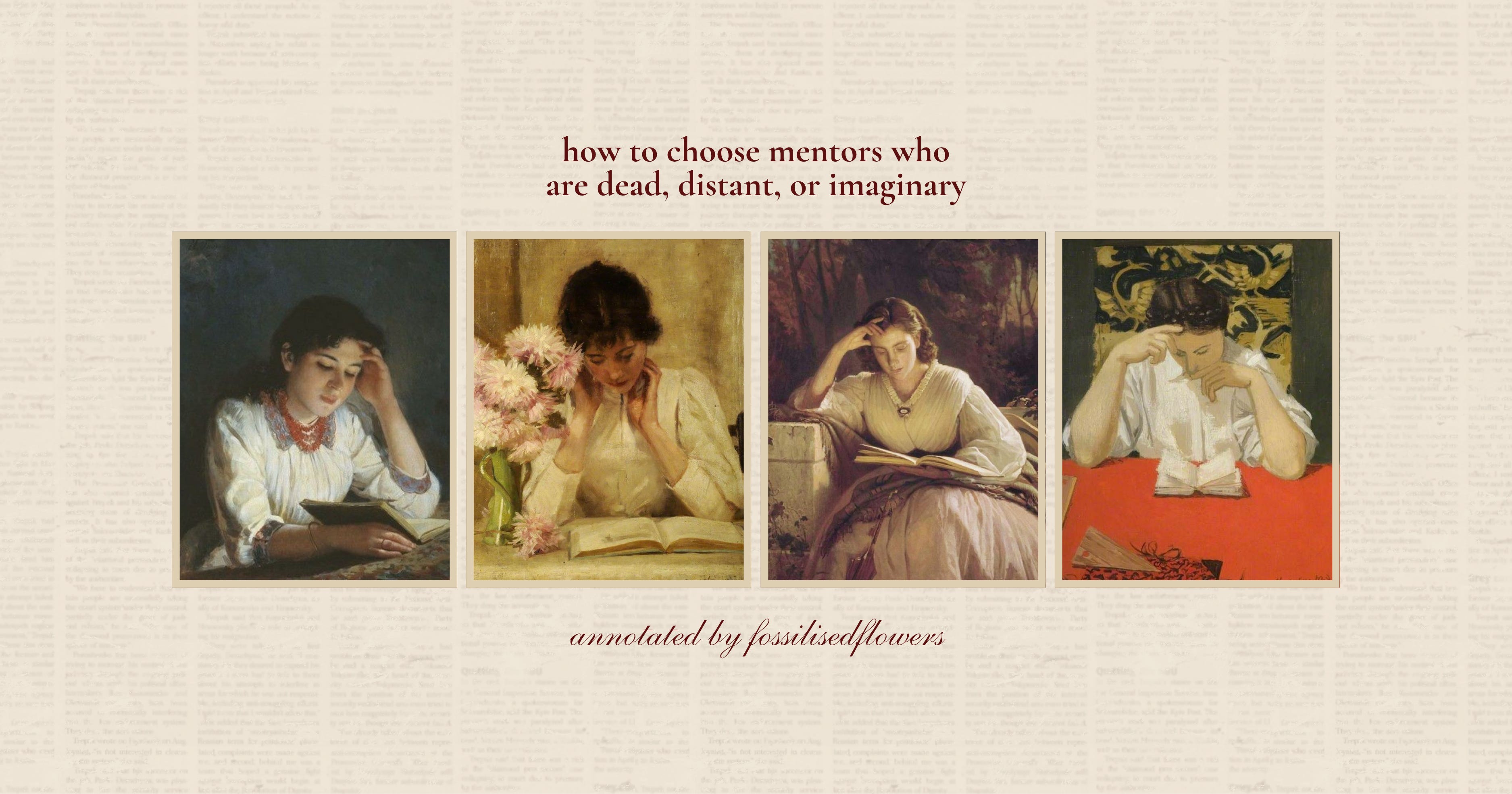
most of the mentorship advice i’ve encountered assumes a specific scene, with someone older, someone wiser, someone who picked you. maybe they saw your work, or heard you speak, or happened to teach the class you happened to take. the whole model depends on proximity and selection, which means it depends on being in a room that somebody with power is also in, at the age when that kind of room still feels possible to enter.
i was never in those rooms. i don’t think most people are. if you’re a woman with children, if you came to your work laterally, if you built what you built from a kitchen table in the hours between everything else, nobody was scouting you. nobody was going to tap your shoulder at a conference. the entire infrastructure of mentorship as it’s usually described requires a kind of professional life that you may not have had access to at 23, and by late 30s and 40s, the window feels closed in a way that nobody warns you about because the people giving the advice were already inside.
so i built something else. over the past several years, without fully naming it until recently, i’ve assembled what i think of as a council—people i study, people i observe from a distance, and in some cases people i’ve invented entirely. the word mentor applies to all of them, but the relationship is conducted in one direction: i study their work, their choices, their daily logistics, their refusals, and i extract from all of it what i can actually use in the life i’m living now. some of them are dead—writers, artists, thinkers who left behind letters and diaries and interviews i can read the way a biographer would. some are distant—alive and working, never going to know my name, but whose careers i can watch unfold in real time. and some are imaginary—composites, projections, the version of myself at fifty-five who made the calls i’m weighing today.
the dead ones have been with me longest. the core of my council is five women—joan didion, anaïs nin, hilma af klint, agnes martin, and ruth asawa—and what i take from each of them is specific enough that i could describe it in a single paragraph. i’m going to below. but the more useful thing might be to start with how this kind of mentorship works at all, because it’s a practice with a method, and that’s what makes it different from admiration.
Comments
Nothing yet. Say the first thing.
Sign in to join the conversation.