
the children have been asleep for two hours. the dishwasher is finishing its cycle. you are on the couch with a book open in your lap, and you have read the same paragraph three times, because your shoulders are at your ears and your jaw is doing something independent of you, and the book is not going in. nothing is happening. nothing has happened in the last two hours. the day’s last hard moment was a tantrum at five-fifteen, and it ended without incident. the body is still in it. the body has not been told.
on a different day, the texture is different. you are at your desk in the early afternoon and the kitchen counter has six things on it that don’t belong there, and the disorder of the counter has somehow gotten into your chest. you put the things away. your hands feel papery, so you go upstairs for hand cream, and on the way past the guest room you see the unmade bed and feel the unmade bed enter your body, and you change the sheet because to walk past it back to the desk is no longer something the body will let you do. the scene is misread from the outside as procrastination or a preference for tidiness. the experience from the inside is closer to involuntary triage. the body has registered each piece of disorder as a small physiological event, and the harder task — the email, the call, the writing — cannot proceed until each event has been resolved.
there is a vocabulary around all of this now: regulation, dysregulation, polyvagal, ventral vagal, fight or flight, freeze, fawn. the language has become so available that it has lost some of its diagnostic edge. the question of whether we ourselves, on a given afternoon, are regulated or dysregulated, often goes unasked, or is asked too vaguely to be useful. the assessment that follows is one way to ask it carefully. it is not a clinical instrument and it does not produce a diagnosis. it is a self-inquiry, designed to be used on more than one day, with the body present and the room ordinary.
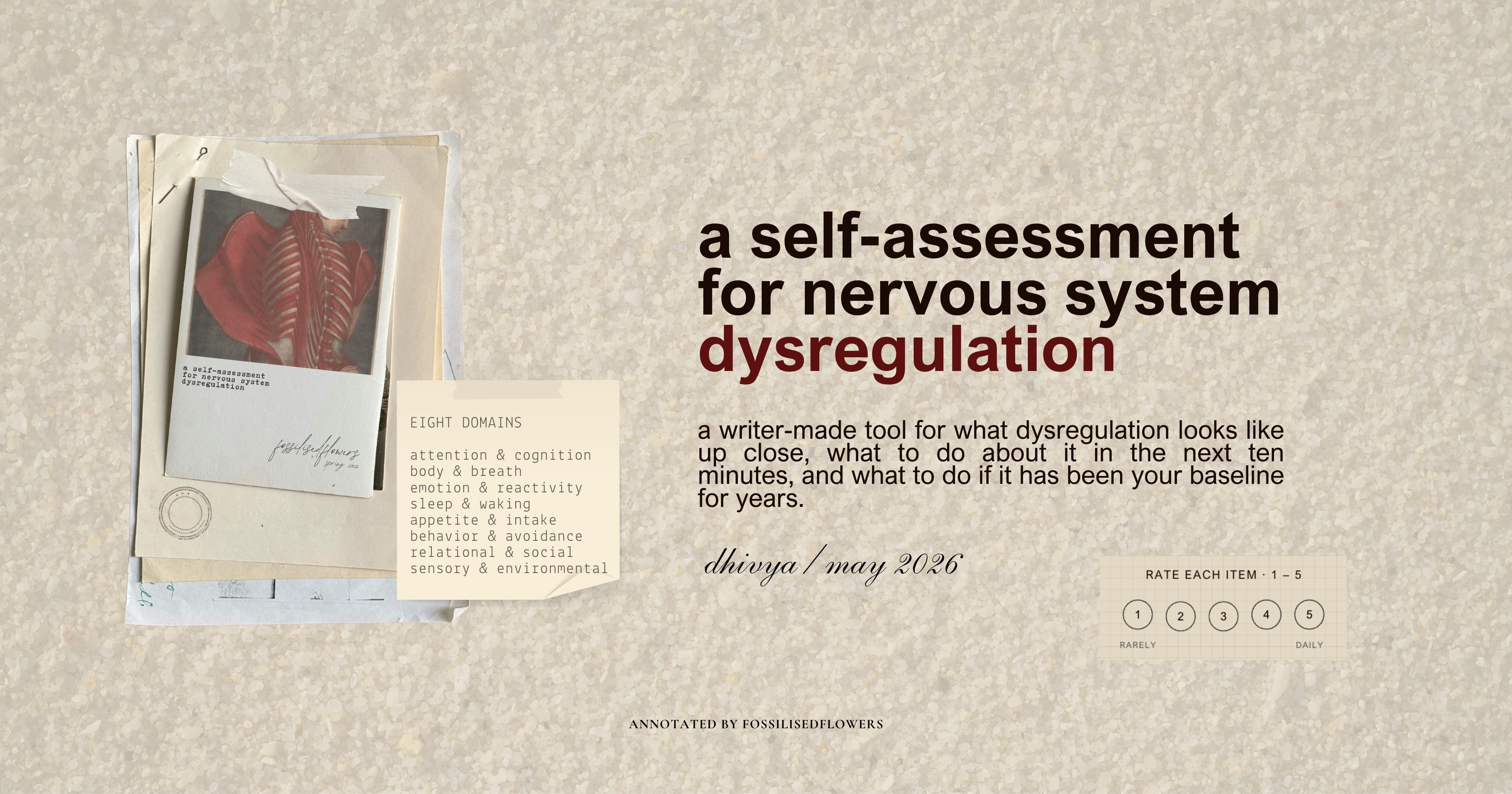
this tool is for the person who suspects something is off but cannot name where. it is not for someone in active crisis, and it is not a substitute for clinical care. if you are in acute distress, the right next step is a doctor or a therapist or a crisis line. if you live with a diagnosed condition that makes self-scoring feel punishing, use this with someone who can hold it with you.
print this, make tea or pour a drink, find a notebook and your favorite pen. give the next thirty minutes to this and nothing else. answer from the last two weeks, rather than from your hardest day or your easiest one. resist the urge to round up or down. there is no use in performing regulation for an instrument designed to detect dysregulation.
the questionnaire is organized into eight domains and contains fifty-six questions. answer all of them. each question is rated on a scale of 1 to 5 — 1 is rarely or not at all; 2 is once or twice in the past two weeks; 3 is a few times a week; 4 is most days; 5 is daily or almost daily. if a question does not apply to your life, skip it. there is a normalization formula at the scoring section.
the full 56-question self-assessment, the 11 acute-moment practices, the 10 architectural audits, and the thirty-day tracking log are below for paid subscribers. or, if you’d rather have it as a printable to keep in a notebook, it’s available for $26 (launch price $14 through 5/22).
Comments
Nothing yet. Say the first thing.
Sign in to join the conversation.