
How awful an existence it must be to fear being executed by your own government for dissent. As Americans, our God-given right to lawful assembly and individual expression is thankfully protected by the U.S. Constitution.
Thank goodness for the wisdom of James Madison and the Founding Fathers for recognizing how crucial free speech is to being human, that without it, we can never truly experience liberty. We make progress as a nation and as individuals when we’re free to openly exchange ideas without fear that our government will punish us. (That our national discourse has become antagonistic is a separate issue.)
The First Amendment is not absolute, however. As you know, we can’t use our words to incite violence, threaten, or defame.
And we can’t violate the rights of others by blocking public thoroughfares, regardless of how righteous we believe we are in our cause.
Reports of protesters blocking public roads has been on the rise, as you’re aware. This behavior causes traffic accidents and injuries, prevents first responders from helping citizens in distress, interrupts the daily grind of commerce (which harms businesses and residents), and can perpetuate violence.
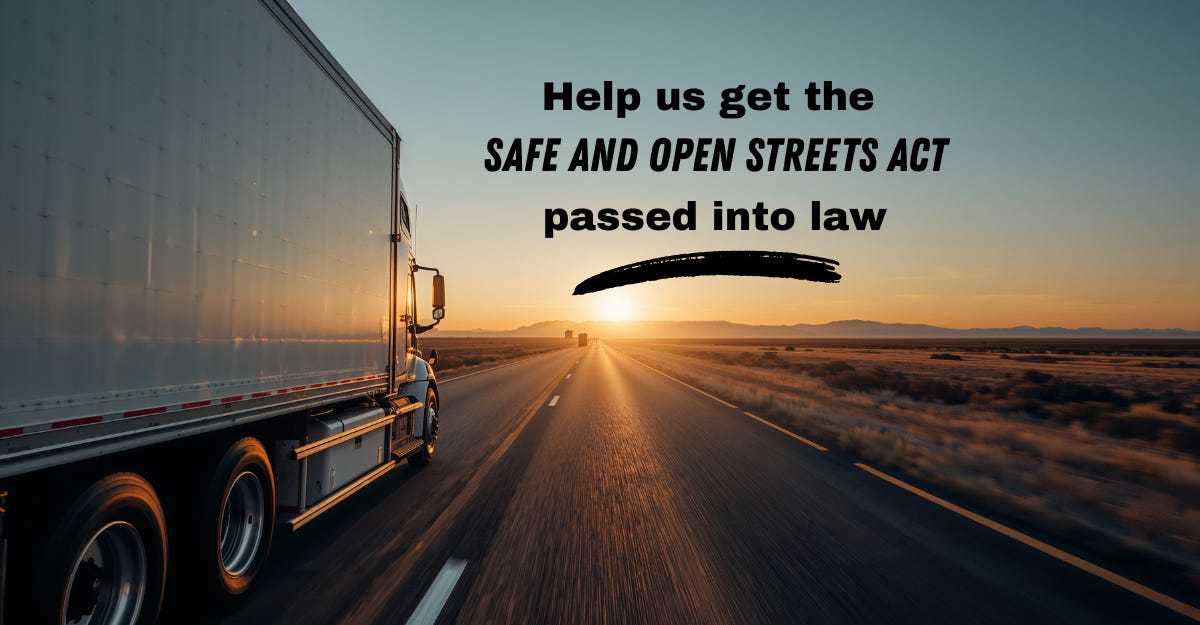
The Safe and Open Streets Act (S. 2115 / H.R. 4015) is a congressional bill designed to address this issue. It was initially introduced in the 118th Congress, and subsequently reintroduced this session.
Let’s get it passed!
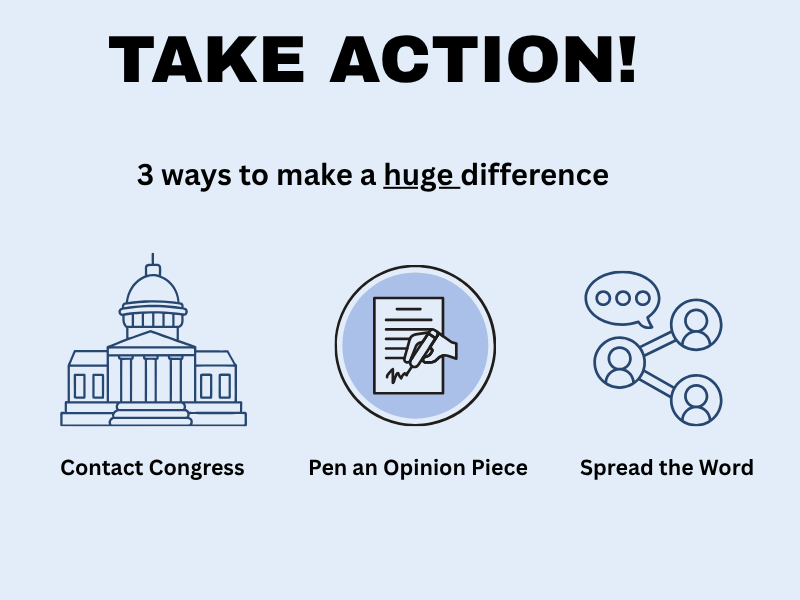
Please consider taking on any or all of the following:
Call your lawmakers asking them to support this bill.
Write a letter or opinion piece to a media outlet.
Help spread the word. We have a better chance of success when everyone gets involved.
The Safe and Open Streets Act was introduced in response to the radicalized demonstrations surfacing in American cities.
Given that state laws don’t always adequately penalize these offenses, a federal law is useful. Let’s take California, where blocking streets and sidewalks is a misdemeanor (see Penal Code 647c).
You may remember last summer, when anti-ICE protestors took it upon themselves to block access to public roads, highways, and expressways. In Los Angeles, these demonstrations escalated into violent acts, including attacks on law enforcement and the burning and damaging of police squad cars.
Local streets primarily remain a matter for local law enforcement, as it should be. When blocking a thoroughfare affects interstate commerce or crosses state lines, Congress can act. This is per Article I, Section 8 of the U.S Constitution, known as the Commerce Clause.
Although the U.S. Supreme Court has final determination on whether a law is constitutional (if at some point, they are called to make a ruling on a specific case), they have already established precedent for it.
Creates a federal crime. Amends title 18 of the United States Code to create a federal criminal penalty for knowingly interfering with, or conspiring to interfere with, the flow of traffic on a public street.
Results in serious federal penalties. Obstructing any public thoroughfare would result in fines, a maximum term of five years imprisonment, or both.
The First Amendment protects our guaranteed right to peaceful expression and lawful assembly. The U.S. Constitution does not, however, give license to engage in lawless acts or violate the rights of others.
Blocking public roads is a reckless act that causes traffic accidents and injuries, prevents first responders from helping citizens in distress, and that can perpetuate violence. It also disrupts the daily grind of commerce, ultimately harming businesses and communities.
These acts have escalated in recent times, and unfortunately state penal laws do not always adequately address them. When state laws are inadequate and lawmakers fail to protect the citizenry, the federal government has a mandate to intervene, provided it acts within the framework of the U.S. Constitution.
The Safe and Open Streets Act makes it a federal crime to intentionally block, or conspire to block, a public road or highway. The Supreme Court has long recognized that Congress can regulate how these thoroughfares are used. This includes activities that obstruct the flow of people or commerce when they occur across interstate commerce or cross state lines.
Both of your U.S. senators
Your congressperson
Find contact information for your U.S. senators here.
Find contact information for your U.S. representative here.
Or call the U.S. Capitol switchboard and asked to be directed to your lawmakers. That number is 202-224-3121.
Local newspapers
National newspapers
Political / news websites and journals
Newsletters and journals published by foundations, clubs, and organizations.
If your piece does go live, would you kindly forward it to me? I want to keep track of these, and with your permission, I’d love to share your work in future Substack editions and on social media.

For the Blue is a solutions-based initiative. I’m just an American patriot asking questions. I don’t work with any political party and I answer to nobody. For me, the health of the nation, due process (including for police officers), the rule of law, and respect for individual liberties, will always transcend party affiliation. I welcome your thoughts, even if you disagree; though personal attacks will be ignored. You can reach me at fortheblue@substack.com.
Thanks for reading For the Blue Police Advocacy! This post is public so feel free to share it.
No posts
Comments
Nothing yet. Say the first thing.
Sign in to join the conversation.