
Doing it for the Attention is a newsletter that highlights how asking for attention has been weaponized against us. Through personal essays, Q&As and community resources, I offer strategies to help us rebuild the skill set and the capacity that puts our creative, liberatory work in the spotlight.
“You’ve sent three emails now instead of just sending the pitch…not efficient use of time tbh.”
Self-doubt bloomed in the space between my in breath and out breath. It was clear that I had annoyed this lady, and I hated that. People-pleasing tendencies? Activated.
Was there something inherently wrong with asking for permission prior to pitching? Was I being inefficient, or worse, a burden?
Other negative responses I’ve received have looked like:
“I am open to pitches but I would prefer to not have to send you an extra email to say that.”
“Unsubscribe.”
In some respects, I get it. Perhaps there’s a version of myself that would have also been annoyed. After all, we receive so much more email than we can manage. Was what I hoped would be a respectful and warm request actually a waste of people’s time?
Before we spend too much time speculating on the negative, it would be imbalanced for me not to mention the other responses I’ve received — the ones that appreciate being asked before being bombarded by bullet points and one sheets.
“I’m not accepting podcast pitches at the moment, as I’m taking a break for summer and I’m backlogged on podcast guest interviews right now, BUT I do gotta say... I appreciate this style of outreach, as someone who receives a lot of pitches regularly. 😘”
“Thank you so much I appreciate this! Absolutely am open. Looking forward to hearing more :)”
”I would love to receive this pitch. Thank you for asking for consent. That’s such a breath of fresh air! Just to let you know, we’re booked through the summer. But I am vetting guests for our Fall episodes and would love to know more about your client. Your website and message are incredible. Thank you for doing this work! I welcome pitches from you anytime.”
I’ve been asking for consent before sending a full pitch since 2018. What started as a way to save time while juggling a client roster that exceeded my capacity became an exercise in landing in strangers’ inboxes with respect, tact, and consideration. It’s important to say that after seven years of pitching this way, I’ve only ever received those three negative emails.
And I’ve booked clients on hundreds of podcasts using this methodology.
Before we get into the why, let’s address the what.
What does asking for consent look like?
Here’s a typical inquiry pitch that I’ll send to a podcast host.
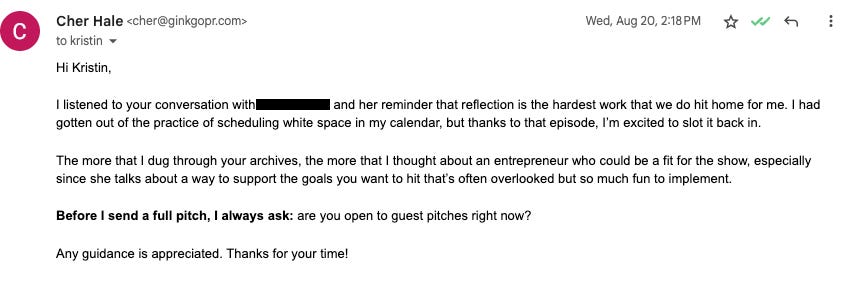
The key question is, “Before I send a full pitch, I always ask: are you open to guest pitches right now?”
This simple question has served as a foothold as I’ve developed a more comprehensive philosophy around how I try, with all my might, to ethically practice public relations.
If you ask Betty Friedan, the author of the Wheel of Consent, what I’m engaging in using this methodology lies within the quadrant of Taking-Allowing. In Allowing, they’re giving me access to their attention. In Taking, I’m receiving the gift of access.
While much of Friedan’s approach is about consent and touch, she believes that we can extend it to the dynamics of our non-romantic relationships too. Furthermore, she states that each quadrant has a shadow side, “ways it gets misused, overused, or distorted.”
I find that last piece especially critical in this context.
What method of marketing or visibility, in our industry, hasn’t been misused, overused, and distorted?
When I pitch someone and assume they’re receptive to pitches, there’s a subtle arrogance floating between the text that communicates, “I’m entitled to your time.”
This person isn’t at a networking event with the explicit expectation of being approached by strangers. Nope. They’re likely in their stretchy pants, sipping their chai tea latte and trying to blast through their to-do list.
Instead, I used this approach to gently ask for attention on behalf of my clients.
It meant giving the receiver space to establish expectations and boundaries that are such a critical piece of any relationship-building process.
Almost 100% of the publicists I’ve run into over the years have claimed that they prioritize relationships. I’m also one of those well-intentioned people.
But I have the sneaking suspicion that saying that is a convenient way to sidestep the reality that we’ve inherited a publicity practice entrenched in capitalist, colonialist, and patriarchal beliefs.
We create and protect relationships, sure, but often via extractive, inauthentic, and transactional means.
Let me be clear. I’m not claiming that publicists or other entrepreneurs who operate this way are at fault. After all, while catering to media that supports the work of the state, what other way is there to get the headline or book the show?
But what if there were another way, one founded on genuine engagement and respect?
To explore this possibility, we need to zoom back to 1919 so I can introduce you to good ol’ Edward L. Bernays, often referred to as the “father of public relations.”
Exploiting insights from his uncle, Sigmund Freud, Bernays wielded a complex understanding of human psychology in his work that gave him the leverage required to convince the masses to take a specific action, buy a specific product, or even start a war.
From making it morally acceptable for women to smoke to influencing the US government overthrow of Guatemala, Bernays created campaigns that shaped the lives of thousands of people.
The author of a book literally titled Propaganda, he created standards in the public relations space that encouraged manipulation and subterfuge.
Some argue that it created pathways to public relations campaigns like this one that strategically run bot armies for Israel.
Of course, this isn’t the whole story. Edward Bernays also created campaigns that brought issues like MS to the public consciousness. Like so many historic figures, he was complex.
He shaped public perception in an unimaginable way and experienced massive success as a result of it. Over his career, he worked with over 400 clients with a starting annual retainer of $12,000/yr in 1923. In 2025, that equates to just over 200,000/yr for a singular client.
Now, even if you’re the kind of person who believes that consent is important, you might be experiencing some cognitive dissonance here that makes you ask, “But why, Cher? Why is asking for consent important in this instance? Is it possible we’ve all gone a little over the top when it comes to asking for consent? I mean, what’s next? Will I be asking for consent to post on Instagram next?”
I wondered the same thing actually.
I first started writing this piece in February 2025 but found that I couldn’t ignore the flaws in my own reasoning about pitching for consent.
After years of operating this way, I had to reckon with questions like:
Is this approach too gentle?
Is it too light a touch for what I’m trying to accomplish on behalf of my clients?
And most importantly: Can we really land the attention we need this way?”
In a world replete with aggressive marketing messages and commodified parasocial relationships, could a lighter touch be just as, if not more, effective?
I started my experiment by looking back at the data. When I reached out to someone with a consent-type inquiry, how often did it lead to a relationship? How often did it lead to a booking?
I knew it was possible that I had stopped thinking clearly while bathed in the thin altitude of my moral high ground, but I hadn’t realized how much until I looked at the data.
Sure, I had been effective in getting my clients booked. After all, there was a reason that clients stayed on my roster for years at a time.
But it became clear to me that I had been too careful, only showing up with half the presence I had.
In re-engineering the methodology, I discovered something wonderful.
I realized that asking for attention can be both a gentle and a direct process. That I still don’t have to run in with over-designed one-sheets and arrogant statements to put my clients in a position to get noticed by their ideal audiences.
So let me back up to the original question: when we pitch others, do we have a responsibility to ask for consent?
The answer is what any lawyer might tell you. It depends. Here’s a breakdown of how I’m asking for consent post-experiment.
When I’m pitching a show for the first time and they have an intimate audience and zero guidelines about pitching
When I’m pitching associations or local groups about whether or not they’re looking for speakers
Embedding consent looks like writing a full pitch but saying something like, “If you’re open to pitches, I wondered if X person might be a fit for the show.”
When I’m pitching a podcast with a large audience that doesn’t communicate any guidelines about pitching
When I’m pitching a podcast host I’ve worked with in the past but haven’t spoken to in a long time (oftentimes, their format or focus has shifted)
When I’m on a tight timeline, e.g. the book is coming out in one month and I have 100 pitches to send
When I’m pitching a show with hundreds of reviews that belong to a podcast network like Dear Media, Lemonada, or Wondery
When I’m pitching a podcast host that has recently given me consent
When I’m pitching journalists or editors
When I’m pitching segment producers for television
When I’m pitching conferences that have a specific submission process
Now, I’m not claiming that these guidelines are what all folks who pitch others must do if they want to be “in integrity.” Rather, what I’m advocating is that we take a collective pause and decide what feels most in alignment with how we want to be in relationship with each other.
If you don’t want to receive a higher number of aligned and well-researched pitches, the kindest action you can take is public communication. On your Contact page and on the Podcast page of your website, include a specific blurb that details your expectations or requirements about pitching. Here are some examples:
”We’re fully booked through 2025 and won’t be accepting pitches until February 2026.”
”To pitch this show, please use this submission form. If we’re interested, we’ll follow up with you. Please do not follow up with us to make sure we received it. I promise you, we receive and carefully consider every pitch.”
”To pitch the show, send an email with subject line “Pitch: [Topic]” to [This Person] at emailaddress@emailnetwork.com”
”This show is invitation only.”
Some hosts include this information as an email autoresponder. Coming from someone who sometimes spends up to an hour researching and personalizing a pitch, it would be so appreciated if you could post this information somewhere in the public domain.
Slow down enough to decide on a case-by-case basis whether or not it makes sense for you to ask for consent.
Thoroughly check a website for pitching guidelines.
When in doubt and on a tight timeline, embed consent into the pitch.
This can be as simple as including a line that reads, “If you’re open to pitches right now, my name is XYZ.”
Recently, I offered podcast support for a book launch with an author at one of the top five publishing houses. I had three months to pitch ~150 top-tier shows. In my practice, top-tier shows have 500+ reviews along with healthy, active engagement on at least one social media platform.
After organizing the shows by priority, I got to work. Over the course of three months, we booked just over forty shows, and I embedded consent in the pitch for less than 5% of them.
Let’s contrast this with a client of mine who I would consider an emerging voice, someone who has a small social media following of less than 2k followers and a small list of less than 500 people. She had been on a handful of small podcasts before and really wanted to increase her visibility across a variety of niches and on shows with larger followings.
We booked twenty shows, and I sent a consent inquiry email for 20% of those. Another 20% were pitched via submission forms. The remaining 60% were pitches either had embedded consent or were with podcasters that I already had consent from.
I firmly believe that how we relate to the world and to each other, especially in these miniscule moments, matters.
That’s why I keep waving to my grumpy, elderly neighbor who never waves back.
It’s why I spend my limited time each month putting these community digests together.
It’s also why I deleted email from my phone and stopped using Instagram and and and
Finally, if you like this approach, I want to emphasize that there isn’t one way to do this. This isn’t another blueprint or framework.
Like all of the topics I write about, it’s an invitation.
Sit with how this gentler approach feels for you. Then, I encourage you to give it a try.
I’d love to know how it feels for you.
Every essay I write is a labor of love, and one of the best forms of reciprocity is when I get to hear your thoughts. What did this bring up for you? Tell me by hitting reply or leaving a comment below.
No posts
Comments
Nothing yet. Say the first thing.
Sign in to join the conversation.