
Red onion tart with Payoyo Mezcla cheese
Beetroot tartare
Radicchio salad with pickled red onion, raw purple carrot, garlicky kidney beans, and tahini dressing
I hold all these recipes in my head, a space where they like to mingle with one another. I pace my body between dishes, keeping each of their timelines in motion. I shift from setting the beets to boil, to slicing onions, to rolling out dough, to draining beans, to tearing radicchio leaves. And while doing so, I can see how each step is only a part of something much larger.
Written recipes tell the idyllic story of when ingredients finally come together, revealing the plot up to the moment their union comes into view on a pretty plate. At their best, recipes bring into view the resolution of many natural rhythms and a lot of work. They narrow our attention to a certain window of time, yet beyond that frame, histories stretch far backward.
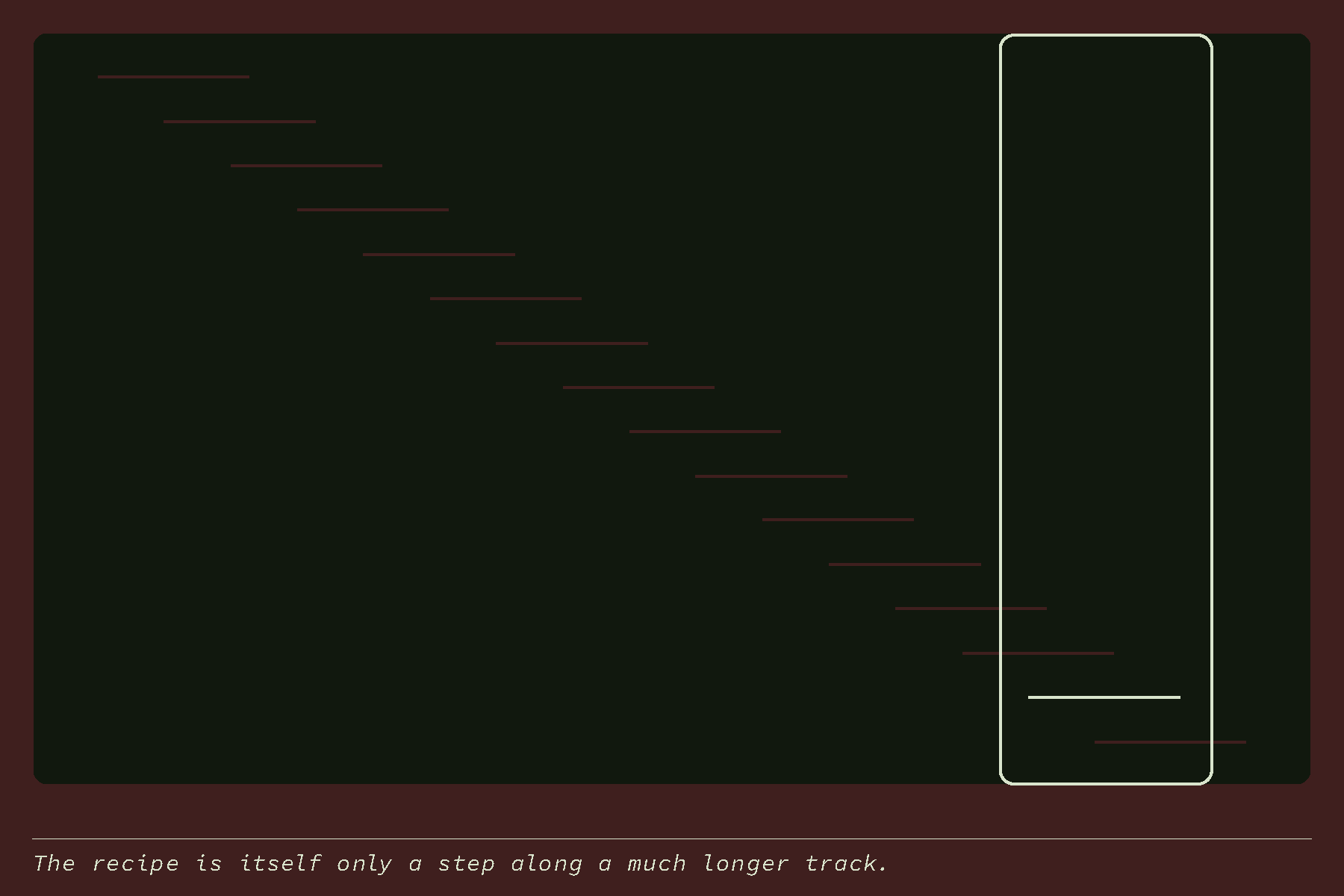
Consider the vinegar used to pickle the onions, and later spun into the dressing. That fermentation had to take place long before it reached my kitchen. Or the sesame oil frying the kidney beans, a product of a stretched-star-shaped bulb whose seeds were harvested, pressed, and transformed long before reaching my pan. What about the cheesemaker in Spain who carefully aged the Payoyo Mezcla before it arrived at the fromagerie five minutes from my house in the Netherlands? How about the beetroots, red onions, and carrots and how long they took to grow, the distances they traveled before ending up at the pick-up point an hour from my home, where I collect a box of vegetables every two weeks? And there are more steps I’ve already taken myself. I pickled the onions last week. I made the tart dough back in November and pulled it out from the freezer just yesterday. Each ingredient becomes a timekeeper, carrying a lineage of intention, dedication, and patience, while expanding the temporal scale of the meal. A recipe plays out without clearly admitting the processes that made it possible. Some of these processes are obvious, others obscure, extending across minutes, seasons, or even generations. There’s currently no bandwidth to hold the extent of this information and for now it’s on us to imagine it.
Just as ingredients arrive already shaped by time, so too does the desire to cook them. At some point, a dish appears as a thought, whether imagined, craved, or remembered. Every decision after that is shaped by season, stamina, skill, and mood. From there, the subtle planning begins, bringing the dish closer to reality, from checking what is on hand, to deciding when to shop, to accounting for the time dough needs to rest or pickles need to pickle. A cook orchestrates themselves so that all preparation converges at the precise moment when ingredients meet. A recipe joins many trajectories: the journeys of the ingredients, the work of the cook, and the unfolding of the world that brings them together.
Written recipes rarely reveal these depths because they pretend the middle, or near end, is the beginning. A recipe may actually begin with the decision to cook, a shopping list, a jar pulled from the pantry, a seed planted in the ground, or even the conditions that made planting possible, such as knowledge passed down, land tended, or cultures of bacteria preserved and shared. When we cook, we are not starting from zero. We’re compressing long stretches of time into a single meal. In doing so, a recipe weaves these threads into a moment we can taste, perceive, and carry with us, a fleeting condensation of care, labor, and temporality. Recipes, in this sense, are magic realist devices1, allowing us to apprehend the hidden2 work and histories contained in every dish.
Tonight’s meal3 is:
Red onion tart with Payoyo Mezcla cheese
Beetroot tartare
Radicchio salad with pickled red onion, raw purple carrot, garlicky kidney beans, and tahini dressing
Nicola Humble, The Literature of Food: “Ingredients have to be grown, harvested and prepared by hand: quails and turkeys killed, eggs slowly gathered as the hens lay and then preserved over months; nuts one by one roasted, shelled and the bitter inner skin removed. Food in this culture and time can fill - and use up - a whole life, and part of the point of the recipes is to speak to the gap between our worlds and theirs. The recipes themselves are magic realist devices - making strange the ordinary and making the magical real by giving us a set of rules which will apparently reproduce it.”
“Taste... is an avenue for intimacy with our environment. Those moments of paying attention add up, and they will ground us more fully in what our experience of dwelling has to do with non-humans, with ecological and industrial systems, with our climate, and with scales of time and space beyond ourselves... We will not always see the vast network at play, but we can start to see individual links, and use our senses and our attention to actively co-shape our environments.” Allie Wist, How do you pay attention to a glacier?
No posts
Comments
Nothing yet. Say the first thing.
Sign in to join the conversation.