
Before continuing our exploration of Matthew 5:48, I want to pause and gather together the major themes we have explored so far.
Today’s reflection is a recap of previous teachings, blending them into a more unified view of the Christian life and the realities we navigate on our journey with God. These are the themes we will continue to explore together in our Guided Conversation Gathering.
The central idea I have sought to convey throughout this series is this:
There are real circumstances surrounding our lives as Christians that we must both embrace and contend with. These realities sometimes create tension. Yet God has also provided a way forward.
We must learn to hold these truths together without collapsing into one or the other.

Sin corrupted our nature as human beings, influencing how we live and function as God’s image-bearers (Genesis 6:5; Romans 7:18).
The implication is that we still reflect God’s attributes as his image-bearers, but often do so in distorted ways that do not truly capture who God is (Romans 1:21–23; James 3:9).
As believers, when we gave our lives to Christ, we were credited with Christ’s righteousness, so we no longer stood guilty before God (2 Corinthians 5:21).
This right standing with God was the vital initial condition that had to be met before God’s healing of our corrupted nature could unfold. This is because healing can only begin within a relationship with God (Romans 5:1).
Being in right standing with God—or what Scripture sometimes refers to as being justified—is what makes us eligible to enter a relationship with him. Our relationship with God is truly a privilege Christ obtained for us (Galatians 2:16; 3:24).
Yet this restoration also requires God’s Spirit in intimate connection with our spirit (Romans 8:16; 1 Corinthians 6:17). This would not be possible apart from our relationship with God. But it is now possible for us as believers.
God’s personal presence now indwells us through the Holy Spirit (1 Corinthians 3:16).
The intimacy between our spirit and God’s Spirit is akin to the intimacy that exists among the persons of the Trinity. This, in itself, is already evidence that healing has begun.
Hence, our identification with Christ opens a new life and reality for us:
Justified — We are in right standing with God.
Intimacy — We are in an intimate relationship with God through the presence of His Spirit within us. God’s Spirit is not merely present around us; he actually indwells the depths of our being alongside our spirits (notice the distinction between the capital “S” and the lowercase “s”).
Healing — The Greek word often translated as “saved” or “salvation” is sozo. One of its meanings is healing. Therefore, when we received salvation, God’s healing work began. He started healing our corrupted nature.
Already, Not Yet — This phrase is often used in Christian teaching to describe our present reality. God’s healing has begun, but it has not yet reached its completion (Romans 8:23). We are already experiencing restoration, but we have not yet arrived at complete restoration (1 John 3:2).
Redemption ushered in healing, but because that healing remains incomplete, our sinful disposition has not yet been fully eradicated.
Both the Spirit of God, active within us, and the sinful nature, still active within us, continue to exert influence on our lives (Galatians 5:16–17).
This is the tension we must learn to navigate.
Yet God has not left us without help in this struggle.
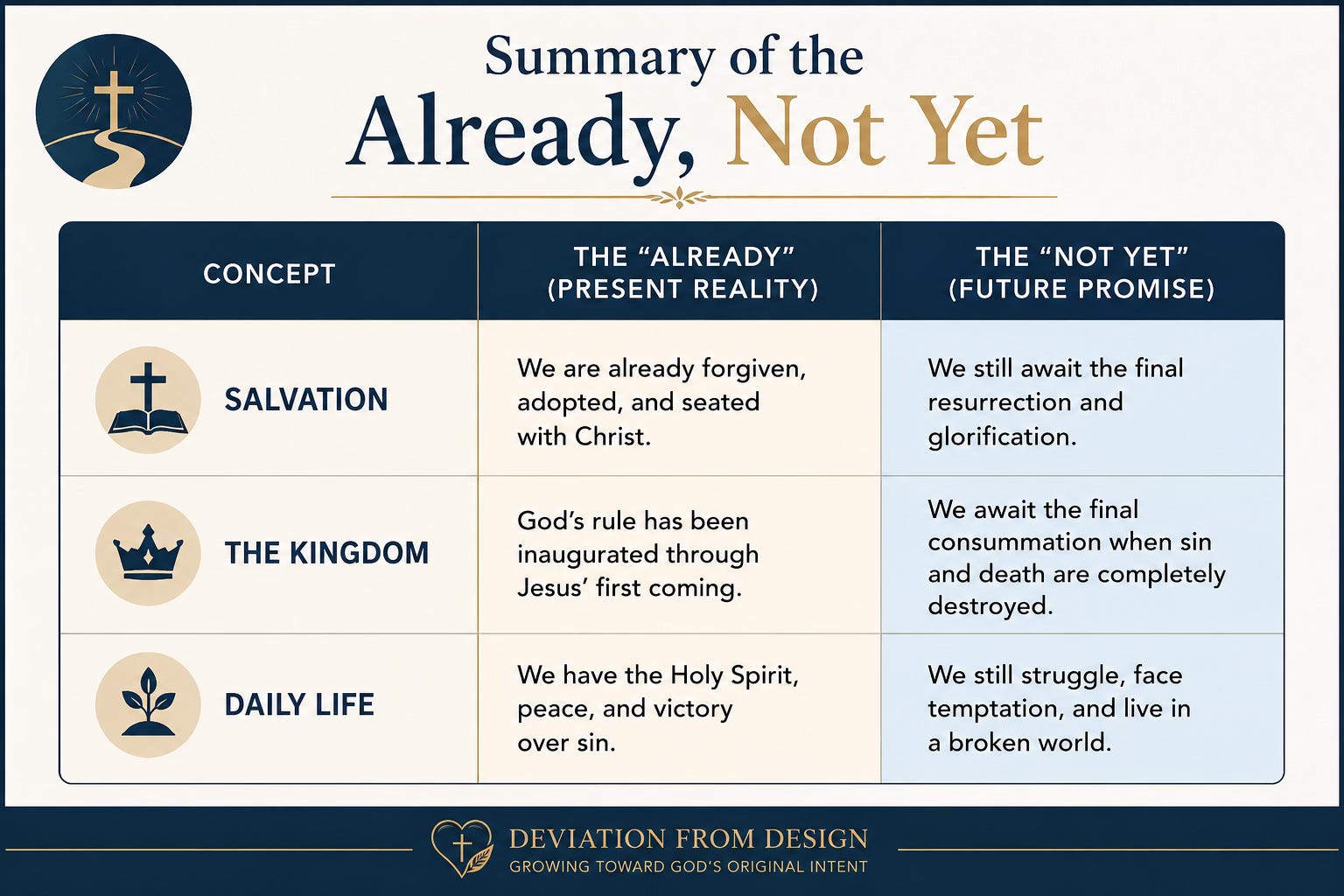
The problem is that we sometimes forget the reality of the “Already, Not Yet” and begin living as though our restoration is already complete.
When we fail to hold both realities together, we can fall into several traps that are deeply detrimental to our spiritual growth.
We become performative and hide our struggles because we assume those struggles reveal a lack of spiritual maturity.
We become prone to minimizing or justifying persistent sinful patterns.
Sometimes, we elevate the seriousness of sinful tendencies we do not personally struggle with to make our own struggles appear less significant.
This tendency can occur both individually and collectively within the Christian community.
This tension can also affect our relationship with God.
Instead of relating honestly to him, prayer and spirituality can become centered on presenting an idealized version of ourselves—the person we think we should be or the person we imagine God would find more acceptable—rather than bringing our true selves before him.
“Therefore, you are to be perfect, as your heavenly Father is perfect.”
— Matthew 5:48 (NASB95)
This sometimes misunderstood passage offers a glimpse into God’s heart amid all of this.
When properly understood, the phrase:
“You are to be perfect as your heavenly Father is perfect”
is essentially saying:
God’s will and plan for you is that you will reach your intended end—a state of completeness and wholeness—where you fully reflect your heavenly Father’s completeness and wholeness.
God is fully aware of our current struggles, yet he has also established our destiny.
His personal presence within us, through the Holy Spirit, serves as the seal assuring us of that destiny (Ephesians 1:13–14; 2 Corinthians 1:21–22).
And he is steadily moving us toward it (Philippians 1:6; 2:13).
Yet God also has intentions for us right now.
As we continue this series, Deviation from Design, we will continue exploring and clarifying that plan. We will also continue to consider how we can live into that reality now as we spur one another on toward growth and maturity.
Join me tomorrow for our Guided Conversation Gathering on Zoom as we continue to reflect on and discuss these themes together.
How have our recent reflections impacted the way you interpret and understand this passage?
Therefore if anyone is in Christ, he is a new creature; the old things passed away; behold, new things have come. —2 Corinthians 5:17 (NASB95)
How do you understand the phrase “new creation” as it is used in this passage?
Which of the three tendencies that can emerge when we fail to hold together the reality of the “Already, Not Yet” have you experienced, either now or in the past?
How has our recent exploration of Matthew 5:48 impacted your understanding of that passage?
What insights about the Christian life does it offer?
What aspect of the passage resonates most deeply with you, and why?
If this reflection was meaningful or helpful to you, consider sharing it with someone else who might benefit from it.
Comments
Nothing yet. Say the first thing.
Sign in to join the conversation.