
*A six-minute briefing on why provincial connection rules are beginning to decide which large electricity users can build, where, and under what conditions. Confidence levels are marked on material analytical claims.*

*Photo: Quintin Soloviev, via Wikimedia Commons, CC BY 4.0.*
Meta’s July 8 announcement of an Alberta AI data centre paired with a 932 MW power plant made the visible story difficult to miss: hyperscale computing now arrives as an energy project. The weaker signal sits underneath that headline. Provincial connection rules are starting to determine which large loads become real, where they can locate, and what they must contribute to the electricity system.
The pressure extends beyond AI. Ontario’s system planner defines “large step loads” as projects of 20 MW or more that arrive in substantial blocks, including data centres, the EV production supply chain, mineral extraction and processing, and other electrification projects. Federal policy is simultaneously supporting the expansion of domestic AI-compute capacity.
**The signal in this issue: grid interconnection is becoming de facto industrial policy in Canada. The ability to secure a connection, and the conditions attached to it, is beginning to determine which large electricity users can build in each province.** *(Confidence: Emerging.)*
#Why this matters now
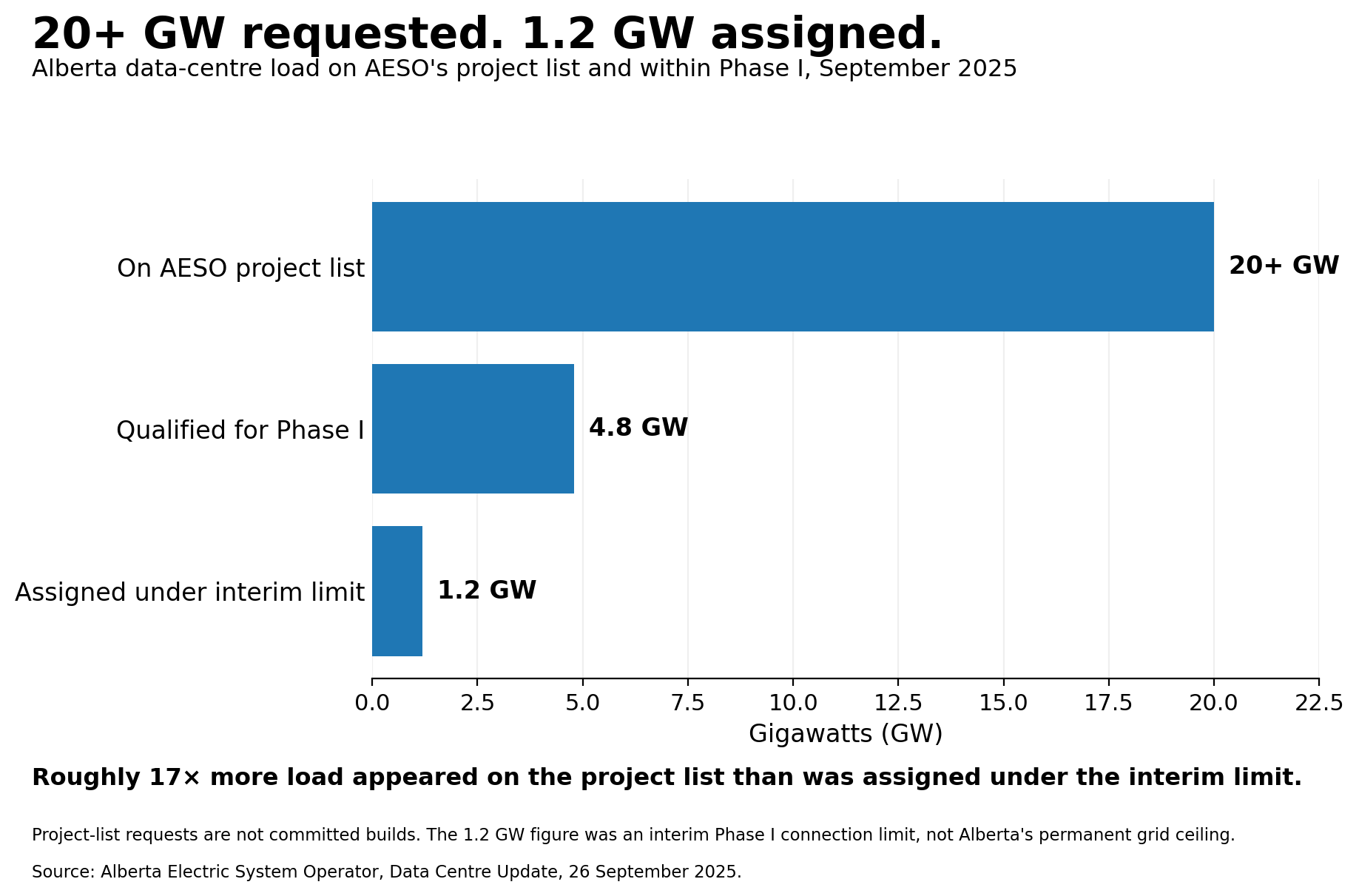
Alberta is the bellwether. In September 2025, the Alberta Electric System Operator had more than 20,000 MW of data-centre load on its project list. Of that total, 4,800 MW qualified for the first phase of its Large Load Integration Program. AESO assigned 1,200 MW under an interim connection limit.
*Source: Alberta Electric System Operator, Data Centre Update, 26 September 2025.*
The number to remember is the gap: roughly 17 times more load appeared on the project list than was assigned through the interim limit. Project-list requests are not committed builds, and 1,200 MW is not Alberta’s permanent grid ceiling. The gap nevertheless shows that connection is no longer only a routine engineering step. It is becoming a process for sequencing demand, testing project readiness, assigning system obligations and deciding who bears the cost of new capability. *(Confidence: Emerging.)*
That evolution is already visible. AESO has moved from asking whether large loads should bring their own generation to actively developing a Phase 2A BYOG process. It has also issued detailed technical requirements for transmission-connected data centres, including project-specific operating and reliability obligations. The weak signal is therefore not simply that grids are constrained. It is that the rules for accessing them are becoming a mechanism of economic selection. *(Confidence: Emerging.)*
#Province by province
**Alberta.** More than 20 GW of data-centre load appeared on AESO’s project list, while 4.8 GW qualified for Phase I and 1.2 GW was assigned under the interim limit. Alberta’s decision is how to turn temporary allocation, an active BYOG workstream and new technical obligations into a durable framework for project readiness, system access, transmission contributions and reliability. *(Confidence: Emerging.)*
*Photo: TagaSanPedroAko, via Wikimedia Commons, CC0.*
**Manitoba.** Manitoba Hydro says the province needs new electricity supply by 2030. Under one high-load case, its modelling shows a potential accredited-capacity shortfall of 388 MW in 2029 even with demand-response and curtailable-rate programs, while cautioning that the shortfall depends on the demand that materializes. Manitoba’s decision is how much near-term optionality to preserve while new supply is developed. *(Confidence: Emerging.)*
**Quebec.** Hydro-Québec’s map of 13 industrial zones shows that total provincial energy supply and the local ability to connect are different questions. Several zones had less than 10 MW of residual transmission connection capacity, while others had more room or approved reinforcement. Quebec’s decision is how connection geography will interact with project selection, regional development and the cost of network upgrades. *(Confidence: Emerging.)*
*Photo: P199, via Wikimedia Commons, CC BY 2.5.*
**Ontario.** IESO projects commercial data-centre electricity use rising from 4.5 TWh in 2027 to 22.6 TWh in 2050 in its reference scenario, while assessing active and prospective projects for their probability of successful implementation. Ontario’s decision is how much prospective large-load demand to incorporate into procurement and transmission planning before individual projects become sufficiently credible to justify system investment. *(Confidence: Emerging.)*
*Photo: GTD Aquitaine, via Wikimedia Commons. Public domain.*
The pattern underneath them is consistent, but the decisions are not. Alberta must design allocation rules. Manitoba must preserve optionality. Quebec must manage connection geography. Ontario must plan around uncertain project maturity. *(Confidence: Emerging.)*
#What we’re watching
- **Bring-your-own-generation is moving from question to process.** AESO’s Phase 2A work now includes a proposed BYOG process, readiness requirements, allocation questions and a bridging option. Watch whether self-supply becomes a repeatable route to connection or remains a province-specific response to an exceptional queue. *(Confidence: Emerging.)*
- **Connection-capacity maps may become pre-development screens.** Hydro-Québec plans to update its industrial connection map annually and describes it as an initial source of information before the formal connection process. Developers may begin testing connection headroom earlier in site selection, before treating land, incentives or advertised power prices as decisive. *(Confidence: Speculative.)*
- **Project maturity is becoming a planning input.** IESO assesses the probability that active and prospective projects will be implemented, while AESO’s proposed BYOG process includes readiness checklists, fees, security requirements and progress milestones. Watch whether comparable maturity gates become standard before large loads enter forecasts or trigger capital plans. *(Confidence: Emerging.)*
# The horizon read
Looking back from 2042, the decisive provincial advantage may not be the lowest advertised electricity price or the largest theoretical energy surplus. It may be connection optionality: the ability to translate supply, transmission and regulatory capacity into a credible connection on a project timeline, without obscuring costs or weakening reliability.
Where that capability compounds, provinces can choose among industrial opportunities. Where it does not, queues, location constraints and bespoke negotiations choose for them. The early divergence is visible now in allocation limits, self-supply processes, localized capacity maps, shortfall planning and uncertainty-adjusted forecasts. *(Confidence: Emerging.)*
# The decision on your desk
For provincial energy ministries, utilities, system operators, regulators and economic-development agencies, the question is no longer simply how much electricity the province expects to need. It is how a limited and uncertain connection pipeline should interact with reliability, ratepayer exposure and industrial priorities.
Three questions we could answer for you:
1. Which projects in your current pipeline are mature enough to enter the demand forecast, and what evidence should each provide before triggering transmission or supply investment?
2. How should connection, reinforcement and reliability costs be allocated among applicants, ratepayers and the wider system under your province’s mandate and tariff structure?
3. Which allocation framework best fits your province’s industrial priorities, reliability constraints and tolerance for stranded investment when several projects compete for the same near-term grid capability?
The answers depend on the province’s assets, mandate, rate structure, project pipeline and tolerance for stranded investment. This briefing identifies the decision. It does not choose the route.
---
# Method & sources
This briefing uses the Foresight House AI horizon-scanning method, Stream 1: weak-signal identification, cross-category source corroboration and confidence tagging on material analytical claims. Directly reported figures are linked to their original sources. Confidence tags apply to the analytical interpretation built from that evidence.
**Confirmed** means multiple independent sources, including at least one Category A peer-reviewed or Category B institutional source. **Emerging** means two or more sources from different categories support a developing claim and its causal mechanism. **Speculative** means one credible source supports a documented mechanism that has not yet been independently corroborated.
Primary and institutional sources:
- [Alberta Electric System Operator, *Data Centre Update*, 26 September 2025](https://www.aeso.ca/assets/Uploads/grid/Data-Centre/AESO-Data-Centre-Update-September-2025.pdf)
- [Alberta Electric System Operator, *Large Load Projects*, accessed 13 July 2026](https://www.aeso.ca/grid/connecting-to-the-grid/large-load-projects/)
- [Alberta Electric System Operator, *Guide to AESO Connection Requirements for Transmission-Connected Data Centres*, 12 June 2026](https://www.aeso.ca/assets/Uploads/grid/Guide-to-AESO-Connection-Requirements-for-Transmission-Connected-Data-Centres.pdf)
- [Alberta Electric System Operator, *Phase 2A: Large Load Integration | BYOG Process*, updated 8 July 2026](https://aesoengage.aeso.ca/pre-engagement-phase-ii-large-load-integration)
- [Innovation, Science and Economic Development Canada, *Canadian Sovereign AI Compute Strategy*, page modified 4 June 2026](https://ised-isde.canada.ca/site/ised/en/canadian-sovereign-ai-compute-strategy)
- [Innovation, Science and Economic Development Canada, *Canada to drive billions in investments to build domestic AI compute capacity at home*, 5 December 2024](https://www.canada.ca/en/innovation-science-economic-development/news/2024/12/canada-to-drive-billions-in-investments-to-build-domestic-ai-compute-capacity-at-home.html)
- [Manitoba Hydro, *2025 Integrated Resource Plan*, updated 7 July 2026](https://www.hydro.mb.ca/corporate/planning/)
- [Manitoba Hydro, *Appendix 7.2: Modelling & Analysis Results*, 2025 IRP appendix, accessed 13 July 2026](https://www.hydro.mb.ca/docs/corporate/irp/2025-irp-report-appendix-a7-2.pdf)
- [Hydro-Québec, *Capacités de raccordement de projets industriels au réseau de transport: 13 zones de développement industriel ciblées*, December 2025](https://www.hydroquebec.com/data/projets/presentation-zones-raccordement-industriel.pdf)
- [Independent Electricity System Operator, *2026 Annual Planning Outlook*, March 2026](https://www.ieso.ca/-/media/Files/IESO/Document-Library/planning-forecasts/apo/2026/2026-Annual-Planning-Outlook.pdf)
- [Independent Electricity System Operator, *2026 Annual Planning Outlook: Demand Forecast Module*, March 2026](https://www.ieso.ca/-/media/Files/IESO/Document-Library/planning-forecasts/apo/2026/2026-APO-Demand-Forecast-Module.pdf)
Additional source trail retained for audit:
- [Alberta Electric System Operator, *Data Centre Connection Process Update*, 20 March 2025](https://www.aeso.ca/assets/AESO-Data-Centre-Update-March2025.pdf). Documents 11,834 MW of requested load before the later Phase I allocation.
- [TD Economics, *Data Centers in a Grid Constrained World: Challenges and Opportunities for Canada*, 23 March 2026](https://economics.td.com/ca-data-centers-and-grid-constraints). Secondary context only; the phrase `1.2 GW by 2028` remains excluded because that date has not been located in the primary AESO material reviewed.
Recent mainstream context used for the novelty check:
- [Associated Press, *Meta plans billions for first AI data center in Canada, largest outside the US*, 8 July 2026](https://apnews.com/article/922a7d15ab730ec53b934269fc00a0fa)
Produced with AI-agent support under Diana Olynick’s editorial direction.
*Not investment or policy advice. Signal confidence levels are analytical judgments, not guarantees.*
**If this was useful, subscribe.** One Canadian field at a time, province by province, before the implications become obvious.
Comments
Nothing yet. Say the first thing.
Sign in to join the conversation.