
A lot of the AI conversation is already aging badly.
For a while, the big question was whether models could write, summarize, draft, answer, and help people move faster. That phase isn’t over. But it’s no longer where the interesting things are happening.
The deeper shift now is that AI is moving closer to execution.
Not producing an output. Not offering a suggestion. Actually taking action inside workflows.
That’s the signal.
And once that happens, the conversation changes fast. Because the real question stops being:
Can the model do the task?
It becomes:
What are we willing to let it do on its own?
Delegation becomes governable
The enterprise AI conversation is starting to move from capability to authority.
That sounds abstract until you see it in practice. Organizations are testing and adopting AI systems that don’t just assist a person at the keyboard. They move work forward inside real operating environments.
We’re talking about things like drafting and sending internal materials, triaging tickets, routing approvals, handling vendor or customer operations, triggering downstream processes, updating systems of record, making bounded decisions inside software.
Each one looks small in isolation. Together they point to something much bigger.
AI is starting to look less like a passive tool and more like a junior operator.
That’s where the risk profile changes.
Why this is different from what came before
When AI only generates content, the main concern is output quality. Is it accurate? Is it good enough?
When AI starts acting inside workflows, the concern becomes supervision. And the questions get harder.
What authority does the agent have? What systems can it access? What can it do without a human reviewing first? What should trigger escalation? Who is accountable when something goes wrong?
This is why organizations are quietly building something they don’t always have a name for yet. A management layer for AI labor. Assigning roles. Setting permissions. Defining limits. Reviewing performance. Deciding where human oversight is non-negotiable.
That’s not a tooling conversation. That’s organizational design.
The line that actually matters
The most useful distinction right now is simple: AI that suggests versus AI that acts.
If a system drafts an email for you to review, that’s one kind of risk. If it sends the email automatically, that’s another.
If it recommends how to route a ticket, that’s one thing. If it assigns the owner, changes the priority, updates the system, and triggers the next step — that’s something else entirely.
A lot of organizations are treating these as just different levels of automation. That framing is too shallow.
The real difference is authority.
Once a system can act, the critical design questions aren’t about answer quality anymore. They’re about permission boundaries, escalation rules, supervision quality, auditability, rollback mechanisms, and ownership when something breaks.
This is where most organizations are less prepared than they think.
Pay attention to the vocabulary
One useful way to read where the market is heading: watch the words.
More enterprise AI products are being framed around agents, actions, workflows, orchestration, autonomy. That language matters because it signals how vendors and buyers are redefining value.
The promise is no longer just that AI helps a worker. The promise is that AI takes work off the worker entirely, at least for certain classes of tasks.
That’s attractive for obvious reasons. Most organizations don’t want intelligence in the abstract. They want throughput. Faster cycle times, lower coordination costs, less human effort on repetitive work.
But delegated execution creates a new burden.
You now have to manage what you delegated.
The uncomfortable truth
Most organizations want the productivity gains of delegation. Very few are structurally ready to supervise many semi-autonomous agents at once.
That gap matters more than most people admit.
In many firms, there’s still no clear answer to basic questions: Which actions always need human review? What level of confidence is enough for the system to proceed? When should an agent stop and escalate? Who owns the system once it moves from pilot to production?
Without those answers, delegation becomes fragile.
And when failures happen, they get described the wrong way. People say the model was unreliable. The AI hallucinated. The output was poor. Sometimes that’s true. But often the deeper failure is that the organization granted authority without designing supervision.
The risk isn’t bad outputs.
The risk is unmanaged authority.
What changes if this signal strengthens
If delegation becomes normal, several parts of the organization get pulled into the AI conversation whether they planned for it or not.
Operations teams will need to design for authority, not just automation. Managers will need to know what work is handled by humans, what’s handled by AI, and where exceptions surface. IT and product teams will find that permissions, logging, and rollback stop being background plumbing and become core governance infrastructure. Legal and compliance will need to explain not just whether an output was acceptable, but why an action occurred, under what controls, and under whose accountability.
And leadership will face this as a governance question before it ever becomes a scale advantage.
Firms that treat delegation as a product feature will make worse decisions than firms that treat it as an operating model choice.
A better question to start asking now
Most teams are still asking whether AI is capable enough.
That’s no longer the only useful question.
A better one is this: What class of authority are we prepared to delegate, under what controls, with what escalation path, and with which accountable human owner?
Less exciting. Much closer to reality.
Because every delegated AI system ends up having a role, a scope, a permission boundary, an escalation path, and an owner — whether the organization defined them or not. If any one of those is missing, the system may still work for a while.
It just won’t be governable.
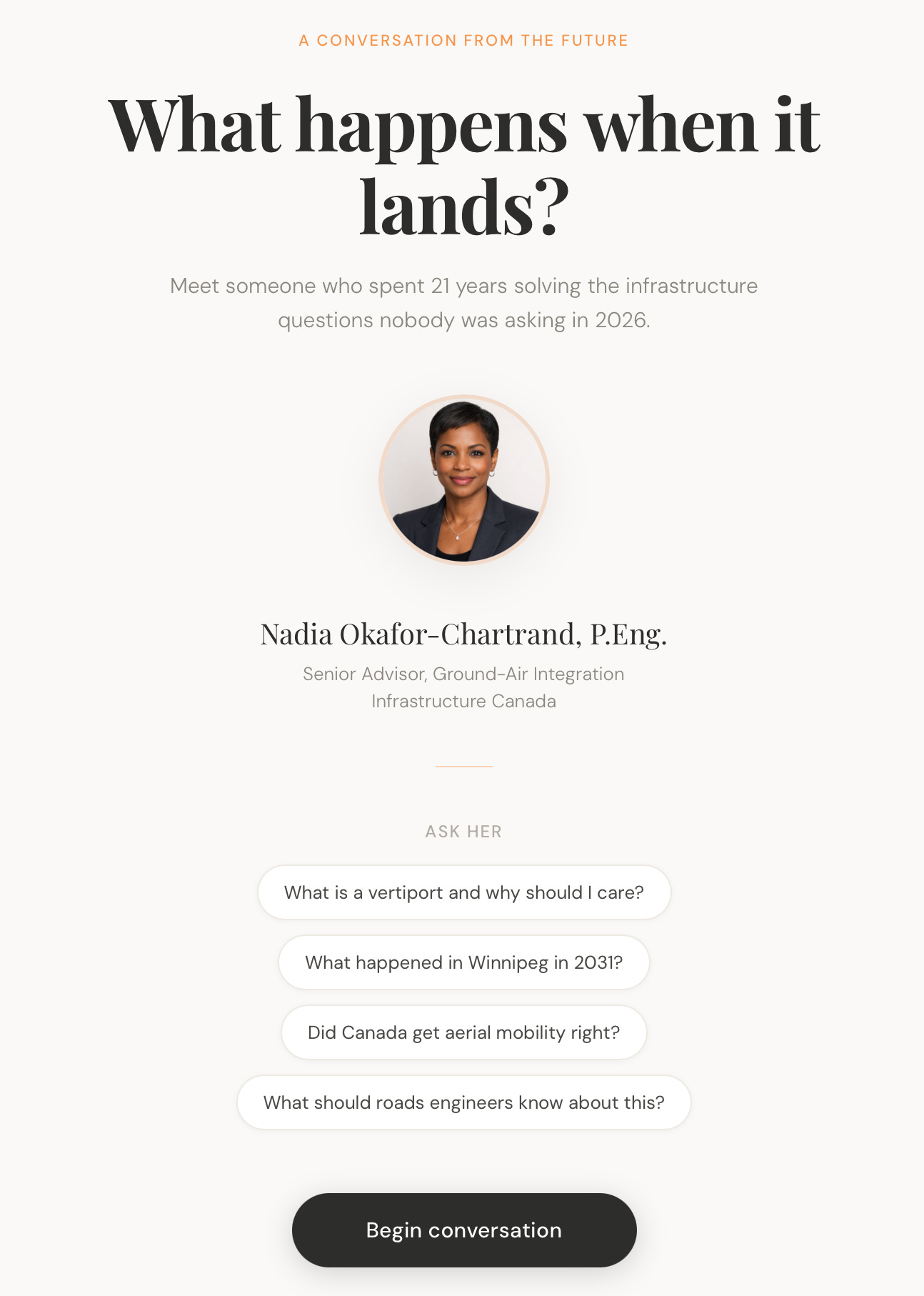
That’s exactly the point of this signal. In the image below, by the way, I am sharing a recent agent I built for a conference coming up. Her name is Nadia, a PEng from the future specialized in advanced infrastructure.
Coming next in this Case File
Over the next three weeks we build this into a full scenario set.
Week 2: the scenario world. Week 3: speculative artifacts. Week 4: signposts and a decision drill.
Comments
Nothing yet. Say the first thing.
Sign in to join the conversation.