
Ovaherero and Nama communities in today’s Namibia are still living with the consequences of the brutal occupation of the region by German colonial forces (1884-1915). The legacies of the genocides carried out during that period are depleted environments, stolen lands, and economic inequalities that endure until today.
Fractured Lifeworlds, opening at Spore Initiative in Berlin on 6 June, showcases a body of work developed by Forensis and Forensic Architecture over four years, in close collaboration with descendant communities, oral historians, Indigenous scholars, and activists in Namibia and Germany.
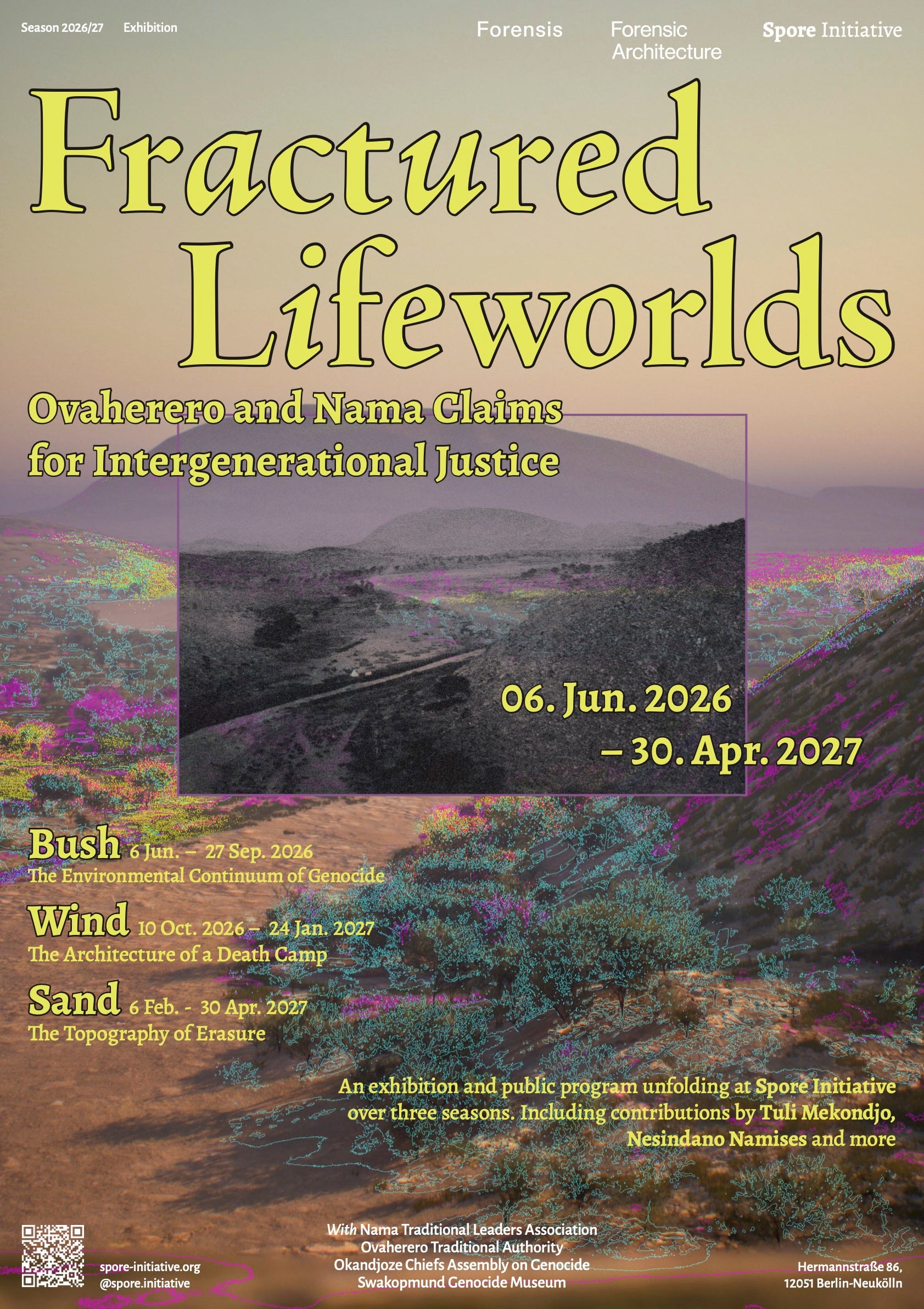
Colonial histories are never a remote or self-contained past; today, Namibia is a lens through which to understand unresolved histories which define the contemporary world: dispossession, extractivism, genocide, and memory.
The exhibition will unfold over three seasons – Bush, Wind, and Sand – each reflecting an aspect of Namibia’s landscapes, and highlighting a different cluster of research within the collaborative project.
In Berlin? Join us for the opening from 4pm on 6 June.
We’re looking for a proactive, ambitious, and sensitive fundraising professional to join our team and expand our network of individual donor support.
Take a look at the advert and job description for more information and how to apply. Applications close at 16:00 BST, Thursday, 21 May 2026.
Hours before a ceasefire agreement was due to take effect between Lebanon and Israel on the evening of 26 November 2024, Israel bombed an apartment building in Beirut’s Barbour district.
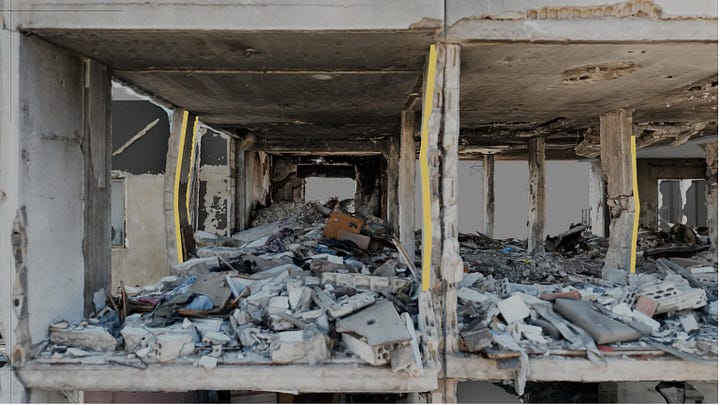
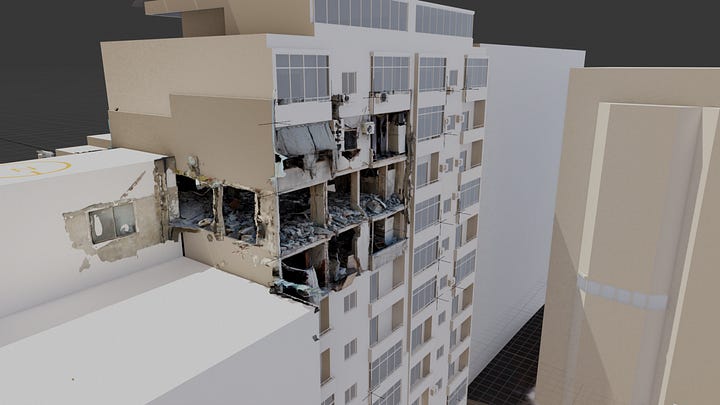
Mahmoud Naim Cherri and Nadira Hayek, husband and wife, were killed in their ninth floor apartment. Five others died in the strike, including the grandmother of a long-time collaborator with FA.
In April, Ali Cherri, a renowned French-Lebanese artist and son of Mahmoud and Nadira filed a complaint for war crimes over the strike with the Paris Judicial Court, with support from the International Federation for Human Rights (FIDH). This marks the first attempt to hold Israel legally accountable for war crimes committed in Lebanon since October 2023.
FA reconstructed the building and the apartment in which Cherri’s parents were killed. We identified the GBU-39 munitions involved in the strike, and sketched possible trajectories of the munitions.
Data for our investigation was provided by Mohamed Shehab, a drone pilot in Beirut. In March of this year, Shehab was also killed in an Israeli airstrike on his home in the south of Beirut, along with his 3 year-old daughter.
Our director’s latest book, Ungrounding: The Architecture of Genocide, was released on 6 May 2026. Ahead of the release, Eyal wrote for a recent edition of the London Review of Books, on Israel’s ‘Yellow Line’ in Gaza (paywall). He writes:
Two and a half years after 7 October 2023, most of the Gaza Strip – cities, refugee camps, schools, universities, mosques, the health infrastructure, agriculture, wells and the soil itself – has been destroyed and made toxic by bombs, artillery, tank shells and sappers. The most systematic destruction was caused by D9 bulldozers made by the US company Caterpillar. These giant armoured machines stabbed their blades into the ground, churning up fields, felling orchards, flattening homes, tearing through roads and ploughing through cemeteries … The bulldozers turned the agriculturally rich land of eastern Gaza into a monochrome desert of crushed grey cement mixed with the area’s yellowish soil. Entire cities such as Rafah, towns such as Beit Hanoun and refugee camps such as Jabalia were erased. When buildings are bombed or bulldozed, their remains – plastics, wiring, solvents, insulation, asbestos – release toxic chemicals into the soil. Some bombs penetrate the ground before exploding and release heavy metals or metalloids – such as uranium, lead and arsenic – deep underground. Many of these substances are slow to decay and will affect the composition of the soil for decades. A lived-in landscape has been turned into what a former Israeli general, Giora Eiland, described as a place ‘where no human being can exist’.

Comments
Nothing yet. Say the first thing.
Sign in to join the conversation.