
My summers as a young teenager were unsophisticated. My sister Danielle and I spent long afternoons in my grandparents’ Beirut apartment, lounging across various armchairs and sofas after a delicious lunch, usually in silence and alongside our cousins, Gida and Ibrahim. Those summer afternoons were quiet, but comforting, though often lacking in a basic amenity, electricity, which meant no sounds of the television in the background, but plenty of muffled sounds from the street below.
On those warm days, we often found ourselves reading voraciously. With no more than a year apart in age between us, we were blessed (and perhaps cursed) to share the same taste in books, often fighting over who got to read the next shared copy of the newest installment of Harry Potter, or taking long naps before roping each other into a too-competitive game of cards.
Despite the lack of television as entertainment, those long summers never felt lacking, even when punctuated with unexpected visits from various neighbours; sometimes enthralling, others sublimely boring.
Ever so cool and welcoming, Teta Renée would have a jug of lemonade waiting for surprise visitors, with always enough in the frozen vessel for our band of cousins to join in on as we responded to well-meaning interrogations from the visitors who had stopped by.
On those hot afternoons, with little more than a hand-held fan to cool us, an aunt or a parent would sometime pop in to check on us, back from an important errand, and often on their way out to another. Though in retrospect it appears like we did very little, we were never bored. We had each other, and we had Teta Renée, doting on us on all those afternoons, making sure we were well-fed and well-loved.
Once we were in university, our schedules began to differ, each of us arriving on a different day, usually from somewhere far away where we deeply and sorely missed the tasty meals from home. As my grandmother prepared for our respective arrivals, she would enquire about our choice of dish, much like one would ask about an inmate’s last meal request, but far less morbid. This was the best treat we could fathom. It was our one chance to get just a little bit more of her love.
Soon, we all came into our own, comfortable in picking a favourite and asking for it shamelessly. I don’t always remember what the others’ favourites were, though some were more vocal than others in expressing their desires: my cousin Tanya always wanted the lamb chops for example, and I’m sure there was someone who always requested the stuffed cabbage leaves, which were coincidentally the worst thing I could ever be told was for lunch.
To begin with, I had always requested stuffed vine leaves. This time- and labour-intensive meal is a sure sign of love, I thought, and so delicious. It still holds a high spot on the list of meals I love.
However, over time, it was a much simpler dish that I craved: Mjaddara.
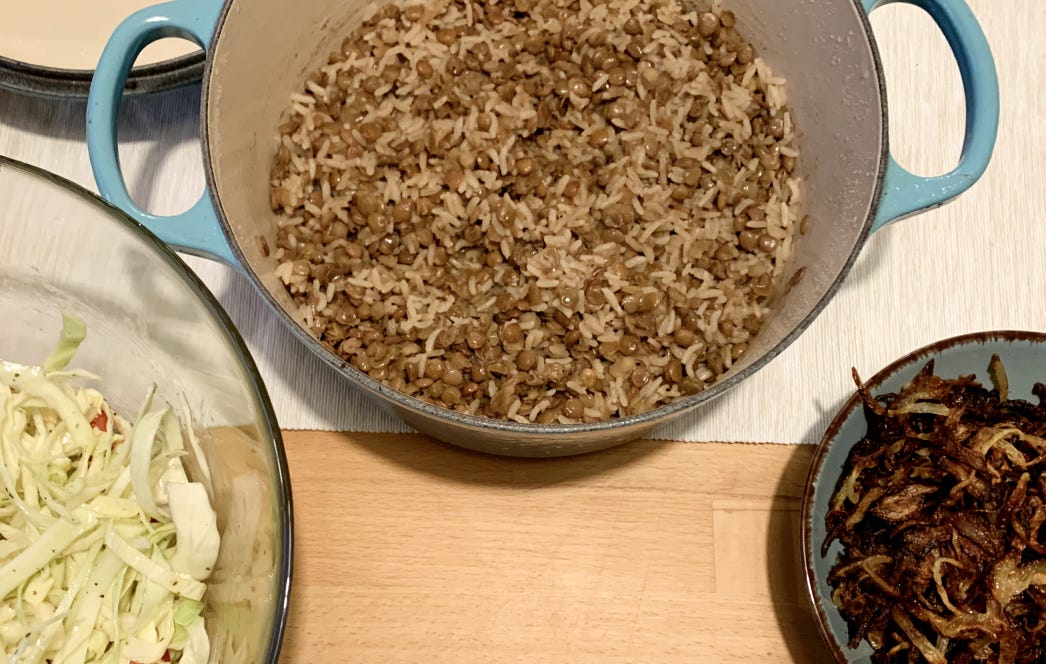
Mjaddara (also referred to as mdardara depending on where you grew up and what part of Lebanon is home to you) is a simple combination of rice, lentils, and crispy fried onions (of course the best part). The dish is, as far as I’m concerned, best enjoyed with a side of thinly-sliced cabbage salad dotted with tomatoes and drenched in an olive oil and lemon dressing.
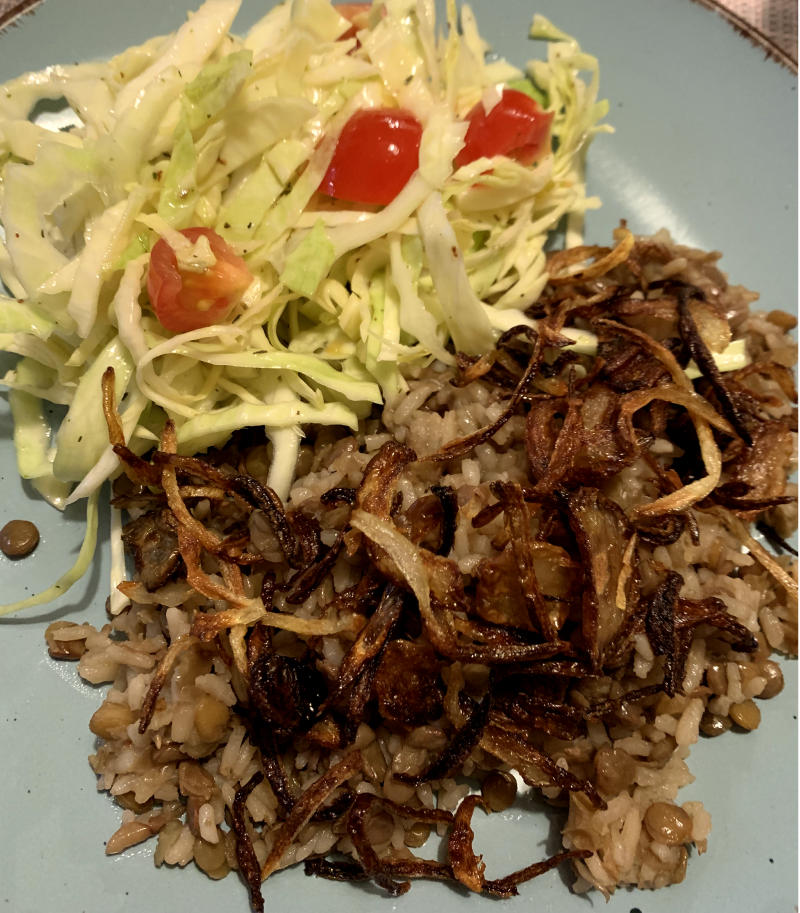
The dish has no spices, no meat, and no pomp or circumstance, so much so that Teta often referred to it as the “food of the poor”. At the time, I felt this moniker had somehow diminished its importance, but so many years later, I now see how this is what makes it even more so. With so few ingredients and some of the cheapest you can get your hands on, you have yourself one of the most delicious and most democratic meals you could make.
As we got older, and our parents settled into their own Beirut homes, we found ourselves spending fewer afternoons luxuriating in books, cards, and lemonade. Instead of being the ones receiving visitors, serving glasses and taking them away at our grandmother’s behest, we became the visitors ourselves, the happy recipients of her ice-cold lemonade and, if we were lucky, a bite of something delicious from the very special cart of tasty treats usually reserved only for guests.
But Teta never tired of cooking for us, and even in her final years, she would always go out of her way to let me know that a pot of mjaddara would always be waiting for me in her kitchen, whenever I wanted a plate.
My grandmother imparted so much wisdom, a lot of which I cherish and carry with me through my days. From her reminders that “she who has a tongue and is able to speak is never lost”, to her advice about drinking a glass of lukewarm water just after you wake up to keep you in tip-top shape, she always had something to teach everyone around her.
She also taught me how to make mjaddara, and it has become the comfort food I crave, and the dish I return to when I need a little bit more love in my day.
However, her recipe was always verbal, with a heavy reliance on ballpark measures and subjective estimates that changed from time to time, so when I do want to make myself a foolproof pot, I turn to a dear friend of our family and of my grandmother, Dina Bayoud Kohl, who Teta Renée had cherished deeply.
Her recipe for Mdardara is perfect down to the last bite, and I encourage anyone who wants to make this dish to follow it carefully!
Prepare a wire rack with paper towels on one side, and nothing on the other. Place it close to where you will be frying your onions for easy transportation from pan to rack.
Slice your onions really thinly — not paper-thin, but almost.
Use olive oil, and do not substitute for anything else! There are so few ingredients that you might as well do it right.
Once your onions are chopped, place them in a bowl and toss them with a tablespoon or two of cornstarch, using a pair of chopsticks to separate every onion slice into its own sliver.
Make sure your oil is hot enough and deep enough to more or less deep fry the onions, rather than sauté them.
Once they are in the pan, do not touch them for a few minutes, and then use the chopsticks to gently move them from time to time. It’s okay if they stick to each other. It’s a sign of love.
Once they start to colour, glue your eyes to them. They will go from perfectly bronzed to burnt carbon in a matter of seconds, so be ready to fish them out when they are perfect.
Use those trusty chopsticks to carefully take out the onions, draining as much of the oil as you can over the pan (you need that precious gold to go into the lentil-rice pot) before placing them carefully on the paper towel portion of the rack.
A minute or two later, using the chopsticks, move them to the other side of the rack to cool and crisp up.
Congratulations, you now have perfectly crispy onions! Bon appetit!
No posts
Comments
Nothing yet. Say the first thing.
Sign in to join the conversation.