
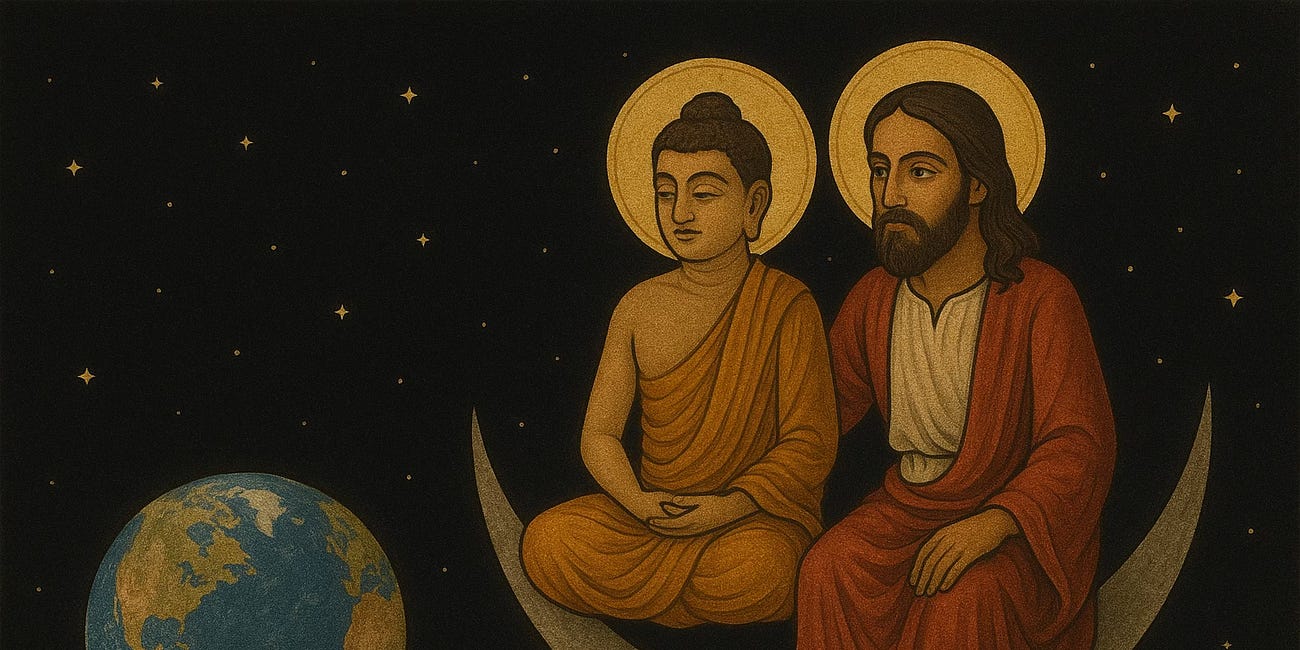
Rupert and I recorded another conversation following our exchange last week on formal causation, this time on a far more intimate topic: our spiritual autobiographies and shared senses of the triangulation between Buddhism, Christianity, and Hinduism. Rupert suggested the topic after listening to my talk here in Chiang Mai a few days ago on my relationship with Buddha and Christ.
Rupert and I both considered ourselves atheists as adolescents. And we both moved beyond it as a result of experience rather than argument. I admitted that the Christ event still embarrasses my rational mind even while also summoning a higher or heartened form of reason in which incarnation and resurrection might become thinkable. That work remains unfinished, but it operates in the imaginative background of my cosmology whether I foreground it or not. Rupert’s path ran through India, Transcendental Meditation, and his relationship with Bede Griffiths, then back to the Anglican church, drawn by the recognition that liberation is not merely personal.
The metaphysical core of our discussion was the Trinity. Rupert mapped Sat-cit-ānanda onto Father-Logos-Spirit as ground of conscious being, cosmic form (Bede’s cosmic Christ, the Logos whose primary incarnation is the cosmos itself), and moving breath. The Trinity is not a symbol we project onto nature but the reason projection and speech are possible at all. I suggested a resonance with Whitehead’s account of cosmic life as rhythm, a polarity with a mediating third, exemplified at every scale.
I suggested the incarnational vector evident in Christianity arises as a development within Buddhism itself, where the escape to nirvana becomes the Bodhisattva’s vow to return to saṃsāra until all sentient beings are likewise liberated. I also see this vector in the realization that that śūnyatā or emptiness is immediately flooded by karuṇā, or compassion. We both landed on the relational selfhood evident in the Trinity as the resolution of Mosaic “I am that I am” and the Buddhist anātman: as Paul put it, “not I, but Christ in me.”
I’ve explored this theme many times before:
Religious Dialogue as Soul-Making
·
May 8, 2025
The following essay was originally written in April 2011 while I was enrolled in a graduate seminar on inter-religious dialogue facilitated by Professor Jacob Sherman. I still agree with my 25-year-o…
Comments
Nothing yet. Say the first thing.
Sign in to join the conversation.