
Welcome to Mental Garden, a newsletter about creativity, focus, and systems for writing and building projects on the internet. To explore the full library, go here.
🏷️ Categories: Learning, Attention, Memory.
There’s someone holding the bar for you right now.
You don’t see it. It’s in every video, in every reel, in every 60-second summary you consume before your brain even gets to process it. You keep moving the mental weight. You keep feeling like you’re learning, like you’re gaining new knowledge. You end the scrolling session with the feeling of having done something meaningful.
You haven’t.
You confuse having consumed something with having understood it, and that error has a name: the illusion of fluency (Jacoby, Bjork, & Kelley, 1994). The fluency with which you process information gets confused with the depth with which you understand it. The easier something is for you to consume, the more convinced you are that you’ve understood it. It’s the perfect trap, because it doesn’t feel like a trap.
It’s a bias of your brain.
What you need is not more fluency. It’s friction. Much more of it.
It’s the same principle that makes your muscles grow. The same one that strengthens your immune system. Controlled stress (not comfort) is what generates adaptation. Civilization as a whole has dedicated itself to eliminating mental friction over these last decades. Along with it, it has started eliminating the capacity to think.
If “learning” doesn’t cost you anything, worry.
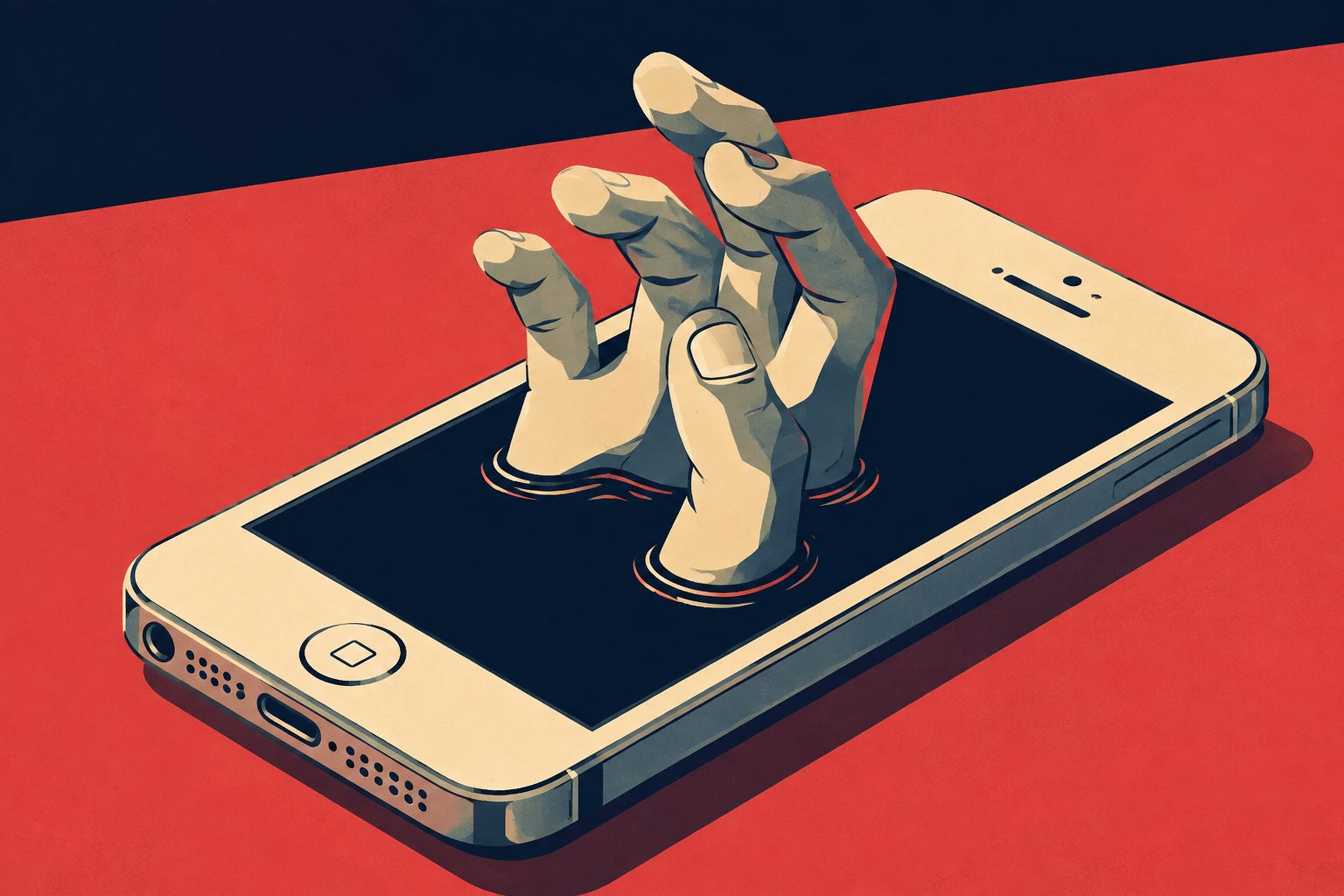

You finish a twenty-minute video.
You close the app believing you’ve understood something. Five minutes later, someone asks you to explain it to them. A pang in your chest warns you: you don’t remember. The words don’t come out. You knew the concepts, didn’t you?
No.
They left your mind the instant you closed the video.
Your brain has no way to measure whether it has truly understood something. The only thing it measures is how easy it was to process the information, and it uses that ease as a substitute for comprehension. Video is the perfect machine for keeping you trapped in that illusion for hours, every day, without you noticing. Moving images. Warm voice. Background music. Cuts every three seconds so that your attention never has to make the effort of sustaining itself on its own.
You confuse that ease in consuming data with having learned.
Imagine two people studying the same economics concept. One watches a twenty-minute explanatory video. The other reads, for the same amount of time, an article about the same thing. When they finish, both rate their comprehension as high, nearly identical. Only one will be able to reconstruct the ideas without help a week later.
The content is the same.
The mechanism is not.
Confusing fluency with comprehension is like confusing an empty highway with knowing how to drive well. You go fast because there are no obstacles, not because you’ve improved. The day a real obstacle appears, you crash.
Only friction makes you better. Seek it out.
Friction governs every biological system you know.
A muscle doesn’t grow because you move it a lot; it needs you to take it to the point where the fibers get damaged at a microscopic level, and the body, in repairing them, overcompensates: it builds more tissue than there was before (Schoenfeld, 2010), anticipating that the stress will return. An immune system strengthens by being exposed to pathogens, not by avoiding them at all costs. Adaptation is always a response to friction.
Learning is no exception to this rule.
Psychologist Robert Bjork devoted decades to studying this phenomenon, and his finding challenges what thousands of students do every day in libraries, hoping to pass an exam (Bjork & Bjork, 2011): difficult conditions (retrieving information from memory instead of rereading it, spacing out study instead of concentrating it, generating your own answers instead of receiving them already chewed) produce worse immediate performance… and skyrocket your long-term comprehension (Dunlosky et al., 2013).
The mistake almost everyone makes is optimizing for the feeling of fluency.
That’s why I use the gym example. When a training partner helps you lift the bar (reducing the real weight your body bears), you’re still moving the bar, but your muscle never receives the signal of real stress. It’s as if, deep down, you’re lifting less weight.
Video does exactly this to your prefrontal cortex.
It lets you “move the weight” of knowledge (finish the video and feel like you’ve learned) without your brain ever having to bear the weight that would produce adaptation.
You urgently need to train the muscle of your attention.
And books are the gym where you must go to train it.
There’s a difference between reading and watching that almost no one talks about.
Text is, perhaps, the only mass communication technology whose progress depends entirely on your capacity for comprehension. A book doesn’t move on to the next sentence until you decide to move on. If you don’t understand a paragraph, the paragraph stays there, waiting with its usual coldness. Text stops when you stop. It goes back when you go back. Its pace is, in a literal sense, your pace.
Video doesn’t work that way.
It moves forward regardless, whether you understand it or not. The next twenty seconds will play even if your brain is still stuck on the previous one, trying to process a dense idea. There’s no natural pause. There’s no waiting. Just the content, moving forward at a pace someone else decided for you, edited entirely so that you feel fluency.
Reading is rowing your own boat. Watching a video is riding along while someone else rows.
Hold on to this.
It’s the reason why society as a whole has come to know a bit of everything and understand nothing. More content is consumed than ever. Less is understood than ever.
Video is just the most visible example.
It goes further. There’s the summary that saves you from reading the book. The thread that saves you from reading the article. The AI that gives you the answer before you bother making the minimum effort to try it yourself. Each layer, on its own, is a bit of control you give up. Together they amount to the complete atrophy of your capacity to learn.
It’s the paradox of our generation.
On one hand, we live in the era with the most access to information in all of history. Entire libraries fit in a pocket. Any question has an answer four seconds away. On the other hand, a growing number of indicators (sustained reading comprehension, reasoning about extended arguments, long-term retention of what is “consumed”) only get worse.
It’s the direct consequence of optimizing fluency for the masses.
People can no longer tolerate cognitive friction.
Train your mind like an athlete trains their body.
You have to distinguish between friction that holds you back and friction that builds you up.
A serious athlete seeks the heaviest weight they can control with good technique (not the heaviest possible, which would injure them, nor the most comfortable, which would generate no stimulus at all). The same applies to learning. It’s not about seeking out the densest, most inaccessible material that exists. It’s about finding the friction that takes you just above your current limit: the exact point where the effort is real and progress is still possible.
In which areas of your life should you introduce that friction?
The answer begins by reversing the most common and least questioned habit of information consumption: active retrieval versus passive recognition.
Recognizing is nodding along when you see something again, feeling the familiarity of “I already knew this.” That’s how society spends hours scrolling without understanding anything.
Retrieving is closing the source and forcing your brain to reconstruct it from scratch, without help. That’s where friction happens. Reading a chapter and closing the book to rewrite the central idea from memory, without looking, is what changes everything.
Writing, in this sense, is the most accessible friction generator that exists.
Why do you think I write every day?
Writing forces you to discover, sentence by sentence, where your understanding of something you thought you had mastered breaks down (Bangert et al., 2004). You can’t fake clarity on a blank page the way you can fake it by nodding along in front of a video. The page hands you back the exact gap your comprehension still has.
It exposes you.
If you want clear thinking, and to truly learn, you need to write. Civilization as a whole is running, at full speed, toward total fluency.
Every product, every platform, every new layer of artificial intelligence competes to eliminate a little more friction from your day. And in the middle of that collective race, the advantage lies in being one of the few who still know how to carry the weight alone.
Think about physical work — the same thing happens.
When manual effort was the norm, no one needed to go to the gym: the body exercised itself, every day. Society moved to sedentary jobs, and not exercising on purpose began to lead the body into atrophy. That same thing is already happening to your mind (and it’s going to get worse). A society that worships fluency is going to lose its cognitive capacities if it doesn’t train them on purpose.
Pick up the bar and lift the weight yourself.
Start reading.
— Álvaro
“If you want to lift a hundred pounds, you don’t expect to succeed the first time. You start with a lighter weight and work up little by little. You actually fail to lift a hundred pounds, every day, until the day you succeed. But it is in the days when you are exerting yourself that the growth is occurring.” — Norman Doidge, The Brain that Changes Itself
P.S. I also offer 1:1 consulting to help you grow on Substack.
If you’re just starting out and don’t know how it works, or if you’ve been at it for a while but are stuck, this will help you. I’ll help you find your direction, position yourself as a leader in your niche, and build a system tailored to your needs for sustainable growth.
My credentials? Over 100,000 global readers in 2 years, 100% organic growth, with 300,000 monthly visits. All from scratch, writing all by myself in my spare time.
If you’re interested, email me at: jardinmental@proton.me
Bangert-Drowns, R. L., Hurley, M. M., & Wilkinson, B. (2004). The effects of school-based writing-to-learn interventions on academic achievement: A meta-analysis. Review of Educational Research, 74(1), 29–58. URL
Bjork, E. L., & Bjork, R. A. (2011). Making things hard on yourself, but in a good way: Creating desirable difficulties to enhance learning. En M. A. Gernsbacher, R. W. Pew, L. M. Hough, & J. R. Pomerantz (Eds.), Psychology and the real world: Essays illustrating fundamental contributions to society. URL
Dunlosky, J., Rawson, K. A., Marsh, E. J., Nathan, M. J., & Willingham, D. T. (2013). Improving students’ learning with effective learning techniques: Promising directions from cognitive and educational psychology. Psychological Science in the Public Interest, 14(1), 4–58. URL
Jacoby, L. L., Bjork, R. A., & Kelley, C. M. (1994). Illusions of comprehension, competence, and remembering. En D. Druckman & R. A. Bjork (Eds.), Learning, remembering, believing: Enhancing human performance (pp. 57–80). URL
Schoenfeld, B. J. (2010). The mechanisms of muscle hypertrophy and their application to resistance training. Journal of Strength and Conditioning Research, 24(10), 2857–2872. URL
No posts
Comments
Nothing yet. Say the first thing.
Sign in to join the conversation.