
Welcome to Mental Garden, a newsletter about creativity, focus, and systems for writing and building projects on the internet. To explore the full library, go here.
The following letter is part of our “Notes on Giants” collection, in which we explore the thoughts and lives of humanity’s greatest minds.
🏷️ Categories: Mental models, Decision making and biases, Continuous improvement.
If you only work hard, you risk achieving nothing.
It sounds impossible in a culture that applauds effort as the supreme virtue.
Let me prove it to you with the most brutal story I know: a medical team that worked to the point of exhaustion in a war hospital, and still watched thousands of men die without ever knowing why. All that effort was worth nothing.
It failed on one crucial point.
This is the reason the soldiers were dying. And it’s the same reason so many goals fail today.

In 1854, the nurse Florence Nightingale arrived at the military hospital of Scutari to care for the wounded of the Crimean War. She worked with absolute dedication alongside her team. Endless shifts. Whole nights walking through wards with a lamp (so much so that she was called “the lady with the lamp”).

Despite everything, that winter was devastating at the front.
4,077 soldiers died in Scutari alone.
Human effort to save lives was at its peak. And yet more people were dying than before she arrived.
How could both facts be true at the same time?
That was the question no one at the front managed to answer. The days passed and the bodies piled up in the corridors. Falling wounded was, almost always, your end. What was happening inside that hospital? Why weren’t care and dedication enough? What was truly killing those men, if it wasn’t battle wounds?
The answer lay in having focused on the wrong variable.
In Scutari, the real cause of death was invisible because of the very system of work. No one cross-referenced cause of death, month, and ward condition. The sanitary commission was unable to find the answer.
Florence Nightingale was the one who found it.
She proposed a method to record, cross-reference, and read the data that had been piling up for months without anyone knowing how to interpret it. That was the only real change. A few months were enough to reverse the mortality that a whole year of physical effort had not managed to fix.
What did she find?
The problem wasn’t the wounds, the hunger, or the exhaustion. It was infections caused by broken sewers under the building, something that needed to be repaired.
Mortality dropped sharply instantly (Nightingale, 1992).
Here is the principle that explains Scutari, and a good part of your life: no system (a war, a company, a body, an entire life) can correct itself without a feedback loop that shows it, precisely and in time, what is failing and why.
It sounds technical. It’s simple.
Think of a company that demands 80-hour weeks from its team, optimizing processes that no one has verified are the actual bottleneck. Think of someone who “tries hard” every day in a relationship that is breaking apart, without knowing what is truly breaking it.
However hard they try, they waste their time.
You need to understand two concepts:
Open loop: you act and the result isn’t seen. No one confirms whether it worked, so you repeat the same gesture over and over, with the same blind faith as always.
Closed loop: the result of your action comes back to you turned into new information, and that information corrects the next move.
The difference between the two is what makes some advance at a tremendous pace while others remain stuck even though they work ten times harder.
Being busy gets confused with making progress. They have nothing to do with each other.
You need feedback to stop making blind efforts. You need a system where the error can be seen from outside yourself (a piece of data, a graph, another person), something that closes the loop and informs you.
What Florence did to change the situation was not to work harder.
She sat down to think.
She found a way to represent data that already existed but that no one knew how to read. The result is known today as the rose diagram, or coxcomb chart: a circular graph where the visual area of each death was obvious (Selanders, 2026).
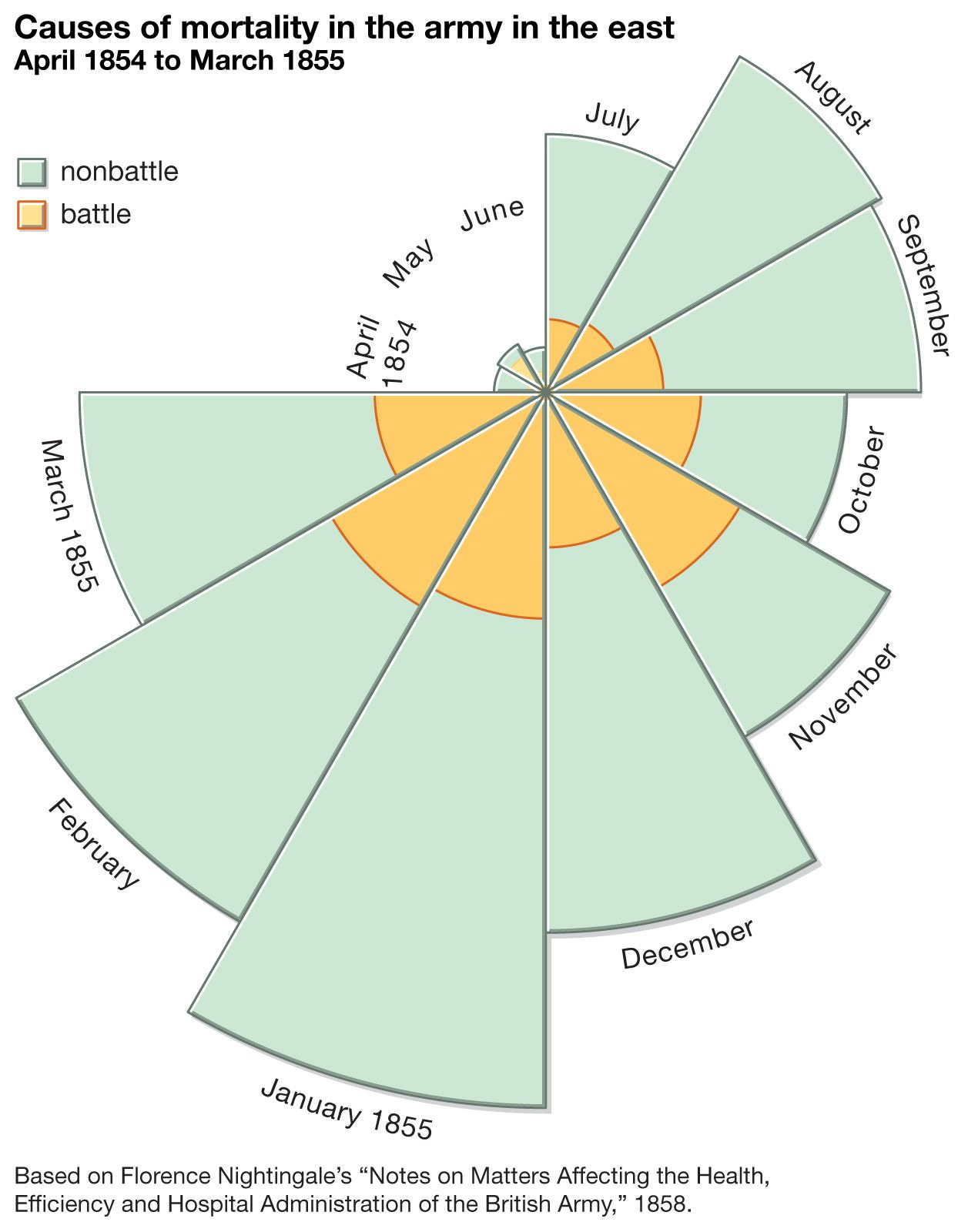
Twelve months of the year represented in a single image that convinced an entire government that most of those deaths were preventable, and that the war (and the lives) were being lost because they weren’t working on the right variable.
Here is something almost no one explains well: the human brain does not process columns of numbers the way it processes a shape. An area of color, enormous, taking up half a page, communicates in a second what forty rows of a table would take half an hour to convey (if anyone even gets to reading them). It’s pure psychology: your brain evolved recognizing shapes, sizes, and contrasts long before learning to read a table (Brasseur, 2005).
Feedback only changes you when the next action is clear.
This is the reason 99% of people remain stuck, despite having all of humanity’s accumulated knowledge four seconds away. It is not a problem of access. It is a problem of friction. Everyone hates friction. Having the information and knowing what to do with it is not a direct path. For the great majority, that friction weighs heavy: thinking, hours of effort, hours of solitude putting ideas into practice with no one to help you along the way.
— “Ugh, how tiring, better not.”
That’s why most people don’t change despite having the potential to achieve it.
Now imagine the opposite: shrinking that distance to the minimum.
If the data says A, you do B.
If the data says B, you do C.
The path becomes obvious with clear instructions.
Florence’s diagram versus a 40-page report that no one reads. The calorie counter on a smart watch versus the vague “I know I eat badly” that you repeat when you weigh yourself. The weekly bank statement versus the balance you’ve spent months avoiding opening, with that mix of anxiety and avoidance.
Norbert Wiener, the father of cybernetics, put forward this law in 1943:
“Every self-regulating system needs a feedback loop that translates the result of an action into a signal readable for the next decision cycle.” (Norbert Wiener, 1943)
What does this mean?
He explained it with a rocket. A rocket that does not receive continuous information about its deviation from its trajectory never reaches its destination, no matter how much fuel it carries. The same happens to you with your goals. It doesn’t matter the effort, the hours, the money, the willpower. It will all be wasted if you don’t have a signal that tells you, in time, how much you’ve deviated.
You need to study your own performance every day.
A day without feedback is a day in vain.
Most people live exactly like Scutari in its first winter.
Trying hard, but without any system that shows the real cause of why things aren’t changing. Without a graph of their energy, their money, their writing, their body, their relationships. Only with the vague feeling that “something isn’t right,” a feeling too hazy to act on with precision.
Applying the idea is simple. What’s striking is that almost no one does it.
Here are examples you can set up in minutes:
A time log: forget what you say you do each day. Write down what you actually do, in time blocks, every 24 hours. There you’ll see whether you focus on what you say you focus on. I did it. It will strike you to see the reality.
A kakeibo: a minimalist Japanese method for saving. With paper, a notebook, and a calculator, in 5 minutes you have the month’s finances done.
A habit metric: what you eat each day, how you train, how much you write.
Think about which aspects of your life truly matter to you. Make a list of the variables you can measure in each one. Keep one to three variables (the most crucial ones) and measure them for a couple of months. That’s what I did during my first 3 months of writing and I multiplied my performance by 4. The secret? Measuring.
Your results will take off.
See before acting. Measure before improving.
That is the sequence. Almost no one follows it. You need your own graph. Choose a single area of your life (the one that matters most to you) and create, today, the simplest possible signal that makes it obvious what to improve. Everything else comes after. The work becomes too easy when 100% of your energy goes to the center of the target.
— Álvaro
Talent is overrated: An in-depth analysis of what separates the top 1% on the planet from the rest
The infinite soup experiment: What isn’t measured, doesn’t improve
P.S. I also offer 1:1 consulting to help you grow on Substack.
If you’re just starting out and don’t know how it works, or if you’ve been at it for a while but are stuck, this will help you. I’ll help you find your direction, position yourself as a leader in your niche, and build a system tailored to your needs for sustainable growth.
My credentials? Over 100,000 global readers in 2 years, 100% organic growth, with 300,000 monthly visits. All from scratch, writing all by myself in my spare time.
If you’re interested, email me at: jardinmental@proton.me
No posts
Comments
Nothing yet. Say the first thing.
Sign in to join the conversation.