
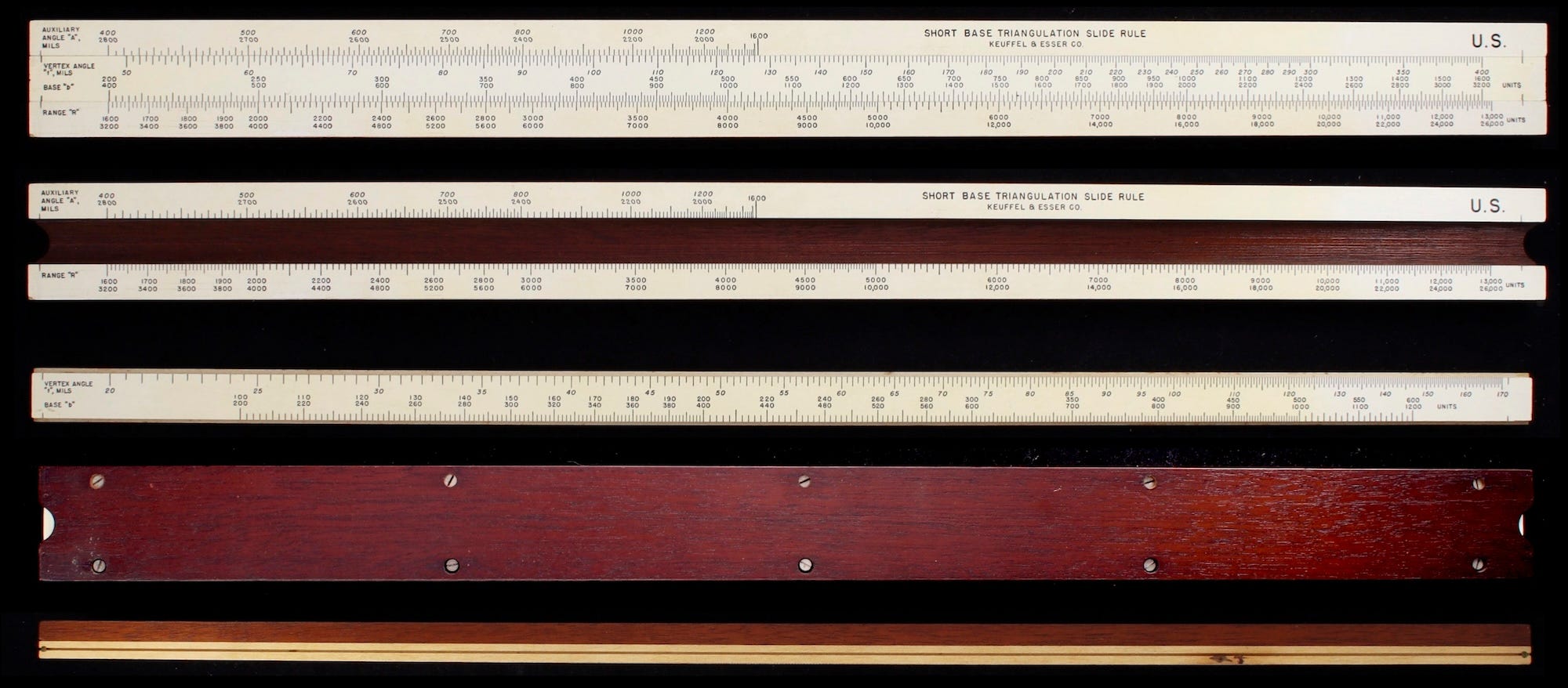
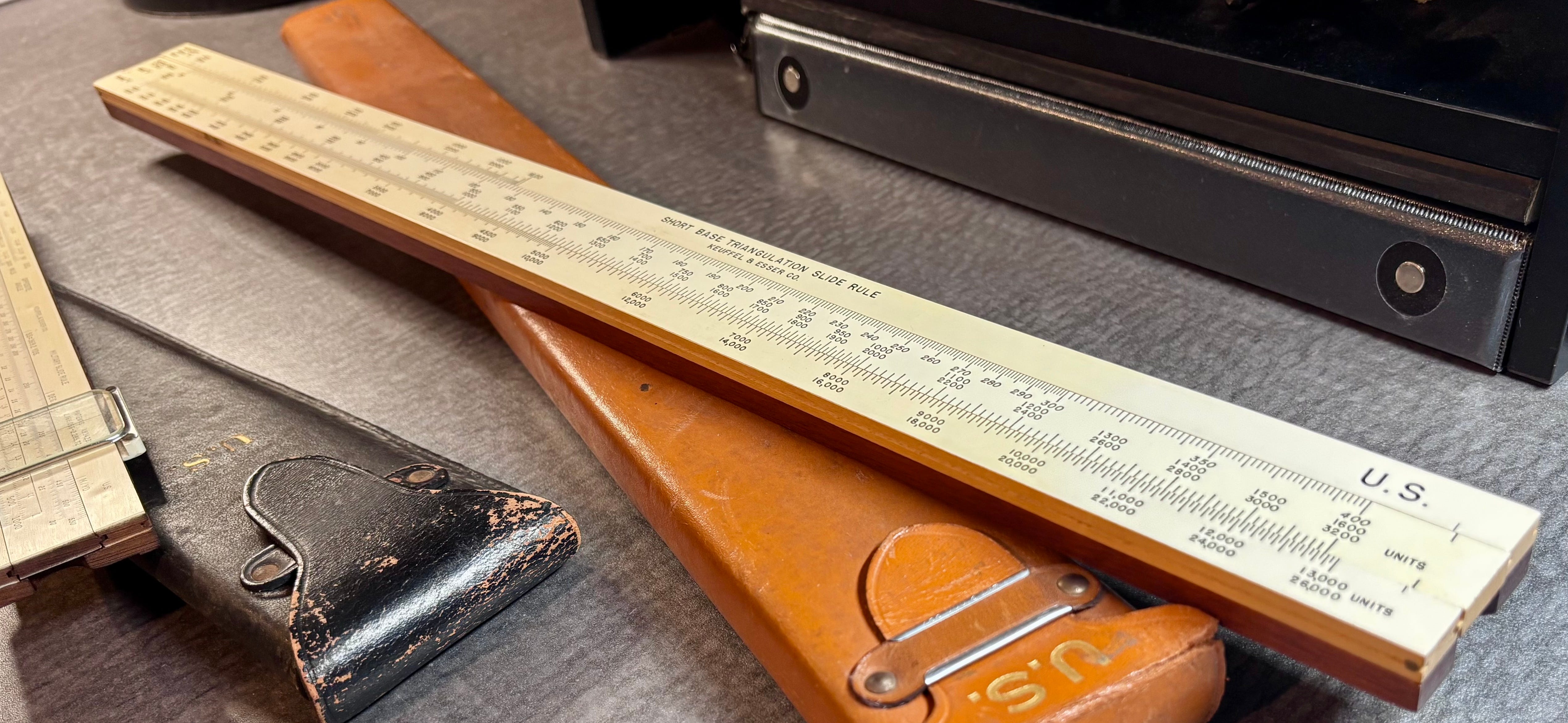
During a trip back to Chicagoland from Florida this Spring, I discovered from an app on my phone that an interesting slide rule was for sale at a small town in Indiana just off the Interstate. And so, for a very modest price, and a very short diversion, I was able to acquire a Keuffel & Esser (K&E) Short Base Triangulation Slide Rule, made for the U.S. Military.

The slide rule is just over 21.5 inches long (55 cm). The rule has a slightly different construction, in that it has a mahogany base, but an upper layer made of a softer wood (pearwood?) with painted or transferred numbers applied, not engraved. The dating of these fairly rare rules is not well understood, as they have no serial numbers or distinguishing markings on them to assist us, but are of the World War II era, and appear to have been used during the Korean War.
The scale layout is simple, with just four scales on the front, and two more on the back of the slide. (The back scales are just the front scales on the slide, translated by a certain amount.) The bottom two scales — slide/stock — are both basic logarithmic scales with 55 cm decades. Because of the labels at the ends of the scales, the scales themselves do not cover a complete decade. The top two scales are sine scales, with angles given in “mils”, where 1600 mils = 90 degrees. With these trig scales and basic log scales, the rule is used to determine the distance to a target through angular sightings from two different locations separated by a known baseline distance.
This slide rule from Indiana does not have a cursor, but there is no real need for one, as we will soon see. However, the rule originally would have come with a cursor. As found on other examples, the original cursors exhibit K&E’s 1937 patent for a “Runner for Slide Rules” — their metal cursor that followed their all-glass cursor. The original cursor for this slide rule had two hairlines, which could be used for converting from yards to meters. Why one would need to do such a conversion during the use of this rule, I am not sure.1 Also, the literature shows that of the rules that still have their cursors, most of them suffer from KERCS.2 It is apparently rare to have an original, uncompromised cursor. Even a photo from the Korean War era appears to show soldiers using this type of slide rule without a cursor.3

The purpose of the K&E Short Base Triangulation (SBT) Slide Rule is to perform a straightforward triangulation problem. Imagine a gun that is to be used to fire at a target, but the distance to the target needs to be determined in order to set up the gun properly. For its simplest use we will assume that the target is visible from two observation points, one being located at the gun, and the other at an auxiliary location at a known distance, b, from the gun. The quantity b is called the Base distance. We’ll assume the two stations to be at the same elevation, though corrections can be made if they are not. Surveying-type instruments are used to measure azimuthal angles between the baseline and the target; one angle, g, is measured at the gun location, the other angle, A, is measured at the auxiliary location, as shown below.

Note how g and A are measured in the same “sense” relative to the baseline. The remaining angle in the above triangle, t, is computed from the other two, since
\(\begin{eqnarray*} t + A + g' = 180^\circ &\longrightarrow& t = (180^\circ - g') - A \\ \rightarrow ~~~t &=& g-A. \end{eqnarray*}\)
With this information the distance from the gun to the target (the Range, R) can be found using the Law of Sines, which says that the ratio of the side of a triangle to the sine of its opposite interior angle is the same for all three sides/angles. Hence,
\(\frac{b}{\sin t} = \frac{R}{\sin A}\)
or,
\( \frac{R}{b} =\frac{\sin A}{\sin t} .\)
So, taking the ratio of the sines of the two angles using the top two scales, and locating the Base value b on the third scale, we find opposite this value the range R.
Since settings and readings are made with scales directly next to each other, the cursor really isn’t required for lining up scales.
Army Field Manuals detail best practices for certain conditions, such as when oblique angles are involved, when to place the Auxiliary location to the “left” in our figure above, height determinations, and so forth. But the technique is basically the same and the above figure illustrates the gist of the basic calculation involved.
The term “Short Base” refers to the circumstance that the Base distance is small relative to the Range, where by small we mean roughly 10% or less. Notice that the b scale and the R scale are labeled with values that differ by a factor of 8, and that the ranges of values on the upper sine scales are limited accordingly.
This might be a good point at which to discuss angular units. We are all familiar with a circle being made up of 360 degrees. And, historically, degrees were subdivided into 60 equal parts — minutes — and each minute was divided into 60 equal parts — seconds. So, tables of sine functions, for instance, were developed which gave the value of sin(𝜃) where the angle 𝜃 is given degrees with subdivisions in minutes and seconds of degrees, and such divisions on slide rules followed suit. This system of degrees, minutes, and seconds (DMS) became tedious to deal with when doing more modern science and engineering mathematics where arguments of trigonometric functions became more valuable in decimal form. So, an angle like 37o 17’ 47’’ had to be converted to a decimal angle through
\(37^\circ~ 17’~ 42’’ = 37+\frac{17+42/60}{60} = 37+ \frac{17}{60} + \frac{42}{60^2} = 37.295^\circ\)
During the 1700s and 1800s when the metric system became popular in France and other parts of Europe, a metric system for angles was created where rather than there being 360 degrees in a circle, there were 400 units, where each unit was called a gon or a grade or grad or gradian. In other words, a right angle would be either 90o or 100g. Some regions of then world still use this system in surveying and civil construction.
Another way to express an angle is in terms of the ratio of the path length, s, along a circular arc divided by the radius, R, of the circle. If the arc and radius are both increased by the same factor, the “angle” that subtends the arc doesn’t change — so this ratio, s/R, is a natural way to express angles by pure numbers. The angular extent of a total circle is thus 𝜃 = 2𝜋R/R = 2𝜋. When expressed this way, we say the angle is in units of “radians”, and the conversion to degrees is made using 2𝜋 radians = 360o.
But particularly in military use, yet another system or two developed. Firstly, many angles involved in artillery calculations and settings can be thought of as small angles. That is, a small number of degrees, or even fractions of degrees. Note that even an angle like 5.7 degrees is a small number of radians, roughly 0.1 radians, also called 100 milliradians. So a “milliradian” might be a more convenient unit when dealing with angles of a few degrees or less. Plus, we know that the sine and tangent for such small angles turn out to be approximately equal, and approximately equal to their values in radians. A transverse distance y observed from a distance r can be estimated by the measurement of a small angle. An object 3 m tall located at a distance of 1000 m will subtend an angle of about 3 milliradians — a useful relationship to know when in the field.
Since there are 2000𝜋 = 6283.185… milliradians in a circle, a new system was created in the U.S. military, called mils, where there are exactly 6400 mils in a circle. A 90o angle is thus 1600 mils, a 45o angle 800 mils. The mil is a bit larger than a milliradian, with a difference of
\(\frac{6400 - 6283.185}{6283.185} = 1.859\%.\)
But when needing to dial in an angle on a device when under the pressure of war time, having a system where angles are fractions of nice, round numbers, rather than dealing with fractions of “𝜋” , can save a lot of time and effort, and calculations and settings should be less error prone.
A similar system was created in Russia, where the Russian unit — also called a mil or milliradian, has 6000 units in a circle, or 1500 units in a right angle. A few other countries have similar but slightly different units as well.
For our Short Base Triangulation Slide Rule, the units being used are mils, with 6400 mils in a circle. If we look at the range of values on the rule, we see angles that vary between 20-170 mils on the back t scale — our “Vertex Angle” — and 50-400 mils on the front t scale. The range for the A scale — the “Auxiliary Angle” — goes from 400 up to 1600 and on to 2800 mils. Notice that this scale runs left to right from 400 to 1600 (upper row of numbers), and then from right to left from 1600 to 2800 (lower row of numbers). This is because 1600 mils is 90o, and the function sin(𝜃) is symmetric about 90o.
Let’s go back a few years to see what was going on in the area of triangulation just prior to the beginning of the U.S. involvement in World War II. In a 1940 Coast Artillery Field Manual, FM 4-110, found online, the “Crichlow Slide Rule” is described. This circular slide rule, which operates mechanically much like a Gilson slide rule, was apparently in use from an even earlier time.
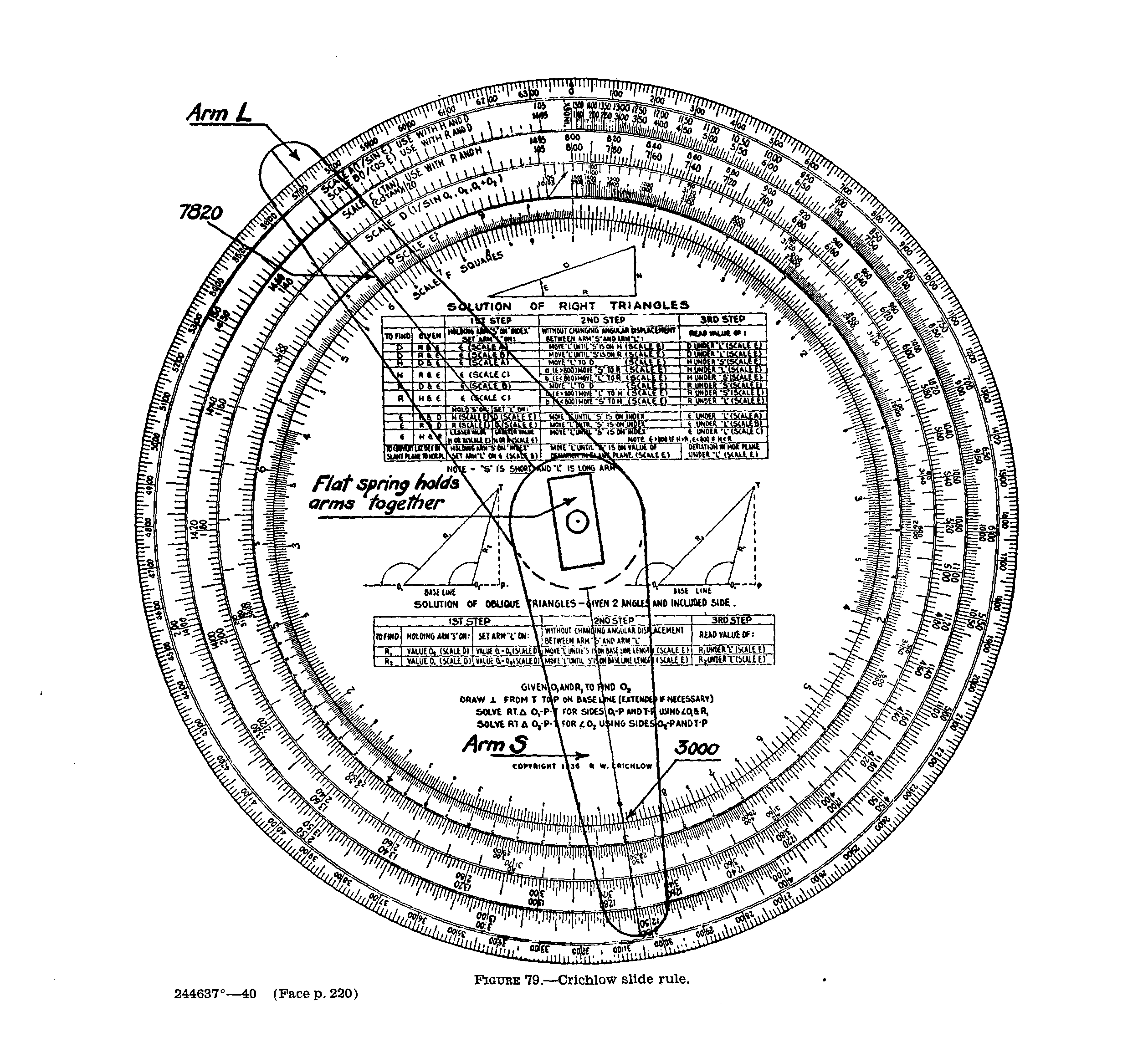
Once I read through this manual, and saw the image of the Crichlow slide rule, I was immediately reminded of a circular rule that I found during a trip to Iowa 3-4 years ago that was made by The Sillcocks Miller Company in 1942. (The U.S. entered World War II in December 1941.) I later found in the manual from 1940, on page 225:
NOTE. — The Crichlow slide rule is being revised. The new rule will be slightly larger and the scales will be arranged in a different order. In solving problems, use the rules printed on the face of the particular slide rule.
The Sillcocks Miller slide rule is evidently the updated version of the Crichlow; same scales, though a couple of less important scales are missing and others are slightly re-arranged.
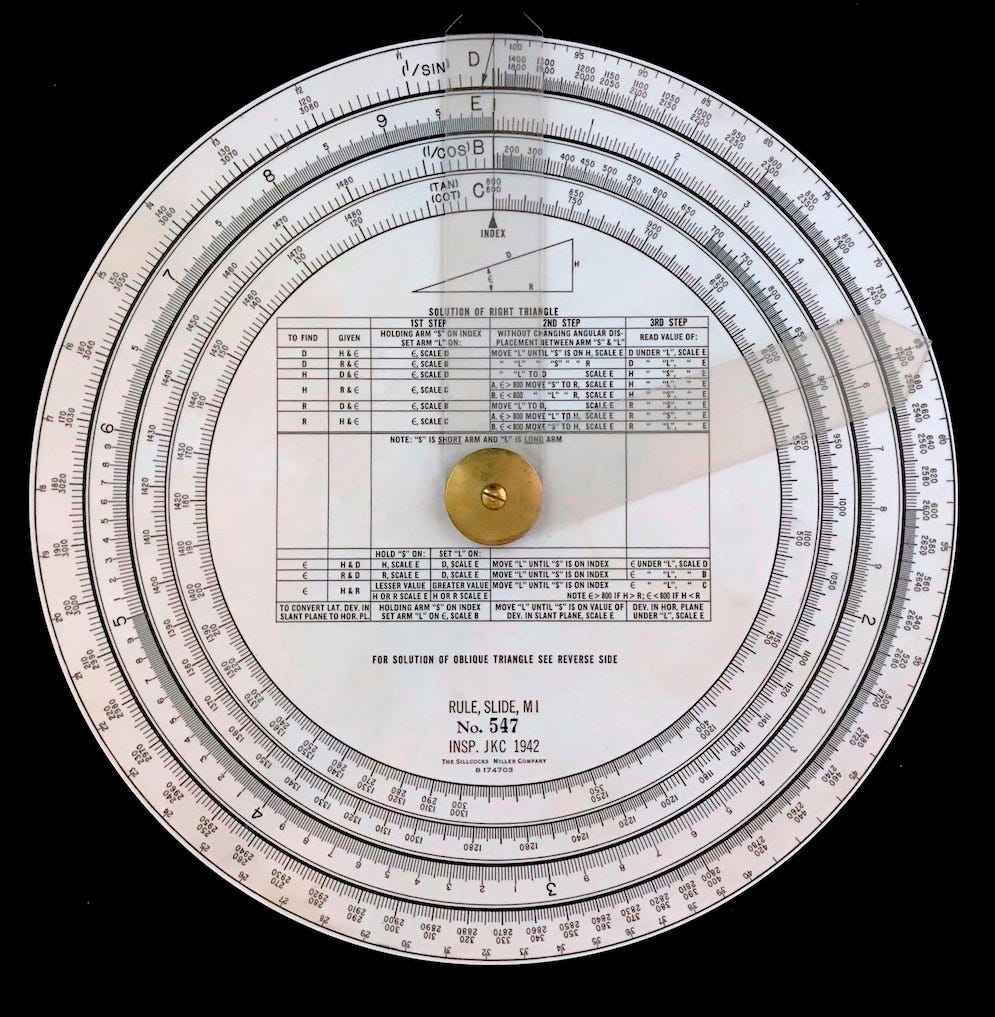
The 1940 instructions, however, still refer to the appropriate D, E, B, and C scales as found on the 1942 rule, and the new scale placements perhaps made it easier to use than the layout found on the original Crichlow. From this background, I feel that the K&E Short Baseline Slide Rule was just a linear implementation with an even simpler-to-follow procedure for solving the same problem.
An image of an original Crichlow slide rule can be found at the ISRM web site.
Suppose we are working with a base length b = 450 ft. The gun station measures an angle g = 876 mils (49.275o) to the target while the auxiliary station measures an angle A = 756 mils (42.5o). Thus, t = g-A = 120 mils (6.75o).
Let’s compare the computational approach using the various slide rules being discussed.
The Crichlow design apparently predates the Short Base Triangulation rule, so we’ll look at this design first. To perform our calculation with the Crichlow system, we’ll use the Sillcocks Miller slide rule, with the same scales. Note that the D scale on these circular slide rules is a “1/sin” scale. To perform our ratio calculation —
\(\frac{R}{b} = \frac{\sin A}{\sin t} = \frac{1/\sin t}{1/\sin A}\)
we start by placing the long arm at the value of t = 120 on the D scale. Note that t appears in the numerator of the final equation above. Next we hold the long arm in place with one hand and move the short arm to the value of A = 756 on the D scale, A being in the denominator of the final equation above.
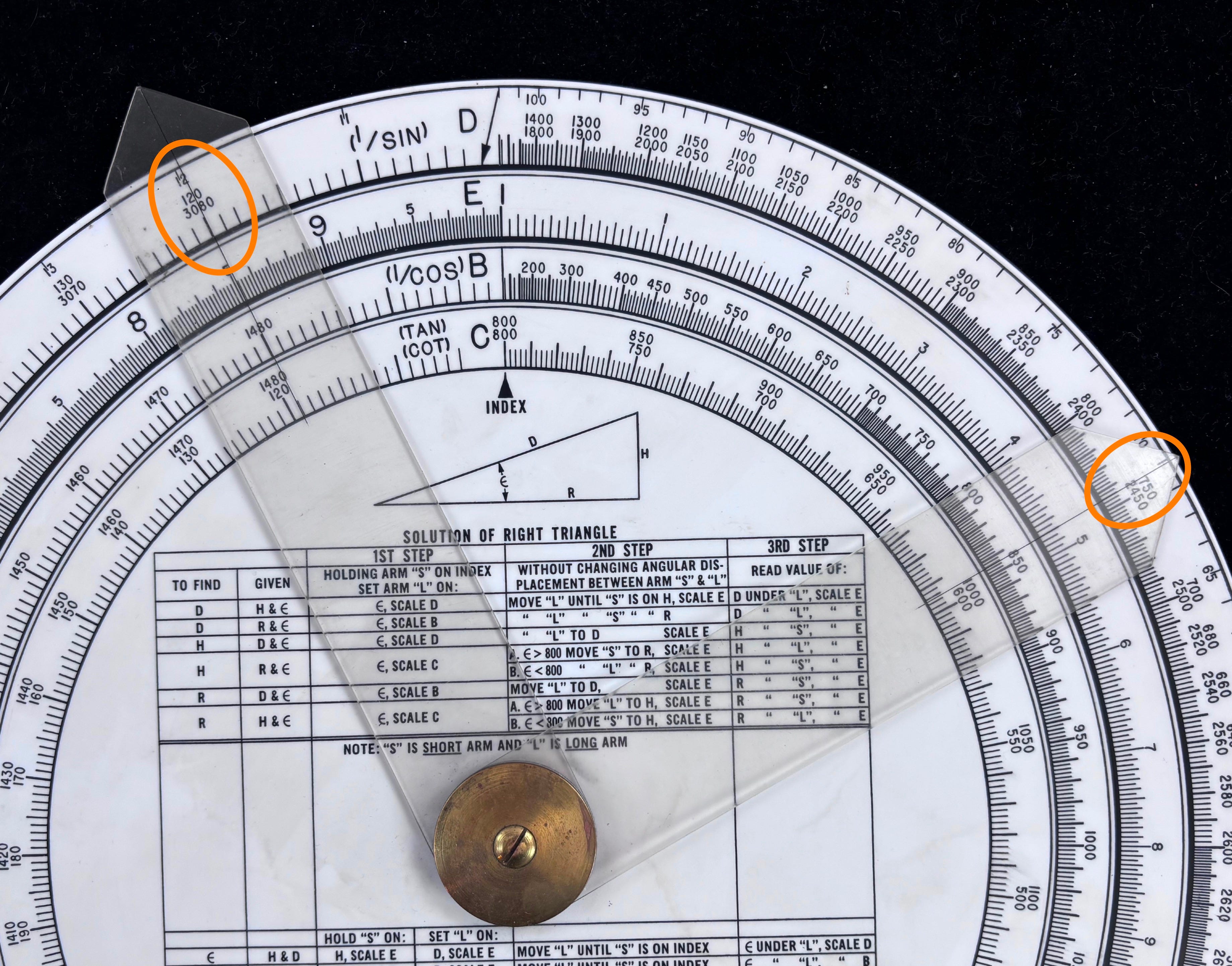
Then, carefully moving both arms together using the long arm, we set the short arm to the value of b = 450 on the E scale, since b is also in the denominator of our expression. The value R = 2590 will be found on E under the long arm. Since b is in units of feet, then so is R.
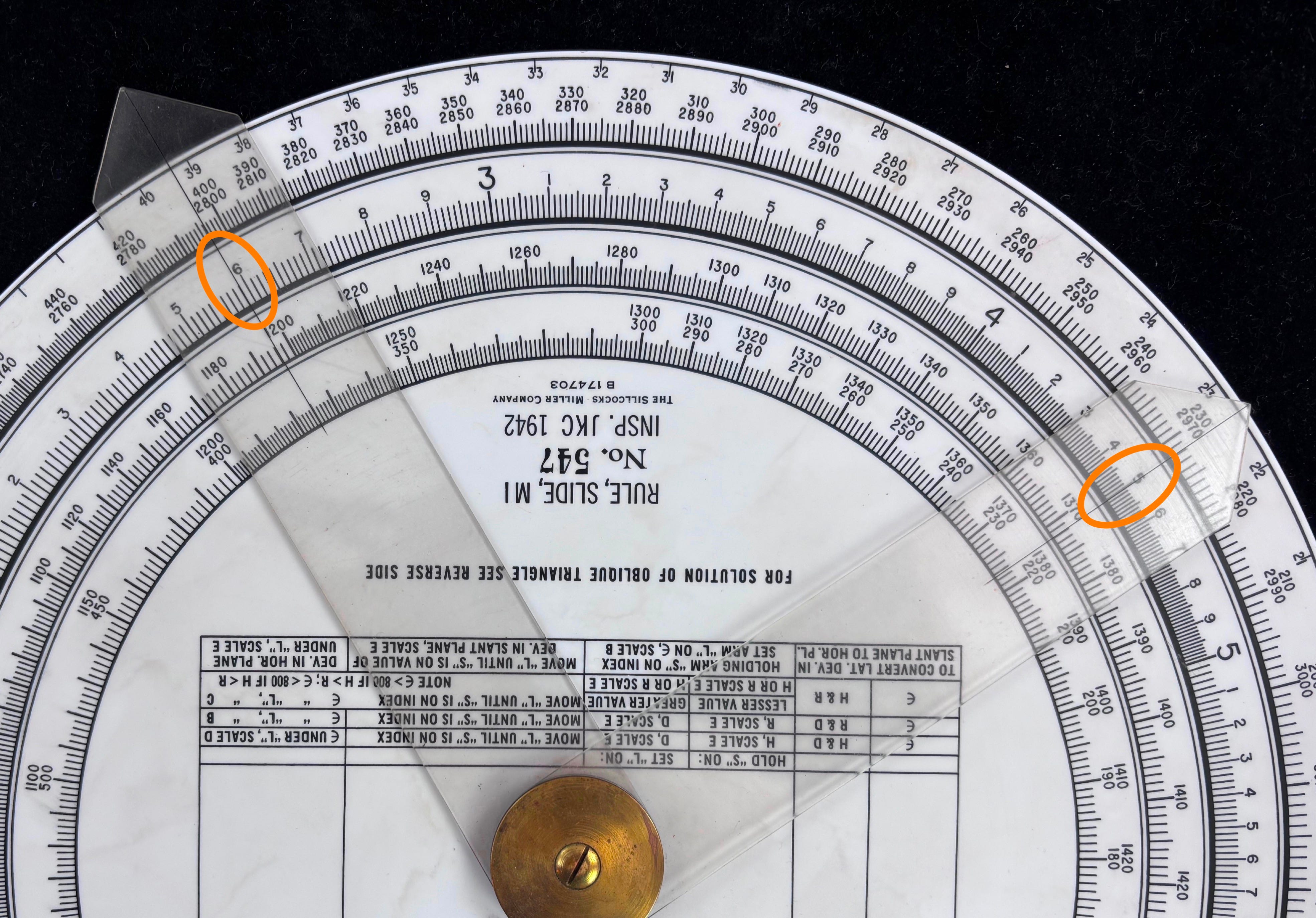
This slide rule is definitely very interesting to study, and sometimes fun to use, as is its cousins in the Gilson family, but I can see where its use in the field during battle could have been harrowing at times.
Repeating our calculation using the Short Base Triangulation slide rule, we simply place the value of t opposite the value of A using the top two scales on the rule:
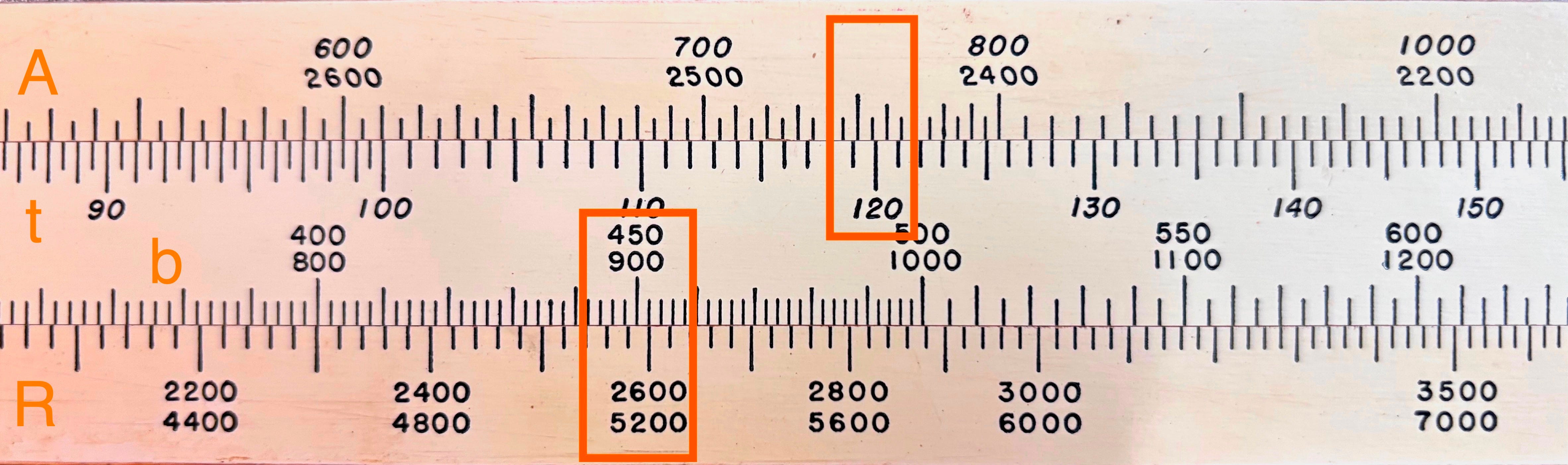
We then locate our value of b = 450 on the lower scale on the slide. For our example, it appears on the upper line of numbers for the b scale, and hence the result on the R scale just below it is read off of its upper line of numbers, R = 2590 ft. With its improved labeling and simple 4-scale system, I can see where the SBT slide rule would be an improvement for most field work.
For completion, we perform the same calculation using the K&E Model 4108 Military Slide Rule (or, equivalently, the American Blueprint version), which was discussed in a previous post.4 The K&E rule is shown again here:

Note that the Military Rule is a 10-inch slide rule, compared to the 22-inch SBT rule. Zooming in on the left end of the Military Rule, we see the same sine scales in “mils” as on the Short Base slide rule, along with adjacent sine scales in units of degrees. On the Military Rule, the “A” scale is labeled “Opposite Angle”, while the “t” scale is labeled “Apex Angle”.
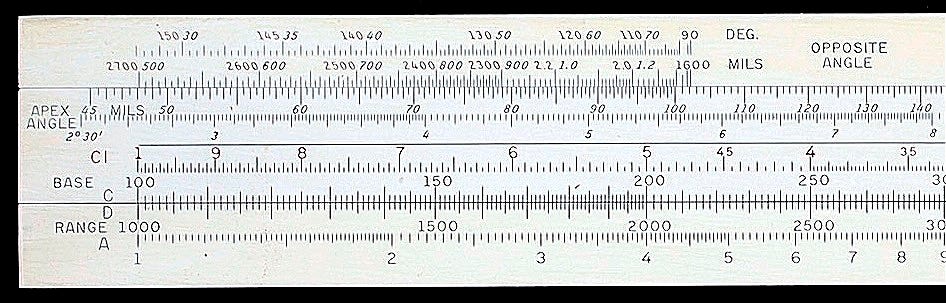
The scales used for b and R are just the standard C/D scales on the slide rule, which are also labeled as “Base” and “Range”.
The operation is the same as for the Short Base slide rule. We set 120 mils on the top scale of the slide, labeled “Apex Angle”, in “mils”, against 756 found on the “Opposite Angle” scale on the stock, using the line labeled “mils” :
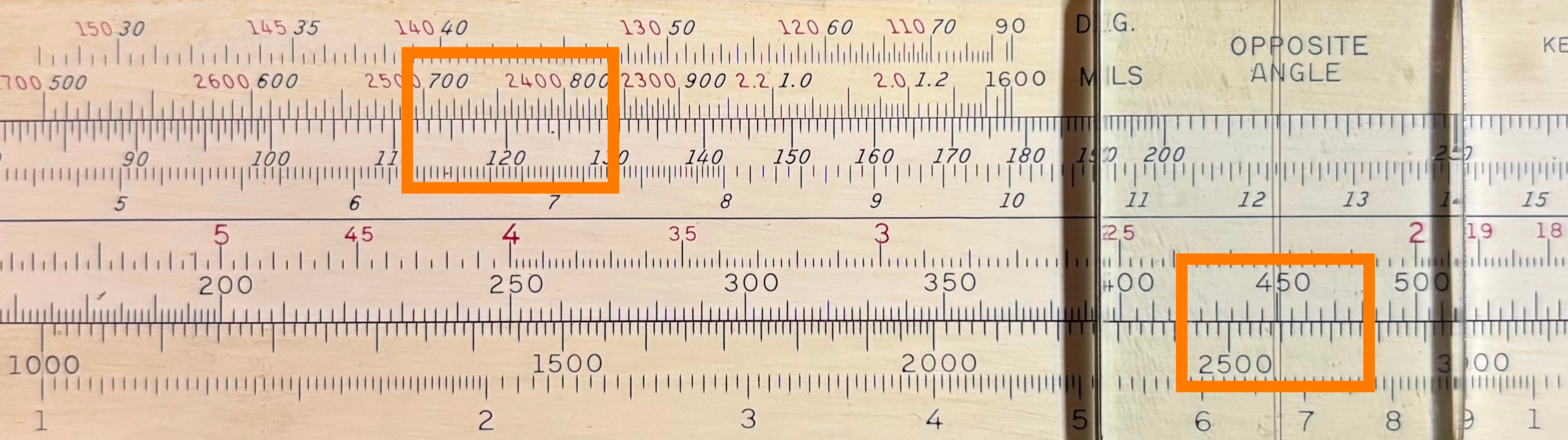
Moving the cursor to 450 on the C scale — “Base” — we find just below on the D scale — “Range” — our answer: R = 2590.
Note that on the Military Slide Rule, as the Base and Range scales are simply C and D scales, then the printed values of Range, Base, and the range of the two angles on the rule are slightly more limited than found on the SBT slide rule.
Though the Model 4108 Military Rule has many other features, like additional CI and A scales on the front and T, ST, and S scales (in mils) on the back, the 22-inch-long Short Base Triangulation slide rule might still have been the instrument of choice in the field under many circumstances, due to its ease of use and more accurate (i.e., longer) scales.
We mentioned the 1940s Field Manual that talks about the Crichlow slide rule and its use. So we know that this triangulation slide rule was available prior to the U.S. involvement in World War II. In fact, from the images of the original Crichlow slide rules we saw above, we find that it had a copyright year of 1936. So it could have been in production for 3-4 years before it was mentioned in the Field Manual.
Now what about the Short Base Triangulation Slide Rule? After consulting with collaborator Eamonn Gormley, the earliest document we were able to find was one mentioning the SBT rule in 1943. From Eamonn’s searches of the Field Artillery Journal periodical, he found the following:
1942: Vol 32 Iss 9 — on page 699 there is a discussion of the need for “A Graphical Computer for Quicker Survey”, seemingly unaware of the Crichlow-style slide rules. Note that 1942 is the year of our Sillcocks Miller version.
1943: Vol 33 Iss 9 — on page 672 it states, “The Short Base Triangulation Slide Rule, for solving short base problems, has been recently standardized and will be available about 15 September 1943.”
1945: Vol 35 Iss 1 — “The Rule, slide, military, w/case, 10-inch, is a newly standardized item which combines into one item the essential functions of the mathematical slide, and Slide, M1 for the 18-inch graphical firing tables, the Rule, slide, short base triangulation, and the 10-inch polyphase slide rule. The new slide rule will be included as a component part of appropriate sets and will also be carried in T/O & E’s to replace the rules indicated above.”
This text is apparently referring to our 4108-style “Military Slide Rule”. Note that a “T/O & E” refers to a Table of Organization and Equipment.
This all begs the question of how to interpret the meaning of the word “standardized” and to how the year of “standardization” relates to the years of manufacturing. This is particularly interesting to me, as I have become fairly convinced that we have K&E Military rules with serial numbers in the 700,000s that were made in the early 1940s, very likely in 1942.5
My own suspicion is that to become “standardized” the item would have been field-tested, which takes a bit of time; it might be first introduced on a limited basis, say, 1-2 years before such official “standardization” would take place. Could the earliest 4108-style Military Rules (without model numbers) have been produced in late 1942 or so, and then finally standardized in late 1944? (Note that Vol 35 Iss 1 of the Field Artillery Journal, in which the “standardization” of this rule was announced, was printed in January of 1945.)
By the same argument, if the SBT was standardized in 1943, then perhaps it was first introduced in 1941-42. It’s also quite possible that they were simultaneously introduced, but that their “standardization” was staggered. Perhaps it was found that the “Military Rules” were good general slide rules, better suited for higher-ranking officers, while the longer SBT rules, with fewer, easier-to-read, and easier to interpret scales and notation, were found to be of better use in the field. Then perhaps, the SBT slide rules were standardized earlier, and the Military rules a year or so later. The SBT rules easily could have continued to be used in other conflicts such as the Korean War, as standard equipment that went along with particular surveying, gunnery, and other equipment kits.
But it is evident that after WWII was over, the Military Rule acquired its official K&E Model number — the Model 4108 — for entrance into the general market. It does have a more general set of slide rule scales, after all. The only evidence of Military Rules with “4108” labels so far are those with serial numbers from the non-war year of 1946.6
Anyone with information or insights on these slide rules, please leave us a note in the Comments section at the end of this post, or in the Chat.
If you measure a baseline in meters but your gun’s range is calibrated in yards, then I guess this would be convenient. However, if the gun’s range were calibrated in yards, then I would just make a baseline measured in yards, and everything would work fine.
“K&E Rotten Cursor Syndrome” — the deterioration of celluloid cursor parts often found on K&E slide rules from the 1930-40s.
John Hunt, Sr., “Short Base Triangulation Slide Rule, Keuffel & Esser Co.”, Slide Rule Gazette, June 12, Autumn 2011, p32 (2011).
Comments
Nothing yet. Say the first thing.
Sign in to join the conversation.