
Now that the Indy 500 is past us, we can get on with summer. (And what a finish this year!) Yes, the solstice is still to come, but things start to pick up this time of year and we all get busy. Well, I seem to, at least. So, for the foreseeable future we will be moving to bi-monthly standard posts on this forum, rather than weekly. Starting with June which is almost upon us, our Following the Rules Substack publication will come out on the first and third Saturdays of the month. If a very special topic — or, a special contribution from a reader, perhaps? — comes along, we could still see an intermediate post now and then. But this will give me and our other authors more time to put new material together, and more time for that material to be absorbed by our busy summertime readership.
Again, I would like to encourage everyone to engage with our Chat feature, which can be found at the top of this website. The Chat is open to anyone to leave a comment or question; it is not a real-time chat, but rather more like a thread, or a set of threads, that can be accessed at any time, and allows for images to be inserted as well. So leave some comments, start a conversation, and upload some pictures of your slide rules!
At the top of the Following the Rules page, in the upper left-hand corner, there is now a drop-down menu with links to other internal pages and articles. The Chat can be accessed from there, as can the original web site with my slide rule collection. There are also links to sub-collections of posts we have made, such as “Vectors” and “ScaleMaking”, which bring up previous posts on these topics. So, as new posts get written on similar topics, they can all be found with one click. Let me know if you have other suggestions of topics to add to that list.
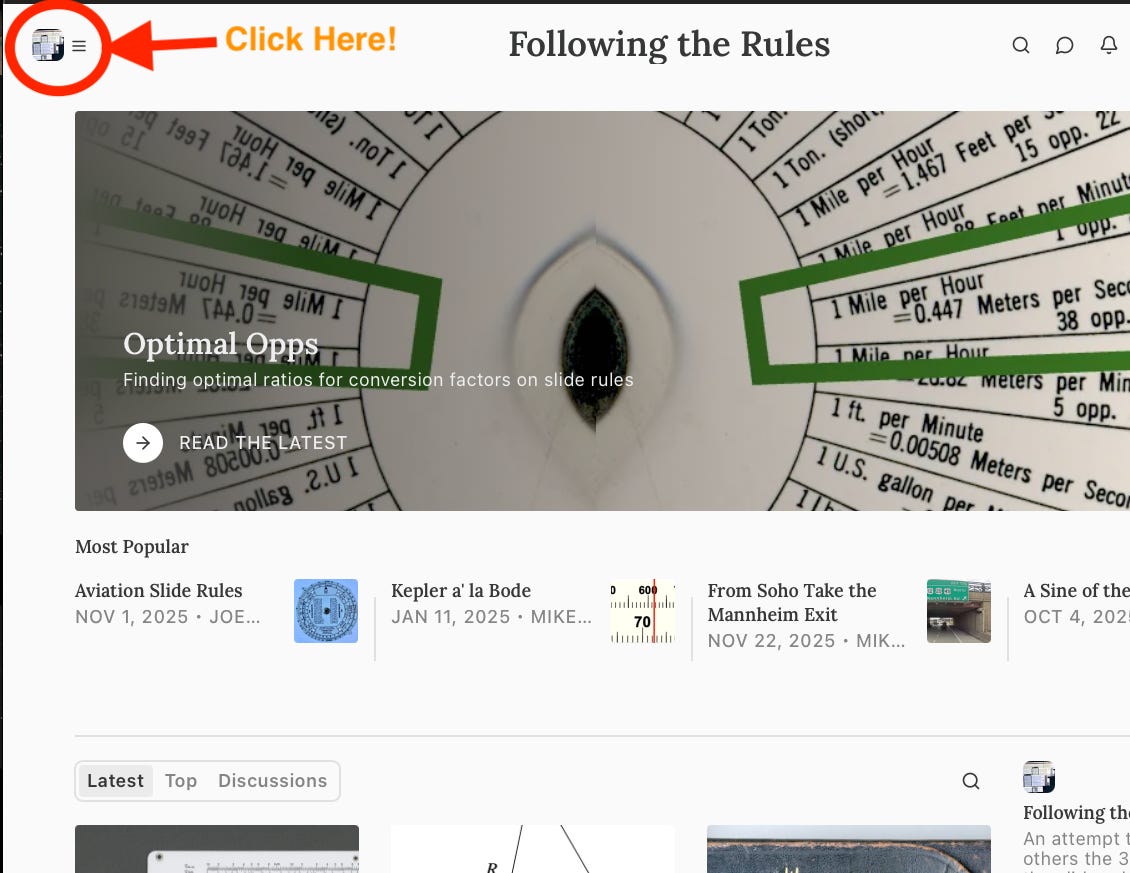
I came across an interesting pocket slide rule for sale online the other day. It is one of the Hemmi 4-inch pocket slide rules with the half-cylinder magnifier, though this one is damaged. (The half-cylinder is missing, but the flat glass cursor with its hairline is still intact. I have a couple of these types of rules that I’ve found over the years, but this one piqued my interest when I saw an image of the back of the rule:
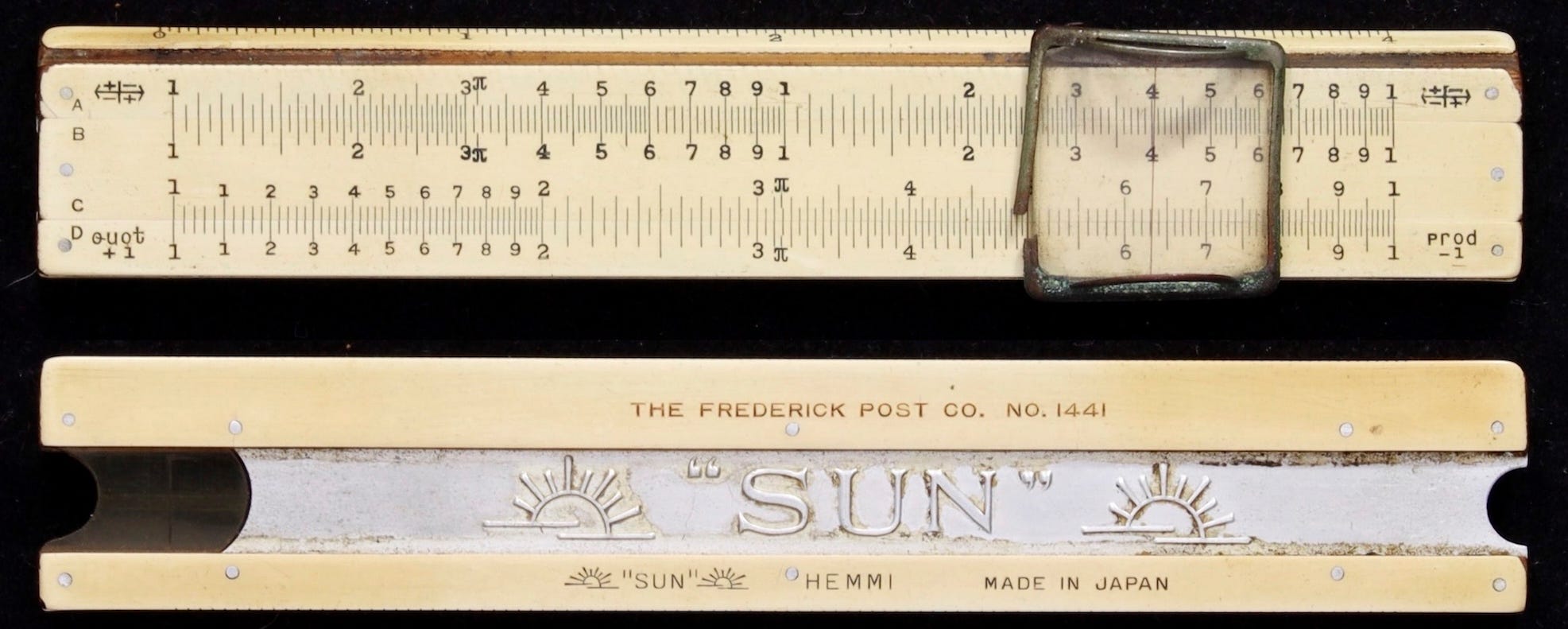
The embossed “SUN” on the metal plate on the back is not very common. Hemmi only did this on some of their rules in the early 1930s. This particular rule was sold by Frederick Post out of Chicago, as their Model 1441. The Hemmi model number likely would have been a model 30. From my reading of Paul Ross’ lists of Sun/Hemmi slide rules, I believe this is from about 1931-33, which is about when Post began selling their branded Hemmi slide rules.
When I went to the check-out for my purchase I discovered that the same online store had a second slide rule for sale — another Hemmi that had been sold by Post — likely from the same owner as the Model 1441 above. This one, Post’s Model 1458, is from the same era. Hemmi would list it as a model 150.
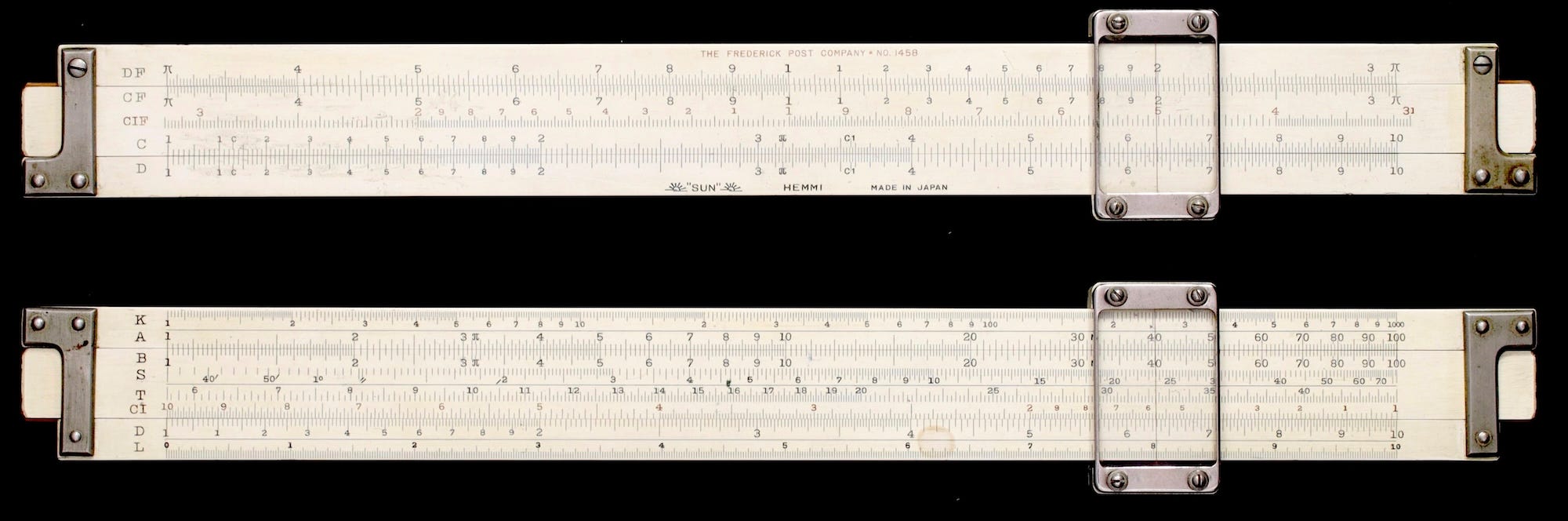
The significance of this rule is that this model was Hemmi’s first “Duplex” (double-sided) slide rule. It has the same scale layout as the K&E Model 4088-3 from the late 1920s. From Paul Ross’ table, he shows this particular rule to be from the early 1930s, which is consistent with the 4-inch model we just discussed. In our post entitled “Scale Wars”, I casually noted (based on Paul’s table) that Hemmi didn’t start producing Duplex rules until the early 1930s — this was the one.
With a couple of back-and-forth emails with the seller in Chicago, I was able to get both rules for a nice deal, with combined shipping.
Then, speaking of Hemmi slide rules, I found another one in my bi-annual trek to an antique store near O’Hare airport. This one is a Hemmi Model 2664:
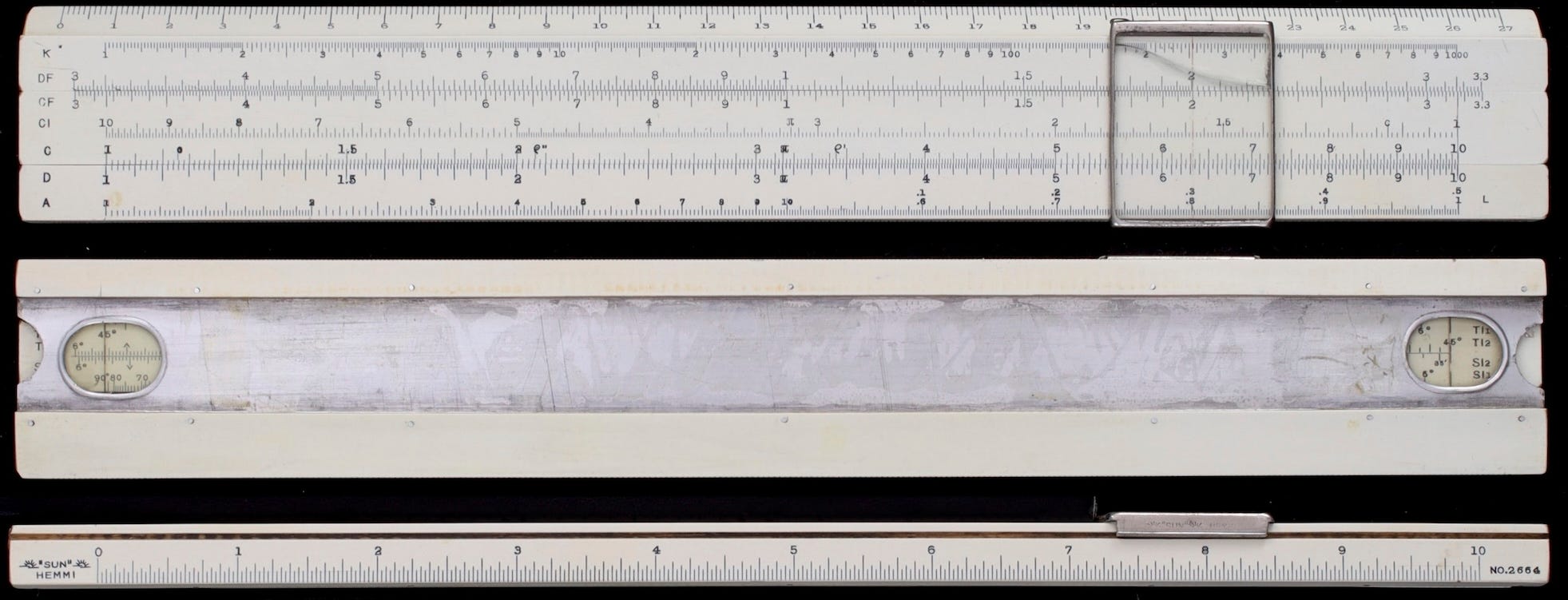
On the back of the slide on this model are inverted T and S scales — TI and SI — which are useful for the vector transforms discussed in Eamonn Gormley’s post on the subject. They can be viewed through the windows on the back, though the slide might likely be reversed for repetitive vector calculations. What is very special about this model, however, is that there are dual scales of each — a TI1 and TI2, plus an SI2 and SI1. It’s the only model I’ve come across with the full set of these four scales.

With the inverted scales, vector transforms can be performed with a single setting of the slide, as discussed in this section of Eamonn’s earlier post. Eamonn noted that, as other rules with inverted trig scales on the slides do not have an SI2 scale, “the TI2 scale can also be used as a SI2 scale, as the values for tangent and sine in this range are very close to each other.” But this rule does have the SI2 scale.
Comparing the TI2 and SI2 scales along the middle of the slide in the image above, one can see just “how close” the two really are (or aren’t). One can see the difference on the left end, where the values do not quite line up. They get closer and closer to being equal as the angle gets ever smaller.

But also notice how the TI2 scale changes abruptly in the middle of the slide; values on the left decrease to the right from about 6o to 2o. At this point, one can switch to the SI2, as below 2o the values on TI2 and SI2 are indeed very close.

So, about midway along TI2, the scale value changes to 70o and begins to march downward to 45o. Thus, rather than repeating the values on the right-hand-side of the SI2 scale for TI2, the right-hand side of the TI2 scale allows one to find values of the tangent for angles greater than 45o, where the corresponding values on C/D are taken to include another factor of ten. This gives the user direct access to a larger range of tangent values, from angles of about 0o 35’ to 70o using the full set of scales, while the sine values available are for angles from 0o 35’ to 90o. It’s a nice use of space, and easy to miss.
And speaking of “split scales”, take a closer look at the bottom scale on the front of the slide rule. It is an A scale on the left, but then at the halfway point, converts to an L scale on the right. How do you take the square root of 81 if the A scale only goes half-way across? You use the DF scale!

And, since the L scale is only half as long as normal, it is twice-labeled from 0 to 0.5 and from 0.5 to 1.0. Again, to find the log of a number using this scale, one uses the D scale for numbers between √10 and 10 (log is from 0.5 to 1), and then the DF scale for numbers between 0 and √10 (log from 0 to 0.5). Nicely efficient.
Like many of our readers, my interest in flight computers has become heightened after reading Joe Plazak’s excellent post on the subject. A couple of months ago I happened upon an interesting device. Within its case, which is labeled “Intercept Officers Kit Type I” on the lid, one finds a mechanical wind vector computer, with a rather standard flight computer just above it, attached to the inside of the lid, along with a table of corrections and a map of magnetic anomalies across the U.S. for compass reading corrections. Made by Cox and Stevens, I felt this type of flight computer provided a very nice connection between the aviation discussion by Joe and the mechanical vector calculators presented by Eamonn late last year.
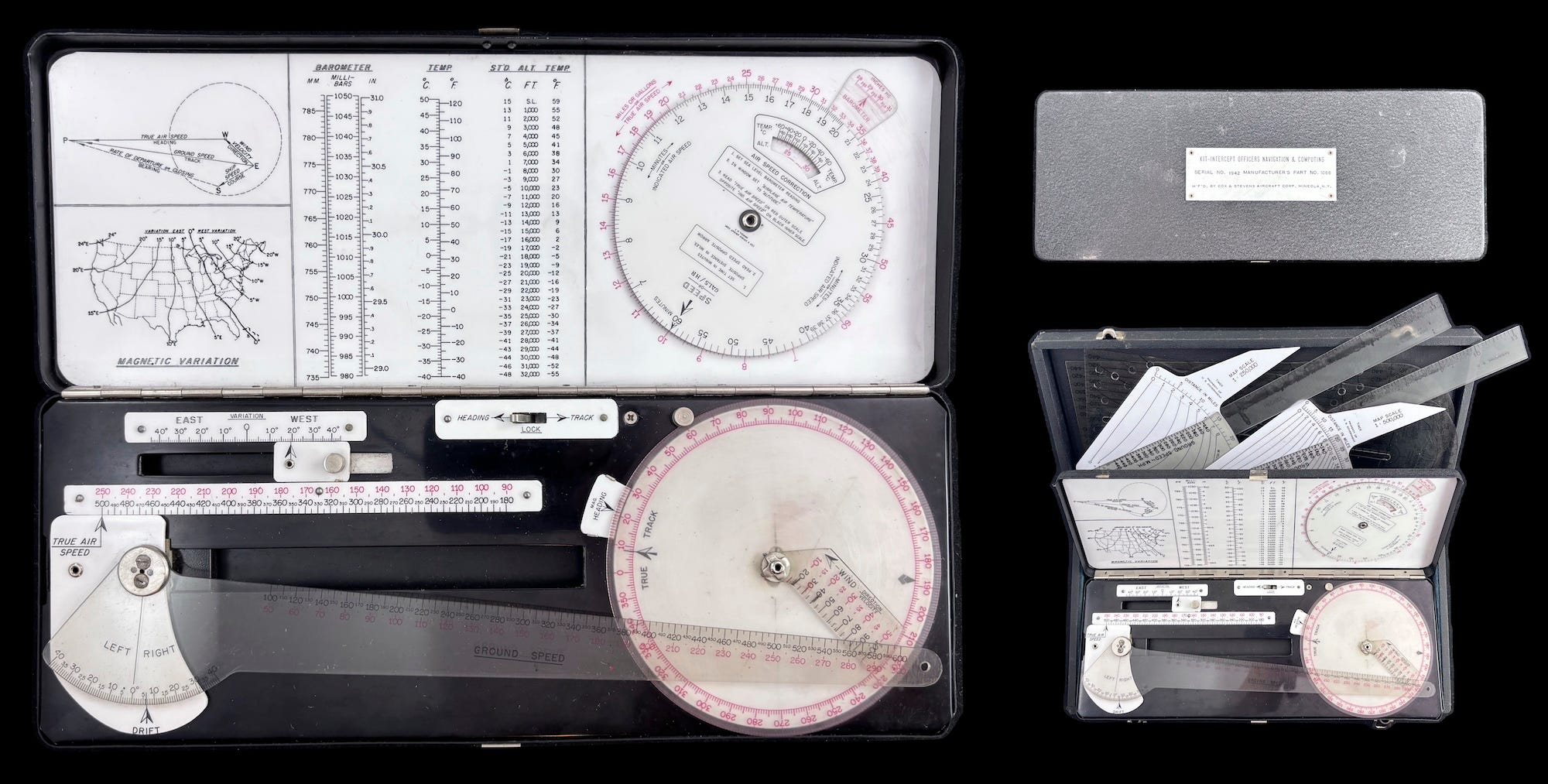
The entire case containing the “computers” fits within yet another case, which has a flap for storing plastic rulers, stencils, and calipers useful for making measurements and plotting courses on maps.
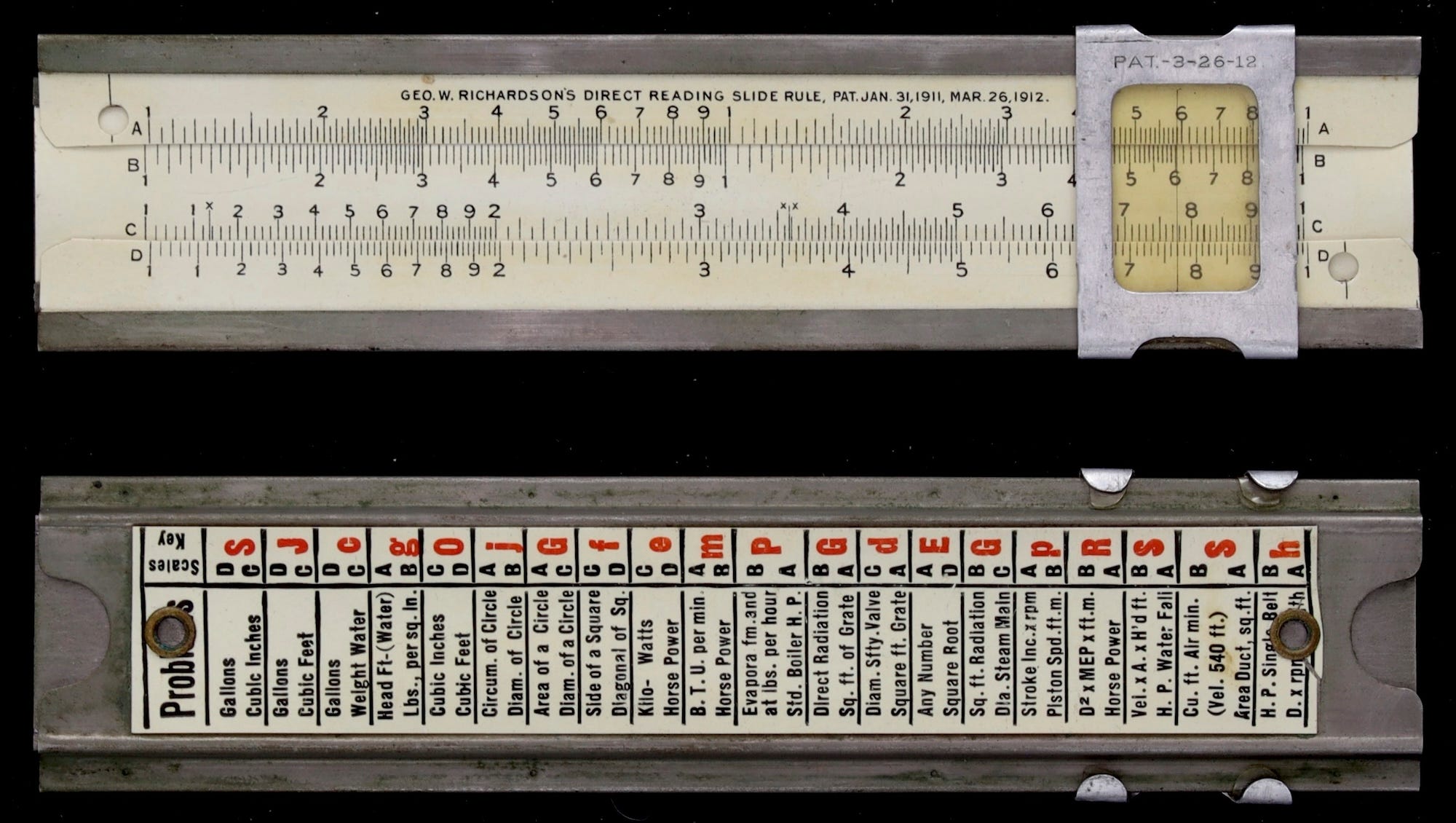
And then, in just the past few weeks, I acquired a renewed interest in the slide rules made by George W. Richardson. Our discussion of the slide rules of Chicago gave a brief description of Richardson and his metal slide rules being made in his home during the early 1900s. After acquiring a few more of these, particularly those from his very early efforts, I began to study his various models through the documentation I could find, in an attempt to understand the timing and history of their development. Much more on this topic will be presented in our next post…
… which, remember, will be on the first Saturday of June.
Oh wait — that’s next weekend!
Comments
Nothing yet. Say the first thing.
Sign in to join the conversation.