
“Oh, it’s you again. Well, how lovely. Enjoyed our wander of the New Forest fairy folk so much you’ve come back for more, have you?
Good. You’re just in time. Today, we’re covering rather more ground – south coast’s giants this time – and we’ll begin right here in Dorset.
Not far from where we stand in Portesham lived a young giant called Grumble. Grumble lived with his mother, and each morning he’d stomp downstairs demanding porridge. No pleases and no thank yous. In an attempt to teach her son some manners, Grumble’s mother would send him upstairs for a pair of boots. Not like yours, no.
These were one-mile boots. Yes – you guessed it – but don’t interrupt, please. Every step he took carried him a mile forward. Off he went – thud, thud, thud – straight to a village shop, where he demanded apples, oranges, and pears. The shopkeeper refused, so home he trudged.
The next morning, it was the same story. But this time, his mother gave him a pair of two-mile boots. A few steps later, and he’s in Scotland, demanding fish and chips. Refused again. Then came the five-mile boots. A long walk later, he found himself in Lebanon, where a woman was making clotted cream and scones. Once more, his sense of entitlement took hold and he demanded them.
And yes – you already know – her answer was no. But this particular no got young Giant Grumble reflecting over the last few days. He returned to the woman and when he asked again, with a please, he got exactly what he wanted. A lesson learned, eventually.
Now, before we move on, I’ve brought something. Go on, guess. No? Fine, I’ll show you.
Five-mile boots! A pair for you and a pair for me. We’ve got quite the distance ahead – Sussex awaits. And I’ve no intention of walking it the ordinary way. Go on, put them on. Quickly now.
Right, northwards – to Cerne Abbas. It’ll be no more than a couple of steps. Just watch you don’t tread on any sheep, people, or alpacas, please…
…There he is, the Cerne Abbas Giant. That carving on the hillside right there. Hard to miss, really. He was one of many giants dwelling in Dorset, though far less polite than our friend Grumble. A real nuisance with an enormous appetite – particularly for sheep and cattle. Usually at nighttime. And from every farm in the area. You see that club he’s holding? He eventually took to wandering around with it in one hand, and a long cloak in the other, which he’d use to sweep up prey before hauling it back up the hill.
One day, he got so greedy that he ate a whole field of cows before falling asleep on the hillside above the village. The villagers took this chance and pinned him to the grass before chopping off his head. The river Cerne, just behind us, is said to have run red with his blood for days and days. Gruesome stuff. Why’s he carved there? The villagers did it, of course. To commemorate their victory.
Seen enough? Good. Seven or eight steps east now, please...
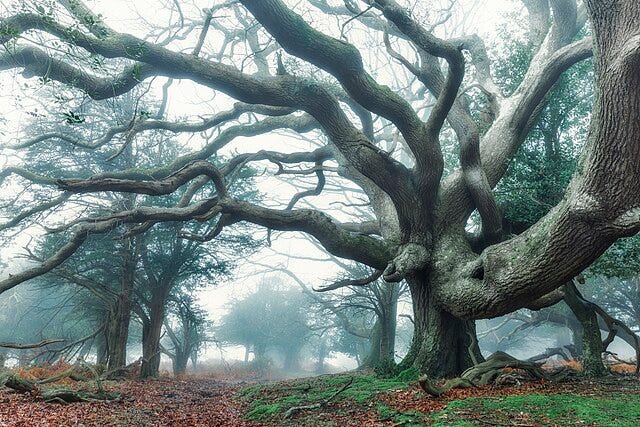
…Here we are. This is Linford, in the New Forest. Though it wasn’t always called that. Before the New Forest was even called the New Forest, it was called the Ettinwood. In the Ettinwood lived a giant named Yernagate. He was a protector of the forest, fighting off the Vikings and watching over the land.
Though he did have a temper. When he caught a man stealing the wood, sticks and twigs off the forest floor to sell them, he picked him up – dog and all – and threw them straight to the moon. They still live there now. Yes, really. Look closely on a clear night. You might still see them.
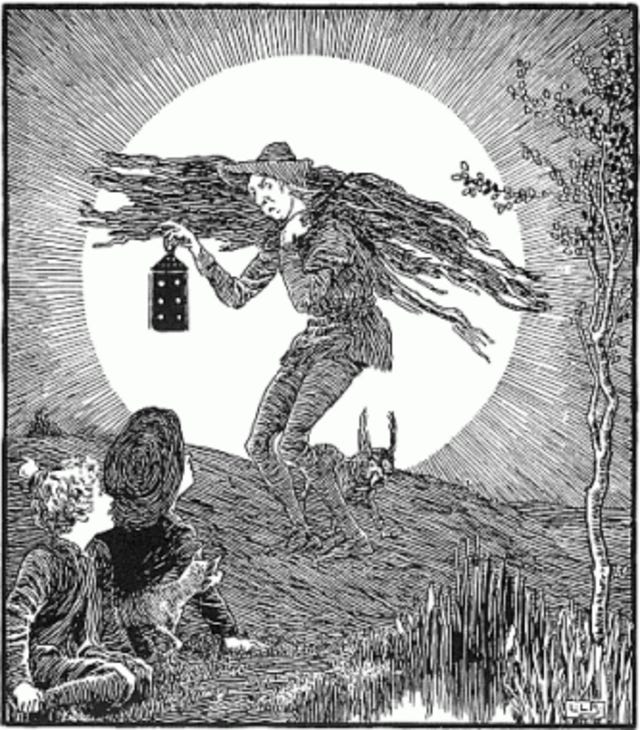
After that, Yernagate went to the man’s house and dug up all the treasure he’d made from selling the wood that did not belong to him, and he scattered it across the forest. All the little glinting pieces buried themselves into moon hills. Every full moon, when the man could see him best, he’d go through the Ettinwood, digging up every coin from every hill and turning it over before burying it again. Why? To help it grow, of course. That’s how these things work.
After years of protecting the forest, he knew it was time to rest – which he did right here on this mound we’re standing on. Yernagate’s Nap. He asked his friends to cover him up, take his eyes from out of his head, and bury them so that he can continue to watch over the forest and return when it needs him. So they did – at Castle Malwood and Ferny Crofts – each hill is named Little Eye. Both about two or three steps from here. Both still watching.
Ready to go? This next bit requires a few more steps, and a leap over some water. Do you think you can manage? Alright, let’s head south then. To the Isle of Wight…
We’re nearly there. You see that amusement park in the distance? A couple more steps, we’re heading just beyond it.
…Here we are – Blackgang Chine. Or what’s left of it. Right here was the chine itself, it was a steep valley created by a stream but it’s since been destroyed by landslides. Careful where you step or you’ll cause another one. A giant once lived here. A truly, thoroughly unpleasant one who ate humans. According to a poem by Abraham Elder, he would stew fat ones in their own gravy and had a particular fondness for spit-roasted children. I know, I did warn you.
Are you alright? You’ve gone a little… green.
Thankfully, a local saint stepped in. They say that when he arrived, the valley was covered in the most beautiful flowers that appeared to welcome him – snapdragons and foxgloves and violets and cowslips and primroses. Can you imagine it? How lovely.
But within the cave, where the giant lived, it was paved with human bones. So the saint spoke his curse, cursing both the giant and the chine. Mist filled the valley and when it cleared, it was gone. All of it. And the little stream running through it was red. Blood red.
Right. That’s quite enough of that, I’m getting the heebie-jeebies. Let’s head back in land. To Sussex, this time...
…This, is Arundel. Here lived a giant named Bevis. A bit like Yernagate, he was here from the very beginning of time, watching all sorts of civilisations come through and settle. When the Normans came and built that castle there, Bevis became its guardian.
Bevis was having a little romance with a mermaid at Mixon Hole, a lovely spot in the water just off the coast here. When he asked her to marry him, she said no. Why? Well, because a giant and a mermaid cannot very well wed, can they? That’d be ridiculous. You do ask some strange questions, you know.
Anyway, he was so devastated that they say the crack of his heart breaking could be heard for miles. He returned to Arundel, lifted his sword, and declared, “wherever this sword lands, lay my poor body to rest”, and he threw it out of one of those windows, closed his eyes, and died. Now, in that park, just next to the castle, you’ll find Bevis’ tomb, and in the castle armoury, you’ll find his sword. I know, because I’ve seen it myself. No, we’re not going in. You’ll have to come back another time. Come on now, off we go. One last stop. Just seven steps…
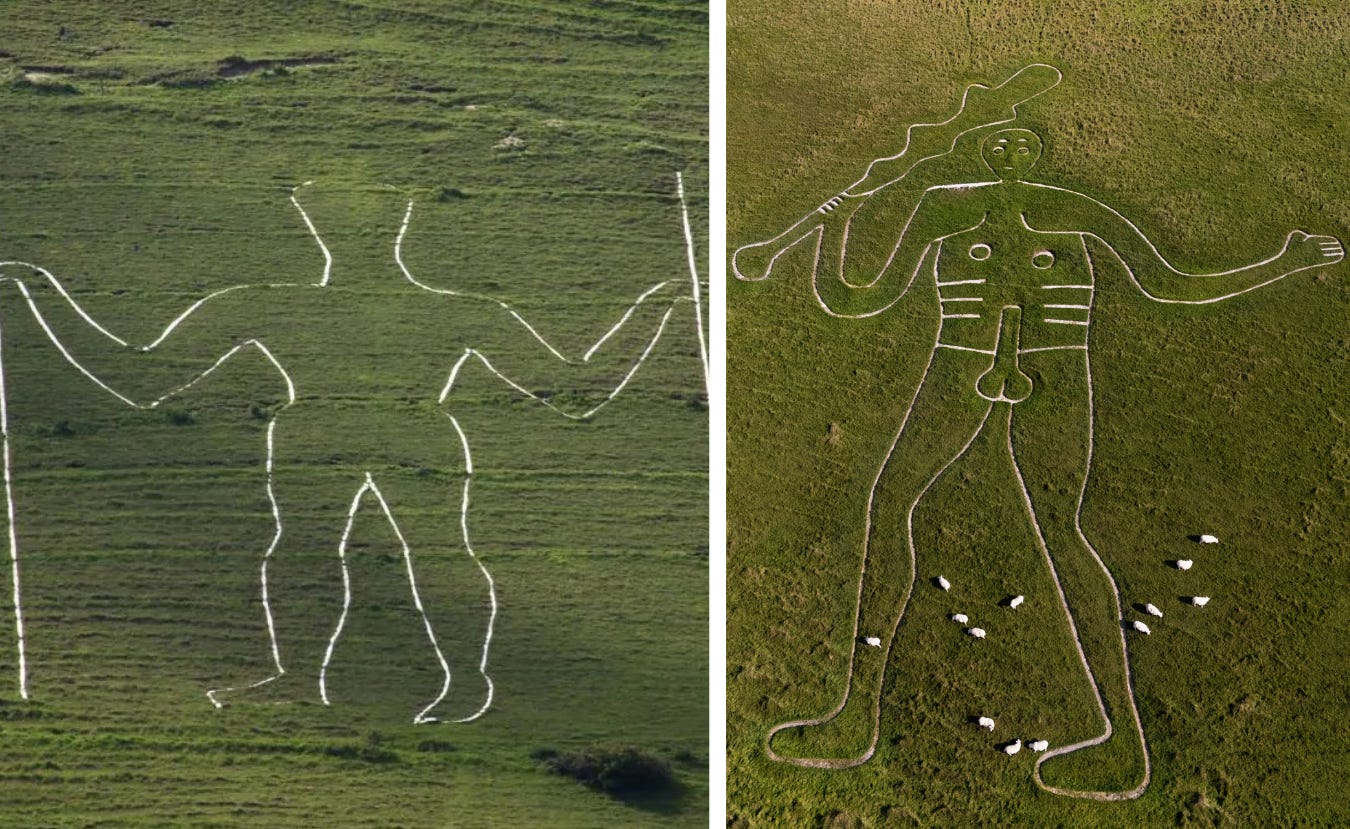
…There. That carving on Windover Hill, above the village of Wilmington, is the Long Man of Wilmington. Between you and me, he was also paying visits to the mermaid of Mixon Hole, and so was the Cerne Abbas giant. Yes, very messy. The mermaid’s father – the king – decided to settle it once and for all. He summoned the Kraken from Norway and declared that whoever could free her could marry her.
Unfortunately, the Cerne Abbas giant fell at the first hurdle – tempted by beautiful mermaids. The Long Man of Wilmington made it, but lost his nerve and retreated. As you can imagine, the king was not impressed. He swore that the Long Man was less than a man, and, well – he took a certain body part from him and gave it to the Cerne Abbas giant. Which does explain the… discrepancy here compared to the Cerne Abbas giant. Which body part? No, no. I’m not saying it out loud. You can see it very well yourself!
And that, I think, is quite enough for today. We’d best get going before darkness falls. The man in the moon will surely be watching.
Oh, before you go – give me back those boots, will you? Grumble will be missing them and I have no desire to deal with him before breakfast. Thank you.
Until next time.”
A note from me:
I couldn’t quite believe how many tales of giants there are in our country. We’re a giant-dense nation. I had to pick my favourites for this, or I’d have been writing for days and days and days and none of you would have made it to the end.
I want to mention that in the tales from Southampton, Sir Bevis is a knight, a hero who defeats a giant named Ascupart. In fact, near where I live, there’s a medieval gatehouse, Bargate, and it used to house two great oak panels with both Bevis and Ascupart painted onto them, on either side of the arch. In this tale from Sussex, however, Bevis is the giant. I wish I could tell you why, but alas, I cannot.
Anyway. Thanks again for walking with me. Until next month… May Day is just around the corner!
No posts
Comments
Nothing yet. Say the first thing.
Sign in to join the conversation.