
"He who has a why to live for can bear almost any how."
(Twilight of the Idols, Friedrich Nietzsche)
I remember writing about life-affirmation for the first time on Gab around five years ago. At the time, I was speaking with a French Canadian esotericist about the teachings of Bernard de Montréal and I was deeply engrossed in a study of Tolkien and his created works. It was from Bernard that I became interested in evolution vs involution, and the supramental vs the mental, the spiritual vs the astral, the Odic Force vs the Actinic Force. Through my studies, I came to the conclusion that you cannot have one without the other, much like how you cannot have order without chaos, or life without death, or the spirit without the material. While discussing the highest mythopoetic function of fairy-story, eucatastrophe (good-destruction), I observed that life wants to live, and that the purpose of life is to affirm life. This means affirming all aspects of life, embracing the cosmic and material struggle, and finding one’s place within the Spheres of Power. Read this article below to learn more about these Spheres and how to find your place within them.
Bernard de Montréal, for all of his faults, was an interesting thinker. He focused on what he termed “Evolutionary Psychology” and he was once asked during an interview just what the end goal of his study truly was. He quipped that “one day, humans will evolve beyond our current conception of what it means to be human, we will fuse our internal and external parts into a unified whole, and we will become supra-human,” and the interviewer asked with incredulity “doesn’t that mean we will one day become non-human?” and Bernard angrily said “That’s exactly right!” — Now, I cannot say that I fully agree with Bernard’s ideas, but the idea that we will one day experience a sort of fusion between the vital and rational parts of our existence and undergo an evolutionary experience has stuck with me for years now (my space-fantasy is based around this idea). This is the ascension of the hero, the creation of eucatastrophe, the divine mandate of our species given to us by Odin himself. We are meant to rise above.
When our race crawled out of the hominoidal-soup of the primordial past, we did not know exactly where it would take us. Cast onto the icy plains of the far north, we struggled to survive in mean environments, set against megafauna and wild beasts. We hunted mammoths, aurochs, and horses. We fought against lions, wolves, and neanderthals. We hunted some to extinction, exiled others, and tamed the rest. We turned ourselves against ourselves like blacksmiths turning iron against iron in a great fiery forge. Our skin changed, our eyes changed, our hair changed, our very minds changed, and we differentiated ourselves from other species of hominids. One might even feel confident to say that our spirits changed, rising above the lower involutionary modes of living into something nearing arête. Slowly, we became heryos, kinsmen, and aryan, aristocrats. Slowly, we became what we are today. In those ancient days, we did not know how we would survive, or what survival would look like. Now, with the 20/20 vision of future eyes, we can look back and see where our ancestral journey has taken us. It took us to victory — the highest virtue.
The spiritual and the mundane, the immaterial and material, the transcendent and the immanent… These words are almost meaningless because you cannot have one without the other, they are interconnected and interdependent, laced together to the point of near homogeneity. However, philosophers have long identified the difference between pneuma and logos. Our wisemen know the difference between ǫnd and orð, between breath and word. Foolishly, the transcendental and materialist thinkers agree that logos is the preeminent concept. They seem blind to the vital spirit that underpins the entire system. There would be no logos without pneuma, no word without breath, and no homogeneity without differentiation. There would be no evolution without Óðr, the frenzy and passion of the mystery, the wandering desire of the vital force, the magnetic pull of the breath that binds us to life itself.
Constant biological and spiritual differentiation is what sets the internal parts of this system into unique pathways of evolution and lived experience. This is true no matter how microscopic or grand one looks. From the smallest sphere that holds the cell, to the largest domain that holds the galaxies, we find constant differentiation created through vital willpower. Life is constantly affirming itself. It can do nothing else lest it fall back on itself in involution and regress into a mutative decay. As Henri Bergson says in Creative Evolution:
"The vital impetus [élan vital], that passes from germ to germ through the medium of a developed organism, is the motive force of all evolution... Life is of the essence of progress."
The Cosmos, the unified order, the hierarchical system is made up of differentiated forms drawing upon unique vital forces. The breath of the African and the European might be coming from the same oxygen and the same atmosphere, but the bellows are different, and the fire produced is different. They do not speak nor understand the same words. The same can be said of all humans, even those within the same racial groups. Our individual wills set us down different paths, and our racial folkgeists set our civilizations onto different highways. There is nothing but the affirmation of our internal and external beings. We cannot escape from this reality. The metempsychosis of our souls is constant. Our habits become the instincts of our children, our faces become their faces, our wills become their wills, and our breath fills them so that they may speak in our tongues. May Ogmios grant us the blessing of good speech and the wisdom of the Gods — from his tongue to our ears!
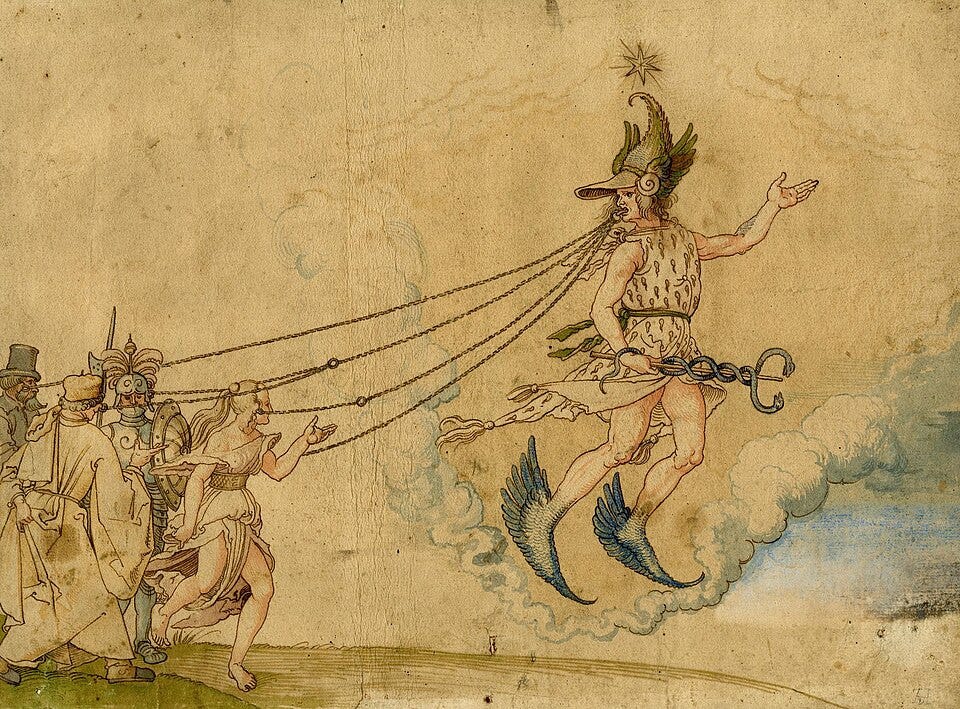
We would do well to remember what Julius Caesar said of the Celts in De Bello Gallico:
“They wish to inculcate this as one of their leading tenets, that souls do not become extinct, but pass after death from one body to another, and they think that men by this tenet are in a great degree excited to valour, the fear of death being disregarded. They likewise discuss and impart to the youth many things respecting the stars and their motion, respecting the extent of the world and of our earth, respecting the nature of things, respecting the power and the majesty of the immortal gods.”
Perhaps now the words of the madman Nietzsche make more sense?
"No greater affirmation of life is possible than to wish every part of it to return to you forever."

No posts
Comments
Nothing yet. Say the first thing.
Sign in to join the conversation.