
Others have written about this topic, or pontificated about it on podcasts, but I am going to offer my 2 cents here. Some of these ideas I thought on my own, others were gathered from online publications, and one comparison in particular was drawn by Spekingar Svan Herul of the Asatru Folk Assembly.
I have written extensive amounts of poetry about Columbia123456, and have done a number of rituals in her name and honor. She is one of the most interesting figures to me, and I often relate her to Indo-European goddesses of the Norse and Gaels. This past 4th of July saw Patriot Front marching through downtown District of Columbia, and as they marched they chanted “Hail Columbia!” which speaks directly to my folkish sensibilities. More than anything else, I desire for this goddess to be better understood, so I will provide a brief history of the historical cult, of Columbia herself, and then dive into the direct comparisons I often employ when doing ritual to the goddess of the land and folk of America.
In the ancient Proto-Indo-European world we find that gods of the tribe, gods of kings and priests, mother goddesses, land goddesses, and divinities of boundaries, thresholds, and hearth-cults all played vital roles in the tribal political schema of our most ancient ancestors. It was common for descendant Indo-Europeans to utilize these deities as away to cement a tribe’s or household’s blood-and-soil claim to a piece of land. This eventually became so commonplace that some tribes named themselves after their own personified goddess. According to mythology, the Greek city of Athens was named for the goddess of wisdom, Athena, after she beat Poseidon in a contest to see who could provide the Athenians with a better gift, and she won after providing them with the first cultivated olive tree. Even in ancient times, some scholars thought that the goddess actually received her name from the city itself, and this theory is now the main theory concerning the naming of Athens. However, this practice developed and was employed again and again in other places, such as the Brigantes of Britain and Ireland being named after the goddess Brigantia (Bridget), the bright goddess of privileged, honorable, and renowned highlanders.
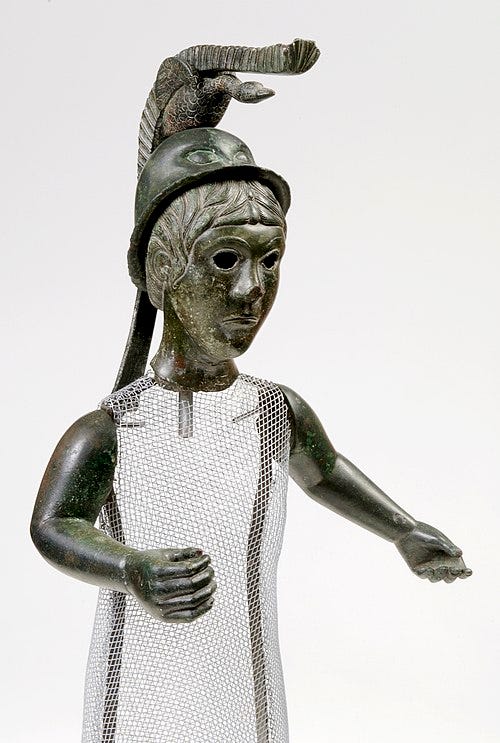
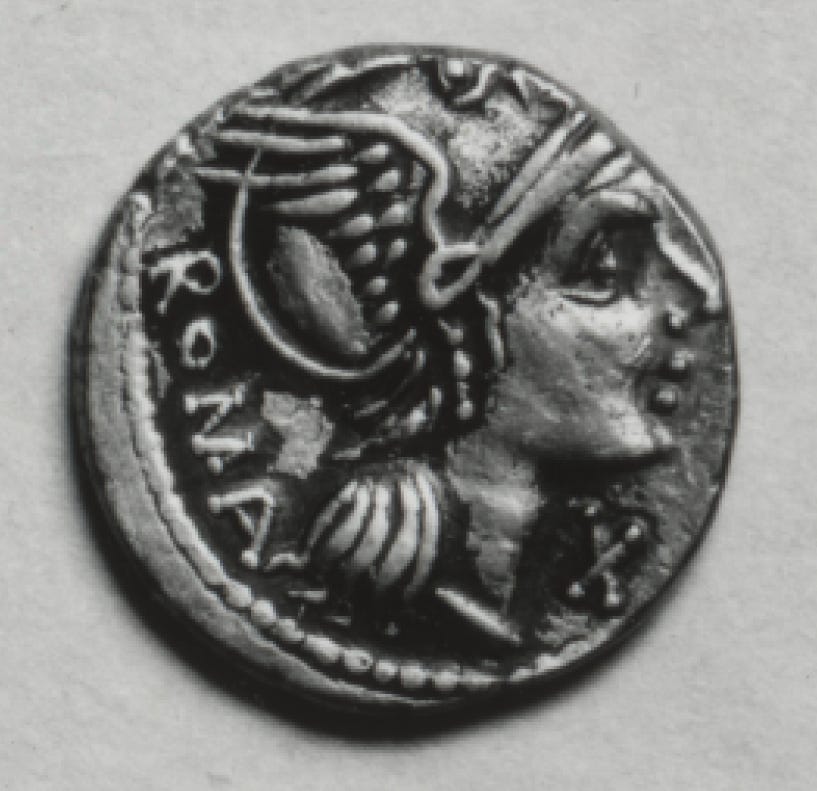
It was also employed by the Romans with the goddess Roma, who was the personification of the Roman state itself, and was especially useful for those who lived far from the imperial center out in the boonies. Roma was a deified abstraction of the state itself who was robed, armed, seated on a throne or trophy, and was first worshiped in cult in the eastern provinces as a way of personalizing loyalty to an otherwise abstract republic/imperium. It has been proposed that her cult started as a form of political diplomacy melding religious priors together into alliance, which changed the traditional Greek divine monarchic honors to the Republican and Imperial system. Conquered/allied tribes and city-states of the Roman state acknowledged the authority of Roman offices, but they did not forgo their local, Greek cults. Most importantly for our purposes, it is significant that democratic city-states such as Athens accepted Roma as analogous to their traditional cult personifications of the folk. This means that the personification of the land was seen as similar regardless of origin or location in the world. The cult goddess was an extension of the land and folk, a spirit who dominated the domain of the of the tribe, city, or nation.
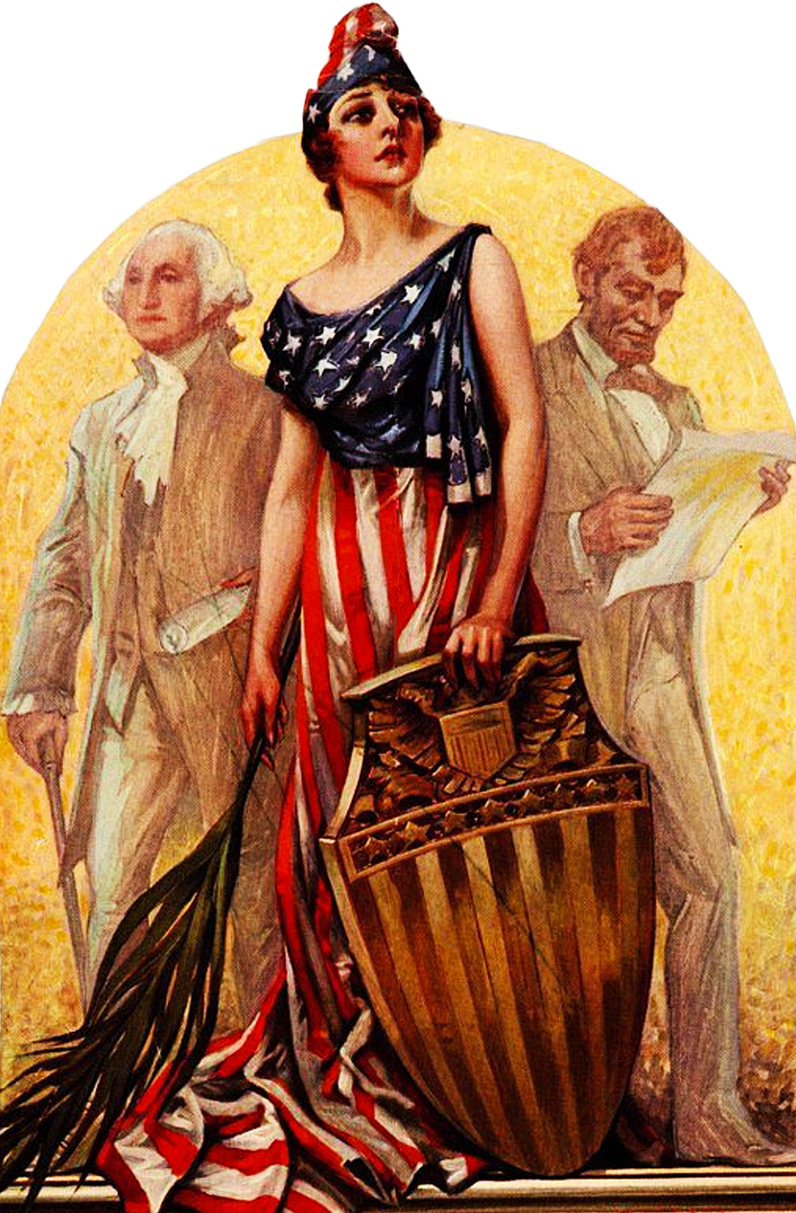
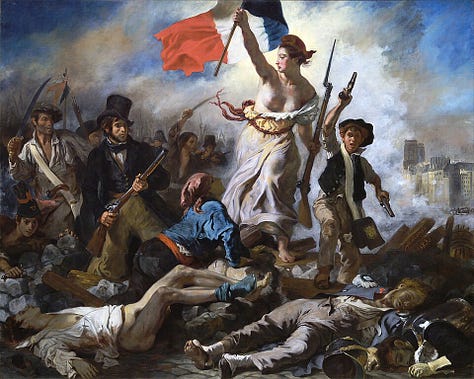
Therefore, Columbia belongs to this genre of national goddesses that starts with the Roman goddess Roma, although the roots of this tradition extend to far older mother, hearth, and land goddesses. Out of that template came all of the early modern national maidens: Britannia for Britain (helmeted, shield-and-trident, shown as a maritime protector of the British Isles., first minted under Hadrian and revived by the Stuarts), Marianne for the French (Phrygian cap, born of the Revolution, embodying the goddess Liberté rather than French territory), Germania for the Germans (blue-eyed with long, flowing, reddish-blonde hair, wielding the imperial sword, and possessing a medieval-style shield that bears the image of a black eagle on a gold field, sometimes carrying or wearing the Imperial Crown of the Holy Roman Empire), and many others not named here. This genre of national goddess is so popular that many non-European nations have adopted the practice.

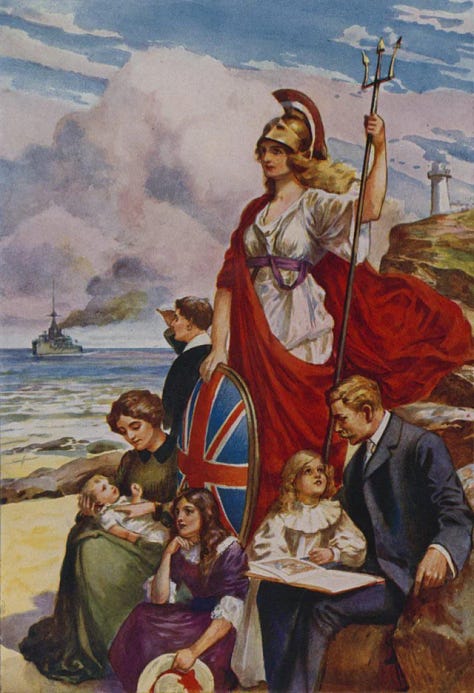
Ultimately, these later national personifications are political inventions, being little more than a rhetorical personification of a political entity, not a survival of an actual ancient pagan cult like Roma, Athena, or Brigantia. Nevertheless, these national personifications, such as Columbia, sit squarely in this family. Columbia’s name is a Latinate coinage of Christopher Columbus, and Columbus just means “dove” which, in a mythological sense, denotes domestic love, familial peace, fertile beauty, and good faith. Slightly unrelated but still important to bring up here, pigeons and doves were once staples of human civilization and were greatly honored for their roles in mythology, along with their important functions as messenger birds. Lanius has a great article about how doves went from symbols of love to little more than scorned city rats with wings7. When America split from Great Britain and cast down the rule of the British monarch, we began to name things after Columbus and quasi-deified him. In 1791, we built the District of Columbia to serve as the capital for Washington, our capital which was named after George Washington who was basically deified in the same fashion as Augustus. I was introduced to this idea by Gildhelm, who has pondered about writing an article on the “Gods of America” and perhaps if he gets prodded, he will write that article for our benefit (we are retards).

Originally, the lands of America were seen as wild places and the domains of the red race, and so early Spanish thinkers viewed the personification of this land as a wild “Indian Queen” who was feathered and exotic, often astride an alligator and holding foreign fruits. As colonization continued, especially after the United States of America formulated itself as an independent nation, Columbia appears in 18th-century verse and engravings, and she was depicted like a Roman matron, and for a long stretch she ran in parallel with (and partly displaced) the earlier "Indian Queen" personification of the colonies. By the early 20th century Columbia herself was partially eclipsed by Liberty, who's really an offshoot of the same genre (Libertas is one of Roma's standard attributes, and has been broken into her own figure, with Marianne of France being another personification of her, and the Statue of Liberty is directly hearkening to the “enlightenment of liberty” as the French saw her).
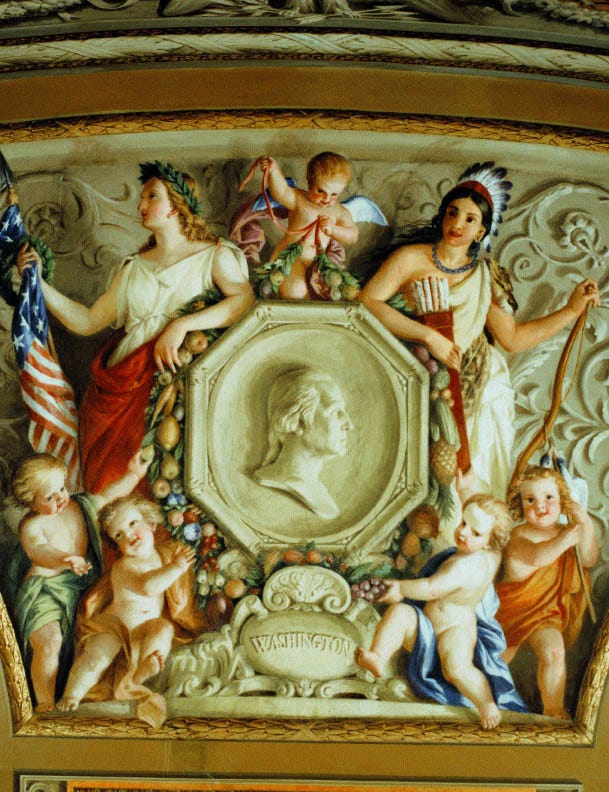
In a very simple sense, Columbia represents our Manifest Destiny here in the New World. She is the white mother goddess of our shining new city on the hill. She is the personification of our New Atlantis. She represents the cornucopia that is the American landscape, the will-to-power that is the American spirit, and the civilizing force that originates in the East and travels West to tame wild lands. We have named many rivers, cities, and buildings in her honor, thereby making her a goddess of threshold boundaries owing to her relation to rivers and doorways, especially making her a goddess of law and justice since these doorways are always those which enter into halls and theaters of government. In the womb of Columbia, America was born, and from her breasts we draw our sustenance; from her cornucopia, we draw our wealth and willpower. She is our claim to this wild land, and upon her mantle rests our natural aristocracy; upon her shoulders, she upholds our rightful heritage as Americans. In the rural places of America, Columbia resides as a maker of civilization, and yet in the cities she resides the ruler of civilization. On the borders of America, Columbia’s power wanes, and she must call upon her cherished children to defend her. She sets the boundaries and calls for expansion, and we follow like soldiers in serried array.
I have already mentioned that Athens had Athena, the Brigantes had Brigantia, and Rome had Roma, but let’s dive into some other comparisons and see what fruit we can harvest from this cornucopic tree. These are the three goddesses I most often compare to Columbia, and since I am a Norse-Gael and Anglo-Celt, it makes sense that the Gaelic and Norse conceptions are first and foremost present in my mind when thinking about Columbia. These would be the Irish Ériu and Danu/Anu, and the Norse Gefjon. Just to make a note, the three goddesses I will mention here are all somewhat connected to the Three Matronae, for each of them exist either as direct matrons (Gefjon), or are members of a triumvirate of three goddesses (Ériu).
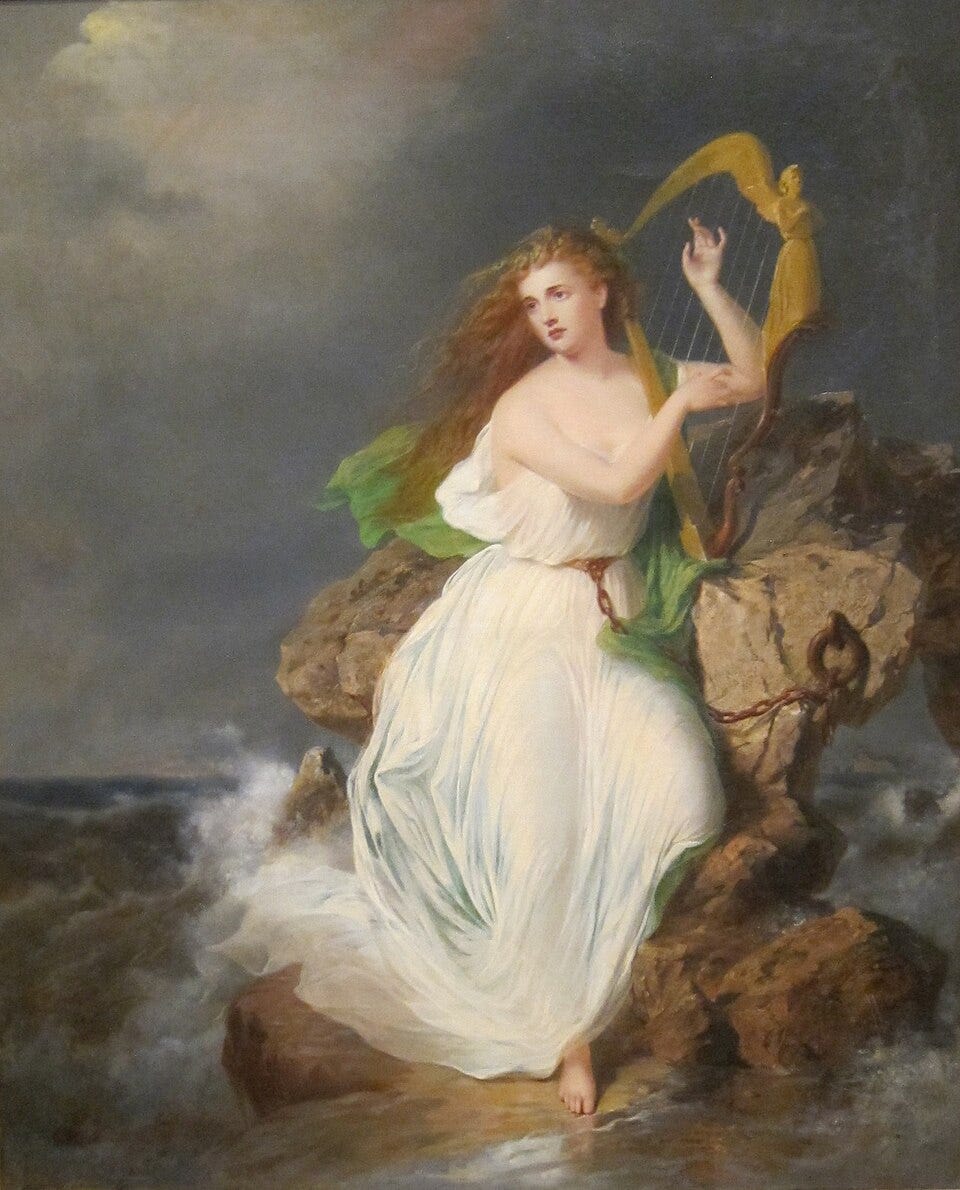
The clearest comparison to Columbia from Irish mythology would be Ériu and her sisters, Banba and Fódla. The naming of the land is vital in Irish cosmology, and it really is the only source we have for creation and the beginning of the world (it is probable that we are missing elements of the cosmology here, and all that is leftover relates to marriage and name-giving). Thus, it is from Ériu who we get the name for Ireland from, Eire, and this is connected to a myth where the three sisters ask the Milesians (Gaels) to name Ireland after them, and Eire becomes the main name while the others are used for poetry. It is from her we get the name Hibernia, another poetic name for Ireland. It is often suggested that the three aspects of the Morrigna (Badb, Macha, and the Morrigan) are directly related to the three sisters, therefore representing a reflective triumvirate of sovereign goddesses with Ériu and her sisters holding the land and heavens, and the Morrigna holding the otherworld. This is contested territory, but it is worth mentioning.
Ériu becomes a lover to a prince of the Fomorians, Elatha, and together they create Bres, who goes on to become the King of Ireland when Nuada Airgetlam loses his hand (imperfect beings cannot be kings). Bres is made king and he marries Bridget (possibly in reference to the king marrying a land goddess to cement his claim, but Bridget is less of a land goddess and more of a hearth goddess). Bres is a tyrant and enslaves the Tuatha de Danann, favoring his Fomorian kin. He is later exiled when Nuada returns with a silver hand (hence, Airgetlam) and he is eventually killed by Lugh after he teaches Lugh the secrets of agriculture.
The etymology of Ériu is fascinating. Ériu comes from reconstructed Archaic Irish *Īweriū, which is related to the ethnic name of the Iverni, one of the ancient Gaelic tribes. It comes from the Proto-Indo-European *piHwerjon- meaning "fertile land" or "land of abundance", and is related to the adjective *piHwer- "fat" meaning fat with abundance.
Danu is the mother of the Gods of Ireland, and it is from her that we get the name of their pantheon, the Tuatha de Danann, or the tribe of the goddess Danu/Anu. Danu’s true name is Danand, and it is possible her name is just a contraction of “dia Anu” meaning “goddess Anu”, however that is debated because “Anand” is applied to many goddesses in different contexts, including the Morrigan, the Phantom Queen and goddess of sovereignty, magic, and warfare. In Scotland, she is known as Gentle Annie. She is a mother goddess, yes, but she is also a goddess of wealth, riches, prosperity, good fortune, and nobility. The Proto-Indo-European root of her name comes from *dʰenh₂- "to run, to flow" and this is where we get the name for the Danube River, which was likely a loanword from Celtic into Scythian. The naming of the land was a major aspect of Irish lore, as was explained above with Eriu, and thus, it is no surprise that there are rivers and mountains named after this goddess, such as the “Paps of Anu” meaning the “breasts of Anu”.
Danu is a cornucopic-goddess who provides sustenance and life to her divine and mortal offspring. From the 9th century Sanas Cormaic (Cormac’s Glossary):
Ana – mother of the gods of Ireland; well did she feed the gods.
She is a little different as compared to Eriu, who is a more apt comparison to Columbia, but Danu is related to the naming of rivers, she is related to the female authority, she is related to the naming of the land and to thresholds of life-giving sustenance, and to prosperity and nobility, all of which are related to Columbia. Now, let’s look away from the Irish to the Norse.
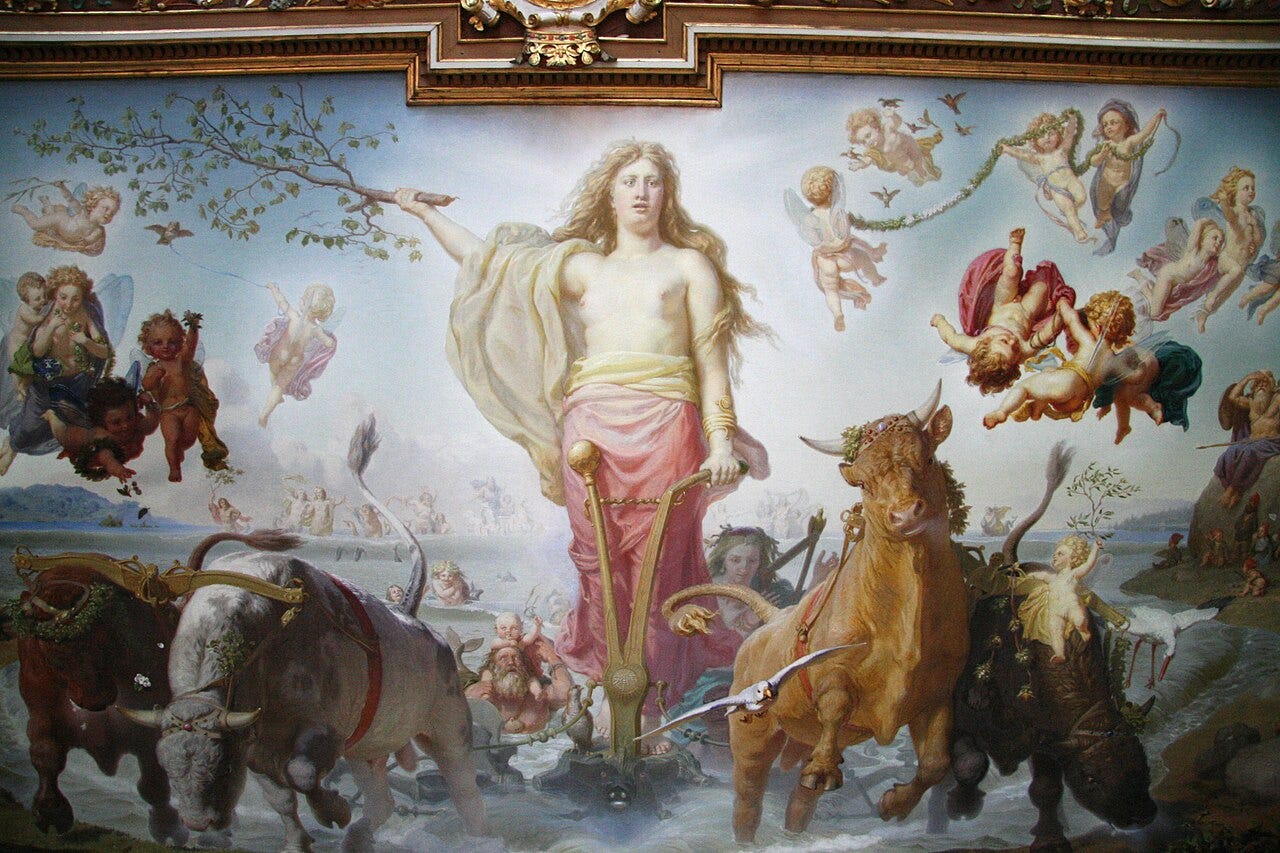
Gefjon’s name might mean “the giving one” or “she who gives prosperity or happiness” but it is contested and regardless of how it is read, it always relates to ploughing and prosperity. The suffix of her name might mean “the joined” meaning lovers in a household, or the crew of a ship. There is a Finnish borrowing from this which means a “bride’s outfit” and here we find all of the elements of Gefjon’s mythopoetics wrapped up neatly in the etymology of her name. Gefjon is related to waters, virginity, fertility, the setting down of boundaries, and the marriage between the king and the land (and the prosperity from that union). There are a number of legends connecting her to the marriage of kings, such as King Skjöldr and King Gyfli. A 9th century skald Bragi Boddason said this about Gefjon and Gyfli:
Gefjun dragged from Gylfi, gladly the land beyond value. Denmark’s increase, steam rising from the swift-footed bulls. The oxen bore eight moons of the forehead and four heads, hauling as they went in front of the grassy isle’s wide fissure.
There are many myths and references to her about how she ploughs the land with her oxen and sets down new boundaries for kingdoms and settlements. She is also reminiscent of the Lady of the Lake from the Matter of Britain, for there are references which seem to speak about Gefjon as arising from lakes, rivers, and the ocean itself with her cattle to bring prosperity to the land. There is something to be said about the waters of life and its relation to wombs, something that is connected to bogs, swamps, and marshes as well. Therefore, it makes sense that Gefjon (like Danu) have a relation to waters. It is said that Gefjon “rushes up in waves” and she is described as “Gefjon gushing, the race of giants” which again draws comparisons to Danu, to waves of settlement, to watery pathways and thresholds where civilization and prosperity crosses over when mortal kings marry the goddess of the land.
Gefjon is often related to Freya/Frigg by some, and that does make sense, but they do hold different places in the divine tribe. Gefjon is said to have all maidens who die virgin gather to her as her attendants. Her virginity is not in question even though she has sexual relations with different figures, and this directly relates to the Welsh myth of Arianrhod who is likewise described as a virgin maiden who then gives birth to the Welsh Lleu (Lugh). This is all connected to the many complex Indo-European rituals wherein the king marries the land to secure noble privilege, sovereignty, and prosperity for his kingdom. That topic is too complex for me to go into here, but it is something worth mentioning. Maybe one day I will write about the practice of kings marrying the land, it is a very interesting topic with many strange rites.
To answer the question that is the title of this article: Yes, Columbia is a Goddess, and she is from the same traditional vein as Gefjon, Eriu, Roma, Vesta, Athena, and many others. Therefore, we as folkish pagans should honor Columbia and supplicate to her in these dark and trying times where our nation is flooded with immigrants, our borders are non-existent, and our lands are plundered. She will assist us.
Hail Columbia!

The Lay of Columbia
·
Jul 7

A young sailor from across the ocean was stranded, Far from his homeland where tyrant king demanded, That he give up his rights which he knew to be true, So, the young sailor fled across the wild sea so blue, He traveled to the New World, the western wilderness, Far away from ancestral London, Dublin, and Inverness. There in the forest he met a fair la…

Speak, Columbia
·
July 4, 2025

O rivers of sweat, rivers so blue, Columbia, Columbia, we call out to you! What would you say in tandem, With those blue boys in blue denim, Who walked from ocean to ocean? Blood on their hands, They crossed these foreign lands, Nothing could hold them back, Nay, for they never did lack, Neither courage nor honor, Virtue so true. What shall you say i…
Columbia, Hold Fast the Line
·
Jan 12

Oft do men speak of the coming day When our guys are in power to slay, Yet when it comes, what will we do? Who to stand with, red or blue? Neither catch my hardened heart. I see only the end of the long start. Neither the tears of liberals crying, Or the blood of Americans dying. Nations fall to raucous laughter, I only see sheep ready for slaughter. …
Americanus
·
September 6, 2025

Sing now, Columbia, And speak of America! That star spangled banner, The woebegone father, And the rebellious mother! America, America, Hearken to Columbia! Foreign blood took power, Raped was the mind, Of noble White daughter, The beginning of the einde, Wombs made to falter, Sons were now born weak, Inheritors of the meek. Now, new sons arise, Ther…
Martial Address to American Patriots
·
November 21, 2025

Torna Braggison recently sent out a challenge to some poets to recreate this poem, but recast into our own struggle. This is my submission, mine will be shorter and I am going to play around with the meter and stresses. I used some old slang phrases from 1800’s American culture as well.
No posts
Comments
Nothing yet. Say the first thing.
Sign in to join the conversation.