
Bonjour dear readers,
This past week-end we celebrated Madeleine’s seventh birthday. For me it was a particularly notable birthday, although I can’t say exactly why. We had a few of her friends over, and it was a really nice time together despite the rain keeping us inside.
Yesterday with the students at Foi et Sandwich, we addressed a question which one of them suggested: Wasn’t Christianity invented in order to control people? It was a great discussion, and since it’s a worthwhile question, I adapted my notes into the first article for this Notebook:
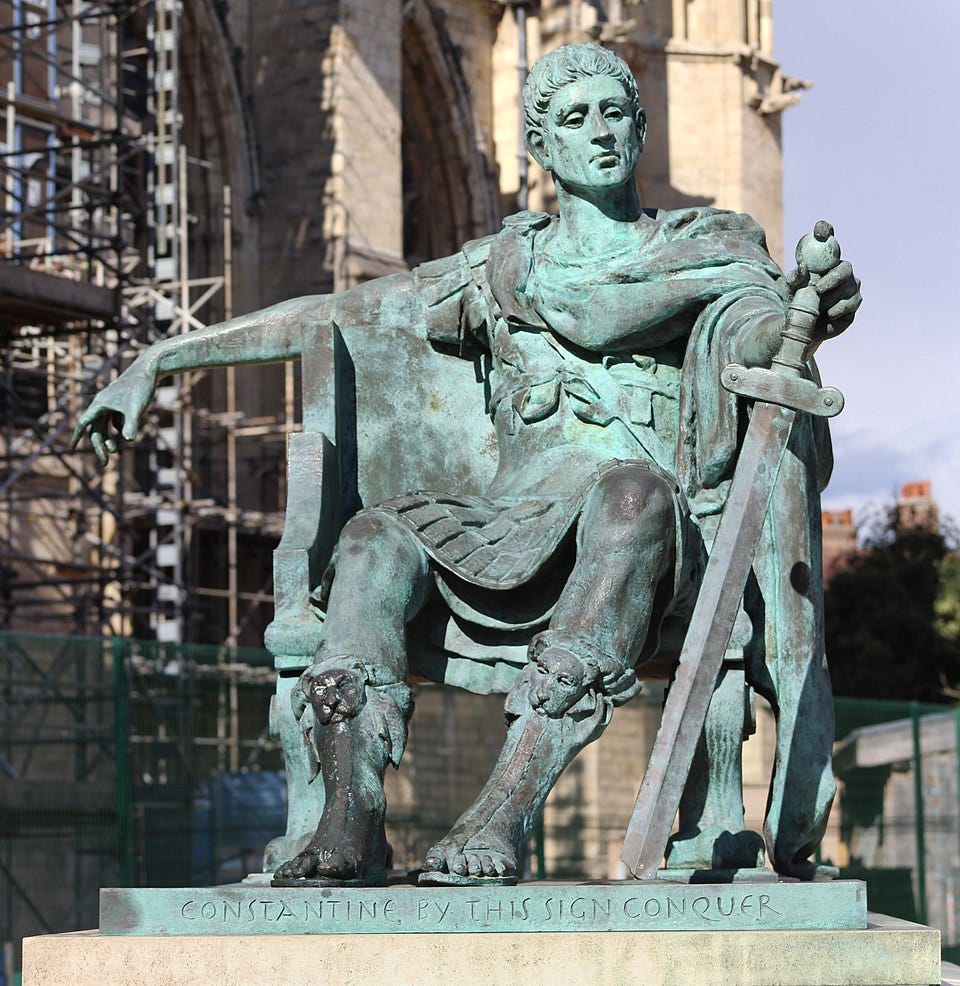
This is a common accusation that seems logical to many people. Christianity is therefore not the truth about God revealed by his Son, but simply an instrument of control used for very earthly purposes. Believing it means being taken in by the cunning men who originated this myth.
The first element of response is to note that there is a logical flaw in the accusation. We can perhaps spot it more easily if we analyze another hypothetical statement that has the same structure:
Covid was invented in order to control people.
It is indisputable that an enormous number of people were controlled because of Covid. However, it is not obvious that the reason for Covid’s existence was to justify these control measures. And if we wanted to argue that the virus itself was a myth, the observation that many people were controlled does not advance the argument in any way. There is simply no logical connection between the control of people and the falseness of the reason for that control.
Therefore, even if the original purpose of Christianity had been to control people, it would not follow that Christianity was necessarily false. One does not imply the other.
It is worth recognizing this logical flaw because it comes up a lot. For example: “You’re a Christian just because you are afraid of dying,” or “You are a Christian just because you were born in the US and not in India or Saudi Arabia.” Even if it is true that I am afraid of dying and that my Christian family was decisive in shaping my own faith, it does not follow that Christianity is false. The truth or falseness of an idea can only be determined by examining its actual claims.
For this reason, if we wanted to, we could simply turn the accusation right back around and say that atheism was invented to control people. There is no doubt that totalitarian regimes find it very useful to be able to claim that there is no higher authority than themselves. Of course that doesn’t prove that atheism is false, but this claim is just as plausible as the first one.
As for the claim itself, is it really plausible that Christianity was originally an instrument for controlling the populace? As soon as the question is asked, the answer is clear. Christianity was not imposed by earthly authorities, but vigorously opposed by them. The message proclaimed and believed by the first Christians was offensive and ridiculous to Gentiles as well as to Jews. Its adherents were for the most part insignificant people in society, and they were frequently persecuted by the majority. No one in the first century would have said that in 300 years Christians would be in control of the empire; that would have been unimaginable. If Christianity was “invented,” its inventors gained nothing, humanly speaking, from their invention. It is therefore implausible — manifestly false, rather — that Christianity was invented to control people.
So, even if this was not the case in the early centuries, can we not say that Christianity was used to control people later on? To this question, we can simply say “yes.” It is obvious that Christianity has been exploited by hypocrites for their own ends. We see this in history, as well as in various cults of our own day.
That being admitted, is Christianity therefore discredited? Of course not. The fact that wicked people can hijack Christianity toward other ends does not in any way prove that Christianity itself is false. For that, one must return to the fundamental doctrines of biblical Christianity and demonstrate in what way they are false.
Furthermore, the Bible itself runs counter to this logic of control. For example:
But you are not to be called rabbi, for you have one teacher, and you are all brothers. And call no man your father on earth, for you have one Father, who is in heaven. Neither be called instructors, for you have one instructor, the Christ. The greatest among you shall be your servant. Whoever exalts himself will be humbled, and whoever humbles himself will be exalted.
Matthew 23:8-12
OK, if it is difficult to argue that Christianity was invented to control, perhaps it was religion itself that was invented for that purpose. The first Christians had no idea of controlling folk, but the problem is that it is a religion, and the religious phenomenon itself has this will to control at its origin.
But this version of the accusation is just as guilty of unsubstantiated claims as the first. Who invented religion to control people? In what part of the earth and at what point in history? The reality is that religion is universal among human beings. No one has ever discovered a tribe of atheists on a remote island, and there is no trace of the humans who would have existed before there was religion. If one rejects the biblical account which states that the very first human beings were conscious of God, one is left with nothing but speculation without any evidence.
Furthermore, the universality of religion runs counter to the idea that it was invented. It is better to recognize that human beings are spontaneously religious. This takes many forms, but the phenomenon itself finds its source in human nature and does not depend on an “inventor.” The interpretation of this fact is then very interesting, but it falls outside the scope of this article.
~ ~ ~
It’s been a long time since I wrote any fiction, but as I was trying to imagine what sort of events might lie behind the enigmatic text of Genesis 6.1-4, I had the idea for “The Priestess of Malakh.”
When men began to multiply on the face of the land and daughters were born to them, the sons of God saw that the daughters of man were beautiful. And they took as their wives any they chose. […] The Nephilim were on the earth in those days and also afterward when the sons of God came in to the daughters of man and they bore children to them. These were the mighty men of old, the men of renown.
- Genesis -
No I imply that what pagans sacrifice they offer to demons and not to God. I do not want you to be participants with demons.
- 1 Corinthians -
And the angels who did not stay within their own position of authority, but left their proper dwelling, he has kept in eternal chains under gloomy darkness until the judgment of the great day.
- Jude -
The light of the setting sun, dusky red on the battlements of Raamah, found the youngest daughter of the city’s king skipping down the steps toward the gate. There she fell in with the other maidens and the musicians who were to supply the melodies for their dance of the full moon. A short walk brought them to the designated clearing just as the bright moon cleared the eastern hills. The pipes let out the first sweet notes, and the next Tovah knew, the music sent her spinning around the glade, giving herself to the wild delight of youth and the seduction of the summer night.
Song followed song, and the moon had risen to the top of the sky, when Tovah caught her breath as a sudden chill descended on the clearing. She turned to look back toward the trees, dark and still. For a moment, there was nothing, then she perceived something moving. The head of an enormous serpent, iridescent blue, rose up out of the grass and glided swiftly toward her. Other maidens screamed and the whole party fled, but Tovah remained transfixed, unable to look away from the serpent’s golden eyes. In a moment it had reached her, the head hovering a handsbreadth from her nose. Helplessly Tovah stood rooted as the creature’s gaze bore into her eyes as if to read the secret thoughts of her heart. Then there was a kind of ripple from its head down to the tail and in place of the serpect there stood a large man in blue raiment that shone like the skin of the serpent.
“Who are you?” breathed Tovah.
“I am Malakh,” he said, and his voice was like the waterfall above Pi-Hagihon.
“Are you the great God, the one they say made the sky and the earth, who made the first people and sent them to wander through the earth?”
The man made a sound between a hiss and a snarl. “Who told you that? Do not dare to question me. I am your God, that is all you need know.”
“My God,” murmured Tovah, gazing in wonder at the marvelous being before her. And slowly with a sense of solemn wonder, she knelt down, prostrated herself at the feet of Malakh, and worshipped.
~
“And Malakh commands that we build him a temple,” Tovah finished her story, looking around at her gathered family. At first no one spoke. Her father’s face was calm, but with an effort it seemed. Her mothers huge brown eyes hid nothing of her shock and fear. As for her brother Irad, his face was angry. He jumped up.
“So, Tovah is the special one who has been chosen to be the mouth of the great God Malakh? What an honor for you, oh my sister!” He paced around the room. “As for me, I never heard of any Malakh. What does Raamah want a God for? Long have we been happy enough without any temples for snake-men.”
Tovah broke in, “Irad, no, you don’t understand!”
He silenced her with a wave of his hand and continued, “Hush little girl, and let the men speak. We are not so easily awed by the beasts of the forest, we men. When we see a snake, we don’t bow to it,” he looked Tovah in the eyes, “we kill it.”
A sharp hiss sounded in Tovah’s ear and panic tightened her chest. She wanted to fly at Irad and strike him. She wanted to run away and hide. In the moment all she could manage was to strangle out, “Irad, please…”
He smiled down at her and opened his mouth again, but their father interrupted, “Peace, my children. Tovah’s tale is a strange one, and it requires reflection. Irad is right to say that no one has ever heard of this Malakh. And yet, a powerful being like the one Tovah described would be better to have as an ally than an enemy. I will think on it this night, and we will speak again tomorrow.”
Tovah reached out for her brother’s shoulder, but he strode firmly out of the hall, followed by her parents. Horror at Irad’s impiety and dread of Malakh’s response weighed her down to the floor, where she remained, alone with the turmoil of her heart.
Waking the next morning, Tovah had no desire to go out and face the world, knowing in her heart that no good news awaited her. The world, however, would not remain outside. Her handmaid rushed in, her face streaked with tears.
“Oh my mistress, oh poor mistress!”
Tovah sat up and stared blankly, waiting for the blow to fall.
“It’s your brother, mistress. Irad is dead!”
He had been found in his bed, struck by no one knew what evil, his skin a range of hideous colors and his features twisted in an agonized grimace. The king of Raamah did not deliberate any further but gave the order to build the temple of Malakh even as he wept by his son’s bier.
~
Tovah stood in the shadow of the great stone pillars of the temple of Malakh, gazing up at his golden statue. This was in the form of a large powerful man with the head of a great serpent, unblinkingly surveying his hall. There was a rustle behind her, and for the second time she heard that voice which seemed to resonate in her bones.”
“You have done well. I am pleased.”
The vivid blue serpent circled around in front of her. Its head was lifted up higher than her own, its body thick like the breadth of a man’s shoulders. Tovah fell on her face.
“My lord!”
“This will be my house, and you are to be my priestess and to take care of it. Here I will hear your prayers and accept your sacrifices.”
“I will do whatever you command.”
“Very good. Tomorrow you must prepare a feast in my honor.”
~
“And what does our God Malakh require for the sacrifice?” asked her father.
“Thirty bullocks from the herd, father.”
“He shall have them,” said Javan with a smile. “The cattle have done very well these past months, as have the sheep and the wheat. I don’t doubt that we have our new benefactor to thank for that. He shall have whatever honor he desires.”
~
Smoke billowed from the altar and the savory smell of roasting flesh filled the air around the people of Raamah in the temple square. Prayers had been uttered, worshippers had prostrated, animals had been presented and slaughtered. Now the people were eating and drinking, and the music began to play.
The sun set, and the moon rose, and cask after empty cask of wine was rolled away, and still the people gave themselves to passionate revelry. Tovah watched from the door of the temple as her father picked his way home, stumbling only slightly, and supported by two young women whom Tovah did not know. Others never left the square, and lay here and there overcome by wine or by love.
Tovah turned back inside, and crossing into the hall, she felt a shiver of delight to hear a soft rustle among the columns.
~
The next morning Tovah’s mother, having observed her daughter’s un-slept-in bed, came seeking her in the temple square. She found Tovah coming out of the temple itself, her outer robe cast up over her hair in the manner of married women.
“Did you spend the night in there, child?”
“Oh mother,” sighed Tovah with shining eyes. “I am so happy.”
“Oh, I see. I mean, I didn’t realize that… that is… if you are so happy, then I am happy for you. Come, let’s go home. Come and we’ll see about some fitting garments for a… for a priestess.”
~
New robes she had, and a new life taking care of the temple and seeing to all the necessary rites and sacrifices. Malakh instructed her carefully about these, although she added several elements of her own invention. She could see that he liked prayers and sacrifices very much, but especially being worshipped and having the people prostate before his statue.
Thoughts of all that the last few months had brought filled Tovah’s mind as she wandered home under a star-strewn sky. On a whim, she turned aside into the king’s garden and made her way to a bench by the fountain pool. Here she sat down with her hands on her swollen belly and breathed the fresh night air. A nightingale sang in the branches above, and a thousand stars shone out from the water of the pool.
Basking in perfect serenity, Tovah was suddenly overwhelmed with inexplicable sorrow. There was something sweet and beautiful that she desperately wanted, but she was outside and there was no way in. What was it though? What could she possibly want that she did not have? She peered quietly into the pool, grasping at the beauty of the reflected stars in her heart. Something in the longing she felt made all the other things she loved seem grey and unimportant. Even the wonderful temple of Malakh appeared small and thin in that moment, and to her shock she realized that Malakh himself struck her as hollow and false, like a weak imitation of some greater substance. He was certainly beautiful in an awe-inspiring way, but this longing seemed somehow clearer and brighter.
Tovah felt a tug, a call to follow this longing, and as clearly as she felt the call, she knew that she had refused it. This, here and now, was who she was, what she wanted. The favor of Malakh had elevated her above all mortal women, had given her exactly what her heart desired.
And so the moment was past, the heart-breaking beauty no longer present to her senses, but merely the ache of a memory.
~ ~ ~
There’s two more chapters which I will publish in future FdD Notebooks.
I’m still reading The Resurrection of the Son of God by N.T. Wright (and will be for a while – it’s enormous). I also started Journal d’un curé de campagne by Georges Bernanos.
Chelsea and I recently discovered this show which we’re enjoying quite a bit. (You can turn on auto-translated subtitles. I can’t speak for how accurate they are…)
~
Whoever believes in me, as the Scripture has said, ‘Out of his heart will flow rivers of living water.’
John 7:38
Aucun post
Comments
Nothing yet. Say the first thing.
Sign in to join the conversation.